
back to top

Abyssal Guardian

Abyssal Guardian beasts are defined by their protective roles in myths, often associated with the depths and guarding ancient secrets.

Relevant Beasts
North America
Abyssal Guardian
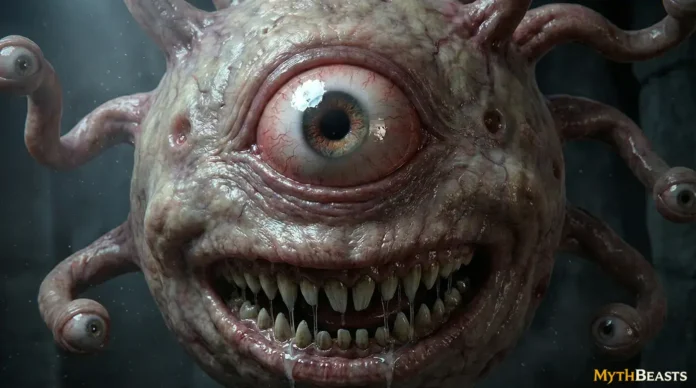
Beholder - dungeons & dragons
USA

Beholder

Beholders are otherworldly creatures with a central eye and many smaller eye stalks, each capable of casting powerful magical...

  • Skills
Life DrainMind Control
  • Weaknesses
Anti-MagicLight

Abyssal Guardian – Overview

The Abyssal Guardian is a mythological beast type characterized by its role as a protector of thresholds or gateways into the unknown. These entities often embody the dual nature of guardianship and threat. Abyssal Guardians serve as custodians of the boundary between the known world and the chaotic or mysterious realms beyond. Across cultures, they are imbued with the power to both shield and challenge those who encounter them. Their existence highlights the tension between the safety of order and the peril of the abyss.

Defining Characteristics

Physical Form and Morphology

Abyssal Guardians consistently display formidable and awe-inspiring forms, often blending physical traits from multiple species or possessing exaggerated anatomical features. Common traits include immense size, armored skin, and a hybrid appearance combining animal and monstrous elements. Their visual representation frequently invokes fear and respect, emphasizing their role as gatekeepers. Despite variations across cultures, these physical attributes serve to reinforce their mythological significance as boundary protectors.

Ontological Nature

Beings of this type are often understood as liminal entities existing at the intersection of the natural and supernatural worlds. They embody the complex interplay between chaos and order, bridging the mundane and the divine. Abyssal Guardians frequently function as cosmic agents, maintaining balance and preventing chaos from overwhelming the known world. Their existence is deeply intertwined with the metaphysical order, symbolizing the boundaries that define and separate different realms of existence.

Mythological Role and Function

Place in Mythological Systems

In mythological systems, Abyssal Guardians occupy a crucial role as mediators between different cosmological domains. They often interact with deities, humans, and natural forces, serving as both protectors and challengers. Their presence emphasizes the importance of respecting boundaries and the consequences of transgression. By maintaining the separation between worlds, they uphold the order and stability of the mythological universe, reinforcing cultural norms and ethical frameworks.

Perception and Meaning

Culturally, Abyssal Guardians are perceived as both protectors and formidable adversaries. Their dual nature embodies the tension between safety and danger, reflecting the human need to navigate the unknown. They are often seen as embodiments of fate, destiny, or cosmic justice, symbolizing the inevitability of encountering and overcoming challenges. Their presence in mythology serves as a reminder of the delicate balance between order and chaos, reinforcing cultural values and moral lessons.

Distinction from Related Beast Types

Conceptual Boundaries

Abyssal Guardians differ from elemental beings, spirits, and human-like monsters by their specific role in guarding boundaries and thresholds. Unlike purely elemental creatures, they engage with moral and cosmological themes. They are distinct from undead entities and animal-based creatures, as they embody a unique synthesis of diverse mythological motifs. Their role as protectors of specific thresholds sets them apart in mythological traditions, emphasizing their unique function within the mythological framework.

Common Sources of Confusion

Confusion arises when Abyssal Guardians are conflated with other boundary-related entities, such as gatekeepers or threshold spirits. This occurs because their roles overlap, but Abyssal Guardians are uniquely characterized by their dual nature and cosmic significance. Scholars distinguish them by focusing on their specific mythological context and symbolic meaning. Their presence in diverse traditions highlights their unique role, separate from more generic guardians or spirits.

Canonical Beasts Associated with This Beast Type

Cerberus

Originating from Greek mythology, Cerberus is a quintessential Abyssal Guardian, guarding the entrance to the Underworld. His role as both protector and deterrent exemplifies the guardian’s dual nature.

Fenrir

In Norse mythology, Fenrir is a monumental beast prophesied to play a crucial role in Ragnarok. His symbolic representation of chaos and fate underscores the guardian’s complex role.

Yama’s Buffalo

In Hindu traditions, Yama’s Buffalo represents the guardian at the threshold of life and death. This creature’s presence reinforces themes of mortality and cosmic justice, embodying the guardian archetype.

Historical Distribution and Cultural Context

Abyssal Guardians appear across numerous cultures and historical periods, reflecting universal human themes of boundary and protection. They are found in ancient Greek, Norse, and Hindu mythologies, among others. These entities often emerge in societies with strong beliefs in afterlife or cosmological dualism. Their recurrence highlights the importance of boundary guardianship in cultural narratives, aiding societies in conceptualizing and understanding the transition between life and the unknown.

Scholarly Interpretation and Uncertainty

Variation in Definitions

Interpretations of Abyssal Guardians vary across cultures, reflecting differences in cosmological and moral frameworks. Some traditions view them as benevolent protectors, while others emphasize their adversarial nature. These variations highlight the complexity of defining this beast type, as each cultural context offers unique insights into their symbolic role. Scholars explore these differences to better understand the diverse meanings attributed to these entities.

Limits of Available Evidence

The historical record provides limited evidence for some Abyssal Guardians, leading to debates and ambiguities in their mythological interpretations. No verified sources describe all aspects consistently across traditions. Scholars must rely on comparative mythology and cultural context to reconstruct these entities’ roles. This uncertainty poses challenges in establishing definitive interpretations, emphasizing the need for careful analysis and acknowledgment of gaps in the evidence.

Mythological Role Across Cultures

The recurrent presence of Abyssal Guardians in diverse mythological traditions addresses shared human concerns about boundaries and the unknown. These entities symbolize the need to navigate and respect thresholds, serving cultural functions related to safety, order, and moral understanding. Recognizing this role helps interpret mythological systems, offering insights into how societies perceive and interact with the complex interplay between known and unknown realms.