Overview of the Medieval Period
Medieval usually names the period between classical antiquity and early modern history, especially in European historical writing; its boundaries vary by region and scholarly convention.
In Europe, historians commonly place the period from approximately the fifth through fifteenth centuries, whereas Byzantine, Islamic, African, Asian, and American histories require distinct chronologies.
Medieval is central to this taxonomy because surviving evidence reflects period-specific religious institutions, manuscript cultures, and changing political communities that shaped recorded supernatural traditions.
Christian Europe, the Byzantine Empire, Islamic societies, and numerous regional cultures formed interconnected but distinct settings for folklore, religious interpretation, and representations of extraordinary beings.
Most people encountered supernatural explanations through local customs, religious teaching, and inherited stories, although literacy and access to written materials varied considerably across communities.
Cultural and Religious Worldviews
Dominant Belief Systems
Latin Christianity shaped much of western European cosmology, interpreting creation through scripture and church teaching while locating angels, demons, saints, and miracles within divine order.
In the Byzantine world, Orthodox Christianity likewise framed supernatural beings through Christian theology, but its institutions and artistic conventions developed within the eastern Roman imperial tradition.
Islamic societies understood creation through Islamic theology, including belief in angels and jinn; interpretations varied across legal, theological, literary, and local contexts.
Jewish communities maintained scriptural and interpretive traditions distinct from Christian and Islamic institutions, preserving varied discussions of angels, demons, extraordinary events, and sacred history.
These systems differed in doctrine and authority, so similar beings cannot be treated as interchangeable expressions of one medieval supernatural worldview.
Natural events could receive religious interpretations without eliminating practical explanations; surviving texts rarely establish how consistently ordinary people accepted any particular account.
Role of Myth in Daily Life
Stories about exemplary saints and divine intervention could communicate religious ideals, making narrative a means of teaching conduct rather than merely describing extraordinary events.
Local legends attached meaning to places, helping communities explain reputedly sacred landscapes or remembered events through accounts transmitted across generations.
Folktales also represented social expectations, but their surviving versions often come through clerical or elite writers rather than direct records of ordinary speech.
Stories of supernatural punishment could reinforce moral boundaries, although evidence does not show that every audience interpreted such narratives literally or uniformly.
Shared narratives contributed to communal identity when they linked local histories with religious calendars, pilgrimage destinations, or established accounts of collective origins.
Mythological Beasts and Supernatural Entities
Common Types of Mythical Creatures
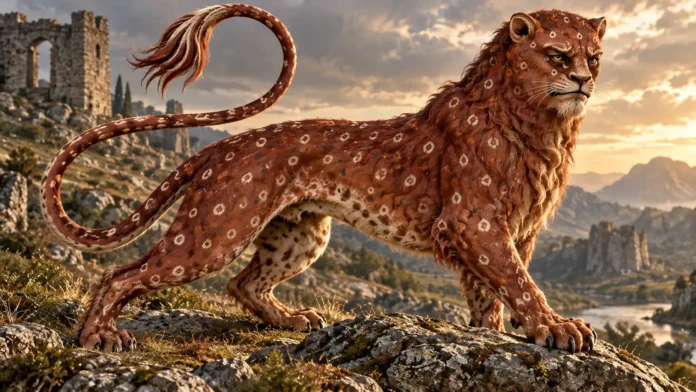
Medieval European bestiaries described real and imagined animals together, presenting creatures as subjects for natural inquiry, moral interpretation, or Christian allegory.
Dragons appeared in varied European religious and literary contexts, frequently as adversaries in saint narratives; their meanings depended on particular texts and settings.
Jinn belong to Islamic religious and literary traditions, where descriptions vary; they should not be recast as equivalent to Christian demons.
Fairies and related beings occur in medieval European literary and folkloric evidence, though terminology and characteristics differ across languages, regions, and sources.
Accounts of revenants and other returning dead appear in some medieval Christian writings, where authors debated reports rather than offering uniform doctrine.
Hybrid creatures, including centaurs and griffins, circulated through inherited classical learning and medieval artistic or textual adaptation, not through one shared belief system.
Symbolism and Meaning
Bestiary animals could signify moral qualities because Christian writers interpreted observable or reputed animal behavior as instruction about human conduct.
In saint narratives, a beast’s defeat or submission could demonstrate a holy figure’s authority, while the episode’s meaning remained tied to its specific account.
Islamic accounts of jinn place them within creation and moral responsibility; this theological framing differs from Christian demonology’s association with opposition to God.
Unusual animals could mark the limits of familiar knowledge, yet medieval writers did not always distinguish observation, inherited report, and symbolic reading consistently.
Psychological interpretations in modern scholarship may illuminate narrative functions, but they cannot establish what every medieval audience privately felt or believed.
Folklore Traditions and Storytelling
Oral and Written Transmission
Oral transmission carried local stories across generations, but direct medieval recordings of spoken folklore are limited and frequently mediated by literate observers.
Latin and vernacular manuscripts preserved saints’ lives, chronicles, romances, and encyclopedic works, each reshaping supernatural material according to genre and audience.
Religious texts transmitted authoritative doctrine, yet references to local beings inside them do not necessarily prove official endorsement of every reported belief.
Inscriptions and images sometimes preserve names or motifs, but without contextual evidence they rarely disclose a complete narrative or the audience’s interpretation.
Later manuscript copies may alter wording or emphasis, making it difficult to reconstruct an earlier story’s precise form or date of circulation.
Regional Variations
Western European dragon narratives often appear within Christian saint legends, whereas Islamic traditions situate jinn within a separate theology of created beings.
Byzantine supernatural representation developed through Orthodox Christian institutions and eastern Roman artistic conventions, rather than simply reproducing western European forms.
Scandinavian medieval materials preserve Norse mythological figures alongside Christian-era writing; the surviving records cannot be assumed to represent unchanged pre-Christian belief.
South Asian religious and literary traditions maintained distinct cosmologies and beings, whose medieval histories should not be collapsed into European categories.
Regional comparison is meaningful only when sources, terminology, and historical contexts remain distinct; shared motifs alone do not demonstrate common origins.
Relationship Between Humans and the Mythical World
Fear, Protection, and Reverence
Some narratives presented supernatural creatures as dangers to travelers or communities, but accounts of threat cannot establish widespread practical fear without corroborating evidence.
Saints sometimes appeared as protectors against dangerous beasts in Christian narratives, locating protection within specific devotional and theological frameworks.
Islamic traditions concerning jinn describe beings with moral agency, a framework unlike the standard Christian depiction of demons as hostile spiritual powers.
Reverence generally attached more directly to God, saints, or sacred figures than to beasts themselves in Christian sources, though local practices varied.
No verified sources describe this for this context.
Influence on Art and Material Culture
Church sculpture included animal and hybrid forms, whose placement could connect them with biblical themes, moral instruction, or established decorative conventions.
Illuminated manuscripts depicted beasts in bestiaries and religious narratives, translating textual descriptions into visual forms shaped by workshop practices.
Textiles, metalwork, and domestic objects also carried animal motifs, though an image alone cannot confirm that its maker or owner believed in the creature.
Architectural carvings may combine symbolic, decorative, and practical functions; interpretations require attention to location, neighboring imagery, and documented context.
Transition and Legacy of the Medieval Period
Early modern printing expanded circulation of older stories, while religious change and humanist scholarship altered how some audiences classified inherited supernatural material.
Medieval motifs persisted in regional folklore, but transmission transformed details; later versions cannot automatically be treated as direct records of medieval belief.
Bestiary symbolism influenced later literary and artistic traditions, especially where authors reused established animals as moral or religious signs.
Modern national folklore collections often recorded stories centuries after medieval periods, making their dating and historical continuity subjects for careful evaluation.
Historical Reliability and Interpretation
Medieval evidence survives unevenly because manuscripts were copied selectively, while oral traditions usually entered records through observers with particular institutional or literary aims.
Historians distinguish evidence that a writer reported a creature from evidence that a community accepted the report as factual.
Texts may combine theological argument, inherited learning, eyewitness claims, and literary convention, requiring genre analysis before their supernatural content is classified.
Scholars use comparison cautiously because parallel motifs can emerge independently; resemblance alone does not prove direct cultural borrowing or shared belief.
Symbolic readings are strongest when supported by contemporary textual or visual context, rather than imposed through modern assumptions about universal meanings.
Medieval classification therefore describes a historically bounded body of evidence, not a single unified mythology or a complete record of popular belief.