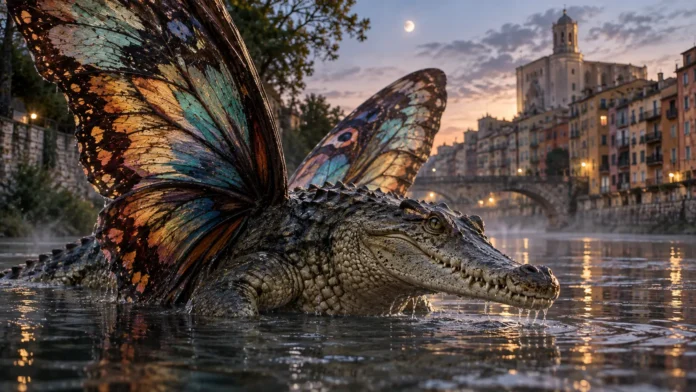
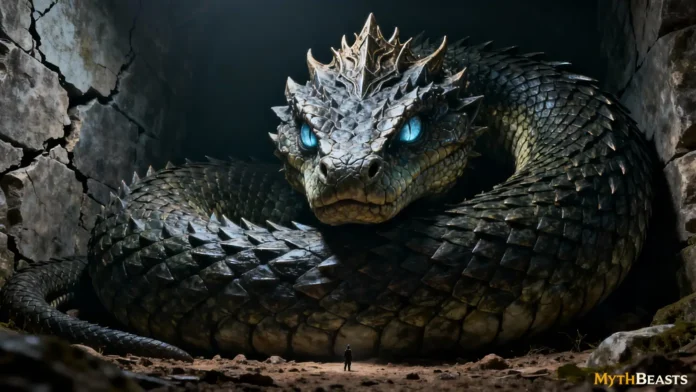
Reptiles & Arthropods – Overview
Reptiles and arthropods form a comparative category for mythological beings whose defining bodies derive from snakes, lizards, crocodilians, insects, or arachnids, including supernatural transformations of those animals.
This taxonomy groups forms rather than one universal tradition. Its members remain culturally distinct, so shared anatomy does not establish shared origin, meaning, or historical contact between traditions.
These beings often make animal traits consequential within cosmology: venom, protective shells, shedding, subterranean movement, or unusual reproduction can mark danger, renewal, guardianship, or boundary crossing.
Defining Characteristics
Physical Form and Morphology
Serpentine bodies, scales, segmented limbs, multiple legs, pincers, and carapaces recur across the category. Particular beings may combine these features, but such combinations require specific cultural evidence.
Movement contributes to recognition: slithering, crawling, burrowing, or sudden striking distinguishes many forms from upright humanoid beings. These motions provide observable models for mythic descriptions without proving symbolic intent.
Ontological Nature
Mythological reptiles and arthropods may be animals, divine beings, spirits, monsters, or hybrids. Their classification depends on a tradition’s account of agency and status, not anatomy alone.
A being can retain recognizable animal form while occupying a supernatural position. South Asian nāgas, for example, appear as serpent beings associated with divine and human relationships in varied texts.
Some figures belong to ordered cosmologies rather than representing disruptions of nature. Their exceptional scale or agency does not by itself make them morally evil, demonic, or chaotic.
Mythological Role and Function
Place in Mythological Systems
Serpents and other crawling forms can mark thresholds between human settlements and wilderness, or between the visible world and subterranean domains. Their placement varies across individual traditions.
In Mesopotamian imagery, the mušḫuššu appears as a divine-associated composite creature, notably connected with Marduk and Babylon. Its role places reptilian morphology within civic and divine order.
In other contexts, serpent figures embody opposition to a god or cosmic order. Such adversarial roles should not be generalized to every serpent being or culture.
Perception and Meaning
Animal traits can support multiple interpretations. Venomousness may make a creature a credible threat, whereas protective associations may arise from its attributed guardianship in a specific tradition.
Shedding skin has invited interpretations involving renewal, but this symbolic reading is not universal. It should be applied only where historical representations or texts support it.
Arthropod figures may express danger through stings, pincers, or swarming. Their meaning depends on documented cultural context rather than an assumed, cross-cultural symbolism of insects.
Distinction from Related Beast Types
Conceptual Boundaries
This category is distinguished primarily by bodily reference to reptiles or arthropods. Elemental beings instead derive identity from forces such as fire, water, or wind.
Spirits and undead beings are classified through their relation to death, souls, or immaterial existence. A serpent-shaped spirit may therefore fit both categories under different taxonomic criteria.
Humanoid monsters are primarily defined by humanlike posture or social form. Reptilian traits alone do not make a being humanoid when its identity remains animal-shaped.
Common Sources of Confusion
Composite creatures complicate classification because their bodies combine animal and human features. Analysts should identify which traits define the being’s traditional identity, rather than count body parts.
Translations can also blur distinctions between snakes, dragons, lizards, and fabulous composites. Comparative classification must preserve the source tradition’s terminology wherever reliable evidence permits.
Modern taxonomies group beings by morphology for practical comparison. This method differs from historical classifications, which may organize creatures through divine affiliation, place, behavior, or narrative function.
Canonical Beasts Associated with This Beast Type
Nāga
In South Asian traditions, nāgas are serpent beings appearing in Hindu, Buddhist, and Jain materials. Their serpent identity is central, although forms and roles vary across sources.
Mušḫuššu
The mušḫuššu is a Mesopotamian composite creature represented in Babylonian art and associated with Marduk. Its scaled, serpentlike body makes reptilian form central to its identity.
Girtablilu
Girtablilu, commonly called scorpion-men, appear in Mesopotamian literary and artistic traditions. Their humanlike upper bodies and scorpion features make arthropod anatomy essential to classification.
Apep
Apep, also called Apophis in Greek-derived usage, is an Egyptian serpent associated with opposition to solar order. Its serpentine identity is inseparable from its mythological role.
Historical Distribution and Cultural Context
Serpent beings occur in ancient Near Eastern, Egyptian, South Asian, Mediterranean, and East Asian traditions. This broad distribution documents recurrence, not a single shared belief or origin.
Arthropod beings are less evenly represented in prominent surviving mythological records. Mesopotamian scorpion-men offer a well-documented example, while absence elsewhere may reflect preservation limits.
Representations survive through varied media, including literary works, religious imagery, and material objects. The evidence differs by region, making direct comparisons uneven and sometimes uncertain.
Scholarly Interpretation and Uncertainty
Variation in Definitions
Historical communities did not necessarily treat reptiles and arthropods as one conceptual class. This grouping is a modern comparative convenience grounded in bodily form.
Some frameworks classify composite beings by their dominant animal anatomy; others prioritize divine affiliation or narrative function. Neither approach automatically reproduces a culture’s own categories.
Limits of Available Evidence
Surviving sources often preserve elite literary or visual conventions more clearly than everyday popular belief. Claims about broad social attitudes therefore require caution.
Names and descriptions may shift through translation, later retelling, or fragmentary transmission. No verified sources describe a universal meaning shared by all members of this category.
Mythological Role Across Cultures
Animal forms make invisible concerns perceptible through familiar bodies associated with habitats, hazards, or distinctive movement. This helps explain recurrence without assuming identical interpretations across societies.
Comparative study is most useful when it separates morphology from cultural meaning. Similar serpent shapes may serve different cosmological positions, while unlike creatures may perform comparable boundary roles.
Recognizing this distinction prevents a taxonomy from flattening local beliefs. Reptilian or arthropod form identifies a useful comparison, not a universal mythology or fixed moral character.