
Flood Myths Around the World: Destruction, Survival, and Renewal
Flood myths appear in many cultures across the world. They are especially common across Eurasia and the Americas, but water-catastrophe stories also appear in Oceania, Australia, and other regions.
These stories should not be treated as proof of one single global flood. They are better understood as related myths shaped by local landscapes, religious ideas, oral memory, and literary tradition.
What they share is a powerful image: water as both life-giver and destroyer. In some traditions, the flood punishes human corruption.
In others, it ends one age and begins another. Some stories focus on divine warning, while others praise cleverness, engineering, humility, survival, or community cooperation.
Flood myths are not only disaster stories. They ask big questions: What happens when the world breaks? Who survives?
Can humanity begin again? Because the surviving sources vary so much, each story needs its own context. Some come from ancient tablets or scriptures, while others survive through later collectors, translations, local tradition, or modern cultural institutions.
Mesopotamian Flood Tradition: Utnapishtim in The Epic of Gilgamesh
The flood story in The Epic of Gilgamesh appears in Tablet XI of the Akkadian epic. In this part of the story, Gilgamesh meets Utnapishtim, a man who survived a great flood and received immortality from the gods.
The British Museum’s famous Flood Tablet preserves part of this tradition. The tablet tells how the gods decide to send a flood, but Ea reveals the plan to Utnapishtim and tells him to build a boat.
This warning gives one human household a chance to survive a disaster meant to erase ordinary life.
Utnapishtim follows the warning. He builds the vessel, seals it, and brings aboard his family, possessions, skilled workers, and animals.
The storm arrives with overwhelming force. The story does not make the gods look calm or perfectly just.
Even the gods fear the violence of the flood once it begins.
After the waters fall, the boat grounds. Utnapishtim releases birds to test whether dry land has returned. This detail later became one of the strongest points of comparison with the biblical Noah story, though the two versions have different religious meanings.
The Mesopotamian flood tradition is not simple moral teaching. It shows a world where divine powers can disagree, hide knowledge, and act dangerously.
Humanity survives because one god breaks divine secrecy and one human acts before disaster arrives.
Utnapishtim’s reward, immortality, also connects the flood story to the larger theme of Gilgamesh: the human fear of death. Gilgamesh hears the flood story because he wants to escape mortality.
Utnapishtim’s answer is not comforting. His immortality came from a unique event that cannot simply happen again.
Sumerian Flood Tradition: Ziusudra and the Eridu Genesis
The Sumerian flood story, often connected with the Eridu Genesis or the Sumerian Flood Story, gives an older form of the broader Mesopotamian flood tradition. The surviving text is fragmentary, but it preserves the key figure of Ziusudra, a king who survives a flood sent by the gods.
In this version, the gods decide that a flood will sweep across the land. Ziusudra receives divine warning, survives in a huge boat, and later honors the gods after the waters calm.
The text describes the boat being rocked by waves and storms for seven days and seven nights.
This detail places the Sumerian story close to later Mesopotamian versions while keeping its own identity. Ziusudra is not just another name for Utnapishtim.
He belongs to an earlier layer of flood storytelling, where kingship, survival, divine order, and sacred reward are deeply linked.
After the flood, Ziusudra opens the boat and worships. He sacrifices oxen and sheep. The gods then grant him extraordinary life and settle him in a distant place.
In mythic terms, he passes from ordinary human kingship into a special sacred status.
This Sumerian tradition matters because it shows that flood mythology was already old before the best-known versions of Gilgamesh and Genesis. It is one of the deep roots of the wider ancient Near Eastern flood tradition.
The Biblical Flood: Noah and the Ark
The biblical flood appears in Genesis 6-9. In this version, the flood comes as a response to human violence and corruption.
God sees that the earth has become filled with wrongdoing, but Noah is described as righteous in his generation.
God commands Noah to build an ark. Noah brings his family and living creatures into the vessel. Rain falls for forty days and forty nights, but the full flood narrative lasts longer than that.
The story includes the rising waters, the ark resting, the sending of birds, and the slow drying of the earth.
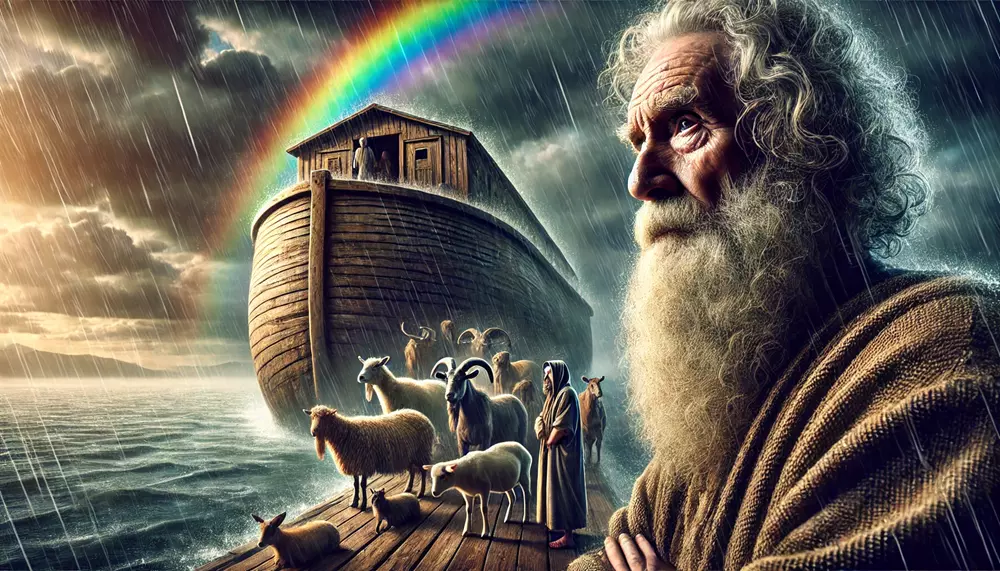
The strongest ending comes after the flood. Noah leaves the ark, offers sacrifice, and receives a covenant. God promises that floodwaters will never again destroy all life, and the rainbow becomes the sign of that promise.
This makes the biblical flood different in tone from the Mesopotamian versions. It is not only about survival from divine danger.
It is also about moral judgment, obedience, covenant, and a renewed relationship between God, humanity, animals, and the earth.
The Noah story remains one of the world’s most widely recognized flood myths because it sits at the heart of biblical tradition and later religious culture. Its details also show strong family resemblance to older Near Eastern flood stories: divine warning, a vessel, animals, birds, sacrifice, and survival after cosmic danger.
Greek Mythology: Deucalion and Pyrrha
In Greek mythology, the most famous flood survivors are Deucalion and Pyrrha. Their story appears in several ancient sources, including Ovid’s Metamorphoses.
In this myth, Zeus decides to destroy a corrupt human race with a great flood.
Deucalion is the son of Prometheus, and Pyrrha is the daughter of Epimetheus and Pandora. In some versions, Prometheus warns Deucalion before the disaster.
In Ovid’s version, the couple survives the flood and lands on Mount Parnassus after the waters recede.
The world they find is empty. They seek guidance from the goddess Themis, whose oracle tells them to throw “the bones of your great mother” behind them.
At first, this command sounds shocking and impossible. Then they understand the riddle: the great mother is Earth, and her bones are stones.
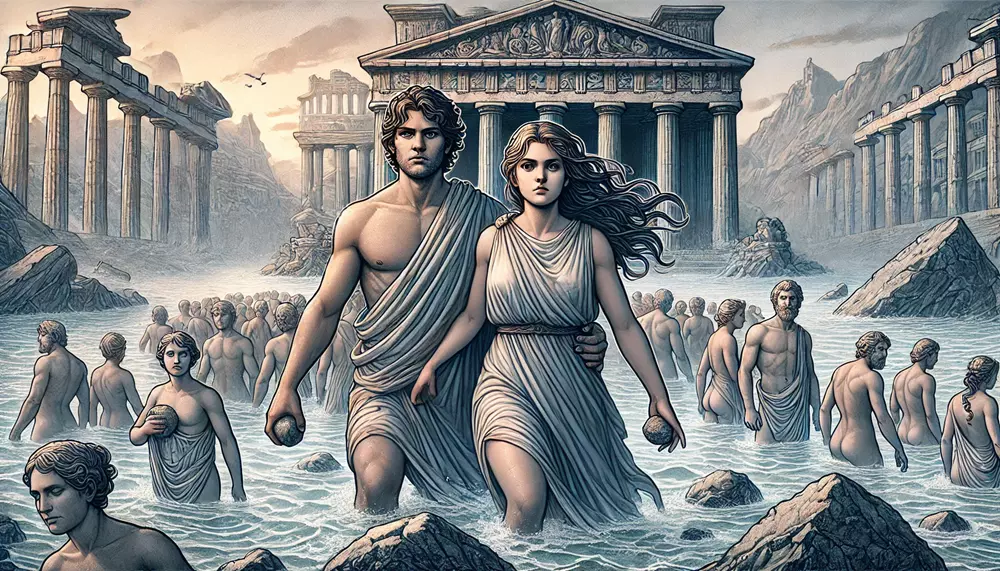
Deucalion and Pyrrha throw stones over their shoulders. The stones thrown by Deucalion become men, and those thrown by Pyrrha become women.
Humanity returns, but in a symbolic and strange way. The new human race comes from stone, suggesting endurance, hardness, and deep connection to the earth.
The Greek flood myth values interpretation. Survival alone is not enough. The survivors must understand divine language correctly.
The story turns catastrophe into a test of wisdom, symbolic thinking, and the ability to rebuild from a broken world.
Indian Mythology: Manu and the Fish
The Indian flood story appears in an early form in the Shatapatha Brahmana. In this version, Manu saves a small fish, and the fish later warns him that a flood will sweep away living beings.
The fish tells Manu to prepare a ship.
As the fish grows, Manu moves it from a small vessel to larger waters, then eventually to the sea. When the flood arrives, Manu enters the ship and ties it to the fish’s horn.
The fish pulls the vessel safely toward a northern mountain.
This early version does not need to begin with human wickedness. The focus rests on care, warning, preparation, and preservation.
Manu protects the vulnerable fish, and the fish later saves Manu. It is a story of kindness returned as rescue.
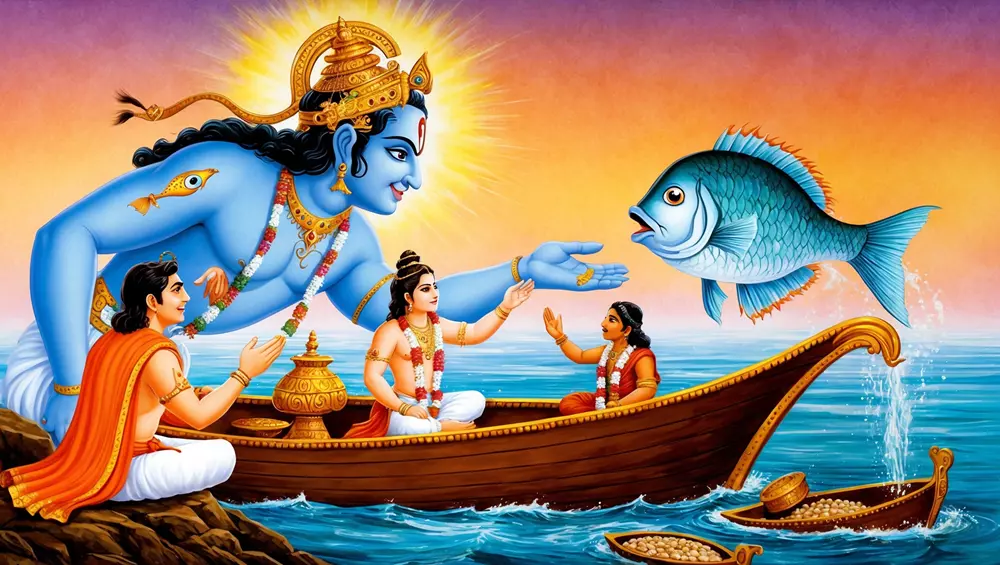
After the flood, Manu becomes the sole surviving human in the early account. He performs sacrifice, and through ritual renewal a woman appears.
Together, they become connected with the continuation of human life.
Later Hindu tradition identifies the fish more clearly with Matsya, the fish avatar of Vishnu. In these later versions, the story becomes part of a wider religious vision in which Vishnu preserves life and cosmic order during a time of danger.
The Manu flood myth fits well with ideas of cyclical renewal. The flood does not only erase the old world.
It protects the seed of the next one. Compared with stricter punishment stories, this tradition places more weight on continuity, protection, and divine guidance.
Chinese Mythology: Gun, Yu, and the Great Flood
The Chinese Great Flood tradition is different from many ark stories. It does not usually focus on one family escaping a sudden global flood.
Instead, it tells of long-lasting floodwaters that threaten society and must be controlled before human life can continue safely.
The story often begins with Gun, the father of Yu. Gun tries to stop the flood by blocking or damming the waters.
In some versions, he steals magical soil from heaven to help him. His effort fails, and he is punished.
Yu succeeds where Gun fails. Rather than only blocking the waters, Yu channels them. He dredges rivers, opens passages, and guides water toward the sea.
His work takes years and demands extreme dedication. In later tradition, he becomes Yu the Great, a culture hero and legendary founder of the Xia dynasty.
This flood myth values labor, discipline, engineering, and harmony with the landscape. The problem is not solved by hiding in an ark.
It is solved by understanding how water moves and reshaping society around that knowledge.
That makes the Chinese flood story one of the clearest examples of human agency in world mythology. Yu becomes heroic because he studies the crisis, works with the terrain, and saves society through practical wisdom.
The story also shows a different view of water disaster. Flooding is not only a divine punishment. It is a challenge of order, governance, landscape, and responsibility.
The hero is not a chosen survivor. He is a worker, organizer, and founder.
Norse Mythology: Bergelmir and the Blood of Ymir
The Norse flood story is unusual because it is not caused by rain, the sea, or moral judgment. It comes from the death of the primordial giant Ymir.
In Norse cosmogony, Odin and his brothers kill Ymir and shape the world from his body. His flesh becomes the earth, his bones become mountains, his skull becomes the sky, and his blood becomes the sea.
In the Prose Edda, the flood of Ymir’s blood drowns nearly all the frost giants.
Bergelmir and his wife survive. Different translations describe the object that saves them in different ways, such as an ark, a wooden vessel, or a box-like object.
Because of that uncertainty, it is best to avoid calling it simply a boat without explanation.
This flood is not a cleansing of human corruption. It happens before the human world is fully established.
It belongs to creation itself. The world begins through violence, and survival comes from escaping a cosmic killing.
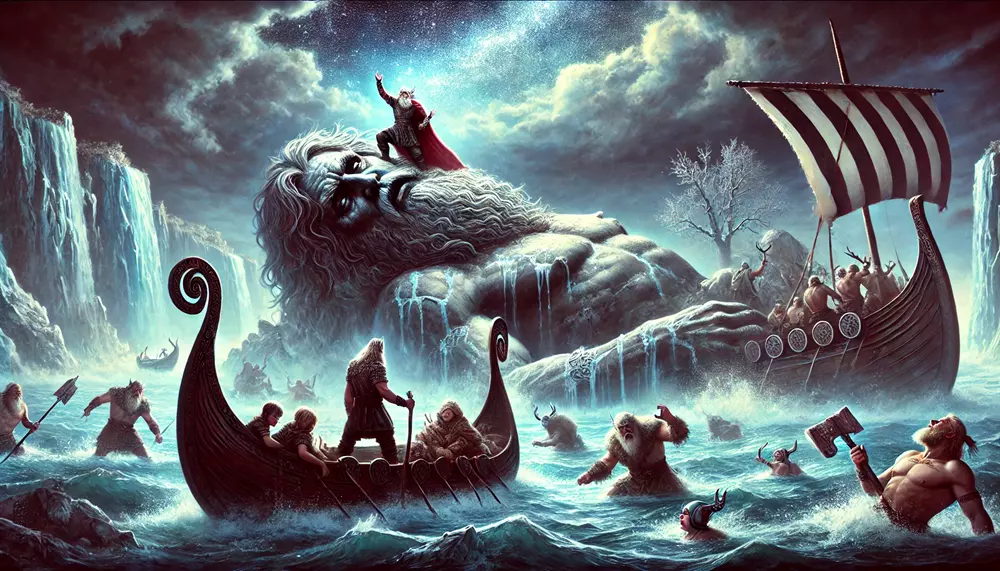
That harsh tone fits Norse myth, where creation and destruction often stand close together. The death of Ymir makes the ordered world possible, but it also leaves behind survivors from the older giant race.
Bergelmir’s survival explains why frost giants still exist after Ymir’s death. In that sense, the flood does not create a purified world.
It leaves a memory of ancient chaos, and that chaos continues to challenge the gods.
Mesoamerican Mythology: Tata and Nene in the Codex Chimalpopoca
Mesoamerican flood traditions have several versions, and they should not be blended too loosely. One clearer Nahua account appears in the Codex Chimalpopoca, where the survivors are Tata and Nene.
In this account, Titlacahuan, a form or aspect of Tezcatlipoca, warns Tata and Nene that destruction is coming. He tells them to hollow out a great cypress tree and enter it.
They are given corn to eat while the waters cover the world.
Tata and Nene survive inside the hollowed tree. When the waters recede, they come out and roast fish.
This act angers the gods because the smoke rises into the sky. Instead of becoming honored ancestors of a renewed humanity, they are punished and transformed into dogs in the version preserved in the Chimalpopoca tradition.
This gives the story a very different moral shape from Noah or Utnapishtim. Survival is not the end of the test.
The survivors still must obey divine instruction after the flood. Their mistake after rescue matters as much as their escape from the waters.
The Nahua flood tradition also belongs to a wider world of cosmic ages, destructions, and renewals. Humanity is not secure forever.
Worlds can end, gods can remake creation, and each age can carry its own danger.
This makes Tata and Nene a strong example of how flood myths can warn against disobedience even after salvation. Rescue does not remove responsibility.
Hawaiian Mythology: Nu‘u and the Flood
The Hawaiian story of Nu‘u should be handled carefully because recorded versions strongly resemble the biblical Noah story. Martha Warren Beckwith’s Hawaiian Mythology preserves material in which Nu‘u builds a large vessel, survives a flood, and comes to rest on Mauna Kea.
After the flood, Nu‘u offers worship to the moon, thinking the moon saved him. Kāne then appears and corrects him, showing that Nu‘u has thanked the wrong divine power.
The story becomes a lesson about proper reverence, humility, and recognition of the true source of rescue.
This story is relevant to flood mythology, but it should not be presented too simply as an untouched ancient Hawaiian parallel to Noah. Beckwith notes that some recorded forms show strong pressure from biblical comparison, especially in the houseboat details.
That does not make the Nu‘u story worthless. It means the article must explain its source history. Mythology is not frozen.
Oral tradition, religion, colonial contact, translation, and later teaching can reshape a story over time.
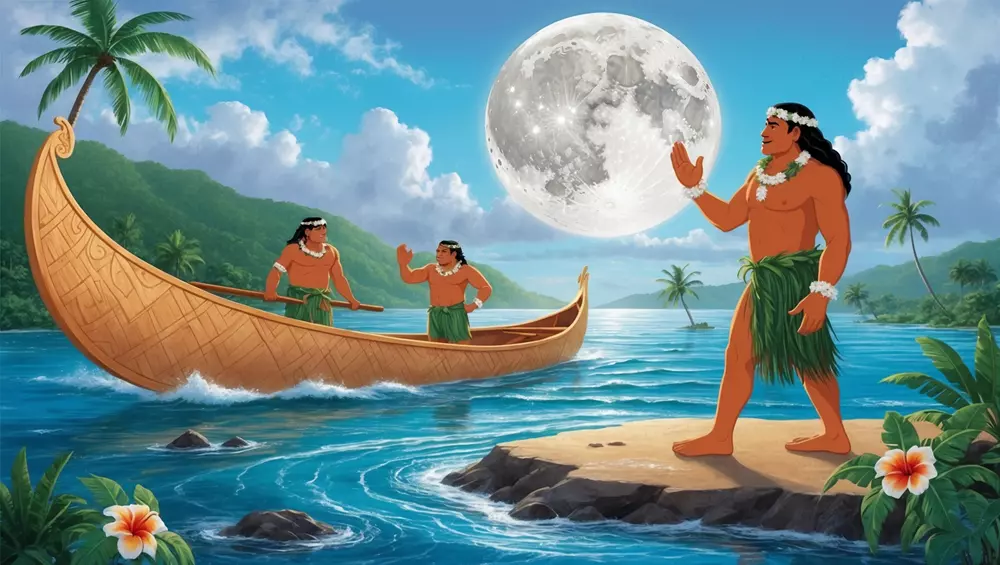
Nu‘u matters because his story shows how flood narratives can travel, merge, and change. Some flood myths survive as ancient written texts.
Others survive through layered records, where native tradition and later religious influence must be carefully separated.
For a modern mythology article, the best approach is honest balance. Nu‘u belongs to Hawaiian mythological material as recorded, but the Noah-like features need careful framing.
Indigenous Australian Water-Catastrophe Story: Tiddalik the Frog
Tiddalik the Frog is not a standard global flood myth in the same way as Noah, Utnapishtim, or Manu. It is better described as a water-catastrophe and creation story.
Still, it belongs in this article because it explores the same deep theme: the danger of water being lost, released, and restored.
Indigenous Australian stories are culturally specific. They should not be treated as one single tradition shared by all Aboriginal peoples.
The version discussed here is the Gunnai Kurnai version presented by Museums Victoria and Bunjilaka Aboriginal Cultural Centre.
In that version, Tiddalik is a very thirsty frog whose greed drains the water from creeks, lakes, and rivers. The land dries out, and the other animals must work together to solve the crisis.
Their plan is to make Tiddalik laugh. When he finally laughs, the water comes rushing back out. In many retellings, this restores the land.
Some older or regional versions can include more dangerous consequences, including flooding and landscape change.
The story teaches against greed and selfishness. It also teaches teamwork, respect for water, and the importance of listening to elders.
Unlike flood myths where gods destroy humanity, Tiddalik focuses on ecological balance. Disaster comes from hoarding what should be shared.
This makes Tiddalik a useful comparison point, even though it is not the same type of flood myth as many ancient ark stories. It shows that water myths do not always begin with rain from the sky.
Sometimes the crisis is drought, imbalance, or the sudden return of water after misuse.
Why Flood Myths Resonate Worldwide
Flood myths endure because floods are among the most powerful disasters humans face. Rivers overflow, storms destroy homes, seas rise, and water can erase the boundary between safe land and chaos.
Ancient communities did not need a global flood to fear floodwaters. Local disasters were enough to shape memory.
A major shared pattern is survival through warning. Utnapishtim hears Ea’s secret message. Noah receives God’s command.
Manu listens to the fish. Tata and Nene enter a hollow cypress. These stories turn survival into a test of attention.
The wise person listens before disaster arrives.
Another pattern is the protected vessel. Boats, arks, ships, hollow trees, and wooden containers all become symbols of continuity.
They carry life through collapse. In mythic terms, the vessel is more than transport. It is a small world that protects the future.
Flood myths also explain moral order. In Genesis, the flood responds to violence and corruption. In Greek myth, Zeus destroys a corrupt age.
In Nahua tradition, obedience after survival still matters. In Tiddalik, the crisis comes from greed. These myths turn water into a moral force.
But not all flood stories are about punishment. The Manu story emphasizes preservation. The Chinese story praises human engineering.
Tiddalik teaches ecological balance. The Norse Ymir flood belongs to creation through cosmic violence. Treating all flood myths as the same would erase their real cultural meaning.
Water also carries double symbolism. It destroys, but it also renews. It kills, but it makes life possible.
It covers the old world, but it can reveal a new one. That is why flood myths often end with sacrifice, covenant, repopulation, restored land, or a changed relationship between humans and the sacred.
These stories also help cultures remember danger. A myth can preserve the emotional truth of catastrophe even when it does not record history in a modern scientific way.
It can teach where floods happen, why humility matters, and why communities must prepare, share, listen, and rebuild.
Conclusion
Flood myths are not one story copied everywhere. They are a family of stories built around water, danger, survival, and renewal.
Some come from ancient written texts, some from oral traditions, some from later religious retellings, and some from cultural contact between traditions.
The Mesopotamian and biblical stories focus on divine warning, vessels, animals, sacrifice, and the fate of humanity. The Greek story adds interpretation and rebirth from stone.
The Indian story highlights preservation through Manu and the fish. The Chinese tradition turns flood survival into engineering and social order.
The Norse version makes flood part of cosmic creation. The Nahua account of Tata and Nene shows survival followed by divine punishment.
The Hawaiian Nu‘u story requires careful treatment because of its strong Noah-like features in recorded versions. Tiddalik brings in a different but relevant water-crisis lesson about greed, sharing, and ecological balance.
Together, these myths show why flood stories still matter. They speak to fear of disaster, hope after loss, and the question every culture must face after catastrophe: how can the world begin again?
Further reading
Encyclopaedia Britannica, Flood myth, 2026. Reliable overview of flood myths as widespread traditions, especially across Eurasia and the Americas, with useful framing for destruction, expiation, survival, and renewed worlds. (Encyclopedia Britannica)
British Museum, Flood Tablet, object K.3375. Primary artifact source for Tablet XI of The Epic of Gilgamesh, Utnapishtim, Ea’s warning, the boat, animals, birds, and survival. (britishmuseum.org)
SOAS BAPLAR, The Epic of Gilgameš, Standard Version, Tablet XI, Andrew R. George translation. Scholarly translation source for the Babylonian flood account and Utnapishtim’s speech to Gilgamesh. (SOAS)
Electronic Text Corpus of Sumerian Literature, The Flood Story, University of Oxford. Primary translation source for Ziusudra, the fragmentary Sumerian flood account, seven-day storm, huge boat, sacrifice, and divine reward. (etcsl.orinst.ox.ac.uk)
Bible Gateway, Genesis 6:9-9:17, New International Version. Useful text source for Noah, the ark, the flood timeline, the covenant after the flood, and the rainbow sign. (Bible Gateway)
University of Virginia, Ovid’s Metamorphoses Book I, A. S. Kline translation. Provides the Deucalion and Pyrrha episode, Themis’ oracle, stone symbolism, and humanity’s rebirth after the Greek flood. (ovid.lib.virginia.edu)
Encyclopaedia Britannica, Deucalion, 2026. Concise reference for Deucalion, Pyrrha, Prometheus, Mount Parnassus, the Greek flood tradition, and the stone-born renewal of humanity. (ovid.lib.virginia.edu)
Sacred Texts, Satapatha Brahmana: A Fish Saves Manu from the Flood, Julius Eggeling translation. Primary translated source for Manu, the fish’s warning, the ship, and the mountain landing.
(Internet Sacred Text Archive)
Encyclopaedia Britannica, Matsya, 2026. Useful reference for the later Hindu identification of the fish as Vishnu’s Matsya avatar and the flood rescue of Manu. (Encyclopedia Britannica)
Encyclopaedia Britannica, Da Yu, 2026. Reliable reference for Yu the Great, Gun’s failed flood-control attempt, stolen magic soil, Yu’s dredging, and the legendary Xia dynasty connection. (Encyclopedia Britannica)
Harvard Magazine, Harvard Researchers Find Evidence of China’s Great Flood, 2016. Useful modern discussion of Yu’s flood legend, ancient Chinese flood memory, and scholarly debate around possible geological background. (Encyclopedia Britannica)
Wikisource, The Prose Edda: Gylfaginning, Arthur Gilchrist Brodeur translation, 1916. Primary-access translation for Ymir’s body becoming the world, his blood becoming the sea, and Norse creation imagery. (Wikisource)
Purdue University, Codex Chimalpopoca Flood Account. Accessible translated Nahua source for Tata and Nene, Titlacahuan-Tezcatlipoca, the hollow cypress, corn, roasted fish, and punishment.(web.ics.purdue.edu)
John Bierhorst, History and Mythology of the Aztecs: The Codex Chimalpopoca, 1998. Scholarly book source for the Chimalpopoca tradition, Nahua myth-history, cosmic ages, and translated Aztec mythic material. (Google Books)
Martha Warren Beckwith, Hawaiian Mythology, 1940. Key source for Nu‘u flood material, Mauna Kea, the moon offering, Kāne’s correction, and caution about biblical influence.(Internet Sacred Text Archive)
Museums Victoria, Tiddalik the Frog, Bunjilaka Aboriginal Cultural Centre. Reliable cultural source for the Gunnai Kurnai version, water loss, greed, teamwork, environmental lessons, and story context.(museumsvictoria.com.au)
FAQ
Flood Myths in different ancient civilizations
| Aspect | Hawaiian Mythlogy | Indian Mythology | Norse Myths | Mesopotamian Mythology |
|---|---|---|---|---|
| divine punishment | Deities punish humanity for moral failings, leading to catastrophic floods. | Gods unleash floods as retribution for human sins and ignorance. | Odin and other gods judge humanity, resulting in destructive floods. | Deities decide to cleanse the earth, punishing humanity for its wickedness. |
| cosmic renewal | Floods symbolize renewal, allowing for a fresh start and new life. | The deluge represents a cycle of destruction and rebirth in nature. | Cosmic order is restored after the flood, leading to new beginnings. | Floods signify a reset of civilization, paving the way for renewal. |
| human survival | Survivors often receive divine assistance or demonstrate resilience. | Humanity survives through cleverness, divine favor, or sheer willpower. | A few chosen individuals endure the flood, ensuring human continuity. | Survival is often attributed to divine intervention or moral righteousness. |
| cultural significance | These myths reflect deep cultural values and beliefs about nature. | Flood stories convey moral lessons and the importance of dharma. | Norse tales emphasize fate and the cyclical nature of existence. | Myths serve as cultural touchstones, illustrating societal fears and hopes. |
| water symbolism | Water represents both destruction and the potential for life. | Rivers and oceans symbolize the duality of creation and chaos. | Water is a powerful force, embodying life, death, and rebirth. | The flood illustrates the life-giving and destructive aspects of water. |
| judgment themes | Judgment themes highlight moral accountability and divine oversight. | Human actions are scrutinized, leading to divine retribution through floods. | The flood serves as a test of worthiness and moral integrity. | Judgment is central, as deities assess humanity's actions before the deluge. |