
back to top

Primordial Giant

Primordial Giant refers to colossal beings in myths, embodying creation, chaos, or earth's primal forces across diverse cultures.

Relevant Beasts
Greece
Primordial Giant
Typhon - Greek Mythology
Greece

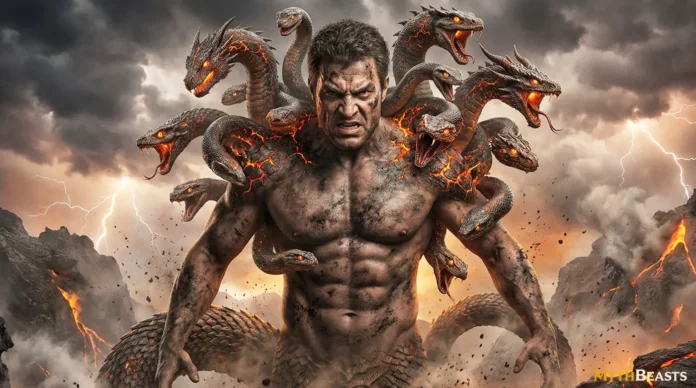
Typhon

Typhon is a formidable figure in Greek mythology, often depicted as the most fearsome of all creatures. Known as...

  • Skills
Fire BreathingPhysical Strength
  • Weaknesses
Divine Smite

Primordial Giant – Overview

Primordial Giants represent a mythological category encompassing entities often depicted as enormous, ancient beings. They are typically integral to cosmogonic myths, symbolizing chaos, creation, or foundational forces. Many cultures depict them as pre-divine or existing alongside gods, either as progenitors or adversaries. Their attributes often include immense size, power, and a connection to elemental forces or the universe’s raw energies. This category is not defined by a single myth or culture but comprises a shared concept that transcends regional and temporal boundaries. Consequently, they serve as symbols of primordial states or cosmic order.

Defining Characteristics

Physical Form and Morphology

Primordial Giants are often illustrated as possessing immense and intimidating physiques, frequently towering over gods and humans. Their bodies may embody natural elements such as mountains or the earth itself. The portrayal typically includes exaggerated features, emphasizing strength and durability. Due to their symbolic connection with creation myths, their morphology may also reflect a connection to terrain or celestial bodies, often depicted with a rugged or mountainous appearance. These features emphasize their role as foundational elements within the mythological universe.

Ontological Nature

In mythological frameworks, Primordial Giants are viewed as liminal entities that exist between the physical and metaphysical realms. They are often seen as embodiments of chaos, representing a world before order and civilization. Their existence may blur boundaries between the natural world and cosmic forces, illustrating their status as intermediaries between creation and destruction. Typically, they are not bound by human morality or logic, often acting as forces of nature or cosmic balance rather than beings with personal motives. This highlights their role in maintaining or disrupting cosmic equilibrium.

Mythological Role and Function

Place in Mythological Systems

Primordial Giants often occupy essential roles in mythological systems, acting as precursors or challengers to divine authority. They may be depicted as primordial entities that gods must overcome to establish order. This role positions them as both creators and destroyers within cosmological narratives. In some traditions, they assist in forming the world, contributing elements of their being to the earth or heavens. Such narratives often emphasize their dual nature as both foundational and antagonistic, highlighting the tension between chaos and order.

Perception and Meaning

Culturally, Primordial Giants are perceived variably as symbols of chaos, creation, or natural forces. Some traditions view them as menacing threats that gods or heroes must subdue. Others interpret them as necessary instruments of creation or cosmic renewal. Their perception often hinges on the duality of their nature—both essential to existence and potential disruptors of order. Thus, they function as cultural symbols of the timeless struggle between chaos and order, reflecting humanity’s desire to understand and harness the raw forces of the universe.

Distinction from Related Beast Types

Conceptual Boundaries

Primordial Giants differ from elemental beings or spirits by embodying a more complex role in creation myths. While elemental beings often represent specific natural forces, giants embody broader cosmological principles. Similarly, unlike humanoid monsters or animal-based creatures, Primordial Giants are typically not defined by physical form alone but by their integral role in mythological narratives. This distinction helps scholars categorize them as entities of significant metaphysical importance, distinguished by their involvement in cosmogonic events rather than simple environmental or supernatural interactions.

Common Sources of Confusion

The term “giant” may lead to confusion with other large creatures in mythology. However, Primordial Giants should be distinguished by their foundational roles in cosmology. Unlike folkloric giants, which often feature in tales of strength or size, Primordial Giants possess an essential position within creation myths. Their identification as primordial relates to their temporality and cosmic significance rather than their physicality. Scholars differentiate them through their consistent thematic role across diverse cultures, emphasizing creation, destruction, or cosmic order over mere physical traits.

Canonical Beasts Associated with This Beast Type

Ymir

In Norse mythology, Ymir is a quintessential Primordial Giant, believed to be the progenitor of the frost giants. His body forms the earth, illustrating his integral role in Norse cosmology.

Gaia

Originating from Greek mythology, Gaia is sometimes considered a Primordial Giant. As the Earth personified, she represents the foundation of life and existence, highlighting the giant’s role in creation myths.

Tiamat

In Babylonian mythology, Tiamat embodies the chaos of primordial waters. Her defeat by Marduk signifies the transition from chaos to order, exemplifying the giant’s role in cosmic balance.

Historical Distribution and Cultural Context

Primordial Giants appear in numerous cultural mythologies, reflecting a widespread archetype. They are prominent in ancient traditions, such as Norse, Greek, and Babylonian mythology, often linked to creation myths. Their presence is noted in varying forms across Europe, the Middle East, and Asia, suggesting a universal narrative pattern. Historically, these giants are involved in cosmogonies, where they symbolize chaos and creation, reflecting ancient societies’ attempts to explain the universe’s origins and order. Their recurrence indicates an archetypal narrative deeply embedded in human cultural consciousness.

Scholarly Interpretation and Uncertainty

Variation in Definitions

Scholarly interpretations of Primordial Giants vary due to cultural and historical differences. While some see them as symbolic representations of chaos, others interpret them as literal ancestors of gods. Cultural contexts may influence these interpretations, with some traditions emphasizing creation and others focusing on destruction. Academic frameworks also differ, with some scholars analyzing them through mythological narratives and others through symbolic functions. This variation highlights the complexity of defining Primordial Giants within a singular framework.

Limits of Available Evidence

The mythological record for Primordial Giants is often fragmented, with limited comprehensive narratives available. No verified sources describe them uniformly, leading to varying interpretations. Evidence may be sparse or inconsistent across cultures, making definitive conclusions challenging. Scholars must navigate these ambiguities carefully, acknowledging the limits of the available evidence while seeking patterns in disparate myths. This uncertainty necessitates cautious analysis, ensuring interpretations remain grounded in documented traditions rather than speculative reconstructions.

Mythological Role Across Cultures

The recurring presence of Primordial Giants in diverse mythologies highlights their significance in addressing universal human questions about origins and chaos. They serve as archetypes for explaining the existence of the world, the struggle between order and disorder, and the transitions from primordial chaos to structured cosmos. Their role provides insight into shared human concerns and symbolic needs across cultures, illustrating how societies conceptualize foundational narratives. By examining these giants, scholars can better understand comparative mythology, revealing common threads in humanity’s quest for meaning and order.