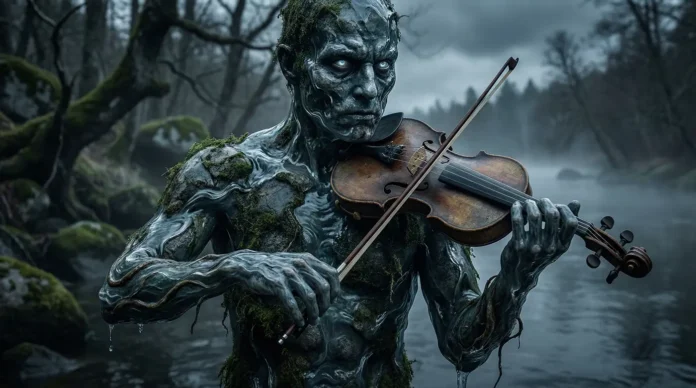
Denmark – an Overview
Denmark is a Scandinavian region with a distinct cultural and mythological identity documented through historical, archaeological, and folkloric sources. Its mythological significance is established mainly from the early medieval period into later centuries.
Geographically, Denmark comprises the Jutland Peninsula and numerous islands, which have shaped its historical development. Its coastal environment and proximity to other Scandinavian lands influenced both material culture and narrative tradition.
Denmark’s identity as a mythological source is inseparable from its historical position among Norse-speaking peoples. Its stories and belief systems remain distinct from neighboring Sweden or Norway in both structure and content.
Historical and Environmental Context
Time Frame and Location
Denmark’s mythological tradition is primarily documented from the early Viking Age through the early modern period. Archaeological and historical evidence indicates active cultural development during these centuries.
The landscape of Denmark consists of fertile lowlands, forests, and waterways. This physical environment shaped settlement patterns, agricultural practices, and the symbolic landscape of mythological narratives.
Coastal proximity to the North Sea and the Baltic Sea enabled maritime activity. These features contributed directly to the prominence of seafaring, trade, and associated mythic themes within Danish tradition.
Contact and Cultural Exchange
Denmark maintained regular contact with Norway, Sweden, and territories across the North Sea. Archaeological finds confirm frequent exchange of goods, ideas, and religious practices.
Distinct elements of Danish myth were influenced by contact with Continental Europe, especially through trade and later Christianization. This contact shaped both mythic content and the transmission of tradition.
Mythological Framework
Worldview and Cosmological Concepts
Surviving sources suggest a cosmological understanding structured around interconnected realms. These concepts were closely related to those found in broader Norse mythology, but with uniquely Danish adaptations.
Cosmological order was maintained through cycles of birth, death, and renewal. The relationship between the human world and other realms was perceived as permeable but structured by ritual boundaries.
Spiritual or Supernatural Categories
Documented supernatural beings in Danish tradition include deities, land-spirits, and ancestral presences. These categories are attested in early folklore collections and archaeological iconography.
Danish myth distinguishes between gods associated with natural forces and local land-spirits. This distinction shaped ritual practice and informed the symbolic meaning of supernatural encounters.
Folklore and Narrative Tradition
Recurring Mythological Themes
Common themes in Danish folklore include transformation, hidden treasure, and the dangers of liminal spaces. These motifs appear in both oral narratives and written collections from the nineteenth century.
Many Danish legends explore the consequences of pride or hubris, often employing supernatural beings as agents of punishment or reward. This theme recurs across multiple documented traditions.
Encounters with non-human entities frequently symbolize conflict between order and chaos. These stories reinforce the boundaries between the human and supernatural worlds in Danish thought.
Transmission and Preservation
Oral tradition served as the primary means of transmitting Danish mythological knowledge until the advent of widespread literacy. Stories were recounted in familial or communal settings.
Written collections, especially those compiled by folklorists in the nineteenth century, preserved much of the narrative material. These works document earlier themes and provide insight into regional variation.
Material culture, including rune stones and archaeological artifacts, provides indirect evidence for mythological beliefs. Such objects often contain symbolic imagery linked to attested narrative traditions.
Mythological Beasts and Non-Human Entities
Entities classified as mythological creatures in Denmark are documented in historical folklore and are inseparable from Danish cultural context. Their functions and identities are uniquely shaped by Danish understanding.
Ellefolk (Elves)
Ellefolk are supernatural beings widely attested in Danish folklore. Their association with Denmark is central, as their behavior and habitat reflect specifically Danish landscapes and social anxieties about boundaries.
Helhesten (Hell Horse)
The Helhesten appears in Danish myth as a spectral horse. Without Danish sources, its symbolic function and narrative placement would be fundamentally misinterpreted, as it does not match neighboring traditions.
Mare (Nightmare Spirit)
The Mare is a supernatural entity responsible for sleep disturbances in Denmark. Its role and symbolism diverge from similar entities elsewhere, uniquely reflecting Danish interpretations of illness and fear.
Symbolic Roles of Creatures and Forces
Ellefolk in Danish folklore often symbolize liminality and danger at the boundaries of cultivated land. Their presence serves as a warning against venturing into unknown or sacred spaces.
The Helhesten functions as a symbol of death and improper burial practices. Its appearance in narratives reflects communal anxieties about death and the maintenance of social order.
The Mare represents the intrusion of malevolent forces during vulnerability. Its symbolism is closely related to night terrors and the importance of protective rituals in Danish tradition.
Internal Variation and Temporal Change
Evidence demonstrates that beliefs associated with Ellefolk shifted over time. Their characterization softened in some regions as Christian influence increased, reflecting broader changes in Danish mythic outlooks.
Regional variation is attested for the Helhesten, with different forms and associated stories appearing across Denmark. This variation is documented in both oral and written traditions.
Related Cultural Origins and Myth Sources
Danish mythology shares structural similarities with Norse myth, especially regarding categories of supernatural beings. However, Danish narratives frequently emphasize local landscape and social realities, marking a clear difference.
Unlike Icelandic or Swedish myth, Danish tradition often incorporates Continental motifs. This reflects Denmark’s prominent position as a crossroads of northern and western European cultural exchange.
Evidence Limits and Scholarly Uncertainty
Archaeological evidence for mythological practice in Denmark is often indirect. Many narratives are attested only in late collections, limiting certainty about their early form or function.
Oral transmission complicates reconstruction of pre-Christian beliefs. Scholars debate the extent to which later written sources accurately represent older mythological systems in Denmark.
No verified sources describe a comprehensive cosmological system unique to Denmark. Existing narratives often overlap with broader Norse traditions, and clear demarcation remains a challenge for researchers.