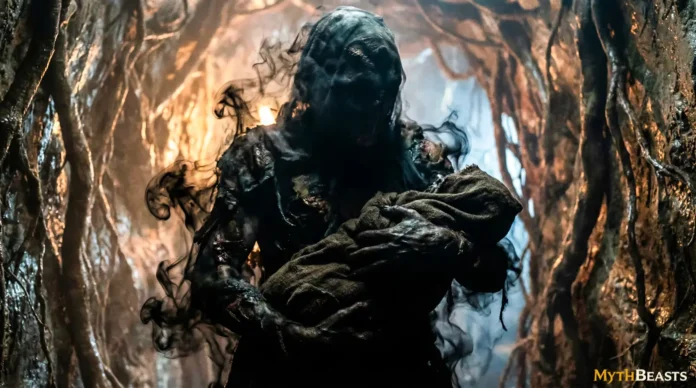
Deathless Shade – Overview
The Deathless Shade is a mythological beast type characterized by its elusive nature and immortality. This category encompasses entities that typically exist between life and death, not bound by the ordinary mortal cycle. These beings often appear as spectral figures, distinct from both living creatures and conventional spirits. Across cultures, they embody liminality, often serving as intermediaries between realms or symbolizing eternal aspects of the human condition.
Defining Characteristics
Physical Form and Morphology
Commonly, Deathless Shades are depicted with ethereal forms lacking solid corporeality. They possess humanoid features yet appear translucent or shadowy, often cloaked or robed to signify their separation from the physical world. They may display eyes or other features that glow, emphasizing their supernatural origin. While their forms are consistent in appearing otherworldly, variations exist based on cultural interpretations, often reflecting regional aesthetics or spiritual beliefs.
Ontological Nature
Deathless Shades are primarily understood as supernatural entities, occupying a liminal space between life and death. They are often regarded as ancient or eternal, existing independently of the natural order. Their presence in mythological frameworks suggests an awareness of cosmic cycles, where they act as custodians of secret knowledge or as reminders of mortality. This dual existence often aligns them with cosmic or spiritual domains, reinforcing their status as eternal witnesses or intermediaries.
Mythological Role and Function
Place in Mythological Systems
In various mythologies, Deathless Shades are integrated as agents of fate or prophecy, bridging divine and mortal realms. They serve gods or powerful deities, sometimes tasked with guarding sacred sites or delivering messages from the beyond. Their interactions with humans often emphasize moral or spiritual lessons, guiding individuals through transformative experiences or warning them of impending dangers. These roles underline their significance within larger cosmologies as connectors or disruptors.
Perception and Meaning
Culturally, Deathless Shades are often viewed with ambivalence, both feared and revered. As embodiments of the unknown, they may signify impending doom or offer protection against spiritual harm. In some traditions, they function as guides for the deceased, ensuring safe passage to the afterlife. Their presence in folklore highlights existential themes, reflecting human anxieties about mortality and the afterlife. Despite variations, they consistently serve as potent symbols of life’s mysteries.
Distinction from Related Beast Types
Conceptual Boundaries
Deathless Shades are distinct from elemental beings or traditional spirits due to their explicit connection to immortality and death’s boundary. Unlike elemental spirits, they lack ties to natural elements and focus on existential, not environmental, themes. They differ from undead entities, as they are not reanimated corpses but rather eternal presences. These distinctions underscore their unique role as both markers of and mediators between life and death.
Common Sources of Confusion
Confusion often arises when Deathless Shades are conflated with ghosts or other spectral entities. Scholarly differentiation hinges on their portrayal as timeless, rather than residual, entities. Unlike ghosts, which are often linked to unresolved earthly matters, Deathless Shades exist beyond the mortal sphere, emphasizing their timelessness. Mythology experts delineate them through their symbolic roles, which extend beyond mere haunting to embody deeper metaphysical concepts.
Canonical Beasts Associated with This Beast Type
Hindu Preta
Pretas are ghost-like figures from Hindu mythology, embodying unfulfilled desires. They are considered Deathless Shades due to their perpetual state and symbolic representation of unsatisfied yearnings, transcending physical mortality.
Yurei
In Japanese folklore, Yurei are spirits denied a peaceful afterlife. Their eternal unrest classifies them as Deathless Shades, highlighting their liminal existence and role as harbingers of unresolved human emotions and spiritual imbalance.
Draugr
Originating from Norse mythology, Draugr are undead warriors animated by unending greed or vengeance. Their physical immortality and role as grave guardians align with Deathless Shade characteristics, emphasizing themes of unyielding strength and wrath.
Historical Distribution and Cultural Context
Deathless Shades appear across numerous cultures, notably in ancient Greek, Hindu, Norse, and Japanese traditions. Their presence spans historical periods, from early mythologies to contemporary folklore, reflecting universal human concerns with death and the beyond. While specific forms and attributes vary, their core themes of immortality and liminality persist, highlighting shared existential anxieties. Regional adaptations further enrich their portrayal, linking them to local spiritual beliefs and societal values.
Scholarly Interpretation and Uncertainty
Variation in Definitions
Definitions of Deathless Shades vary based on cultural and temporal contexts. Some scholars emphasize their symbolic roles, while others focus on their physical forms or origins. This variation reflects broader debates on categorizing mythological entities, with some traditions prioritizing spiritual over corporeal elements. Academic frameworks further influence interpretations, dividing scholars on the importance of narrative versus symbolic attributes in defining this beast type.
Limits of Available Evidence
Existing evidence offers fragmented insights into Deathless Shades, with limited primary sources and regional inconsistencies complicating comprehensive understanding. Ambiguities in textual and oral traditions pose challenges, leading to debates on their precise nature and function. Scholars acknowledge these gaps, relying on comparative analysis to reconstruct potential frameworks. No verified sources describe every aspect, necessitating cautious interpretation and recognition of interpretive boundaries.
Mythological Role Across Cultures
Deathless Shades recur across mythologies due to their embodiment of universal human fascinations with death and the afterlife. They address existential questions, offering cultural narratives to explore mortality, immortality, and spiritual transitions. This consistent thematic presence suggests a shared human desire to understand life’s impermanence and continuity. Recognizing their mythological roles enhances comparative analysis, illustrating how diverse traditions navigate similar existential landscapes through distinct symbolic expressions.