Introduction
The Āl is a folkloric figure documented across Iranian, Armenian, Caucasian, and adjacent cultural regions, widely associated with moments of childbirth crisis, maternal illness, and early infant mortality rather than fertility or creation.
In traditional belief systems, the Āl does not function as a narrative character within myths, but as an explanatory presence invoked when childbirth outcomes abruptly shift toward danger or irreversible loss.
The figure emerges within societies where childbirth represented one of the most unpredictable and hazardous life events, occurring beyond the reach of systematic medical intervention or scientific explanation.
By attributing crisis to the Āl, communities transformed biological uncertainty into a culturally intelligible phenomenon, allowing fear, grief, and vigilance to be organized through shared symbolic understanding.
Over time, the Āl accumulated regional variations, symbolic embellishments, and later interpretive distortions, especially as oral traditions weakened and the figure entered broader mythological and popular classifications.
This article reconstructs the Āl from its foundational folkloric function, separating original belief structures from later reinterpretations and examining how cultural transmission reshaped its meaning across time and geography.
What the Āl Is
Core Definition
The Āl represents a folkloric personification of childbirth danger, primarily appears during moments of medical rupture, sudden illness, or fatal outcome rather than acting as an initiating or generative force.
Its presence signals a breakdown in expected biological processes, marking childbirth as a liminal state where ordinary explanations fail and unseen forces are believed to intervene.
Rather than existing continuously, the Āl manifests episodically, tied directly to crisis events and disappearing once the moment of danger has resolved or concluded.
Functional Role in Traditional Belief
Within village-based belief systems, the Āl served a stabilizing explanatory role, offering coherence during traumatic events that otherwise appeared arbitrary, uncontrollable, and socially destabilizing.
By externalizing danger into a recognizable figure, communities preserved social cohesion, reduced personal blame, and justified heightened vigilance, collective responsibility, and protective practices surrounding childbirth.
This framework transformed fear into action, encouraging preparation, observation, and communal presence during periods when women and infants were considered most vulnerable.
Conceptual Boundaries and Classification
The Āl does not appear in traditional belief as a fully individualized mythic persona with a consistent biography, personality, or narrative continuity across regions or generations.
Instead, it operates as a situational presence, emerging only within specific childbirth-related contexts and lacking agency outside those narrowly defined moments of crisis.
The figure is not integrated into formal religious hierarchies or moral systems, and its appearance does not imply judgment, punishment, or ethical failure on the part of the mother.
Later categorizations describing the Āl as a generalized demon reflect modern abstraction rather than the localized, functional role it originally occupied within oral and community-based traditions.
Liminal Identity
The Āl occupies a liminal position between life and death, appearing at transitional thresholds where outcomes remain uncertain and bodily boundaries are under extreme physical and symbolic stress.
Childbirth, as a moment of transformation, provides the conditions under which such figures emerge, embodying collective anxiety surrounding irreversible change, vulnerability, and loss.
This liminal identity explains both the persistence of the Āl across cultures and the instability of its form, as belief adapts to local fears while preserving a shared functional core.
Original Cultural Forms of the Āl
Iranian and Persian Traditions
In Iranian folklore, the Āl is most commonly associated with postpartum crisis, particularly sudden maternal illness, fever, or physical collapse occurring shortly after childbirth rather than during pregnancy itself.
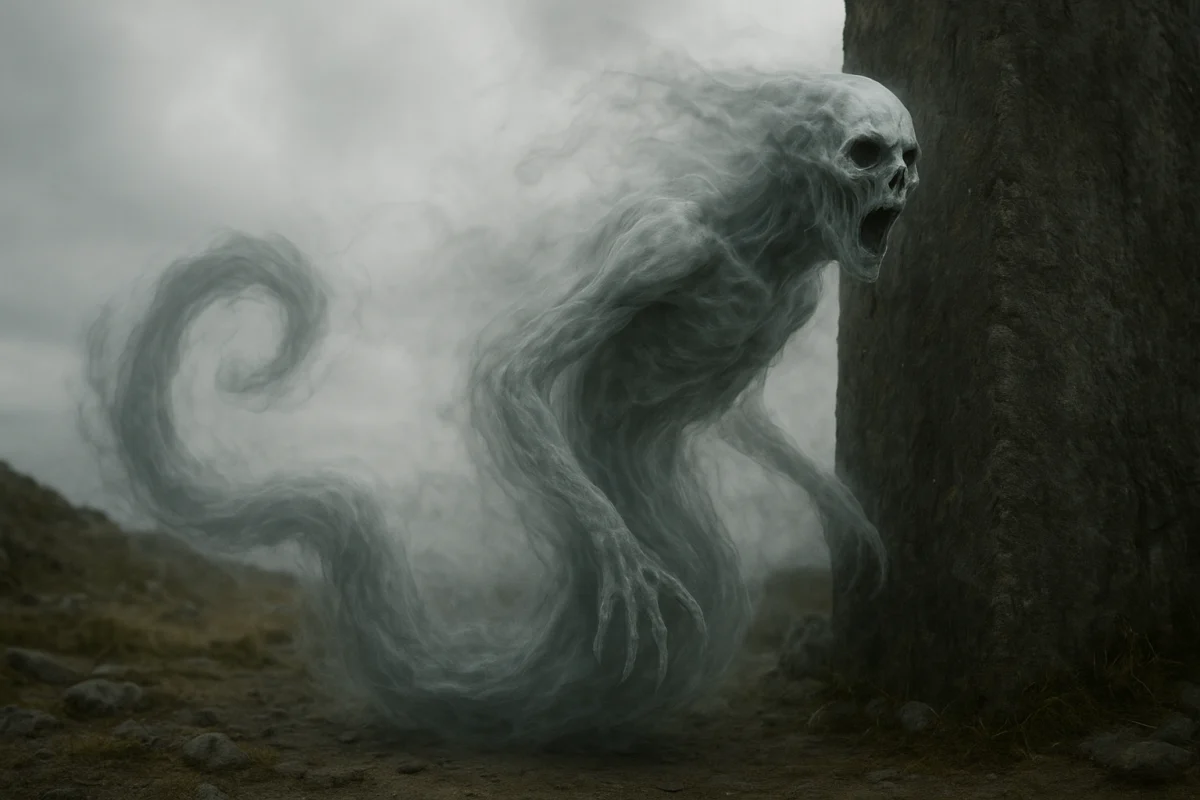
Iranian accounts rarely emphasize a fixed physical appearance. Instead, the presence of the Āl is inferred through outcome and timing, with recognition based on effects rather than visual identification.
Within these traditions, the Āl functions as a situational explanatory presence rather than a visible adversary. Attention is directed toward anticipation, vigilance, and prevention during vulnerable periods following delivery.
The figure is therefore defined less by form than by circumstance, appearing only within specific moments of biological danger and disappearing once the crisis has resolved or concluded.
Armenian Traditions
In Armenian folkloric material, the Āl appears with greater visual and symbolic articulation, shaped in part by written protective practices and religious mediation alongside oral transmission.
Some Armenian protective traditions include illustrated amulets and scrolls that depict threatening beings associated with childbirth danger. In certain examples, the Āl is rendered as a small, dark, humanoid figure, emphasizing bodily harm rather than moral intent.
These representations are not uniform and should be understood as selective visualizations rather than standardized depictions shared across all Armenian belief contexts.
Unlike Iranian traditions, Armenian practice frequently integrates saintly invocation and written charms, framing the Āl as a dangerous presence that may be constrained or repelled through ritual authority rather than communal vigilance alone.
Caucasian Regional Variants
Across various Caucasian regions, the Āl is described as a household-proximate threat associated with the period immediately following childbirth, particularly during times of isolation or reduced social presence.
Accounts emphasize nocturnal vulnerability and proximity to domestic space rather than public settings, reinforcing the belief that danger emerges when protective attention weakens.
Descriptions of the being itself vary considerably, but the shared emphasis remains on timing, stealth, and the targeting of unattended mothers rather than overt confrontation.
These traditions frame the Āl as a conditional presence activated by circumstance rather than a continuously roaming entity, linking risk to isolation rather than transgression.
Turkic and Central Asian Variants
In Turkic-speaking regions, figures such as Albastı or Albaslı are closely related to the Āl tradition and retain a strong association with childbirth danger and postpartum vulnerability.
These variants often display more concrete physical characteristics and may appear in narratives involving pursuit, struggle, or temporary containment, reflecting local storytelling conventions.
While surface imagery and narrative intensity differ, the underlying function remains comparable: explaining sudden maternal or infant crisis occurring around childbirth.
This continuity demonstrates how the core role of the Āl persists across cultures, even as visual form, narrative detail, and perceived agency adapt to regional frameworks.
Comparative Overview of Regional Traditions
The following table presents the Āl by cultural region as columns, allowing direct comparison of function, appearance, and belief structure while remaining readable on mobile and small screens.
| Aspect | Iranian / Persian | Armenian | Caucasus (Regional) | Turkic / Central Asian |
|---|---|---|---|---|
| Local name | Āl | Āl | Al, Al-i | Albastı, Albaslı |
| Primary context | Postpartum crisis | Childbirth and early infancy | Nighttime vulnerability after birth | Childbirth danger and pursuit |
| Moment of appearance | After delivery, during sudden illness | During and immediately after birth | At night when the mother is isolated | During or shortly after birth |
| Typical appearance | Often undefined or abstract | Small, dark humanoid, sometimes holding organs | Shadow-like, elusive presence | More corporeal, sometimes animalistic |
| Core perceived threat | Maternal illness or death | Harm to mother or infant | Nocturnal interference | Physical seizure or pursuit |
| Narrative structure | Explanatory, non-dramatic | Visualized and ritualized | Household vigilance focused | Action-oriented encounters |
| Protective response | Continuous presence, vigilance | Written charms, saintly invocation | Communal watch, avoidance of isolation | Confrontation, trickery, forced retreat |
| Ontological framing | Situational presence | Demon constrained by ritual power | Liminal household threat | Semi-physical adversary |
This comparison shows that while imagery and narrative intensity vary widely, the Āl remains consistently tied to childbirth danger and liminal vulnerability rather than moral judgment or cosmological hierarchy.
Shared Folklore Motifs
Proximity to Childbirth
Across documented traditions, the Āl is consistently associated with the period surrounding childbirth, appearing in close temporal and spatial proximity to labor, delivery, or the immediate aftermath.
Rather than emerging independently, the figure is activated by circumstance, reinforcing the belief that danger arises specifically during moments of physical strain, uncertainty, and heightened vulnerability.
This proximity situates childbirth as a liminal threshold, where ordinary biological expectations become unstable and unseen forces are believed capable of intervening.
Removal of Vital Essence
A recurring motif describes the Āl as removing or disrupting something essential to the mother’s recovery, often conceptualized as an internal organ or vital life substance.
This explanation translates sudden illness, collapse, or death into tangible bodily terms, offering coherence within pre-modern medical frameworks that lacked anatomical or physiological clarity.
The motif emphasizes consequence rather than intent, focusing on the loss itself rather than moral judgment or narrative motivation.
Nighttime and Social Absence
Many accounts place the Āl’s activity during nighttime hours, particularly when the mother is unattended, resting, or separated from sustained communal presence.
Darkness functions as a symbolic marker of reduced vigilance, while isolation signals the weakening of protective social structures traditionally surrounding childbirth.
The motif reinforces the belief that danger increases when observation diminishes, rather than suggesting deliberate wrongdoing or spiritual punishment.
Thresholds and Irreversibility
Some traditions describe the Āl’s actions as involving the crossing of symbolic or physical thresholds, marking a transition beyond which recovery becomes unlikely.
These boundaries vary by region and narrative context, reflecting broader folkloric associations between thresholds, transition, and irreversible change.
Rather than a fixed rule, the motif serves as a symbolic framework for explaining sudden shifts from instability to fatal outcome.
Motive Change & Distortion
Oral Tradition and Stability
In village-based societies, the Āl remained relatively stable, transmitted through repetition, observation, and shared experience rather than written doctrine or centralized authority.
Its meaning was reinforced through practice, not explanation, preserving function even as details shifted gradually across generations.
Decline of Contextual Knowledge
As traditional childbirth practices changed and medical explanations expanded, the experiential foundation supporting belief in the Āl weakened significantly.
Without direct communal memory of crisis, the figure lost situational grounding and became increasingly abstract.
Modern Reclassification
In modern contexts, the Āl was often reclassified as a generalized demon, stripped of regional nuance and functional specificity.
This process favored simplified labels and visual stereotypes over contextual understanding, distorting the original role of the figure.
Digital and Popular Expansion
Digital circulation accelerated distortion, merging the Āl with unrelated mythological beings and reinforcing a uniform identity disconnected from its original cultural environment.
As a result, the Āl shifted from explanatory presence to aesthetic symbol, losing its grounding in lived experience.
Similar Beasts
Lilith
Lilith appears in Jewish tradition as a female nocturnal being associated with infant mortality and maternal vulnerability, particularly during the liminal period following childbirth.

Like the Āl, Lilith functions less as a narrative character and more as an explanatory presence, giving form to fears surrounding sudden loss and unexplained death.
Despite differences in religious framing, both figures occupy comparable symbolic spaces linked to nighttime danger, isolation, and protective countermeasures. Read More
Strix
The Strix originates in Roman folklore as a nocturnal creature believed to attack infants, often described as bird-like and predatory in behavior.
Its role mirrors the Āl’s function as an explanation for infant death occurring during the night, especially when households are unguarded.
However, the Strix lacks the childbirth-specific focus central to the Āl, reflecting broader anxieties about infancy rather than maternal crisis.
Lamashtu
Lamashtu emerges in Mesopotamian belief as a demoness explicitly connected to harm against mothers and infants, often depicted with a defined physical form and aggressive intent.

Unlike the Āl, Lamashtu is embedded within a formal demonological system, interacting with other supernatural beings and ritual specialists through structured religious practice.
The comparison highlights how similar fears can produce figures with very different degrees of theological integration.Read More
Churels
In South Asian folklore, Churels are female spirits associated with reproductive danger, death during childbirth, and the disruption of familial continuity.
Their narratives emphasize betrayal, transformation, and unresolved transition, placing them closer to post-mortem spirits than situational crisis figures like the Āl.
The comparison underscores how childbirth danger can generate different symbolic responses across cultural environments.
Jinn
Within Islamic tradition, certain jinn are believed capable of interfering with human life, including pregnancy and childbirth, though they are not exclusively tied to these contexts.
Unlike the Āl, jinn form a broad ontological category encompassing many behaviors and moral alignments, rather than a single function-bound presence.
This distinction reinforces the Āl’s specificity as a childbirth-related explanatory figure rather than a general supernatural being.
Al compared to Lilith and Lamashtu
| Aspect | Al | Lilith | Lamashtu |
|---|---|---|---|
| Cultural Origin | Iranian and Caucasian folklore. | Ancient Mesopotamian mythology. | Ancient Near Eastern traditions. |
| Associated Illnesses | Fevers, miscarriages, and sudden death. | Infant mortality and maternal illness. | Childbirth complications and nightmares. |
| Role in Folklore | Explanatory figure for childbirth crises. | Demon associated with infant danger. | Demonic figure in childbirth narratives. |
| Symbolic Meaning | Symbol of fear and maternal loss. | Representation of female danger. | Embodiment of childbirth anxieties. |
| Impact on Childbirth | Transforms uncertainty into cultural understanding. | Represents threats to maternal health. | Symbolizes risks during childbirth. |
| Regional Variations | Regional adaptations across cultures. | Variations in demon characteristics. | Different interpretations in folklore. |
Modern Media References
Aal (Feature Film, 2010)
This Iranian psychological horror film is one of the clearest modern screen adaptations drawing on the Āl tradition.
The plot follows Sina, an engineer, and his pregnant wife Fariba during a trip to Yerevan, where escalating accidents and fear reshape pregnancy into a site of supernatural threat.
The film reframes the Āl from a diffuse, context-bound folkloric danger into a visually legible antagonist, aligning childbirth-related anxiety with contemporary horror structure (individualized menace, escalating set pieces) rather than communal vigilance and situational belief logic. (IMDb)
Alkarısı (Short Film, 2022)
This Turkish short horror production draws on the regional Albastı/Alkarısı complex. Its synopsis centers on Kübra, who is staying with her grandmother while caring for her newborn, as a local folk terror of “Alkarısı” (rumored to kill newborn babies) closes in.
The short-film treatment concentrates the tradition into an intimate, isolated dread scenario (household enclosure, personal vulnerability), prioritizing direct haunting dynamics over the wider communal protection framework often emphasized in the older folk context. (IMDb)
Alkarisi: Cinnet (Feature Film, 2015)
This Turkish horror film presents Alkarısı through the “cin/genie film” lens and explicitly ties the threat to pregnancy: Dilara, seven months pregnant, goes on maternity leave, and the haunting intensifies around her.
As with many modern horror reinterpretations, the folkloric figure is handled as an aggressive, personalized haunting presence, leaning on genre conventions (possession-style dread, shock-forward escalation) rather than preserving the Āl’s more functional, context-triggered explanatory role. (IMDb)
Comparative Note: Tradition vs. Cinema
Across these films, the Āl is consistently transformed from an ambiguous folkloric danger-sign into a personalized monster identity.
Traditional belief emphasized timing, vulnerability, and communal protection. Modern cinema replaces these with individual guilt, visual horror, and demonized intent, marking a clear post-folkloric evolution.
Conclusion
The Āl is not a single demon with a fixed biography, but a folkloric pattern shaped by fear, repetition, and cultural memory. Its core function was explanatory rather than narrative, offering communities a way to name childbirth danger.
Across Iranian, Armenian, Caucasian, and Turkic traditions, the Āl remained consistent in role while fluid in form. It explained sudden illness, maternal collapse, and infant loss in societies lacking medical frameworks.
As the figure moved beyond village transmission into print, cinema, and digital media, its meaning gradually shifted. Symbolic warning transformed into literal monster, and ritual logic was replaced by spectacle and horror conventions.
Understanding the Āl requires separating original folkloric function from later reinterpretations. When viewed through that lens, the Āl becomes a powerful example of how myth adapts, degrades, and survives cultural acceleration.
Further Reading
Encyclopaedia Iranica – “Āl (Folkloric Being)”
A definitive academic entry examining the Al as a folkloric figure associated with puerperal fever and childbirth danger.
It covers name variants, regional spread, core motifs, and comparative context across Iranian and Caucasian traditions.
https://www.iranicaonline.org/articles/al-folkloric-being-that-personifies-puerperal-fever/
Theresa Bane, Encyclopedia of Demons in World Religions and Cultures
A modern reference work summarizing demons across cultures.
The entry on the Al provides a concise overview of its attributes, regional variants, and association with childbirth, useful as a cross-cultural index rather than a primary source.
https://mcfarlandbooks.com/product/encyclopedia-of-demons-in-world-religions-and-cultures/
“Al Demon in the Context of Caucasian Contact Zones” – History, Archaeology and Ethnography of the Caucasus
An academic paper examining how the character “Al” appears in the folk beliefs of Iran, Armenia, Georgia, and the North and South Caucasus, including linguistic variants, shared demonological features, and possible pathways of diffusion across cultures.
https://caucasushistory.ru/2618-6772/article/view/17071