back to top

Devil's Hound

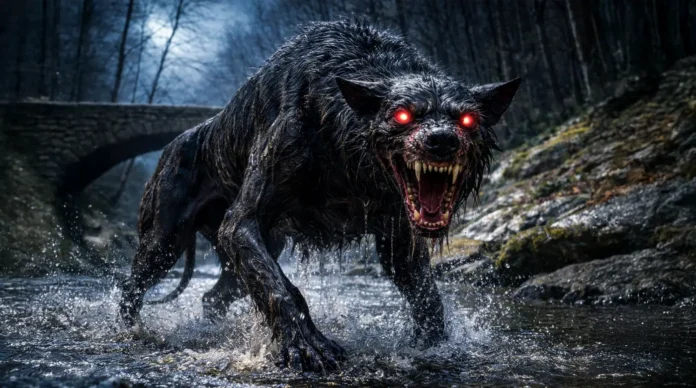
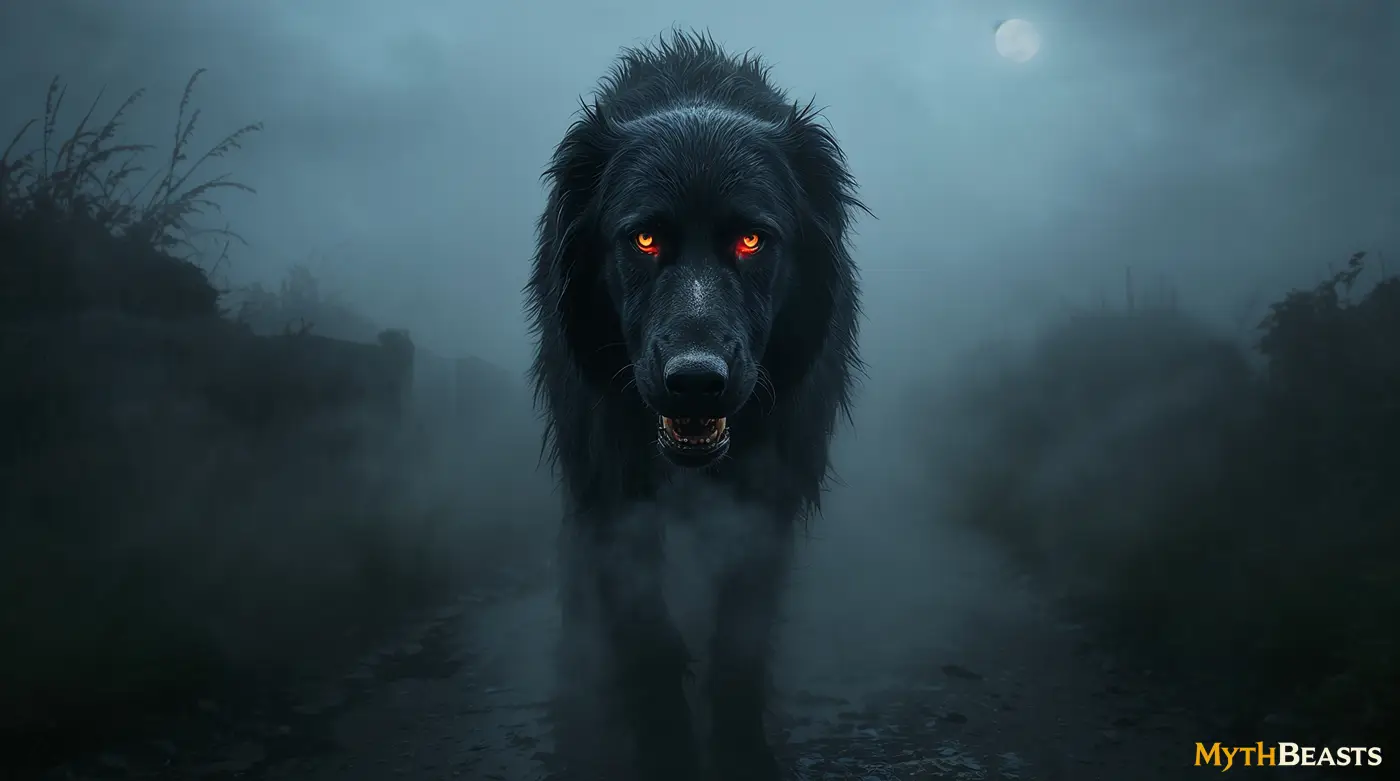
Devil's Hound blazing-eyed, ash-furred hell canines, chained to nocturnal crossroads and graveyard thresholds, relentless escorts of condemned souls

Relevant Beasts

Catalan
Devil's Hound
Dip - the Catalonian Devil's hound
Catalan

Dip

Dip is a spectral black dog from Catalan folklore, often seen as a harbinger of evil and death. Known...

  • Skills
Death & NecromancyFear Inducement
  • Weaknesses
Blessed GroundDivine Restrictions
Greece
Devil's Hound
Cerberus - Three-headed dog
Greece

Cerberus

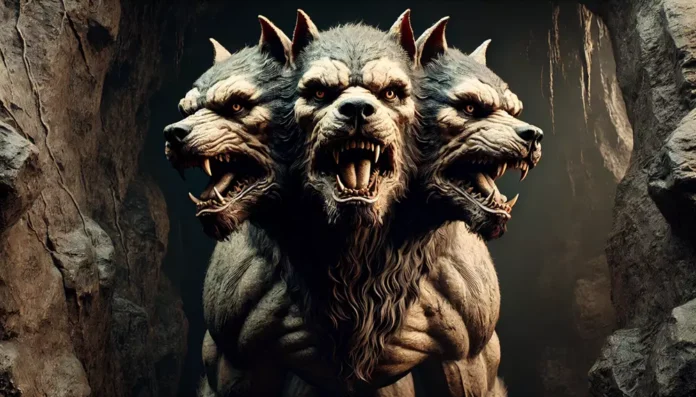
Cerberus, the multi-headed guard of the Underworld, prevented souls from escaping and warded off the living. Known for his...

  • Skills
Fear InducementIllusions & Perception
  • Weaknesses
Blessed WeaponDivine Restrictions
Anglo-Saxons
Devil's Hound
Black Shuck - Omen Black Dog of Anglo-Saxon English Folklore
Anglo-Saxons

Black Shuck

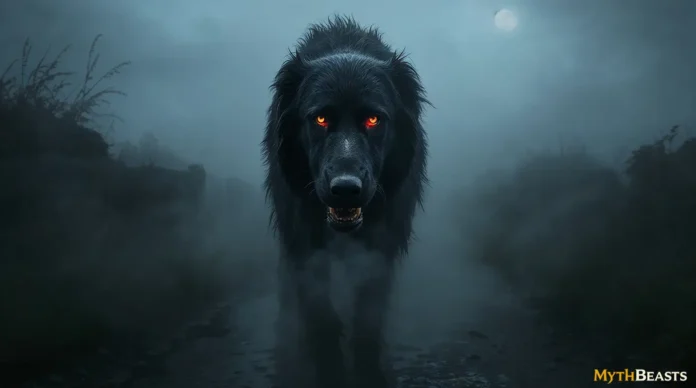
Black Shuck is a spectral black dog from English folklore, known for its terrifying appearance and as an omen...

  • Skills
Fear InducementNight Vision
  • Weaknesses
ExorcismSilver Weak

Devil’s Hound – Overview

Devil’s Hound designates a comparative category describing canine beings linked to infernal, demonic, or underworld powers within historically attested traditions. The type emphasizes persistent canine morphology combined with explicit connections to punitive, boundary-policing, or soul-related functions.Within this category, the “devil” element signifies structural alignment with hostile or morally dangerous realms instead of necessarily referencing Christian demonology. The hound component anchors these beings to recognizable doglike behavior, locomotion, and tracking capacities within symbolic cosmologies.Across traditions, Devil’s Hounds often mediate between living communities and feared regions such as hellscapes, underworlds, or cursed territories. Their presence typically indexes proximity to spiritual danger, transgression consequences, or unstable borders between life and death.These beings rarely function as independent deities; rather, they operate as delegated agents, guardians, or instruments of higher powers associated with punishment or chthonic authority. Their mythological identity becomes unintelligible without reference to those superior controlling forces.As a beast type, Devil’s Hounds assist comparative analysis by grouping diverse canine figures whose defining trait is service to punitive or oppressive metaphysical orders. Without this shared functional orientation, simple monstrous dogs would not qualify within this taxonomy.

Defining Characteristics

Physical Form and Morphology

Devil’s Hounds commonly exhibit enlarged bodies exceeding normal canine proportions, signaling their departure from ordinary zoology. This scale exaggeration underscores their role as overwhelming enforcers, visually communicating disproportionate power relative to human or animal adversaries.Multiple heads, when present, emphasize expanded sensory surveillance rather than simple monstrosity. Each head typically symbolizes extended vigilance over boundaries, reinforcing the hound’s specialization in tracking, guarding, and relentlessly monitoring souls or intruders.Eyes, mouths, and breath are frequently associated with fire, smoke, or corrosive exhalations. These features visually translate underworld heat or spiritual corruption into bodily traits, marking the creature as physically saturated with infernal environmental conditions.Claws and teeth tend to be described with metallic hardness or unnatural sharpness. Such descriptions detach them from ordinary predation, instead presenting their bites or rending actions as metaphysical penalties affecting souls, not merely physical flesh.Coat coloration frequently skews toward absolute black or unnatural darkness, sometimes described as absorbing light. This chromatic emphasis visually aligns Devil’s Hounds with night, secrecy, and hidden realms, differentiating them from protective or solar canine figures.Chains, collars, or shackles appear recurrently as external attributes. These restraints symbolize both subordination to superior infernal authorities and the possibility that, if unbound, the hounds’ destructive or punitive potential would exceed cosmological control.

Ontological Nature

Devil’s Hounds occupy a liminal ontological position between animal and demon. They retain recognizable canine instincts yet operate under metaphysical rules, often ignoring physical fatigue, injury, or natural environmental limits during mythic pursuits.These beings usually derive existence from infernal or underworld domains rather than terrestrial ecosystems. Their origin narratives emphasize creation, commissioning, or emplacement by higher chthonic powers, making them dependent extensions rather than autonomous primordial forces.Many traditions frame Devil’s Hounds as psychopompic enforcers rather than guides. They do not merely escort souls; instead, they chase, seize, or constrain them when moral, ritual, or contractual conditions have been violated within culturally specific frameworks.Because they embody institutionalized punishment, Devil’s Hounds often carry an ontological status comparable to legal instruments. Their attacks signify the activation of cosmic sanctions, making their presence evidence that spiritual or moral law has been invoked.Unlike shapeshifting trickster animals, Devil’s Hounds normally exhibit ontological stability. They rarely change species or form; this persistence reinforces their reliability as boundary markers, whose consistent appearance immediately communicates infernal jurisdiction.In some Christianized contexts, Devil’s Hounds become associated with demonic legions rather than singular entities. Here their ontological nature shifts toward mass manifestations, representing standardized instruments within a broader infernal bureaucracy.

Mythological Role and Function

Place in Mythological Systems

Devil’s Hounds usually patrol thresholds such as graveyards, crossroads, or entrances to underworld regions. Their stationing at these locations integrates them into cosmological cartographies, marking dangerous transition points between existential states.Within many systems, these hounds operate as delegated hunters of escaped souls or oath-breakers. This role situates them within divine or demonic justice mechanisms, where pursuit dramatizes inescapable accountability beyond human legal institutions.In Christian-influenced European folklore, Devil’s Hounds frequently accompany personifications of the Devil or infernal horsemen. Their inclusion clarifies the punitive mission of spectral hunts, distinguishing them from neutral ancestral processions.Some underworld-focused cosmologies position Devil’s Hounds as wardens preventing unauthorized ingress. Here their function tilts from pursuit toward exclusion, protecting the integrity of chthonic spaces against ritual trespassers seeking forbidden knowledge or power.In agricultural societies, reports of Devil’s Hounds sometimes cluster around liminal seasonal times, especially autumn and winter festivals. Their cyclical appearances integrate them into ritual calendars marking perceived openings between living and dead communities.When present in narrative cycles involving saints or holy figures, Devil’s Hounds highlight contested jurisdiction. Miraculous control over these beasts symbolizes the superior authority of sanctified power over previously dominant infernal enforcement structures.

Perception and Meaning

Communities generally perceive Devil’s Hounds as hostile or terrifying, yet their hostility is often conditional. They target specific categories of wrongdoers, making them embodiments of particularized, not random, supernatural violence within moral universes.As omens, sightings or auditory experiences of Devil’s Hounds typically forecast death, storms, or communal misfortune. Their perceived approach warns that hidden transgressions, unfulfilled oaths, or neglected rites may soon attract punitive enforcement.Symbolically, Devil’s Hounds externalize the fear that guilt remains traceable. Their tracking abilities metaphorically express anxiety that individuals cannot outrun consequences, even across geographic distance or after apparent social concealment.In some localized narratives, Devil’s Hounds paradoxically protect sacred boundaries by punishing desecrators. This ambivalent function complicates their evaluation, aligning them with order maintenance despite originating from feared infernal authorities.Modern interpretations sometimes recast Devil’s Hounds as psychological symbols of internalized conscience. These readings, however, are explicitly interpretive frameworks rather than historically attested beliefs within premodern communities.

Distinction from Related Beast Types

Conceptual Boundaries

Devil’s Hounds differ from generic hellhounds by requiring explicit linkage to institutionalized infernal authority. Without clear subordination to organized punitive structures, a fiery or monstrous dog remains outside this stricter taxonomy.They contrast with guardian dogs of deities like Anubis, because those figures primarily oversee orderly transition, not punitive pursuit. Devil’s Hounds emphasize retribution for transgression rather than neutral accompaniment of expected death.Unlike werewolves or canine shapeshifters, Devil’s Hounds lack human origin or alternating identity. Their classification excludes entities whose primary narrative interest concerns transformation, social marginality, or cursed humanity rather than infernal service.Compared with general underworld monsters, Devil’s Hounds maintain a focused functional specialization around tracking, chasing, or guarding souls. Broader chthonic beasts might devour indiscriminately, whereas Devil’s Hounds target specific cosmologically defined categories.The type also differs from demonic riders’ horses or dragons, which symbolize mobility or overwhelming destructive power. Devil’s Hounds instead foreground investigation, detection, and enforcement, making them closer to infernal hounds than infernal steeds.

Common Sources of Confusion

Confusion often arises because many languages lack separate terms for hellhounds and Devil’s Hounds. Scholars must therefore infer classification from described functions, especially whether the canine explicitly enforces punitive authority.Christianization introduces additional ambiguity when previously neutral underworld dogs become demonized. Distinguishing whether they remain psychopompic or become Devil’s Hounds requires careful attention to moral framing within post-conversion textual or oral sources.Modern popular culture frequently generalizes all flaming or spectral dogs as devilish. This flattening obscures historical nuances, leading to retrospective misclassification of protective or ancestral canine spirits as infernal enforcement agents.Comparative studies sometimes overextend the category onto non-canine underworld guardians. Maintaining morphological specificity is crucial, because Devil’s Hounds derive analytic coherence from their persistent doglike form and associated tracking symbolism.

Canonical Beasts Associated with This Beast Type

Cerberus

Cerberus - Three-headed dog
Cerberus – Three-headed dog
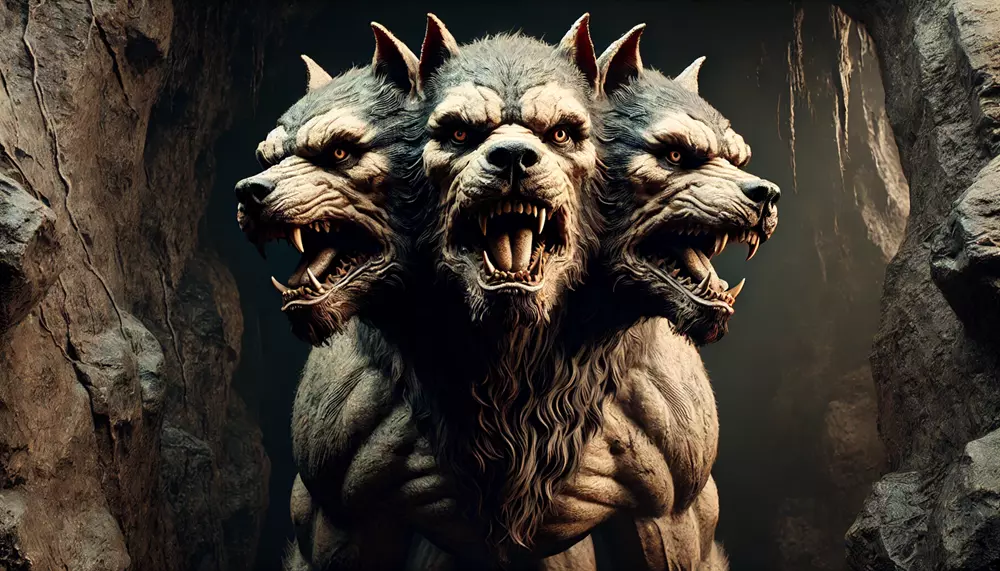
Cerberus from Greek and Roman mythology exemplifies Devil’s Hound characteristics through his multiheaded, gigantic canine form, explicit service to Hades, and role preventing escape of souls, emphasizing punitive containment rather than neutral psychopompic guidance. Read More

Black Shuck

Black Shuck - Omen Black Dog of Anglo-Saxon English Folklore
Black Shuck – Omen Black Dog of Anglo-Saxon English Folklore
Black Shuck from East Anglian English folklore fits this type because its spectral dog form, association with churchyards and storms, and linkage to the Devil mark it as an omen-enforcing boundary guardian. Read More

Gabriel Hounds

The Gabriel Hounds of English and Welsh traditions belong here since their airborne dog pack, interpreted as damned or infernal, enforces moralized warnings about unconfessed guilt, making their canine identity inseparable from punitive cosmological messaging.

Yeth Hound

The Yeth Hound from Devon folklore qualifies through its headless spectral dog body, association with unbaptized souls, and function as a nocturnal hunter, where canine form expresses relentless pursuit driven by infernally tinged unrest.

Historical Distribution and Cultural Context

Devil’s Hound motifs concentrate strongly in European regions shaped by Christian eschatology, particularly medieval and early modern periods, where doctrines of hell, sin, and demonic enforcement created receptive frameworks for infernal canine figures.Pre-Christian Indo-European traditions often possessed underworld dogs without explicit devil associations. After Christianization, these earlier psychopompic guardians were sometimes reinterpreted as Devil’s Hounds, reflecting theological shifts emphasizing punishment over neutral afterlife transition.Rural communities with strong oral storytelling practices preserved Devil’s Hound narratives longer than urban centers. Their tales functioned within local moral regulation, warning against behaviors threatening communal stability, property boundaries, or ecclesiastical authority structures.Maritime and coastal regions occasionally adapted the motif to liminal shorelines, where spectral hounds patrolled cliffs or beaches. These contexts framed the sea as another dangerous threshold, aligning oceanic perils with infernal jurisdiction.Industrialization and urbanization gradually weakened belief in literal Devil’s Hounds, yet the imagery persisted symbolically. Nineteenth-century antiquarians documented residual traditions, providing much of the evidence supporting modern taxonomic reconstruction of this beast type.

Scholarly Interpretation and Uncertainty

Variation in Definitions

Folklorists emphasizing function define Devil’s Hounds primarily through punitive enforcement roles. Under this approach, even modestly described spectral dogs become central if they clearly participate in structured systems of supernatural retribution.Religionsgeschichtliche scholars sometimes restrict the category to beings explicitly labeled demonic or diabolical in sources. This narrower definition excludes underworld dogs lacking direct textual association with named infernal rulers or doctrinal hells.Comparative mythologists occasionally expand Devil’s Hounds to include non-European underworld canines. However, without demonstrable links to punitive devil figures, such extensions remain contested and should be treated as heuristic rather than definitive.Some psychoanalytic interpretations treat Devil’s Hounds as projections of persecutory guilt. These readings foreground universal psychological dynamics, yet they risk erasing historically specific theological and social structures that originally shaped the beings’ functions.

Limits of Available Evidence

Many Devil’s Hound traditions survive only in late folkloric collections, raising uncertainty about earlier forms. No verified sources describe standardized medieval classification systems explicitly identifying a category equivalent to the modern term Devil’s Hound.Oral accounts often conflict regarding details such as size, color, or exact affiliation with the Devil. Scholars therefore prioritize recurring functional patterns over inconsistent descriptive particulars when assigning individual beings to this beast type.Attribution of pre-Christian origins frequently remains speculative. Where textual or archaeological evidence is lacking, responsible reconstruction must acknowledge that continuity between ancient underworld dogs and later Devil’s Hounds cannot be definitively demonstrated.Regional censorship, clerical disapproval, and selective recording practices likely suppressed some narratives. Consequently, absence of documented Devil’s Hounds in certain areas cannot confidently prove their historical nonexistence within those cultural environments.

Mythological Role Across Cultures

The recurrence of Devil’s Hound motifs reflects widespread anxiety about escaping consequences. Canine trackers provide an intuitive metaphor for inescapable pursuit, making them effective vehicles for expressing fears surrounding moral or contractual evasion.Across societies, dogs already occupy liminal positions between domesticity and wildness. Devil’s Hounds intensify this ambiguity, transforming familiar helpers into agents of hostile realms, thereby dramatizing the potential betrayal of trusted social structures.The emphasis on thresholds mirrors cross-cultural concerns with boundaries between life and death. By stationing Devil’s Hounds at liminal points, communities externalize the policing of transitions that otherwise feel abstract, invisible, or theologically distant.Comparative recognition of this beast type assists interpretation of fragmentary traditions. Identifying a spectral dog as Devil’s Hound foregrounds its punitive, infernal alignment, preventing misclassification as merely protective ancestral guardian or neutral psychopompic companion.Ultimately, Devil’s Hounds persist in cultural memory because they condense complex doctrines of judgment, law, and transgression into a single, vividly imaginable figure. Their enduring presence across regions testifies to shared human efforts organizing fear of punishment.