
Anglo-Saxons
Relevant Beasts
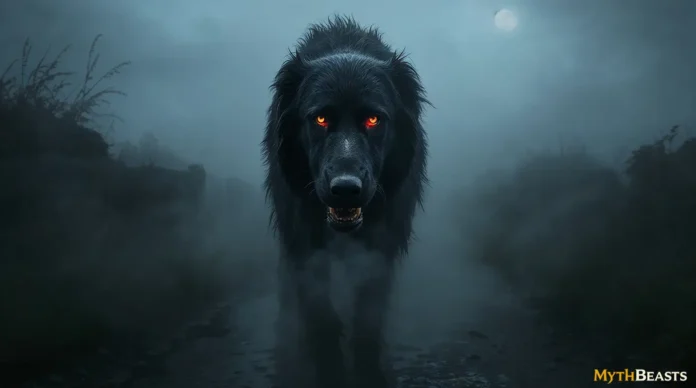
Black Shuck is a spectral black dog from English folklore, known for its terrifying appearance and as an omen...
Black Shuck is a spectral black dog from English folklore, known for its terrifying appearance and as an omen...
Anglo-Saxons denotes communities formed through migration and settlement in early medieval Britain, alongside populations already living there, rather than one uniform people with a single mythology.
As a mythological source, the term refers chiefly to evidence produced in early medieval England, including Old English poetry, names, historical writing, and Christian-era records.
The label covers changing populations and identities from approximately the fifth century through the Norman Conquest in 1066, with considerable regional and chronological variation.
Its geographic center was England, especially areas settled by groups identified in historical sources as Angles, Saxons, and Jutes, though those labels do not describe every community.
Archaeological evidence indicates substantial migration from northwestern continental Europe to Britain during the fifth and sixth centuries, following the end of Roman political rule.
Settlement evidence includes cemeteries, burial objects, and changing material practices, but archaeological patterns cannot identify the language or ethnicity of every individual.
By the seventh century, several kingdoms existed in what is now England, including Northumbria, Mercia, and Wessex, with boundaries and political power changing over time.
Environmental conditions varied across these kingdoms, from lowland agricultural districts to upland regions, so no single landscape represents the entire Anglo-Saxon experience.
Anglo-Saxon communities interacted with Brittonic-speaking populations through settlement, political conflict, exchange, and cultural adaptation, although the scale and character differed between regions.
Christianization began among English kingdoms during the seventh century, involving missions associated with Rome and Irish Christian communities, rather than one uniform conversion process.
Latin learning entered English ecclesiastical settings through Christian institutions, shaping surviving written records and limiting direct access to pre-Christian religious expression.
Scandinavian settlement and political activity from the late eighth century introduced further contact, especially in northern and eastern England, with effects varying by locality.
Old English poetry preserves references to fate, divine power, kinship, and mortality, but these literary themes do not establish a complete pre-Christian cosmological system.
Christian authors transmitted much surviving material, making it difficult to separate inherited vernacular concepts from biblical interpretation or contemporary Christian literary conventions.
Old English sources mention elves, beings called eotenas, and other supernatural categories, though their meanings shift with genre, context, and later Christian interpretation.
Woden appears in royal genealogies and place-names, providing evidence for remembered religious significance without establishing the structure of a widely practiced Anglo-Saxon pantheon.
Christian texts also discuss demons and spiritual powers, but these categories belong to an explicitly Christian framework and should not automatically be classified as pre-Christian belief.
Beowulf presents a heroic world shaped by kinship obligations, feud, lordship, and mortality, themes grounded in early medieval social realities rather than a documented ritual system.
The poem’s supernatural adversaries participate in its literary treatment of social order, but their presence does not prove that audiences regarded them as beings of ordinary belief.
Old English charms preserve combinations of Christian language and vernacular healing concepts, demonstrating adaptation rather than an unchanged survival of pre-Christian religious practice.
Most surviving Old English literature was written in manuscripts preserved through Christian institutions, leaving the evidence shaped by literacy, copying, and religious priorities.
Oral transmission likely contributed to early medieval poetry, but specific pre-Christian narratives cannot reliably be reconstructed from later written versions alone.
Archaeological objects provide evidence for burial customs and visual expression, yet images and grave goods rarely disclose a securely identifiable mythological narrative.
Political identities differed among kingdoms, while religious change proceeded unevenly; consequently, Anglo-Saxon mythology cannot be treated as a stable system shared identically across England.
The surviving written record becomes more explicitly Christian over time, so apparent changes in supernatural language may reflect both changing beliefs and changing authorship.
Regional differences in settlement and political history caution against treating evidence from one kingdom as representative of every Anglo-Saxon community.
Continental Germanic languages and traditions provide relevant comparisons because incoming groups had connections across the North Sea, but similarity alone cannot establish direct continuity.
Old Norse sources preserve more extensive accounts of named deities than Old English evidence, so their cosmological detail cannot simply be transferred to Anglo-Saxon England.
Brittonic traditions formed a neighboring cultural context, yet surviving evidence does not support merging their distinct religious histories with Anglo-Saxon categories.
No verified sources describe a comprehensive Anglo-Saxon pre-Christian theology, and surviving evidence is too fragmentary to establish a unified pantheon or systematic doctrine.
Christian writers recorded much historical information, sometimes interpreting earlier practices through Christian concepts; their accounts therefore require attention to genre and purpose.
Archaeology can identify patterns in objects and burial, but religious meanings remain uncertain when inscriptions, contextual records, or independent corroboration are absent.
Scholars differ over how much pre-Christian tradition survives in Christian-era poetry, since literary inheritance cannot be separated confidently from later reinterpretation.
No verified sources describe this for this context: a complete account of ordinary pre-Christian worship, regional supernatural classifications, or the meanings assigned to every archaeological image.
From hidden lore to legendary beasts, immerse yourself in the world of myth
All content, images, and articles on Myth Beasts are protected by copyright. Content © 2024 Myth Beasts. Reproduction or redistribution without permission is strictly prohibited