
back to top

Serpentine Shifter

Serpentine Shifter creatures are defined by their transformative abilities and serpentine features in mythological tales.

Relevant Beasts
Native American
Serpentine Shifter
Joint Snake
Native American

Joint Snake

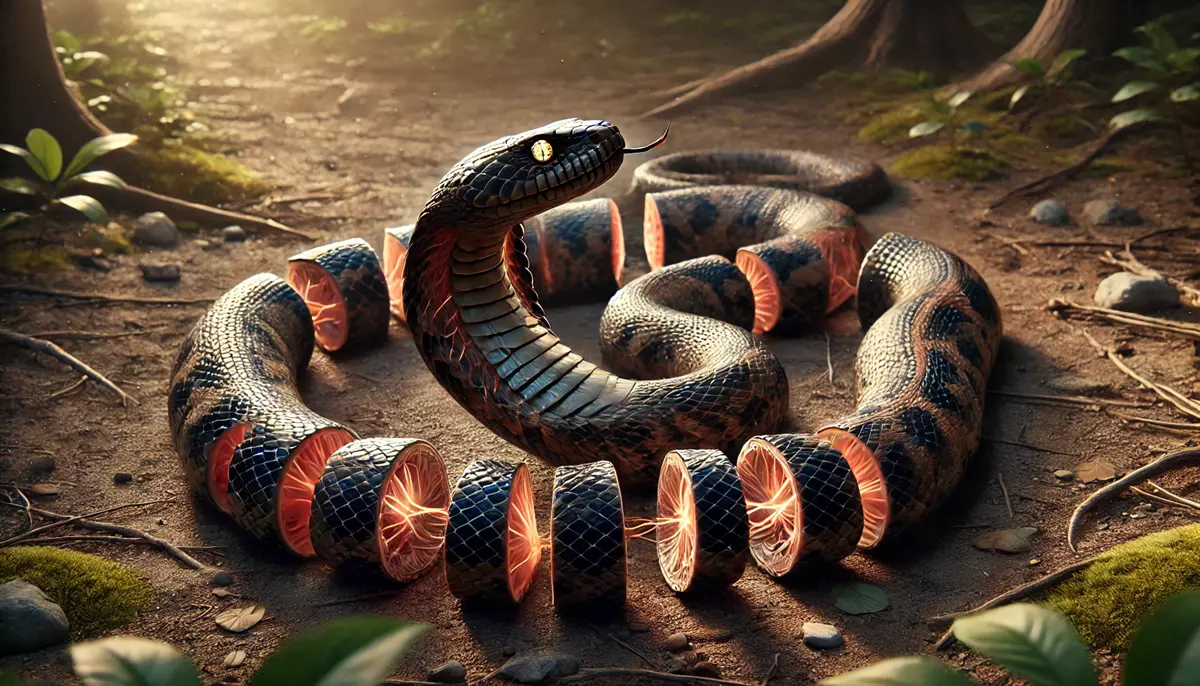
A mysterious serpent from North American folklore, the Joint Snake is known for its ability to reassemble itself after...

  • Skills
Enhanced AgilityHealing & Life
  • Weaknesses
BeheadingElement Sensitivities

Serpentine Shifter – Overview

The Serpentine Shifter is a mythological beast type characterized by its ability to transform from a serpent form to another. It encompasses beings that share transformative traits. These creatures play significant roles across various mythological traditions, often embodying themes of change, adaptability, and duality. They are typically seen as bridges between realms or different states of being and feature prominently in the mythologies of many cultures, highlighting their universal significance.

Defining Characteristics

Physical Form and Morphology

Serpentine Shifters commonly exhibit distinct serpentine features, including elongated bodies, scales, and sinuous movement. Their morphology often allows for seamless transformation, symbolically representing fluidity and change. While the serpent form is a constant, the alternate forms they assume may vary, reflecting cultural interpretations.

Ontological Nature

In mythological terms, Serpentine Shifters are often viewed as liminal entities. They exist between defined categories, embodying both natural and supernatural elements. Their hybrid nature allows them to traverse boundaries, acting as intermediaries between the physical world and the metaphysical or spiritual realms, reinforcing themes of transformation and transcendence.

Mythological Role and Function

Place in Mythological Systems

Within mythological systems, Serpentine Shifters are crucial for their ability to connect disparate elements of the cosmos. They often interact with gods, humans, and natural forces, serving as mediators or agents of change. Their presence challenges established norms and encourages adaptation within the mythological framework.

Perception and Meaning

Serpentine Shifters are perceived in various ways, often embodying both fear and reverence. They can be seen as threats or protectors, depending on their role within a given myth. Symbolically, they are associated with themes of renewal, cycles, and the interplay of stability and change, enriching cultural narratives with their dual nature.

Distinction from Related Beast Types

Conceptual Boundaries

Serpentine Shifters differ from similar beast types by their intrinsic transformative capability. Unlike elemental beings or spirits, their identity hinges on this ability to shift between forms, distinguishing them from other mythological entities that remain static or embody a single form. This transformative essence is central to their classification.

Common Sources of Confusion

Scholars often find it challenging to distinguish Serpentine Shifters from other shape-shifting entities due to overlapping characteristics. However, their core identity as serpents that transform sets them apart. Misinterpretations frequently arise when such distinctions are not clearly articulated, but careful comparative mythology helps clarify these boundaries.

Canonical Beasts Associated with This Beast Type

Naga

Originating in Indian mythology, Nagas are serpentine deities capable of human form. Their role as protectors of treasures and water sources exemplifies the transformative essence of Serpentine Shifters, embodying both danger and benevolence.

Quetzalcoatl

In Aztec mythology, Quetzalcoatl is a feathered serpent god who represents wind and wisdom. His ability to transform into a human form highlights the Serpentine Shifter’s adaptability, bridging celestial and terrestrial realms.

Fafnir

In Norse mythology, Fafnir transforms into a dragon through greed and curse. His serpentine transformation underscores the destructive and protective duality of Serpentine Shifters, demonstrating cultural fears and moral lessons.

Historical Distribution and Cultural Context

Serpentine Shifters appear in diverse cultures, from ancient Mesopotamia to East Asia and Mesoamerica. Their presence spans various historical periods, often in regions where serpents hold symbolic or religious significance. These creatures reflect the universal human fascination with transformation and boundary-crossing, illustrating shared cultural archetypes.

Scholarly Interpretation and Uncertainty

Variation in Definitions

Different cultures and scholars interpret Serpentine Shifters through varied lenses. Some view them as purely symbolic, while others emphasize their religious or moral functions. Academic frameworks often diverge in defining their attributes, reflecting the complexity of mythological classification.

Limits of Available Evidence

Gaps in historical records make fully understanding Serpentine Shifters challenging. While some interpretations are well-supported, others rely on reconstruction from fragmentary evidence. Scholars acknowledge these limitations, emphasizing the need for cautious analysis and open acknowledgment of uncertainties.

Mythological Role Across Cultures

Serpentine Shifters persist across mythologies because they address universal themes of transformation and transcendence. They reflect cultural concerns about change, stability, and the unknown. By analyzing them, scholars gain insight into the shared symbolic language of humanity, revealing deep connections within disparate mythological systems.