
Introduction
A golem is an artificially formed being in Jewish folklore and mystical tradition, animated through sacred language or other extraordinary means. Its defining feature is its creation from otherwise lifeless material, not a single prescribed appearance, purpose, or method of bringing it to life.
The best-known example is the Golem of Prague, associated with Rabbi Judah Loew ben Bezalel, also called the Maharal. Commonly imagined as a humanlike clay figure, this legendary creation serves as a helper or protector, although its behavior and duties differ between tellings.
The Prague story is one branch of a much older tradition. Biblical language concerning unformed substance, rabbinic accounts of artificial creation, and medieval mystical interpretations all precede the familiar guardian narrative.
These earlier materials should not be treated as episodes in the Prague golem’s biography.
The figure brings together questions about creation, human authority, and responsibility for powerful servants. Its importance lies partly in that flexibility: a golem can demonstrate sacred knowledge, perform useful work, defend a threatened community, or expose the limits of its creator’s control.
History/Origin
The word’s biblical foundation appears in Psalm 139:16, where it refers to an unformed state of the human body. This passage supplies an important lexical starting point, but it does not describe a magician constructing an animated servant or a guardian made from clay.
Rabbinic literature provides a different foundation through accounts of extraordinary creation. In the Babylonian Talmud, Sanhedrin 65b, Rava creates a man and sends him to Rabbi Zeira.
The artificial man’s inability to answer helps reveal his origin, after which Zeira orders him to return to dust.
Medieval Jewish mystical writings developed the possibilities of artificial creation through sacred letters and their combinations. The Sefer Yetsira, or Book of Formation, became central to this interpretive background.
Crucially, the work itself does not mention a golem; creation traditions developed through commentary and related practices.
Later legends attached artificial servants to particular rabbis, including Elijah of Chelm. These traditions show that Rabbi Loew was not the only figure credited with creating a golem.
Different regional accounts supplied different mechanisms of animation, practical functions, and consequences for the creator.
The Prague legend’s documentary history is considerably later than Rabbi Loew’s lifetime. YIVO identifies Franz Klutschak’s 1841 publication as the first written transmission of a Prague golem tale told by Prague Jews.
Its earliest literary records therefore belong to nineteenth-century folklore and writing, not contemporary sixteenth-century testimony.
Further reshaping followed in Yudl Rosenberg’s 1909 Nifle’ot Maharal, which presented its narrative as deriving from an earlier manuscript. That claimed provenance is not secure historical evidence.
Nineteenth-century collections and later retellings helped establish the Prague story’s prominence, a development also traced in Prague’s Jewish museum interpretation.
Name Meaning
Golem is a Hebrew word associated with unformed or incompletely developed substance. Its biblical occurrence is in Psalm 139:16, where the speaker describes being seen by God before bodily formation was complete.
The sense concerns a state of becoming rather than a manufactured monster.
The Jewish Encyclopedia glosses the term with meanings including “embryo” and “imperfect substance.” These alternatives reflect the difficulty of expressing its older sense in one English word.
Here, “imperfect” means unfinished or not fully formed, rather than necessarily defective, wicked, or dangerous.
Rabbinic usage also connects the word with incompleteness in a figurative sense. In Pirkei Avot, a golem is contrasted with a wise person, indicating someone lacking cultivated understanding.
This usage concerns human character and learning, not an encounter with a supernatural clay being.
The folkloric meaning extends that underlying idea into an artificially created humanlike figure. Nevertheless, the name alone specifies neither clay nor enormous size.
“Golem of Prague” and “Golem of Chelm” identify particular legendary traditions; they are not separate translations of the Hebrew word.
Appearance
The broad tradition presents the golem as a humanlike artificial being, rather than an animal-shaped beast. Its body is formed instead of naturally born.
Beyond that basic distinction, the surviving accounts do not establish a single appearance shared by every textual, mystical, and folkloric version.
Clay or mud is especially prominent in the familiar Prague interpretation. This material makes the act of shaping a body readily imaginable and connects the figure with earth.
It should nevertheless be treated as characteristic of that popular representation, not a universal requirement for all golem traditions.
Some tellings emphasize a large or powerful servant, but there is no fixed traditional height, facial structure, clothing, or body proportion. A towering guardian is therefore one interpretation rather than the necessary form.
The figure’s human resemblance matters more consistently than any standardized monstrous anatomy.

Humanlike appearance does not always bring complete human capacities. The artificial man in the Talmudic account cannot answer Rabbi Zeira, making speechlessness a significant feature of that episode.
It distinguishes the created body from an ordinary person without requiring an unusual face or visibly damaged form.
Written signs and sacred names also vary. Some traditions involve the Hebrew word emet, meaning “truth,” while Prague accounts may emphasize an animating Shem, or divine name.
Neither mechanism establishes a universal forehead inscription. The material body and the means of animation must be distinguished from later artistic conventions.
Background Story
The golem’s background begins with religious reflection on formation and life. Biblical imagery of an unfinished body and rabbinic narratives of artificial creation provided precedents for imagining a humanlike being produced outside ordinary birth.
Later mystical traditions explored these possibilities through the creative significance of sacred language.
Letters and divine names give the figure a specifically Jewish conceptual setting. Animation is not merely a mechanical improvement to a sculpture: it depends on exceptional knowledge and power.
This background makes the creator’s qualifications and responsibilities important, even when later stories concentrate on practical service.
The Prague protector narrative adds a communal purpose. In its best-known form, Rabbi Loew creates the golem during a period of danger to defend the Jewish community.
The story expresses a desire for protection under conditions of vulnerability, rather than preserving a verified account of supernatural intervention.
Other accounts place ordinary labor nearer the center. In the Prague version recorded by the Jewish Encyclopedia in 1906, the golem serves during the working week, and its animating Shem is removed before Sabbath.
Its usefulness is thus bounded by the community’s sacred calendar.
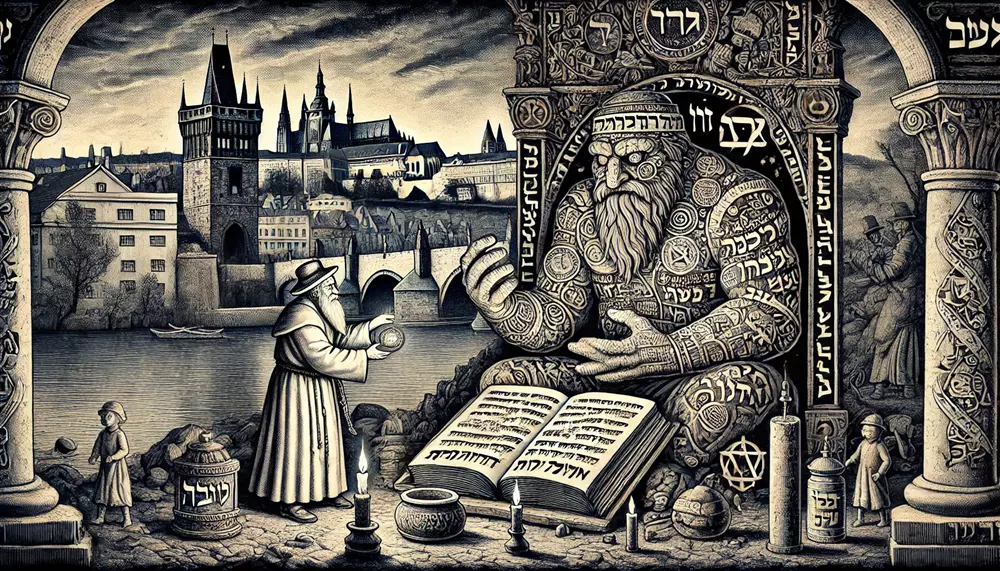
Failure to maintain that boundary produces different consequences across retellings. In the recorded Sabbath episode, the rabbi removes the Shem and the figure falls apart; a later familiar version emphasizes a destructive rampage.
These are related narrative developments, not one uniform account inherited unchanged from antiquity.
The resulting figure combines the learned creator, the useful servant, and the potentially dangerous protector. Later literary transmission strengthened these themes while changing their balance.
Understanding that layered background preserves the difference between older mystical speculation and the community-defense story that eventually made Prague’s golem internationally familiar.
Famous Folklore Stories
The Prague tradition survives in several versions rather than one fixed narrative. The headings below describe documented episodes, not authenticated traditional story titles.
Both concern Rabbi Judah Loew, but their shared setting should not obscure differences in the golem’s behavior and the consequences of its creator’s mistake.
The Weekday Servant and the Sabbath
A Prague version recorded in the Jewish Encyclopedia in 1906 presents the golem as Rabbi Loew’s weekday servant. Its animation depends on the Shem, a sacred name.
Before the Sabbath, the rabbi ordinarily removes this animating element, suspending the creature’s activity.
On one occasion, the rabbi forgets this precaution. He catches up with the golem before the Sabbath begins and removes the Shem.
The artificial being then falls apart. The episode makes continued animation dependent on something its creator can withdraw.
This version emphasizes service, timing, and the interruption of ordinary work. It should not automatically be expanded into the more dramatic rampage narrative.
The recorded account documents a circulating legend, not a contemporary report establishing that Rabbi Loew actually created an animated servant.
The Forgotten Deactivation and the Rampage
Another familiar later Prague version turns the forgotten Sabbath deactivation into a communal emergency. The golem runs amok and threatens the ghetto before Rabbi Loew stops it.
Here, a being normally under its creator’s control becomes a danger to the surrounding community.
The difference matters: forgetting a precaution no longer merely leaves a servant active at the wrong time. It exposes the limits of control over an artificial being.
Read symbolically, the episode asks whether extraordinary creative power can remain safe without continuous attention and restraint.
The Sabbath connection links these versions, but does not establish that every golem story follows the same rule. Nor does the rampage belong automatically to the earliest tradition.
It is a documented later narrative form within the much broader history of Jewish artificial-creation stories.
Cultural Impact
The golem brings together two influential themes: the possibility of artificial life and the responsibility accompanying its creation. Within Jewish tradition, these questions emerge through sacred language, mystical learning, and storytelling, rather than through a single universally accepted account of a clay monster.
In the protective Prague legend, the creature also expresses the need for communal security. Rabbi Loew’s creation offers extraordinary help in a time of danger.
This protective role gives the story a different emphasis from versions centered on domestic service or the failure of control.

Nineteenth-century folklore collection and literary publication helped make Prague the creature’s best-known setting. That prominence connected the golem with the city’s Jewish heritage, while sometimes overshadowing older traditions.
Its association with Rabbi Loew became central to popular recognition, without making it the figure’s original identity.
Gustav Meyrink’s Der Golem, published in book form in 1915, further broadened its literary reach. The novel is a modern imaginative adaptation, not a straightforward preservation of the rabbi’s creation story.
Its influence illustrates how literary reinvention can shape public understanding alongside folklore.
Modern scholarship distinguishes these layers rather than treating them as interchangeable. Mystical writings, collected legends, and modern novels each give the figure different meanings.
The golem’s cultural importance lies partly in this adaptability, although its later popularity should not erase its specifically Jewish textual and religious background.
Similar Beasts
Talos
Talos is an animated bronze guardian from Greek mythology. His artificial body and protective function make him a close comparison for the guardian form of the Prague golem.
Both figures join constructed embodiment with protection. Their resemblance is thematic, however: Talos belongs to Greek myth, not Jewish traditions of sacred language and mystical creation.
Homunculus
The homunculus is an artificial humanoid associated with European alchemical traditions. Its defining comparison here is the imagined creation of a humanlike being outside ordinary natural birth.
Like the golem, it raises questions about manufactured life. Alchemical creation and Jewish mystical animation remain distinct frameworks, despite the shared motif of an artificial human.
Basajaun

Basajaun is a wild, hairy giant in Basque folklore, associated with guarding forests and livestock. His protective role offers a comparison based on function rather than artificial origin.
Both can appear as powerful humanoid protectors. Unlike the golem, Basajaun belongs to the wilderness and is not defined as a being deliberately formed by a creator.
Religion/Ritual
Some golem traditions connect animation with sacred names, letters, and mystical practices. These elements belong to Jewish understandings of language and creation.
They should not be reduced to an interchangeable magic spell, nor treated as a single procedure shared by every account.
Medieval discussions of artificial creation developed in mystical writings and commentaries associated with Sefer Yetsira, the Book of Creation. An important distinction is that Sefer Yetsira itself does not mention a golem.
Later interpretation, rather than an explicit golem narrative in that text, supplies the connection.
The Sabbath episode gives one Prague version a specifically religious rhythm: the servant’s weekday activity must cease before sacred time begins. Removing the Shem is a narrative action within that version.
It does not establish a universal religious requirement governing all imagined artificial beings.
These accounts document religious ideas and attributed mystical practices, not a standard communal observance. The supplied evidence does not establish a customary ceremony for making golems.
Likewise, the legend’s religious vocabulary is not evidence that its animation procedure produced a living being.
Scientific or Rational Explanations
The golem is best examined as a folkloric, mystical, and literary figure rather than an empirically documented organism. The historical question is how accounts of artificial creation developed and circulated.
It is not necessary to posit an unidentified animal behind a tradition explicitly concerned with constructed life.
For the Prague branch, the chronology of written evidence is especially important. YIVO identifies Franz Klutschak’s 1841 publication as the first written transmission of a Prague golem tale told by Prague Jews.
This places the surviving literary record long after Rabbi Loew’s lifetime.
Golem compared to Talos, Galatea, and Homunculus
| Aspect | Golem | Talos | Galatea | Homunculus |
|---|---|---|---|---|
| Origin | Golem originates from Jewish folklore, particularly Kabbalah and medieval Europe. | Talos is rooted in Greek mythology, serving as a guardian of Crete. | Galatea comes from Greek mythology, representing a statue brought to life. | Homunculus has origins in alchemical traditions, symbolizing artificial life. |
| Purpose | The Golem's main role is to protect Jewish communities from harm. | Talos was created to defend Crete from invaders and threats. | Galatea was crafted to embody ideal beauty and love, serving Pygmalion. | Homunculus represents the quest for creating life through alchemical means. |
| Creation Method | Crafted from clay or mud, animated through sacred rituals and inscriptions. | Talos was made of bronze, animated by divine powers and magic. | Galatea was sculpted from ivory and brought to life by a wish. | Homunculus is created through alchemical processes, often in a flask. |
| Cultural Significance | The Golem symbolizes Jewish resilience and the ethics of creation. | Talos represents the protective spirit of ancient Greek culture. | Galatea embodies the idealization of beauty and the power of love. | Homunculus reflects the human desire to control and create life. |
| Historical Context | The Golem's stories are set in medieval Europe, particularly Prague. | Talos is a figure from ancient Greek mythology and literature. | Galatea's tale is part of Ovid's Metamorphoses, a classical work. | Homunculus appears in alchemical texts from the Renaissance period. |
| Symbolism | The Golem warns against overstepping divine limits and control. | Talos symbolizes the dangers of unchecked power and guardianship. | Galatea illustrates the theme of love transforming the inanimate. | Homunculus raises questions about the nature of life and creation. |
A late written record cannot by itself determine when every oral element originated. Nevertheless, it cannot serve as contemporary verification of the events it narrates.
Historical analysis therefore separates the age of a surviving publication from the period in which its story is set.
The same distinction applies to Yudl Rosenberg’s 1909 Nifle’ot Maharal, which purported to draw on an earlier manuscript. Its claim to older authority should not be mistaken for secure contemporary documentation.
It belongs to the later literary transmission through which the Prague legend acquired wider familiarity.
Interpretation can also address the contrasting roles of servant, protector, and threat. As a symbolic reading, these roles explore dependence on powerful assistance and anxiety about losing control.
Such an interpretation explains the narrative’s tensions without claiming to recover one original purpose behind every version.
Finally, differences between accounts are evidence of transmission, not merely errors to eliminate. A servant deactivated before Sabbath and a rampaging guardian need not be forced into one reconstructed event.
Preserving both allows readers to see how storytellers gave the artificial being different religious, communal, and ethical meanings.
Modern Cultural References
Der Golem, novel (1915)
Gustav Meyrink’s novel reimagines the golem within a literary vision of Prague. It helped popularize the figure, but should not be read as a traditional historical account.
(jewishmuseum.cz)
The Golem, podcast episode (2021)
Studio Ochenta’s Cultureverse episode follows Sarah in a contemporary story involving cyberbullying. Her encounter with the golem brings the traditional figure into a modern setting of social conflict.
(play.prx.org)
The Golem, podcast episode
Rabbi Mark Kaiserman retells the Prague legend for Stories We Tell. The episode presents Rabbi Loew’s creation as a protector of the Jewish community, preserving that familiar narrative role.
(reformjudaism.org)
Golem, video game (2018)
Longbow Games’ adventure-puzzle game follows a girl and her shape-shifting golem companion. It adapts the artificial-being motif into interactive fantasy rather than reproducing the Prague legend.
(store.steampowered.com)
The Golem of Brooklyn, novel (2023)
Adam Mansbach’s comic novel places a clay golem at the center of its narrative.
It relocates the figure into a contemporary American setting, extending its literary afterlife beyond Prague.
(penguinrandomhouselibrary.com)
Conclusion
The golem belongs first to Jewish traditions of artificial creation, sacred language, and the boundaries of human agency. Its familiar clay body and association with Rabbi Loew represent a particularly influential later branch, not a complete definition of the being.
Distinguishing older textual and mystical traditions from the Prague legend preserves both their historical depth and their differences. The figure’s importance lies in this layered inheritance, rather than in a single fixed appearance or universally accepted story.
As servant, guardian, or dangerous creation, the golem gives narrative form to questions about power and responsibility. Its protection can express communal hopes, while stories of lost control expose the limits of its maker’s authority.
Modern novels, audio storytelling, and games continue to reshape those possibilities without becoming evidence for ancient practice or supernatural events. Read with that distinction in mind, the golem remains a compelling cultural figure whose changing representations reveal the concerns of successive storytellers.
Further Reading
6777 Golem
Encyclopedia.com hosts reference summaries that can help situate Golem within broader folklore and mythology discourse.
(jewishencyclopedia.com)
Oxford Bibliographies in Jewish Studies, “Golem”, Academic.oup
A later familiar version has the golem run amok after its Sabbath deactivation is forgotten, threatening the ghetto before Rabbi Loew stops it.
The episode is a later.
(academic.oup.com)
Der Golem, jewishmuseum.cz
novel 1915 A widely influential literary reimagining of the golem associated with Prague; it is a modern novel, not a direct record of traditional events.
(jewishmuseum.cz)
The Golem, reformjudaism.org
podcast episode A podcast retelling of the Golem of Prague legend, with Rabbi Loew creating the Golem to protect the Jewish community.
(reformjudaism.org)
Golem, store.steampowered.com
game 2018 A released adventure-puzzle game centered on a girl and her shape-shifting golem companion.
(store.steampowered.com)
Golem Legend, YIVO Encyclopedia of Jews in Eastern Europe
Specialist overview of the Prague legend’s transmission, including its nineteenth-century written records and the 1909 publication by Yudl Rosenberg.
(encyclopedia.yivo.org)