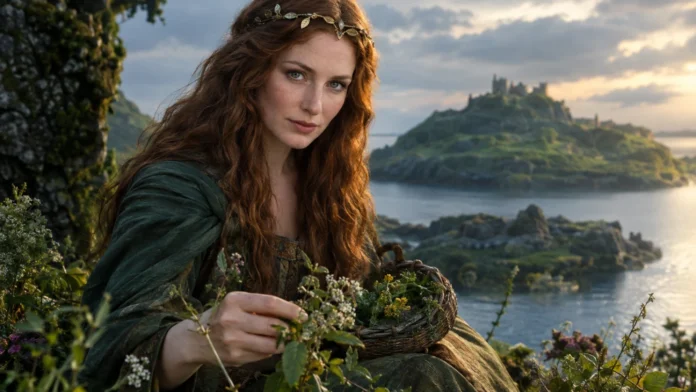
Celtic – an Overview
Celtic designates historically related peoples and languages, alongside cultural traditions associated with them; it does not identify one uniform mythology shared unchanged across every region or period.
The term’s mythological use refers chiefly to evidence from ancient communities and medieval literature produced in Celtic-speaking societies, interpreted with attention to chronology and regional differences.
Celtic is central when classification rests on those languages, historical communities, or documented traditions; without that context, distinct local beliefs risk becoming an artificial universal pantheon.
Historical and Environmental Context
Time Frame and Location
Celtic languages and communities are historically associated with parts of western and central Europe, with later documented traditions especially prominent in Ireland, Wales, and Britain.
Archaeologists commonly associate Hallstatt and La Tène material cultures with ancient Celtic-speaking populations, while recognizing that material styles alone cannot establish an individual’s language or identity.
Hallstatt cultural horizons developed during the early first millennium BCE; La Tène material culture flourished later, particularly from the fifth century BCE onward.
Roman expansion transformed many continental Celtic societies, while insular languages and literary traditions continued developing under different political conditions across subsequent centuries.
Contact and Cultural Exchange
Greek and Roman writers described communities they called Celts or Gauls, providing external testimony shaped by their own political and ethnographic perspectives.
Archaeological evidence demonstrates exchange between Celtic-associated regions and Mediterranean societies through trade, artistic influence, and movement of goods; its local meanings cannot always be reconstructed.
Roman conquest altered religious and social institutions in parts of Gaul and Britain, producing evidence that combines indigenous forms with Roman interpretive frameworks.
Mythological Framework
Spiritual or Supernatural Categories
Continental inscriptions and archaeological contexts attest numerous local divine names, but they do not establish a single standardized Celtic pantheon across Europe.
Roman interpretatio often identified local deities with Roman gods, a practice that records cultural contact but can obscure differences in divine character.
Medieval Irish and Welsh narratives preserve supernatural beings, divine figures, and otherworldly encounters within Christian-era manuscripts; their relationship to pre-Christian belief remains debated.
Ancestor practices and beliefs varied across communities, and available evidence does not support assigning one consistent ancestral category to all Celtic-speaking peoples.
Folklore and Narrative Tradition
Recurring Mythological Themes
Medieval Irish narrative cycles contain stories of sovereignty, kinship, conflict, and exceptional journeys, but these themes belong to particular literary corpora rather than one pan-Celtic canon.
Welsh prose and poetry preserve distinct figures and narrative settings, whose similarities to Irish material require comparison rather than assumption of common original stories.
Otherworld encounters recur in some medieval insular narratives, yet surviving Christian manuscripts frame these episodes through literary conventions that complicate reconstruction of earlier religious meanings.
Animals appear in Celtic-associated archaeology and literature, but their significance varies by object, text, region, and period; a universal symbolic vocabulary is unsupported.
Transmission and Preservation
Much surviving Irish and Welsh narrative evidence was written down in medieval Christian settings, making scribal preservation central to modern knowledge of these traditions.
Oral transmission likely contributed to the formation of medieval narratives, but the precise history of individual stories cannot usually be recovered from surviving manuscripts.
Inscriptions, votive objects, sanctuaries, and iconography provide evidence for ancient religious practice, although images and archaeological deposits rarely explain their meanings directly.
Written records from classical authors offer valuable testimony about continental peoples, but their descriptions reflect outsider observation rather than transparent accounts of local belief.
Internal Variation and Temporal Change
Continental evidence and medieval insular literature differ in language, historical setting, and documentation, so they cannot be treated as interchangeable records of one religion.
Religious evidence changed under Roman rule and Christianization; later literary sources therefore preserve traditions through frameworks unlike those of pre-Roman inscriptions and material remains.
Regional divine names and local archaeological practices indicate diversity, although uneven evidence prevents a complete map of differences among Celtic-associated communities.
Related Cultural Origins and Myth Sources
Greek and Roman accounts provide external comparisons for ancient Celtic communities, but their categories reflect Mediterranean political thought and should not define Celtic belief.
Roman provincial religion shares some divine names with local traditions through interpretatio, yet this correspondence does not prove that the paired deities had identical functions.
Irish and Welsh medieval literatures are related through broad linguistic and historical connections, but each preserves its own texts, characters, and narrative organization.
Evidence Limits and Scholarly Uncertainty
No surviving comprehensive indigenous account explains ancient Celtic cosmology; claims about a unified worldview therefore exceed what the available evidence can securely establish.
Archaeological objects rarely identify their makers’ language, while inscriptions are geographically uneven and often too brief to clarify the full context of worship.
Medieval manuscripts are separated from many pre-Christian settings by substantial time and Christian literary transmission, creating uncertainty about continuity and transformation.
Scholars disagree about how far medieval narratives preserve pre-Christian material, since textual evidence supports interpretation but rarely proves direct survival unchanged.
No verified sources describe this for this context: a single Celtic pantheon, universally shared cosmology, or consistent system of supernatural categories across all relevant societies.