Overview of the Edo Japan Period
Edo Japan conventionally denotes the Tokugawa shogunate, from 1603 until 1868, when political authority centered in Edo, now Tokyo. Its cultural setting was predominantly Japanese, not a collection of separate civilizations.
Relative internal peace, expanding towns, commercial publishing, and travel networks shaped the period’s cultural life. These conditions helped circulate supernatural narratives beyond local communities without erasing regional traditions.
Religious institutions, household observances, and popular entertainment all provided settings for supernatural ideas. Folklore mattered because it connected explanations of misfortune, landscape, social conduct, and community memory.
Cultural and Religious Worldviews
Dominant Belief Systems
Buddhism and kami-related traditions coexisted within varied local arrangements. Their institutions and practices were not uniform, so Edo beliefs cannot be reduced to a single national doctrine.
Confucian ethical thought influenced education and social order, while Buddhist and kami traditions addressed different religious needs. These frameworks overlapped in practice rather than forming mutually exclusive systems.
Role of Myth in Daily Life
Local stories could explain unusual features of landscapes, perceived dangers, or the origins of community customs. Their importance depended on particular places and audiences, not universal acceptance.
Supernatural narratives also conveyed expectations about conduct, including obligations toward family, neighbors, and sacred places. Their moral meanings varied, and a tale’s circulation does not prove literal belief.
Mythological Beasts and Supernatural Entities
Common Types of Mythical Creatures
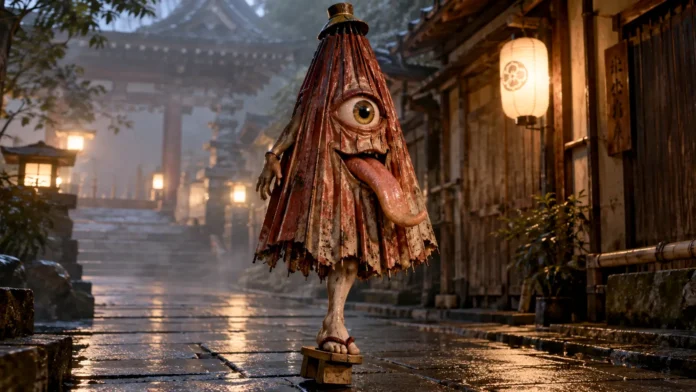
Yōkai is a broad category for uncanny beings and phenomena in Japanese usage, encompassing diverse forms rather than one fixed species. Edo publications helped make some descriptions widely recognizable.
Animal-associated beings included foxes and tanuki in varied regional narratives. Their stories drew on observed animals while attributing transformative or uncanny qualities that differed across specific accounts.
Other narratives featured ghosts, dangerous presences, and beings associated with particular locations. Classification depended on context; surviving evidence does not support one stable taxonomy shared throughout Edo society.
Symbolism and Meaning
Accounts of foxes could connect them with Inari worship, but fox figures also appeared in independent supernatural narratives. The association therefore varied by setting and source.
Yōkai imagery could register anxieties about uncertainty, danger, or social boundaries. Such interpretations are analytical readings of historical materials, not proof that every audience understood beings symbolically.
Folklore Traditions and Storytelling
Oral and Written Transmission
Stories circulated through speech, performance, and local transmission, though oral versions are difficult to reconstruct directly. Later written records preserve selected accounts rather than complete community traditions.
Woodblock printing expanded access to illustrated books and popular collections during the Edo period. Printed depictions helped standardize certain visual forms, although they did not eliminate variation in oral narratives.
Earlier religious writings and local records also preserved supernatural references. Their purpose and audience differed from popular entertainment, making direct comparisons between these sources methodologically cautious.
Regional Variations
Regional narratives reflected local landscapes, livelihoods, and community histories. A being’s attributes could differ between provinces, so national summaries risk flattening distinctions documented in particular accounts.
Okinawan traditions developed within distinct historical and linguistic contexts, unlike narratives centered on the Tokugawa heartland. They should not be treated as interchangeable examples of Edo folklore.
Relationship Between Humans and the Mythical World
Fear, Protection, and Reverence
Some supernatural beings were represented as threats associated with illness, misfortune, or dangerous places. These associations document narrative patterns, not measurable evidence of uniform popular fear.
Other beings could receive protective or revered associations through particular religious settings. Foxes connected with Inari are one example, though their meaning depended on local worship and representation.
Influence on Art and Material Culture
Woodblock prints and illustrated books gave supernatural beings recognizable visual forms for urban readers. Artists’ portrayals documented contemporary imagination, but images alone cannot establish religious practice.
Creature motifs also appeared in decorative objects and architectural settings, though surviving examples require contextual identification. An image’s presence does not necessarily indicate devotion or a protective function.
Transition and Legacy of the Edo Japan Period
After the shogunate’s fall in 1868, political and social institutions changed substantially. Earlier stories nevertheless remained available through printed works, performance traditions, and local transmission.
Meiji-era scholarship and cultural policy reshaped how religious practices and folklore were categorized. These later classifications should not be projected uncritically onto Edo-era understandings.
Modern popular representations draw on Edo-period imagery, but they transform it for new audiences. Such adaptations are evidence of later reception, not direct records of historical belief.
Historical Reliability and Interpretation
Surviving evidence includes printed works, religious materials, local records, and visual objects. Each source reflects specific authorship, purpose, and audience, limiting claims about general belief.
Images and narratives can document available motifs without confirming that people accepted them as literal realities. Historians distinguish representations of belief from independently verifiable events.
Oral transmission leaves substantial gaps because recorded versions are selective and often later than the stories they describe. Where evidence does not establish a practice, conclusions must remain limited.