
back to top

Ocean Depth

Ocean Depth imposes a fixed limitation where certain beings or forces lose power, protection, or form when subjected to the pressures or vastness below the surface.

Relevant Beasts
Greece
Water Spirit
Charybdis
Greece

Charybdis

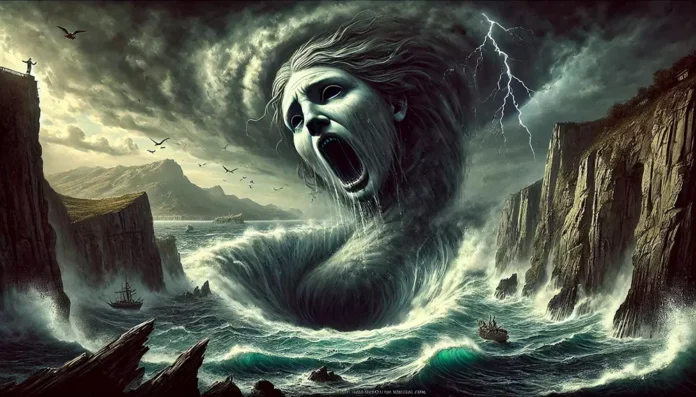
Charybdis, the deadly whirlpool in Greek mythology, symbolizes the unavoidable perils of the sea, alongside its counterpart Scylla.

  • Skills
Whirlpool Creation
  • Weaknesses
Ocean Depth

Ocean Depth – Overview

Ocean Depth, as a mythological weakness, is defined by the inability of certain beings to withstand the profound, boundless, or primordial depths of the ocean. This weakness is not merely physical but invokes existential and cosmological limitations. Mythological systems treat Ocean Depth as a structural constraint because it represents boundaries that no being, regardless of power, can transgress without ceasing to be itself. This limitation is foundational, distinguishing entities through their essential relationship with the ocean’s deepest spaces rather than representing an incidental or narrative flaw.Ocean Depth functions as a symbolic marker for the limits of dominion, existence, or sanctity within mythic thought. Entities defined by this weakness are understood to be wholly potent on land or at the surface, yet absolutely constrained beneath the true depths. This rigid boundary is not circumstantial but intrinsic, signaling the inescapable separation between ordered, inhabited realms and the primordial, chaotic abyss. Such a constraint is non-negotiable within the logic of the mythic cosmos.Mythological systems consistently treat Ocean Depth as significant because it demarcates domains of power and affirms the unbridgeable otherness of the deepest sea. This weakness is not a random flaw but a necessary cosmological balance, imposing checks on what would otherwise be limitless force. The ocean’s depths thus become a sacred limit, enforcing hierarchical order and preventing beings from achieving total supremacy.

Defining Characteristics of the Weakness

Nature of the Limitation

Ocean Depth represents a cosmological boundary rather than a simple physical or moral limitation. Entities constrained by this weakness are fundamentally incapable of surviving, acting, or maintaining essence in the deepest oceanic realms. This boundary is neither circumstantial nor imposed externally, but constitutive of their being. The weakness consistently signifies an existential constraint, not merely an environmental dependency.The limitation is characterized by its permanence and absoluteness. It does not depend on specific actions, rituals, or moral failings. Instead, the oceanic abyss itself is the defining context where the being’s nature fails or unravels. This distinguishes Ocean Depth from vulnerabilities that result from transgression or misdeed.

Conditions of Exposure

Ocean Depth becomes relevant when a being attempts to cross into, reside within, or exert agency in the ocean’s profoundest zones. The symbolic condition is one of trespass against primordial boundaries, not a matter of simple submersion or partial immersion. The critical threshold is the “depth” itself, conceptualized as an uncharted, pre-cosmic space.Environmental conditions that activate this weakness are not meteorological or surface-level. Instead, they pertain to the untouched chasms believed to precede or underlie the ordered world. The being’s limitation is exposed only in such liminal or primordial spaces, emphasizing the cosmological rather than situational nature of the weakness.

Mythological Role and Function

Function Within Mythological Systems

Within mythological systems, Ocean Depth operates to regulate the extent of power possessed by gods, monsters, or heroes. It enforces a limit that cannot be overcome by force or cunning, reinforcing the idea of a world structured by insurmountable divisions. This structural boundary upholds balance by ensuring that no entity can dominate all zones of existence.The weakness preserves cosmic order by maintaining the separation between the known, the ordered, and the primordial unknown. Ocean Depth is not punitive but preventative. It ensures that the world remains differentiated, with the abyssal ocean serving as a reservoir of the unmastered and the unmasterable. The weakness thus plays a systemic role in mythic cosmology.

Symbolic and Cultural Meaning

Symbolically, Ocean Depth is often associated with the inevitability of limitation, the sanctity of boundaries, and the futility of hubris. The weakness embodies the principle that certain frontiers are fundamentally impassable, regardless of a being’s might or virtue. This symbolism underlines the mythic lesson that aspiration beyond prescribed limits results in dissolution or nullification.Unlike weaknesses linked to personal failing or moral error, Ocean Depth represents the impersonal force of cosmic law. In many belief systems, it stands for mortality, non-entity, or the return to chaos. The association with primordial waters further reinforces the motif of boundaries essential to order and meaningful existence.

Distinction from Related Mythological Weaknesses

Conceptual Boundaries

Ocean Depth must be distinguished from general mortality, which concerns the end of life rather than existential dissolution through environmental transgression. Unlike physical injury, Ocean Depth is not an attackable vulnerability but an ontological boundary. Divine punishment typically follows violation of law or taboo, whereas Ocean Depth is not a consequence but a precondition of identity.Taboo violation involves moral or ritual error, activating punishment through agency or fate. Ocean Depth, by contrast, is inherent; it is not triggered by action but by mere presence in the forbidden realm. Situational defeat refers to circumstantial loss, while Ocean Depth is absolute and invariable.

Common Sources of Misclassification

Ocean Depth is frequently mischaracterized as a narrative device or conflated with general limits on movement or breath. Comparative scholars distinguish it through its necessity to the being’s definition: without this weakness, the entity would violate the cosmological order. Misclassification often arises when Ocean Depth’s symbolic function as boundary is overlooked.Scholarly discussions sometimes conflate Ocean Depth with other water-related weaknesses. However, careful analysis emphasizes the abyssal, primordial aspect rather than surface or riverine domains. Only those beings whose identity is shaped by this abyssal boundary are correctly classified under this constraint.

Canonical Beings Defined by Ocean Depth

Tanabata-no-kami (Japanese Folklore)

In Japanese folklore, Tanabata-no-kami, associated with the celestial weaver, is constrained by the ocean’s untraversable depth when separated from her lover. Her narrative is dependent on the impossibility of crossing primordial waters.

Yahweh in Ancient Near Eastern Mythology

Yahweh’s dominion is depicted as absolute over land and sky, yet the chaotic depths (Tehom) remain a boundary even in biblical cosmogony. Without this boundary, Yahweh would lose distinction from primordial chaos.

Poseidon (Greek Mythology)

Poseidon, though ruler of the sea, is often depicted with a domain that ends at the abyssal depths, which remain untamed and distinct. This boundary is essential for maintaining Poseidon’s identity as a god of order within chaos.No verified sources describe additional beings whose ontological definition is fundamentally constrained by Ocean Depth in this manner. Documented examples remain limited to distinct cosmological roles.

Historical Distribution and Cultural Context

Ocean Depth as a mythological weakness is most prominent in cosmologies where the ocean’s depths symbolize primordial chaos or the uncreated. Such beliefs are documented in the ancient Near East, classical Mediterranean, and East Asian traditions. The motif is less common in desert or steppe cultures, where cosmic boundaries are mapped onto different topographies.The persistence of this weakness in maritime societies reflects the ocean’s role as a mythic boundary and source of existential anxiety. Societies with overwhelming riverine or lake symbolism may lack an exact analogue to Ocean Depth, instead associating vulnerability with other environmental frontiers.

Scholarly Interpretation and Uncertainty

Variation in Interpretation

Interpretations of Ocean Depth vary widely. Some traditions read it as a literal limitation, while others emphasize its symbolic or cosmological implications. Early scholarship often misread the weakness as a narrative inconvenience, but later frameworks recognize its broader structural role. Symbolic readings predominate in contemporary comparative mythology.Some scholars argue that Ocean Depth encodes historical anxieties about seafaring or the unknown. Others maintain it represents a universal principle of boundary and order. Cross-cultural interpretations remain cautious about overgeneralizing the motif.

Limits of the Evidence

Evidence for Ocean Depth as a discrete mythological category is fragmentary. Comparative work has identified recurring patterns, but direct statements of this weakness are rare. Most interpretations rely on indirect cosmological analysis rather than explicit mythic testimony.No verified sources describe ritual enactments or explicit doctrinal statements concerning Ocean Depth. There remains debate about the extent to which this weakness is a systematic category or a retroactive scholarly construction.

Mythological Function Across Cultures

Ocean Depth recurs as a meaningful weakness because it expresses shared human concerns with boundary, uncertainty, and the limits of power. Myths use this constraint to articulate the inaccessibility of ultimate chaos and the necessity of cosmic differentiation.Recognition of Ocean Depth as a classificatory constraint enhances comparative interpretation by clarifying why certain beings are powerful yet fundamentally incomplete. It draws attention to the logic of containment and separation as a structuring principle in diverse mythological systems.