
back to top

Religious Sign

Religious Sign represents an inherent constraint in mythological beings, exposing their vulnerability to certain sacred symbols or artifacts.

Relevant Beasts
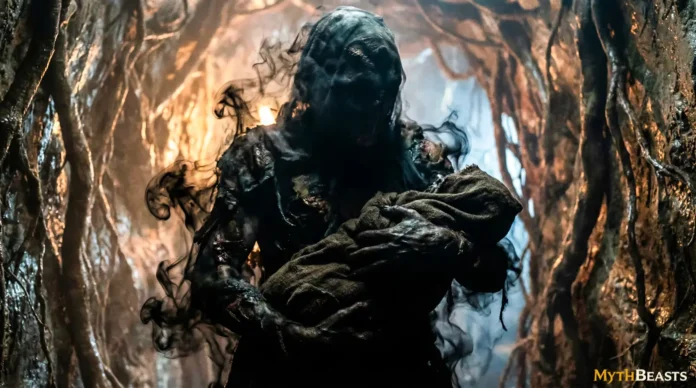
Asia
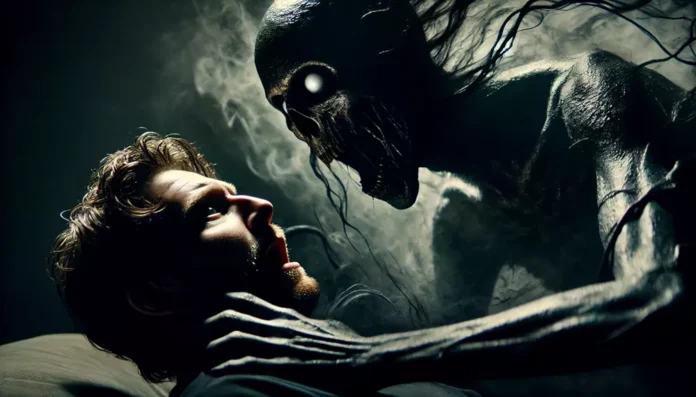
Dark Spirit
Āl (Albastı): The Childbirth Demon
Iran

Āl (Albastı)

The Āl is a folkloric figure associated with childbirth danger in Iranian and Caucasian traditions, reflecting historical fears surrounding...
  • Skills
Death & NecromancyDisease Manipulation
  • Weaknesses
Divine RestrictionsGarlic Sensitive
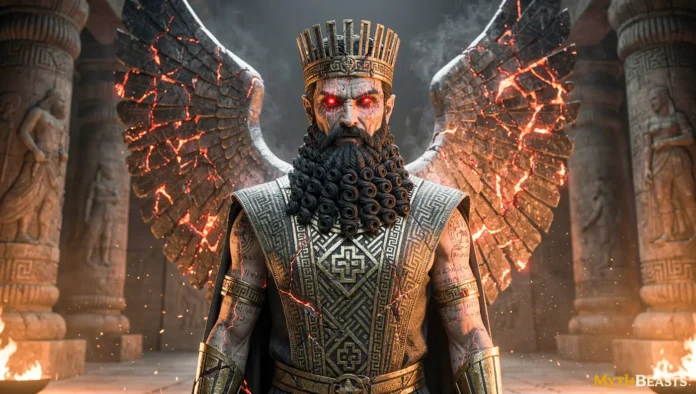
Achaemenid Empire
Demonic Form
Aeshma - the Zoroastrian demon
Achaemenid Empire

Aeshma

Aeshma - a Zoroastrian demon of wrath and violence who disrupts ritual, drives humans to rage and bloodshed, and...
  • Skills
Disease ManipulationFear Inducement
  • Weaknesses
Blessed WeaponDivine Restrictions

Religious Sign – Overview

Religious Sign represents a conceptual weakness in mythological systems, illustrating limitations tied to sacred symbols or beliefs. This weakness is deeply structural, often governing mythological narratives. It is not merely situational, as mythologies inherently embed such vulnerabilities to emphasize profound cosmic truths. The presence of Religious Sign indicates a being’s interaction with divine or moral realms, ensuring that mythological beings remain bound within a culturally meaningful framework.

Defining Characteristics of the Weakness

Nature of the Limitation

Religious Sign often represents a metaphysical restriction, confining a being’s power within boundaries set by sacred laws. These are cosmological constraints, indicating an entity’s dependence on divine or moral order. By establishing these limitations, mythologies convey that ultimate power is unattainable and that beings must adhere to higher cosmic principles. This keeps mythological narratives in harmony with cultural values and beliefs.

Conditions of Exposure

Religious Sign becomes relevant under specific symbolic, moral, or environmental conditions. Symbolically, it might activate when sacred symbols are present or violated. Morally, a being may falter under a breach of sacred trust or law. Environmentally, certain sacred spaces or conditions can expose this weakness, reinforcing the idea that sacred elements govern mythological existence.

Mythological Role and Function

Function Within Mythological Systems

Religious Sign functions to regulate power within mythological systems, ensuring no entity gains absolute control. It enforces cosmic balance, permitting mythological beings to experience downfall or transformation. By imposing limits, Religious Sign preserves cosmic order, preventing any single force from overwhelming the mythological narrative.

Symbolic and Cultural Meaning

Religious Sign symbolizes the inevitability of moral consequence and the supremacy of sacred law. Across cultures, it represents the boundaries set by divine order, highlighting the folly of hubris. This weakness underscores mortality, reminding beings of their inherent limitations and enforcing respect for sacred boundaries, thereby maintaining social and cultural cohesion.

Distinction from Related Mythological Weaknesses

Conceptual Boundaries

Religious Sign differs from general mortality or divine punishment, which are more universal and situational. While physical injury or taboo violation are tangible and immediate, Religious Sign involves deeper metaphysical and existential dimensions. These distinctions are crucial as they categorize Religious Sign as a structural and sacred limitation rather than a personal failure or narrative misfortune.

Common Sources of Misclassification

Religious Sign is often confused with other vulnerabilities due to its abstract nature. Misclassification occurs when it is seen as a simple obstacle rather than a sacred constraint. Comparative mythology highlights these differences by clarifying the symbolic and cosmic roles Religious Sign plays, ensuring accurate interpretation within mythological frameworks.

Canonical Beings Defined by Religious Sign

Jormungandr

In Norse mythology, Jormungandr is a sea serpent encircling the world. It symbolizes cosmic boundaries, as its existence maintains equilibrium. Without Religious Sign, its role as a cosmic destroyer would lose coherence.

Achilles

In Greek mythology, Achilles’ vulnerability is his heel, a representation of Religious Sign. This weakness is tied to sacred notions of fate and divine intervention, illustrating the limitations even great heroes face under divine order.

Kumbhakarna

In Hindu mythology, Kumbhakarna is bound by a curse to sleep for long periods, waking only to eat. This reflects Religious Sign as a constraint imposed by divine law, emphasizing cosmic balance and moral consequence.

Historical Distribution and Cultural Context

Religious Sign appears across diverse cultures and historical periods, from ancient Mesopotamian myths to indigenous African lore. Its manifestation reflects the belief systems and cosmological frameworks of different societies. These recurrent patterns highlight the universal human need to conceptualize limitations within sacred contexts, ensuring that divine order remains central to mythological understanding.

Scholarly Interpretation and Uncertainty

Variation in Interpretation

Scholars interpret Religious Sign differently across cultures and historical periods. While some view it as a literal constraint within mythological narratives, others see it as a symbolic representation of moral or divine principles. Interpretations vary, reflecting cultural perspectives and scholarly methodologies.

Limits of the Evidence

Evidence for Religious Sign’s role in mythologies is sometimes ambiguous. Scholars face challenges in reconstructing mythological contexts, as sources may be fragmentary or symbolic in nature. Established interpretations rely on cross-cultural studies, while uncertain readings remain open to debate and reinterpretation, acknowledging the limitations of historical and comparative evidence.

Mythological Function Across Cultures

Religious Sign recurs across mythological traditions due to its deep-seated connection with shared human concerns and cosmological functions. It symbolizes the need for balance and order, ensuring that mythologies reflect universal themes of mortality, divine law, and sacred boundaries. Recognizing Religious Sign enhances the comparative interpretation of myths, shedding light on the cultural and symbolic dimensions that define human belief systems.