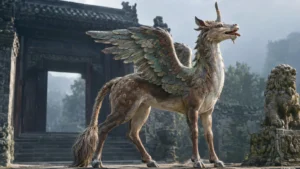
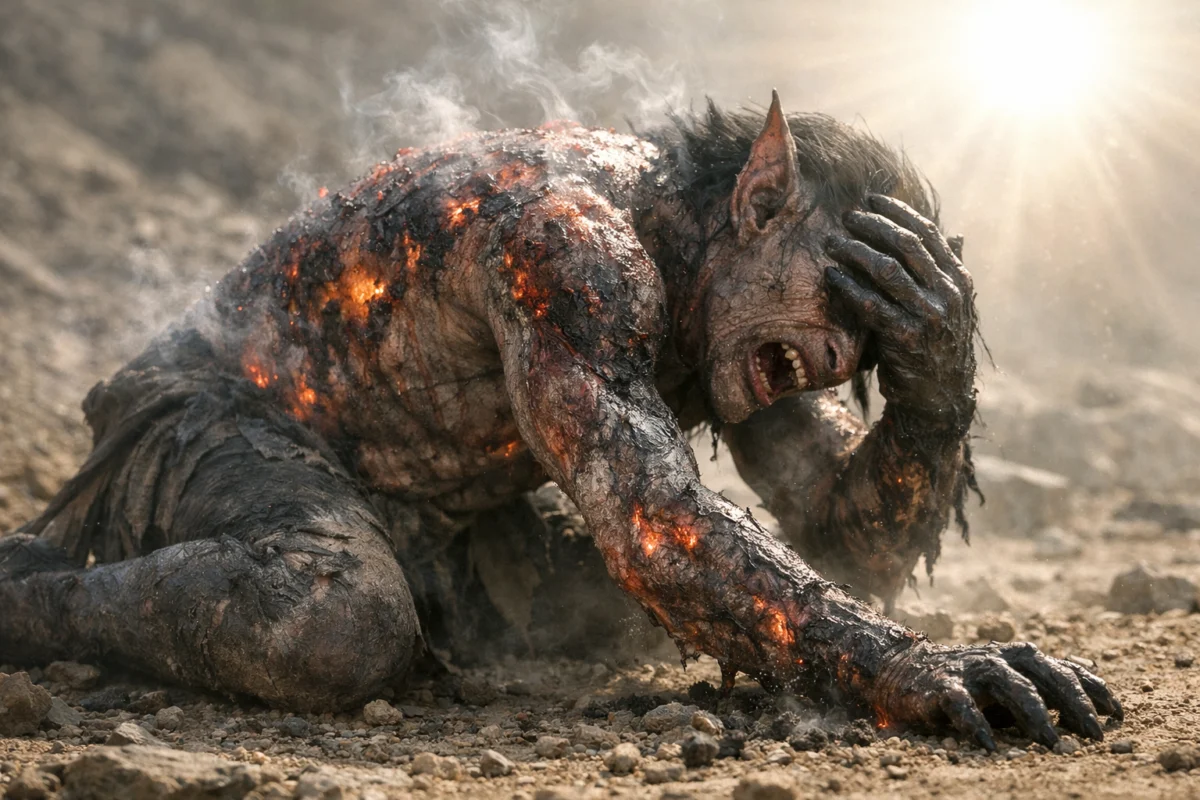
The griffin, a hybrid of lion and eagle, symbolizes strength and guardianship, historically depicted as a protector of treasures in civilizations from the Near East to Greece, reflecting its enduring legacy in art and myth.
Introduction
The griffin stands tall in global mythology as a symbol of strength, guardianship, and duality. With the body of a lion and the head and wings of an eagle, it merges two apex predators into a single majestic being.
For centuries, civilizations across Europe, the Near East, and Asia depicted griffins guarding treasures, sacred sites, or acting as divine sentinels. Their image appears in art, myth, and heraldry, often representing courage and spiritual balance.
This hybrid beast fascinates scholars and storytellers alike. Whether portrayed as a fearsome guardian or divine protector, the griffin commands awe.
Its enduring legacy reflects how deeply myth can embed itself into the heart of culture and belief.
History / Origin
The griffin’s earliest imagery appears in ancient Near Eastern art from around the late 3rd millennium BCE. In Elamite and Mesopotamian cities like Susa, seals and reliefs depict winged creatures with lion-like bodies and avian heads, precursors to the griffin.

These figures likely symbolized divine protection or royalty.
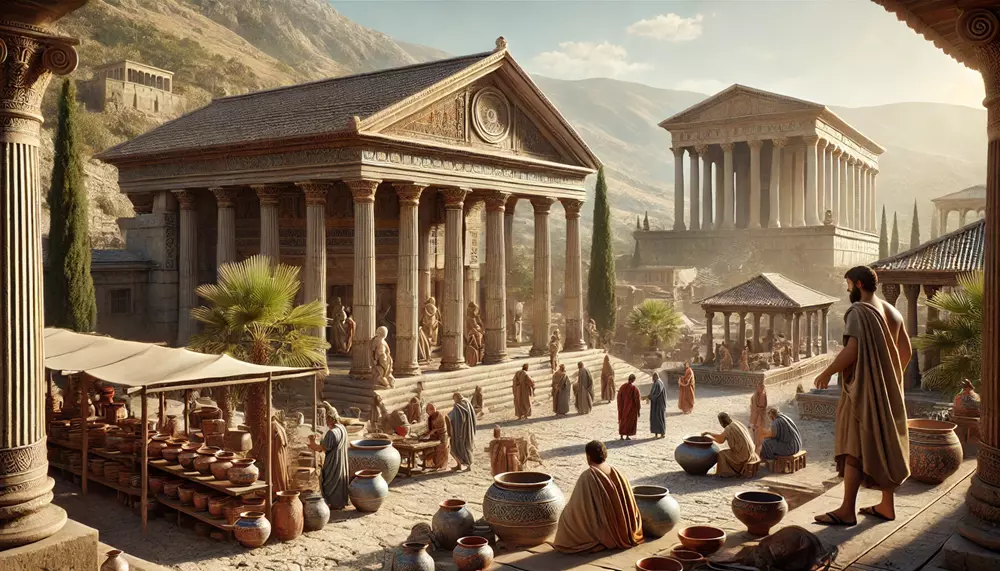
By the 14th century BCE, Minoan and Mycenaean civilizations adopted similar hybrid beasts. A fresco in the throne room at Knossos, Crete, shows a winged lion-like creature flanking the throne, interpreted by scholars as an early griffin figure used to mark divine or royal authority.
In Greek myth, griffins emerged as guardians of distant treasures. According to Herodotus in Histories (Book IV), griffins dwelled beyond Scythia, guarding gold deposits from the one-eyed Arimaspians.

He framed the story as part of the folklore of remote, unknowable lands.
Later classical writers described the griffin as a divine agent or symbolic protector. Aeschylus, quoted in later sources, refers to “the sharp-beaked hounds of Zeus that do not bark,” placing griffins in service of the gods.
Roman iconography linked griffins with Apollo and solar themes. They were featured on mosaics, sarcophagi, and decorative friezes.
Their hybrid form embodied cosmic duality, lion for earth, eagle for sky, making them perfect emblems of divine order and celestial authority.
By the medieval period, Christian writers reimagined the griffin through a religious lens. Bestiaries framed it as a symbol of Christ’s dual nature: eagle for divinity, lion for humanity.
Sculptors and manuscript artists placed griffins at church entrances and margins, emphasizing vigilance and sacred power.
In the Islamic world and Central Asia, griffin-like figures appear in Achaemenid Persian and Sogdian art, known as “shirdal” (lion-eagle). They guard palaces and tombs, echoing the protective symbolism seen in the West.
Trade across the Silk Road helped spread and transform the griffin’s image.
During the Renaissance, griffins gained a new role as heraldic emblems. Nobles, military orders, and cities adopted them on crests, banners, and seals to express strength, honor, and defense.
This stylized griffin, often upright and winged, cemented its place in European symbolism into the modern era.
Name Meaning
The word “griffin” has deep linguistic roots. In English, it comes from Middle French griffon, borrowed from Latin gryphus, which itself comes from the Greek gryps (γρύψ).
The term may relate to grypos, meaning “curved” or “hooked,” likely referencing the creature’s prominent beak.
Some scholars propose older roots. One theory connects gryps to Semitic or Anatolian languages, comparing it to Hebrew keruv (cherub), another guardian figure.
However, this theory remains speculative. There is no direct linguistic path linking cherubs and griffins, despite thematic similarities.
In classical Greek, gryps described the hybrid creature guarding treasure. Over time, its spelling varied by region and language.
Medieval Latin used gryphus, while English adopted griffin, gryphon, and griffon, each valid but reflecting different orthographic traditions.
Heraldry introduced a specialized variant: the “keythong,” a wingless male griffin often depicted with spikes or rays. This version appeared in English heraldic manuals during the 15th century.
Though less common than the winged type, it carried similar symbolic weight.
Regardless of spelling, the term consistently signifies a creature combining eagle and lion, sky and land, into one powerful guardian. The name evolved, but its core meaning as a fusion of authority, vigilance, and myth remained intact across languages and centuries.
Appearance
The griffin is usually depicted as a majestic fusion of two apex animals: eagle and lion. Its body, tail, and hind legs resemble those of a lion, conveying terrestrial strength and dominance.
The front half, however, features the head, wings, and talons of a great eagle.
The eagle head typically includes a sharp, curved beak and forward-facing eyes, giving the griffin a vigilant and intense expression. Some versions also include prominent ears or crests.
In Persian art, griffins often have pointed ears; in Greek versions, feathered crests or curls are common.
Griffin wings are broad and fully feathered like those of a raptor. They often appear extended, either in flight or poised for takeoff.

Their chest may be covered in feathers, and some medieval depictions give them manes or ridged lines along the neck and back.
In many illustrations, eagle talons replace the lion’s front paws, adding to the creature’s hybrid ferocity. The fusion enhances its aura as a supreme predator, capable of soaring like an eagle and pouncing like a lion.
This duality reinforces the griffin’s symbolic connection to both sky and land.
Later medieval and heraldic depictions stylized the griffin further. They appear upright, standing on hind legs with one claw raised.
English heraldry introduced variants like the Opinicus, featuring a camel-like tail and no wings. These forms maintained symbolic weight even as their forms became more decorative.
Despite regional differences, griffins are rarely shown as monstrous. Their symmetrical bodies and elegant poses emphasize beauty as much as danger.
Whether carved into marble or painted in manuscripts, the griffin appears as a creature of fierce nobility and supernatural grace.
Background Story
In Greek mythology, griffins lived on the fringes of the known world, particularly near Scythia. There, they guarded gold from intruders, especially the Arimaspians, a legendary race of one-eyed men.
These stories cast griffins as natural defenders of wealth and sacred boundaries.
Herodotus writes of the Arimaspians raiding gold-rich mountains, only to be repelled by griffins. He presents the tale not as fantasy, but as a belief held by others: “They are said to dwell in the mountains north of Scythia, fighting fiercely with the griffins that guard gold.” (Histories, IV.13)
The griffin’s role wasn’t only defensive, it also evolved into a celestial creature. Roman poets and artists depicted griffins drawing Apollo’s chariot across the sky.
This transition elevated the griffin from a territorial beast to a divine steed aligned with light and order.
In medieval Christian texts, griffins took on symbolic meanings. The eagle represented Christ’s divinity; the lion his human nature.
Together, the griffin became a metaphor for the Incarnation. Bestiaries praised the creature’s loyalty and power as images of divine protection and sacrifice.
One bestiary noted, “The griffin, both lion and eagle, is guardian of purity and emblem of dual kingship,” connecting it to theological doctrine. While sources vary, this synthesis of beast and belief made the griffin a fixture in church art and allegory.
Other traditions expanded on the griffin’s mystery. Some accounts claimed they nested on mountain peaks and laid agate eggs, precious stones believed to hold healing power.
These legends added spiritual symbolism to the creature’s physical grandeur, linking it with purity and cosmic wisdom.
From ancient guard-beast to sacred metaphor, the griffin’s mythology evolved across cultures. It remained a sentinel, sometimes fierce, sometimes divine, protecting not just treasure, but truth, faith, and cosmic balance.
Famous Folklore Stories
The Arimaspians and the Gold‑Guarding Griffins
One of the most enduring tales places griffins as guardians of hidden gold in northern lands beyond Scythia. Herodotus records in Histories that the one‑eyed Arimaspians clashed with griffins over these riches.
He treats the account as a widespread belief among distant peoples rather than Greek invention.
“Beyond these (he said) live the one‑eyed Arimaspoi, beyond whom are the Grypes that guard gold.” (Herodotus, Histories, IV.13.1)
Griffins in this legend nest in mountainous regions, fiercely driving off invaders who seek the treasure they guard. The Arimaspians, mounted on horseback, represent human greed and ambition, always pitted against the beasts of divine protection.
Later writers such as Pliny the Elder and Aelian retold the story, ensuring its endurance.

This myth shaped Greek perceptions of remote lands, blending geography with fantasy. It positioned the griffin as more than just a beast, it was a sentinel at the edge of the world, embodying natural wealth and the dangers of overreaching human desire.
The German Fairy Tale “The Griffin”
The Brothers Grimm collected a tale titled “The Griffin” in their Household Tales. It tells of a princess stricken by illness, who can only be cured with a magical apple.
The king demands the hero Hans retrieve a feather from a griffin as part of the quest.
“The Griffin woke up instantly, and said, ‘Wife, I smell a Christian, and it seems to me that somebody was pulling at my tail.’” (Grimm, Household Tales, 1812 edition)
Hans sneaks into the griffin’s castle, steals a feather, and survives by cleverly questioning the griffin’s wife about unsolved riddles. Through this cunning, Hans learns secrets, how to cure the princess, find a lost key, and escape.
Returning triumphant, he cures the princess and wins her hand.
Unlike Greek legends, this tale presents the griffin less as a divine guardian and more as a dangerous, puzzle‑giving foe. Its emphasis on wit over brute strength reflects the moral tone of many Grimm tales.
The Baby Carried by a Griffin in Sir Eglamour of Artois
The Middle English romance Sir Eglamour of Artois (c. 1350) includes a dramatic griffin episode. Christabel, the heroine, gives birth while cast adrift at sea.
After landing on a rock, she watches as a griffin descends and seizes her newborn child.
“A griffin appeared … and carried Christabel’s baby off to a distant land.” (Sir Eglamour of Artois, c. 1350, stanza 560)
The griffin delivers the infant across the sea, where he is eventually raised far from his parents. Years later, the child, named Degrebelle, is reunited with his family, fulfilling the romance’s theme of trial, loss, and reunion.
The griffin here acts less as a villain than a supernatural agent of destiny.
This story highlights the griffin’s role as a force that disrupts human life. Instead of guarding treasure, the beast manipulates fate, carrying away what humans value most.
It emphasizes the griffin’s unpredictability and power over human destiny, shaping the narrative of separation and return.
Cultural Impact
Griffins left a strong visual legacy in both sacred and secular spaces. In ancient Persia and Greece, they flanked thrones, marked sacred pathways, and guarded elite tombs.
Their image projected divine sanction and supernatural watchfulness in places of political or spiritual power.
During the Middle Ages, Christian Europe reinterpreted the griffin through theological symbolism. It appeared in illuminated bestiaries and monastery carvings as a metaphor for Christ’s dual nature.
The eagle half signified divinity; the lion half, humanity. This made the griffin a powerful emblem of unity and spiritual vigilance.
Renaissance artists embraced the griffin in heraldry, sculpture, and architectural ornamentation. Cities, noble houses, and knightly orders placed griffins on crests to convey legitimacy and noble strength.
From Florence to Prague, griffins became symbols of high status and ancestral virtue.
Today, griffins persist in logos, public statues, and even theme park rides. The creature’s hybrid nature continues to symbolize authority, protection, and mystery, allowing it to cross from mythology into modern design with lasting appeal.
Similar Beasts
Hippogriff

A hippogriff is a hybrid of griffin and mare, half eagle front, half horse rear. Brought into prominence by Ludovico Ariosto in Orlando Furioso, it echoes griffin’s aerial mastery but adds equine grace.
Lamassu
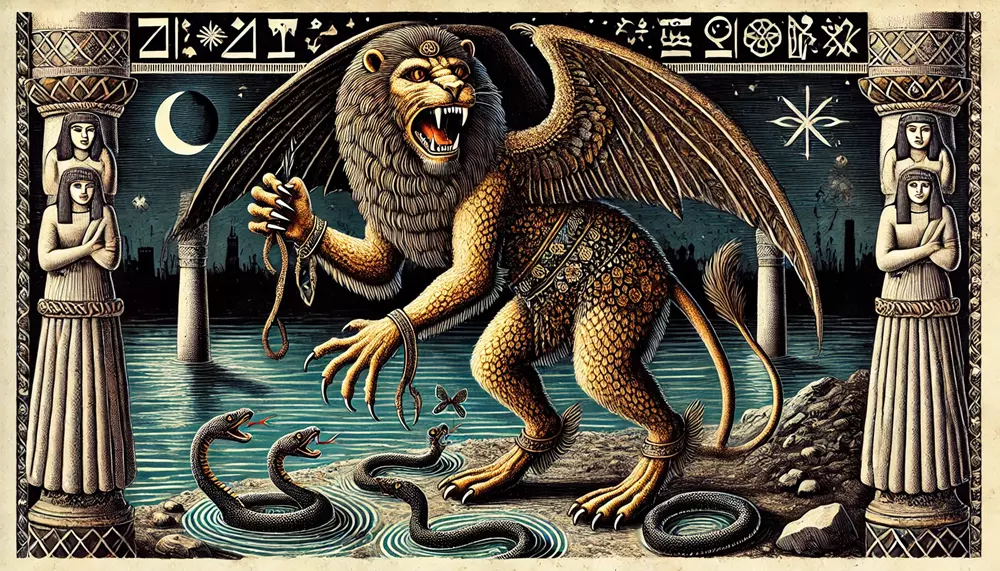
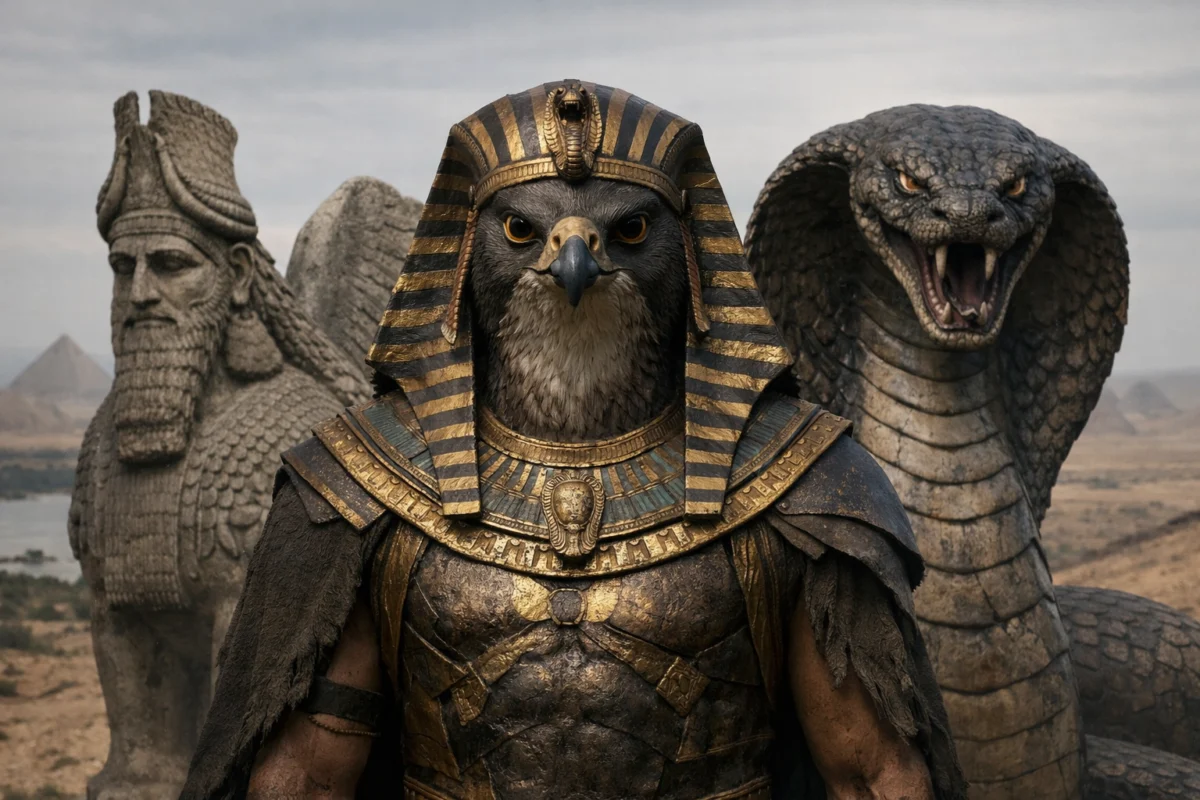
The Assyrian lamassu has the body of a bull or lion, wings of an eagle, and human head. Like the griffin it guards thresholds and royal spaces, but it includes the human intellect in its form.
Simurgh (or Simorgh)
From Persian myth, the simurgh is a giant benevolent bird, sometimes with features of other beasts. Although not a hybrid lion‑bird, it shares guardian roles and immense wisdom attributes with griffins.
Garuda
In Hindu and Buddhist lore, Garuda is an eagle‑like divine being and mount of Vishnu. While fully avian rather than part lion, it parallels the griffin’s domain over sky and its warrior symbolism.
Ziz

In Jewish mythology, the Ziz is a gigantic bird akin to the griffin’s majesty. It primarily dominates sky rather than land, but its role as a cosmic creature mirrors the griffin’s elevated mythic status.
Religion / Ritual
In ancient Persian culture, griffins appeared on Achaemenid seals and architectural reliefs. Their presence near thrones and palatial entrances symbolized divine kingship and cosmic protection.
Scholars link this imagery to broader Zoroastrian ideas of guardianship and moral balance.
In Christian Europe, the griffin’s theological symbolism deepened. It embodied Christ’s two natures, lion for human, eagle for divine.
This made the creature a frequent figure in church art, positioned at portals, atop capitals, and in manuscript illuminations as a guardian of holy space.
Some medieval relics, believed to be griffin claws or eggs, were revered for healing or protection. These were often fossils, exotic tusks, or agate stones, reinterpreted through folklore.
Such objects appeared in pilgrimage shrines or were worn as amulets against illness and evil.
Griffins thus occupied not only symbolic but also ritual roles, believed to protect both the soul and the body in life and death. Their hybrid form suited them for this liminal duty, part sky, part earth, part real, part divine.
Scientific or Rational Explanations
Modern scholars propose that griffin myths may derive from fossil observations. Adrienne Mayor suggested that nomads encountering dinosaur remains (e.g.
Protoceratops skulls) in gold‑rich regions of Central Asia could inspire tales of lion‑eagle hybrids guarding treasures. This hypothesis links paleontology with myth genesis.
Another rational explanation views the griffin as symbolic anthropology. The combination of eagle and lion merges supreme aerial and terrestrial dominance.
In human imagination, mixing apex creatures conveys ultimate power. Myths of boundary guardians often use hybrids to express liminality and control over thresholds.
In art, techniques of syncretism propagated the griffin across regions. As motifs traveled via trade and conquest, local artisans adapted the creature into their iconography.
Thus the griffin’s survival owes as much to cultural diffusion as to deep mythic roots.
Modern Cultural References
The Chronicles of Narnia: The Lion, the Witch and the Wardrobe (film, 2005)
In the battle scenes, flying gryphons join Aslan’s army, embodying classic guardian symbolism on film’s side of good.
Disney Hercules (film & TV series)
In Disney’s Hercules franchise, griffins (e.g. “Mr. Griff”) guard treasures or serve under Hades, melding myth and comedic fantasy.
Gryphon (2007 TV film / Sci‑Fi Channel)
In the Sci‑Fi movie Gryphon, a griffin emerges in a modern setting, threatening characters and combining mythic terror with science fiction.
Griffon (Busch Gardens Williamsburg roller coaster)
A steel dive coaster themed after the mythic griffin, with a 205‑foot drop and floorless trains delivering flightlike thrills.
https://en.wikipedia.org/wiki/Griffon_(roller_coaster)
Griffon (Coasterpedia themed ride)
This amusement ride is explicitly themed after a half‑lion, half‑eagle creature, drawing on the griffin mythos in its design.
https://coasterpedia.net/wiki/Griffon
The Son of Neptune (Rick Riordan’s Percy Jackson series)
In The Son of Neptune, Percy, Hazel, and Frank fight griffins in Alaska, blending myth into modern fantasy adventure.

Merv Griffin Entertainment logo
The production company uses a stylized griffin as part of its brand identity, evoking strength and mythic guardianship.
Philadelphia Museum of Art rooftop griffins
Bronze griffin statues perch on each roof corner of the Philadelphia Museum of Art, symbolically guarding its collections.
Acacia Griffins (Washington, D.C.)
Two limestone griffin sculptures by Edmond Amateis flank the entrance to the Acacia Building, each clutching an agate egg in its paws.
Pisa Griffin (medieval bronze statue)
The Pisa Griffin is a large Islamic-era bronze griffin placed atop Pisa Cathedral, now held in the Museo dell’Opera del Duomo.

Iran Air logo
The airline’s emblem uses a stylized griffin derived from Persepolis motifs.
Conclusion
The griffin’s blend of eagle and lion made it more than myth, it became a symbol, metaphor, and protector across civilizations. From guarding gold in Greek myths to gracing medieval cathedrals, it inhabited the gap between sky and earth, sacred and secular.
Modern culture continues to evoke it in fantasy novels, corporate logos, and public art. The griffin remains an enduring image of authority, vigilance, and imagined hybridity.
Its myth speaks to humanity’s desire to unite strength, wisdom, and transcendence in a single form.
Though its origins remain partly lost, the griffin endures, shrouded in legend yet grounded in symbol, and continues to guard the threshold between our known world and the realm of imagination.
Further Reading
Griffinology: The Griffin’s Place in Myth, History and Art, A. L. McClanan, 2024
A richly illustrated cultural history tracing griffin motifs from ancient art to modern branding.
https://press.uchicago.edu/ucp/books/book/distributed/G/bo214800091.html
Grasping the Griffin: Identifying and Characterizing the Griffin in Egyptian and West Semitic Tradition, Nicolas Wyatt, 2010
Examines Egyptian/falcon‑headed lion hybrids and their link to griffin iconography in Near East tradition.
https://journals.librarypublishing.arizona.edu/jaei/article/id/874/
Griffins, Myths and Religion: A Review of the Archaeological Evidence, Kenneth Lymer, 2018
Analyzes archaeological and art‑historical evidence connecting griffin images to nomadic cultures and religious symbolism.
https://hasp.ub.uni-heidelberg.de/journals/ao/article/view/10616
“Griffin and Arimaspeans”, Adrienne Mayor & Michael Heaney, Folklore 1993
Classic folklore article tracing Greek tradition of griffins guarding gold and their narrative spread in antiquity.
(Available via academic journal databases)
“Did the Horned Dinosaur Protoceratops Inspire the Griffin?”, Mark P. Witton & Richard Hing, Interdisciplinary Science Reviews, 2024
A critical analysis challenging the hypothesis linking Protoceratops fossils to griffin myth origins.
https://journals.sagepub.com/doi/10.1177/03080188241255543
FAQ
Griffen compared to Ziz and Lama
| Aspect | Griffen | Ziz | Lama |
|---|---|---|---|
| Origin | The griffin's imagery dates back to ancient Near Eastern art around 3000 BCE. | Ziz is rooted in Jewish mythology, appearing in texts like the Talmud. | Lama originates from ancient Mesopotamian mythology, often depicted in art. |
| Symbolism | It symbolizes strength, guardianship, and the balance of nature. | Ziz represents divine protection and the majesty of creation. | Lama symbolizes wisdom and is often associated with fertility. |
| Physical Traits | The griffin has the body of a lion and the head and wings of an eagle. | Ziz is often depicted as a giant bird, sometimes resembling a griffin. | Lama is portrayed as a hybrid creature, often with animal-like features. |
| Cultural Significance | Griffins appear in various cultures, symbolizing courage and protection. | Ziz is significant in Jewish culture, representing divine intervention. | Lama has influenced art and literature, symbolizing wisdom across cultures. |
| Role in Mythology | In mythology, griffins guard treasures and sacred sites, acting as protectors. | Ziz plays a role in creation myths, often as a guardian of the skies. | Lama appears in myths as a wise figure, guiding heroes and mortals. |
| Modern Representation | Today, griffins are popular in fantasy literature and games, symbolizing power. | Ziz is often referenced in modern media, symbolizing strength and protection. | Lama influences contemporary art, representing wisdom and nurturing qualities. |