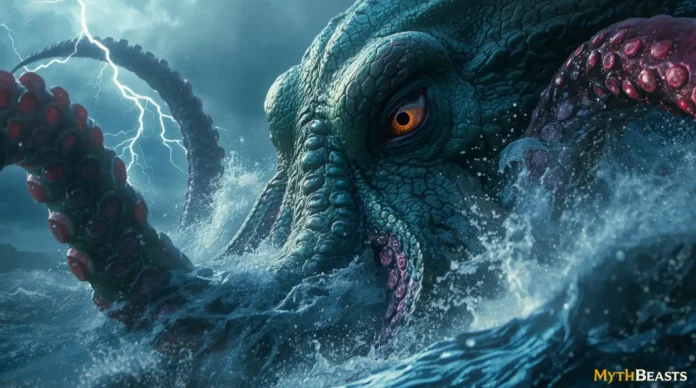
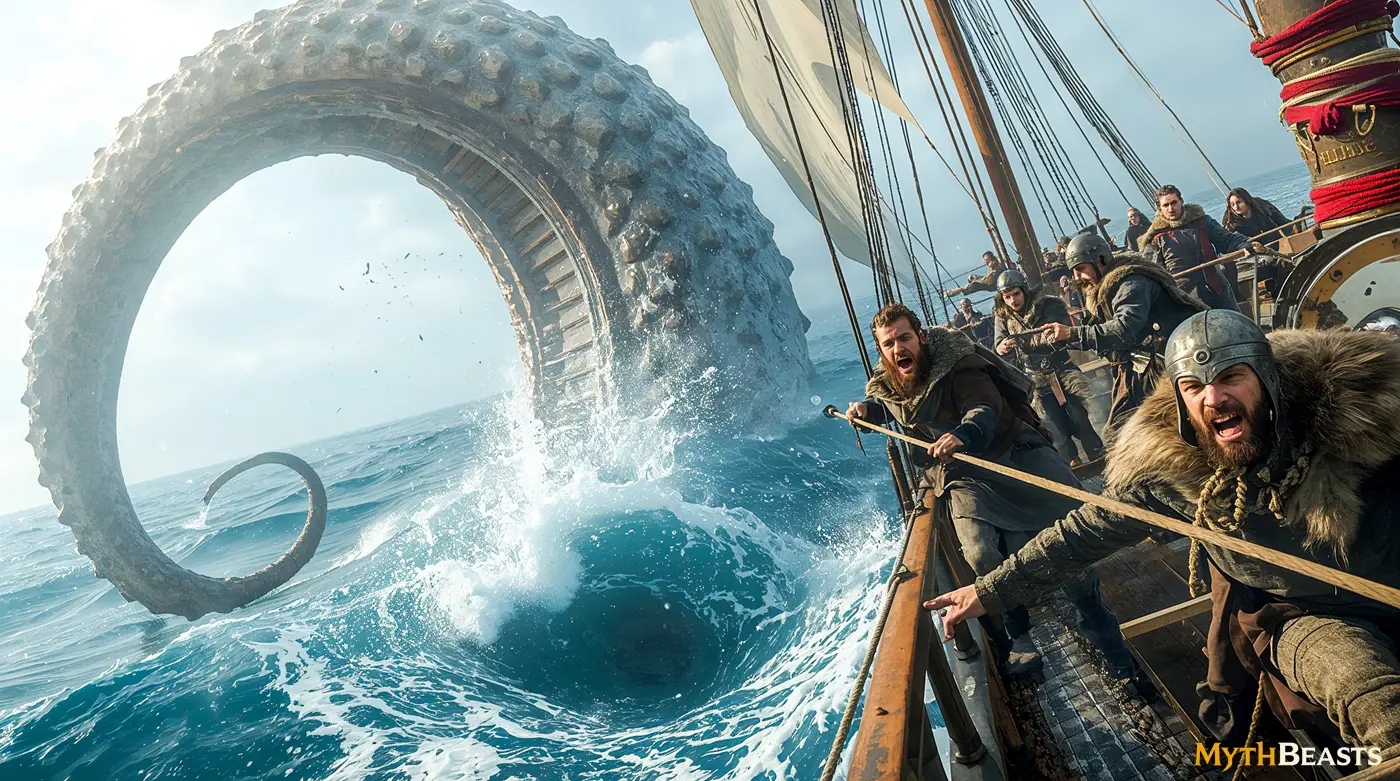
The Kraken is a mythical sea monster said to dwell off the coast of Norway and Greenland. Often depicted as a giant octopus or squid, the Kraken has long been a staple of Norse seafaring tales, feared for its ability to drag entire ships to a watery grave.
History/Origin
The Kraken first appeared in the written record in the 13th century in the Icelandic saga “Örvar-Oddr,” where a creature called the Hafgufa is described. This is considered by many scholars to be the earliest reference to what became the Kraken.
The accounts of the Kraken gained widespread attention in the 18th century, thanks in part to Erik Pontoppidan’s “The Natural History of Norway” (1752). In it, the Danish writer and bishop described the Kraken as a beast so large it could be mistaken for an island.
This fascinated the European continent and cemented the Kraken’s status as a monstrous entity in maritime folklore.
As European exploration expanded, the Kraken myth traveled alongside the navigators of the seas. Across different cultures, the details changed, but the core story of a monstrous undersea dweller remained consistent.
From Norse legends, the Kraken transitioned into global seafaring narratives, adapting to the local lore as it traveled.
Name Meaning
The term “Kraken” is derived from the Norwegian language, where it means “an unhealthy animal” or “something twisted.” Given that the Kraken has often been depicted as a serpent or a squid-like entity, this name is nomenclaturally apt, reflective of both physical form and sinister implications.
Symbolically, the Kraken represents the fear of the unknown in the depths of the seas and mirrors humanity’s endless curiosity about the mysteries that nature conceals. Even today, “Kraken” is used metaphorically in literature and media to signify monstrous challenges.
Appearance
Physical descriptions of the Kraken vary, but it is most consistently described as an enormous cephalopod-like creature, larger than even the most massive of whales. Its tentacles are said to reach lengths from 10 to 20 meters, with stories often exaggerating this for effect.
The coloration of the Kraken ranges according to accounts, from a dark, oily black reminiscent of the ocean depths to the iridescent, reflective tones of deep-sea squids, allowing it to blend seamlessly with its watery environment.
Early illustrations often depicted the Kraken as possessing multiple eyes, a grotesque beak, and sinewy tentacles that could easily ensnare and crush vessels. Artistic renditions have varied over centuries, adapting to new scientific understandings and cultural imaginations.
Background Story
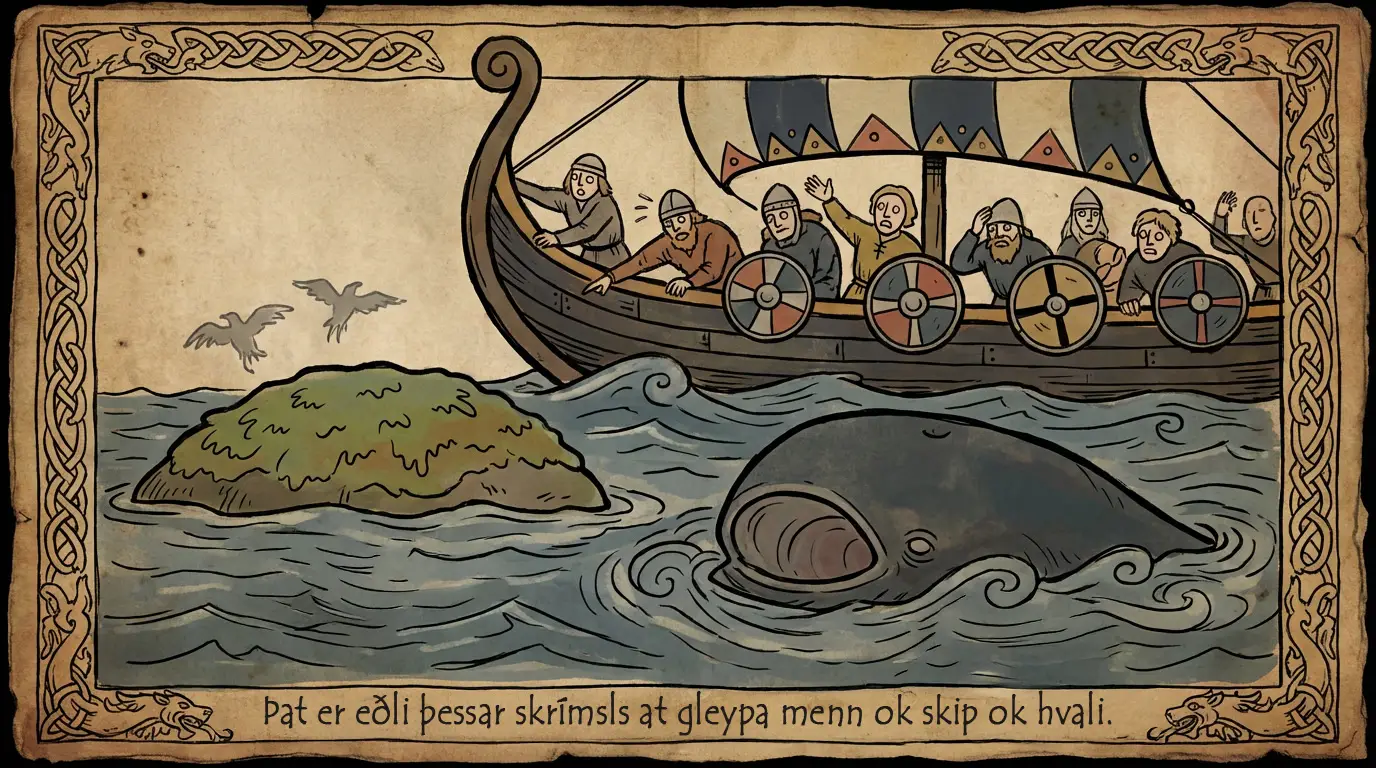
Norse mythology introduced the Kraken as a creature large enough to appear as an island when it rested. Sailors were warned to avoid anchoring near this island, lest it be the Kraken, ready to pull them into the abyss.
According to northern folklore, sailors were advised to observe water movements carefully. If they found fish unusually bountiful or the sea eerily calm, it was a sign that the Kraken was near, attracting marine life before emerging to feed.
In cultural narratives, the Kraken served as a cautionary tale emphasizing respect for the sea’s power and caution against human hubris. As a metaphor for the unpredictable danger inherent in seafaring life, it struck fear and wonder into the hearts of mariners.
Famous Cultural Stories Of The Kraken
The Kraken In The King’s Mirror
In the 13th century Norwegian manual Konungs skuggsjá, The King’s Mirror, a father describes sea marvels to his son, ending with a terrifying “kraken” in the Icelandic seas.
He explains that this creature is so rarely seen that many doubt its existence. When it does appear, sailors mistake its vast back for an island, and its feeding belch lures swarms of fish into its open mouth.
“There is a fish not yet mentioned which it is scarcely advisable to speak about on account of its size.” (The King’s Mirror, ch. 12, tr. L. M. Larson)
The text warns that only a few such beings exist, or else they would strip the seas of life. This is one of the earliest detailed “kraken” style descriptions preserved in a Nordic source.
2. Pontoppidan’s Norwegian Kraken
In the mid 18th century, Bishop Erik Pontoppidan wrote The Natural History of Norway, mixing observation, sailor lore, and theology. He devoted a famous section to the kraken.
Pontoppidan describes the monster as a floating island, sometimes a mile and a half across, surrounded by unusually rich fishing. Norwegian sailors risked casting their nets above it, hoping for huge catches while fearing the beast below.
“[Its arms] if they were to lay hold of the largest man-of-war, they would pull it down to the bottom.” (Erik Pontoppidan, The Natural History of Norway (1755))
He repeats stories that when the kraken finally sinks, it creates a deadly whirlpool like the Maelstrom, capable of dragging ships under the waves. This account shaped most later European images of the kraken.
3. Hafgufa And The Island Trap In Örvar-Oddr’s Saga
Örvar-Oddr’s saga, a 13th–14th century Icelandic adventure tale, tells of two colossal sea monsters, lyngbakr and hafgufa, in the Greenland Sea. Later writers often connect hafgufa to the kraken tradition.
“It is the nature of this creature to swallow men and ships, and even whales and everything else within reach.” (Örvar-Odds saga)
Oddr’s crew first see what they think are two rocks, sail between them, then later spot what seems a safe island. The officer Vignir forbids anyone to land, warning that these “rocks” and “island” are living creatures sent by a hostile sorcerer.
Vignir explains that lyngbakr masquerades as an island, while hafgufa is an even greater monster that swallows ships, men, and whales whole. This island trap motif strongly echoes later kraken stories of ship-eating leviathans.
Cultural Impact
The Kraken has become an icon in maritime mythology, influencing art and literature from the 18th century onwards. Its massive form and destructive power are celebrated in many famous paintings and stories, symbolizing the awe and terror of the sea.
Beyond literature, the Kraken features in global popular culture as a metaphor for daunting challenges or insurmountable odds, enriching the narrative framework of countless fictional works, sometimes reflecting real-world issues of the unknown and the unknowable.
Related Sea Monsters and Identified Equivalents
Across Norse and North-Atlantic folklore, the Kraken is rarely treated as a standalone creature. Instead, it appears inside a broader ecosystem of colossal sea beings that share similar traits: island-sized bodies, whirlpool-creating movements, and the ability to consume entire shoals of fish.
Many scholars argue that several of these monsters may represent earlier or culturally specific versions of what later became widely known as the Kraken. This chapter explores those interconnected beings, showing how traditions overlap and how later writers stitched them together into a single mythic lineage.
Hafgufa
Hafgufa is the oldest and most frequently cited companion to the Kraken myth. It appears in Konungs skuggsjá and Örvar-Oddr’s saga as a gargantuan sea creature capable of swallowing ships, whales, and anything drifting near its mouth.
Medieval descriptions present it as both a physical being and a natural hazard, blending supernatural threat with realistic knowledge of dangerous ocean currents. Later Scandinavian natural-history writers reinterpreted hafgufa as a regional variant of the Kraken, suggesting the two names once referred to the same “species.”
Lyngbakr
Also found in Örvar-Oddr’s saga, Lyngbakr is an island-shaped sea monster that lures sailors to land on its deceptive back. Although distinct from Hafgufa in the saga, later commentators often list Lyngbakr as another “form” of Kraken-like creatures because of the shared motif of mistaken islands.
The shift from saga creature to Kraken-adjacent monster emerged in the 18th and 19th centuries, when antiquarians began categorizing Norse sea monsters under a single umbrella of “Leviathan-type beasts.”
Stórhvalr (The Great Whale)
In several Icelandic traditions, the term stórhvalr (“great whale”) refers not simply to large marine mammals but to mythic super-whales capable of capsizing ships or creating violent water disturbances. While not identical to the Kraken, these beings share enormous size, unpredictable surfacing behavior, and the terror they inspired among medieval sailors.
In some 17th-century writings, stórhvalr descriptions blend directly into Kraken classifications.
The Aspidochelone
From medieval bestiaries, the Aspidochelone is a global analogue often compared to island-like monsters in the North. This creature appears as a gigantic turtle or whale on which sailors unknowingly land, only to be dragged into the sea when it dives.
Even though the Aspidochelone originates from Christian moral texts rather than Norse sagas, its notoriety as the “island that kills” invites natural comparison to Lyngbakr and early Kraken interpretations.
Kraken and Related Creatures
| Creature | Cultural Origin | First Known Source | Key Trait | Connection to Kraken |
|---|---|---|---|---|
| Kraken | Scandinavian (Norway) | Pontoppidan, Natural History of Norway (1755) | Island-sized cephalopod creating whirlpools | Central figure; later writers group all similar monsters under this name |
| Hafgufa | Old Norse/Icelandic | Konungs skuggsjá (13th c.) | Swallows ships, whales, entire shoals | Considered by scholars to be a precursor or early form of the Kraken |
| Lyngbakr | Old Norse/Icelandic | Örvar-Oddr’s saga (13th–14th c.) | Appears as island to lure sailors | Shares deceptive island motif; later grouped with Kraken lore |
| Stórhvalr | Icelandic folklore | Various medieval legends | Enormous whale capable of sinking ships | Sometimes blended into Kraken-like descriptions in later texts |
| Aspidochelone | Medieval European bestiaries | Physiologus (2nd–4th c.) | Island-like whale/turtle trapping sailors | Parallel global analogue; similar “false island” theme |
Similar Beasts
Leviathan

The Leviathan is a monstrous sea creature in Jewish mythology, sharing with the Kraken a terrifying size and dwelling beneath the waves.
Cthulhu
H.P. Lovecraft’s Cthulhu, with its cephalopod appearance and massive scale, resembles the Kraken in its ability to induce fear and chaos.
Scylla

In Greek mythology, Scylla is a sea monster with multiple heads and a penchant for devouring sailors, much like the Kraken’s ship-threatening antics.
Kraken compared to Leviathan, Scylla, and Charybdis
| Aspect | Kraken | Leviathan | Scylla | Charybdis |
|---|---|---|---|---|
| Origin | The Kraken's earliest mention is in a 13th-century Icelandic saga. | The Leviathan originates from biblical texts, symbolizing chaos. | Scylla is rooted in Greek mythology, appearing in Homer's works. | Charybdis is also from Greek mythology, often linked to Odysseus' journey. |
| Appearance | Typically depicted as a giant octopus or squid, it has many tentacles. | Often portrayed as a massive sea serpent, it embodies fearsome power. | Scylla is shown as a multi-headed monster, threatening sailors. | Charybdis is depicted as a whirlpool, capable of swallowing ships. |
| Abilities | The Kraken is said to drag ships under the waves, causing shipwrecks. | Leviathan is known for its immense strength and destructive capabilities. | Scylla is infamous for devouring sailors who venture too close. | Charybdis creates dangerous whirlpools that can sink vessels. |
| Cultural Impact | The Kraken has influenced maritime folklore across various cultures. | Leviathan has inspired numerous religious and literary interpretations. | Scylla has been referenced in various adaptations of ancient myths. | Charybdis has become a symbol of unavoidable danger at sea. |
| Famous Stories | The Kraken features in Erik Pontoppidan's 18th-century writings. | Leviathan appears in the Book of Job and other biblical texts. | Scylla is central to the tale of Odysseus in the Odyssey. | Charybdis is mentioned alongside Scylla in the same epic tales. |
| Symbolism | The Kraken symbolizes the unknown dangers of the ocean depths. | Leviathan represents chaos and the untamable forces of nature. | Scylla embodies the perilous challenges faced by sailors. | Charybdis signifies the unpredictable nature of the sea. |
Charybdis
Another Greek monster, Charybdis, creates whirlpools capable of swallowing ships, akin to the Kraken’s ship-sinking potentiality.
Religion/Ritual
In early Norse rituals, the Kraken may have symbolized the chaotic forces of the ocean that needed to be placated to ensure safe voyages, though concrete rituals are not documented clearly.
Some speculate that offerings, chants, or rites were performed before seafaring expeditions as symbolic gestures to ward off the Krake’s ominous presence, manifesting humanity’s desire to impose order on the chaotic forces of nature.
Scientific or Rational Explanations
The giant squid, scientifically known as Architeuthis, offers a plausible basis for the Kraken myth. These real-life giants reach lengths that can rival accounts of the Kraken, and their elusive nature contributes to awe-filled speculation.
Another possibility is the natural phenomenon of ocean currents and whirlpools, where ships could be caught in turbulent waters or hazardous conditions mistaken for creature attacks. Such occurrences would inspire tales of intrigue and danger among seafarers.
Psychological explanations also play a role, where isolation and long sea voyages could distort perceptions, leading to monstrous exaggerations of real events or creatures, further feeding the Kraken myth across generations.
Modern Cultural References
Pirates of the Caribbean: Dead Man’s Chest, Walt Disney Pictures / Jerry Bruckheimer Films
The film features a colossal Kraken under Davy Jones’ command, attacking ships with massive tentacles.
It became one of the most iconic modern portrayals of the creature in mainstream cinema.
https://www.imdb.com/title/tt0383574/
Clash of the Titans (2010), Warner Bros. Pictures
This remake unleashes a towering, monstrous Kraken as a divine weapon.
The creature’s dramatic emergence cemented its image as a world-ending beast in modern blockbuster mythology.
https://www.imdb.com/title/tt0800320/
Sea of Thieves – Kraken Encounter, Rare / Xbox Game Studios
In this multiplayer adventure game, players face a dynamic Kraken battle where enormous tentacles rise from the ocean, creating unpredictable, cinematic sea fights that helped revive Kraken lore in gaming.
Link: https://www.seaofthieves.com
Kraken Black Spiced Rum – Brand Lore – Kraken Rum (Proximo Spirits)
The brand uses the Kraken myth to shape its identity, featuring stylized tentacles and nautical legends that reintroduce the creature through advertising, merchandise, and storytelling campaigns.
https://www.krakenrum.com/
The Kraken Wakes – Inspired Adaptations. BBC Radio 4 dramatization of John Wyndham’s novel
This adaptation revisits the concept of sea-dwelling threats inspired by Kraken-like creatures.
Its modern dramatization reimagines deep-sea horrors through tense storytelling and atmospheric sound design.
https://www.bbc.co.uk/programmes/b04n0v9v
Conclusion
The Kraken embodies the duality of sea exploration: the allure of discovery and the peril of the unknown. As a myth, it serves as a timeless reminder of nature’s unfathomable power and the human spirit’s enduring curiosity.
Its presence in modern media continues to captivate and terrify, securing its legacy.
Further reading
Kraken: The Curious, Exciting, and Slightly Disturbing Science of Squid
By Wendy Williams – Abrams Books
Popular science book following researchers studying squid and giant squid, animals behind kraken legends, blending exploration, biology, history, and myth to explain how sea monsters gradually transformed into scientific reality.
https://www.abramsbooks.com/product/kraken_9780810984660/
Monsters of the Sea: The History, Natural History, and Mythology of the Oceans’ Most Fantastic Creatures
By Richard Ellis – Alfred A. Knopf
Ellis surveys reports of sea monsters, including kraken-like beasts, comparing sailors tales with marine biology, artwork, and exploration accounts to show how imagination, misidentification, and real creatures shaped folklore worldwide.
https://www.publishersweekly.com/9780679406396
A Deep Dive on the Kraken, a Shipwrecking Sea Monster
By HowStuffWorks
An accessible overview of kraken mythology, tracing Norse origins, changing descriptions, possible links to giant squid, and the legend’s survival in modern culture, games, and films, with diagrams and FAQs.
https://science.howstuffworks.com/science-vs-myth/strange-creatures/kraken.htm
Sea Monsters and Their Inspiration: Serpents, Mermaids and the Kraken
By Natural History Museum, London
Museum article from Londons Natural History Museum examining the kraken alongside other sea monsters, explaining Scandinavian folklore roots, artistic depictions, and how colossal squid inspired terrifying tentacled myths over centuries. https://www.nhm.ac.uk/discover/sea-monsters-inspiration-serpents-mermaids-the-kraken.html
The Kraken: When Myth Encounters Science
Rodrigo B. Salvador – History, Science, Health journal (SciELO)
Peer reviewed paper in a history of science journal tracing how sailors kraken stories intersected with giant squid research, documenting eyewitness accounts, scientific debates, and the transition from legendary monster to species Architeuthis.
https://www.scielo.br/j/hcsm/a/3f7pGvQSBQNC4kkC8MXsbQQ/?lang=en