Overview of the Viking Age Period
The Viking Age is conventionally dated from approximately 793 to 1066 CE, although these boundaries describe northern European historical change rather than a uniform cultural period across Scandinavia.
Its societies included communities in present-day Denmark, Norway, and Sweden, alongside Norse settlements and trading networks extending across the North Atlantic, British Isles, and eastern Europe.
Maritime travel, farming, commerce, raiding, and migration shaped these societies; supernatural beliefs therefore developed within varied local settings rather than one centralized religious system.
Cultural and Religious Worldviews
Dominant Belief Systems
Before Christianization, Scandinavian religious practice encompassed diverse local traditions, including worship associated with Odin, Thor, Freyr, and other divine figures recorded in later sources.
Cosmological accounts describe multiple worlds and relationships among gods, humans, ancestors, and other beings, but surviving evidence cannot establish a single universally shared doctrine.
Role of Myth in Daily Life
Mythic narratives supplied shared language for discussing kinship, fate, honor, and relations with divine powers, although their precise influence on everyday decisions remains difficult to document.
Burial customs and archaeological objects indicate concern with death and remembrance, but they do not independently confirm particular mythological explanations or standardized beliefs about an afterlife.
Mythological Beasts and Supernatural Entities
Common Types of Mythical Creatures
Norse sources describe giants, dwarfs, elves, and other nonhuman beings, whose roles vary among poems and prose accounts rather than forming a stable zoological classification.
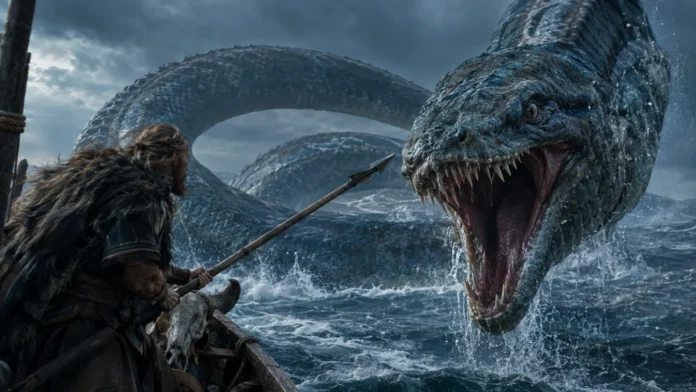
Serpentine and monstrous figures appear in cosmological narratives, including the Midgard Serpent in medieval accounts, where its identity belongs to a specific Norse mythic framework.
Beliefs concerning land spirits and protective beings are less consistently documented for the Viking Age itself; later Icelandic evidence must not be treated as direct contemporary testimony.
Symbolism and Meaning
Giants often occupy positions beyond human society in Norse narratives, yet their characterization varies, preventing a simple equation between them and moral evil.
Serpents can represent cosmic danger in surviving mythology, but interpreting every carved serpent as a specific deity or narrative reference exceeds available archaeological evidence.
Folklore Traditions and Storytelling
Oral and Written Transmission
Poetry and storytelling transmitted knowledge in predominantly oral settings, but the performances themselves are rarely recoverable because contemporary records preserve only limited traces.
Runic inscriptions provide valuable evidence for language, names, and commemorative practices, yet most do not preserve extended mythological narratives or explain supernatural beliefs.
Medieval Icelandic manuscripts record substantial Norse mythological material after the Viking Age, making them indispensable sources whose distance from earlier belief requires careful consideration.
Regional Variations
Scandinavian regions shared linguistic and cultural connections, but local practices and political circumstances varied; evidence does not justify assuming identical supernatural beliefs everywhere.
Norse traditions differed from Christian communities in regions encountered through travel and settlement, where religious contact produced change without erasing distinctions between cultural systems.
Relationship Between Humans and the Mythical World
Fear, Protection, and Reverence
Supernatural beings could mark dangerous or uncertain environments in narrative, but evidence seldom establishes that every creature was consistently feared by historical communities.
Divine figures could receive reverence within pre-Christian religion, whereas mythic beings occupied varied narrative roles; treating all supernatural entities as objects of worship misclassifies them.
Influence on Art and Material Culture
Scandinavian animal ornament on objects and woodwork demonstrates interest in intricate creatures, but visual motifs cannot always be identified as particular mythological beings.
Some picture stones and carved monuments contain imagery interpreted through Norse mythology, although dating, damaged surfaces, and ambiguous scenes limit confident narrative identification.
Transition and Legacy of the Viking Age Period
Christianization across Scandinavia gradually altered religious institutions and public expression, while the pace differed by region and unfolded over generations rather than through one event.
Medieval authors preserved pre-Christian narratives within Christian societies, allowing mythological material to continue as literature even as religious contexts changed substantially.
Historical Reliability and Interpretation
Knowledge combines archaeology, runic evidence, and medieval writing, sources that differ in purpose and date; none offers a complete, direct record of Viking Age belief.
Christian authors sometimes recorded older traditions retrospectively, so scholars distinguish attested narrative details from interpretations about earlier practice that the sources cannot verify.
Modern reconstructions remain provisional where evidence is fragmentary; no verified sources describe a uniform Viking Age system governing every creature, region, or community.