Introduction
The Wolpertinger is a mythical creature rooted in Bavarian folklore, often depicted as a whimsical amalgamation of various animal parts. It is typically associated with the alpine regions of Germany, where stories of this creature have been passed down through generations.
The Wolpertinger is considered a playful representation of the rich tapestry of Bavarian mythological traditions.
This creature is often portrayed as a symbol of the region’s cultural heritage, embodying the natural diversity and imaginative spirit of the Bavarian people. Its existence is primarily sustained through oral folklore and artistic depictions, making it a fascinating subject for mythological studies.
The Wolpertinger is not just a creature of legend but also a reflection of the human tendency to blend reality with fantasy.
In contemporary times, the Wolpertinger has gained a certain level of popularity beyond its traditional Bavarian roots. It is frequently featured in local festivals and souvenir shops, highlighting its enduring appeal as a cultural icon.
The creature’s playful and bizarre nature continues to captivate the imagination of locals and tourists alike, making it an integral part of Bavarian folklore.
Despite its whimsical nature, the Wolpertinger also serves as a reminder of the rich storytelling traditions that have shaped Bavarian culture. It is a testament to the enduring power of folklore to connect people with their history and cultural identity.
Through the Wolpertinger, the Bavarian people have preserved a unique aspect of their cultural heritage, blending myth with reality in a way that continues to enchant audiences today.
History/Origin
The origins of the Wolpertinger are deeply embedded in the folklore of the Bavarian region, with stories dating back several centuries. Reference works describe the creature as a product of the rich oral traditions that thrived in the alpine areas.
These stories were often shared among hunters and villagers, contributing to the creature’s legendary status.
Local folklore records suggest that the Wolpertinger was initially a creation of hunters who sought to amuse themselves and others with tales of fantastical beasts. These stories often served as a form of entertainment during long hunting trips or gatherings, where hunters would exaggerate their encounters with wild creatures.
Later retellings emphasize the role of the Wolpertinger as a symbol of the Bavarian landscape’s biodiversity. The creature’s composite nature reflects the variety of wildlife found in the region, with elements drawn from animals such as deer, rabbits, and birds.
This imaginative blending of features highlights the creativity inherent in Bavarian folklore.
While the exact origins of the Wolpertinger are difficult to trace, its presence in Bavarian culture is undeniable. The creature has become a beloved figure in regional folklore, representing the playful and imaginative spirit of the Bavarian people.
Its enduring popularity is a testament to the power of storytelling in preserving cultural traditions.
Name Meaning
The exact origin of the name Wolpertinger is uncertain, which is the most accurate place to begin. Folklore and reference sources agree that the word belongs to Bavarian dialect tradition, but they do not offer one universally accepted explanation for how it was first formed.
That uncertainty fits the creature itself: a regional invention whose identity was shaped more by local storytelling than by any fixed written canon.
One commonly repeated theory links the name to Wolterdingen, a place associated in later explanations with glassmakers who made animal-shaped schnapps glasses called Wolterdinger. Over time, this may have influenced or merged with the name of the creature.
This theory is not proven, so it should be treated as a reported possibility rather than a settled fact.
What is certain is that the creature is known by several regional spellings and related names, including Wolperdinger and Woiperdinger, which shows that the term developed through dialect use rather than through a single authoritative source. The name became attached to a hybrid alpine beast so strongly that today “Wolpertinger” immediately evokes the Bavarian tradition of horned, winged, impossible animals.
Appearance
The Wolpertinger does not have one fixed appearance, and that is one of the most important facts about it. In Bavarian folklore and later displays, it is described as a hybrid creature assembled from familiar local animals, not as a single standardized beast with one official form.
This variability is part of the legend itself.
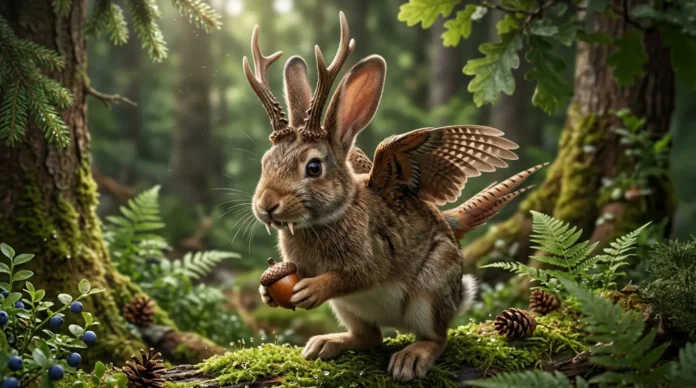
The most widely repeated version gives the Wolpertinger the head of a rabbit or hare, the body of a small mammal such as a squirrel, the antlers of a deer, and the wings, and sometimes legs, of a pheasant or other bird. Other versions add fangs, tails, or different combinations of regional animals.
What stays consistent is the idea that it looks like impossible alpine wildlife made from real Bavarian fauna.
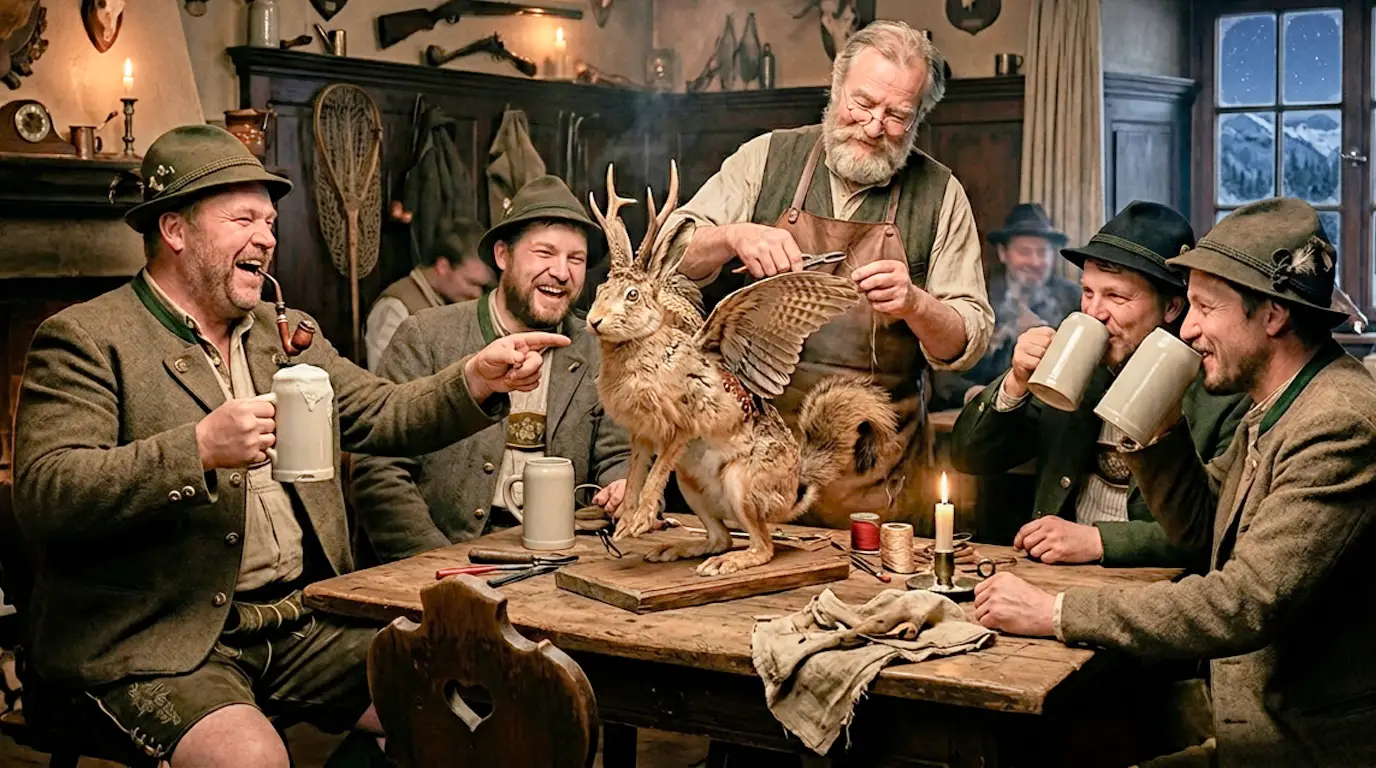
This shifting appearance was reinforced by taxidermy displays, especially from the 19th century onward, when Bavarian taxidermists created mounted “specimens” from real animal parts for humor, curiosity, and tourism. Because each fabricated specimen could differ, no single visual template ever became absolute.
That flexibility helped the creature survive: every village, inn, artist, or museum could present a slightly different Wolpertinger while still staying true to the folklore.
Background Story
The Wolpertinger did not emerge from a grand sacred myth or an ancient heroic cycle. It appears to have grown out of Bavarian rural folklore, hunter humor, and later taxidermy display culture.
In its most grounded form, the Wolpertinger is a folkloric joke creature: a beast imagined from familiar local animals, then made more “real” through stories, tavern talk, and eventually physical composite specimens.
Hunters and villagers in southern Germany passed along stories of strange forest creatures for amusement, especially in alpine regions where wildlife was already part of daily life. The Wolpertinger fits that environment perfectly.
Its body is assembled from animals people actually knew: hare, rabbit, deer, pheasant, squirrel, fox. That made it believable enough to entertain, but absurd enough to stay funny.
In the 19th century, Bavarian taxidermists helped fix the image by creating mounted fake specimens from real animal parts, both as jokes and as curiosities for visitors. Those displays did a lot to turn a loose folk idea into a recognizable regional creature.
Other hybrid folklore beasts likely helped shape how people understood the Wolpertinger, even if they did not directly “create” it. German-speaking regions preserve similar creatures such as the Rasselbock in Thuringia and the Elwetritsch in the Palatinate, while broader comparisons are often made with the Swedish Skvader and the American Jackalope.
These parallels show that the Wolpertinger belongs to a larger family of humorous hybrid animals: creatures born where folklore, visual trickery, regional pride, and human delight in impossible animals all overlap.
Famous Folklore Stories
The Wolpertinger is not best represented by a few fixed, canonical stories with stable titles. Unlike figures from epic mythology, it survives mainly through motifs, local jokes, sightings, and storytelling setups.
The most reliable way to present its folklore is therefore through recurring story patterns rather than invented “classic tales.” (Wikipedia)
One of the best-known motifs is the mock hunt. Outsiders, travelers, or overly confident guests are told that the Wolpertinger can only be caught under very specific conditions, often at night or under the full moon, and only with some ridiculous method.
The point is usually not the creature itself but the prank: the local community gets to test the stranger’s gullibility while reinforcing shared regional humor. This matches the Wolpertinger’s long role as a tavern, hunting-lodge, and tourist joke rather than as a feared supernatural being. (Wikipedia)
Another common motif is the displayed specimen. A stuffed Wolpertinger mounted in an inn, restaurant, or museum is presented as if it were genuine local wildlife.
The visual joke gives the legend a fake physical proof, which is one reason the creature remained so popular. In this sense, the “story” of the Wolpertinger often happens at the moment someone sees the specimen, hears the explanation, and briefly wonders whether such an animal could really exist in the Bavarian forest.
That blend of folklore, performance, and crafted evidence is central to the creature’s identity.
A third recurring theme is the elusive alpine hybrid. Descriptions vary, but the creature is consistently portrayed as shy, bizarre, and just plausible enough to spark curiosity.
No two Wolpertingers are exactly alike, and that variability is part of the folklore itself. The beast changes with the storyteller, the region, and the joke, which is why the Wolpertinger has endured: it is less a single story than a living Bavarian tradition of inventing marvelous local wildlife.
Cultural Impact
Historically, the Wolpertinger has been a symbol of Bavarian folklore, representing the region’s rich storytelling tradition. Its depiction varies, often reflecting the creativity and humor of local populations.
In modern times, scholars view the Wolpertinger as an example of how folklore adapts to cultural and social changes. It illustrates the blending of myth and reality, a hallmark of many traditional tales.
The creature has also influenced local art, with its likeness appearing in woodcarvings and paintings. These artworks often emphasize the fantastical elements, showcasing the creature’s hybrid nature.
Contemporary interpretations of the Wolpertinger often explore its role in tourism. In Bavaria, it is used as a mascot, drawing visitors intrigued by its mythical origins.
Overall, the Wolpertinger serves as a cultural icon, bridging past and present. It embodies the enduring power of folklore in shaping regional identity and community bonds.
Similar Beasts
Jackalope
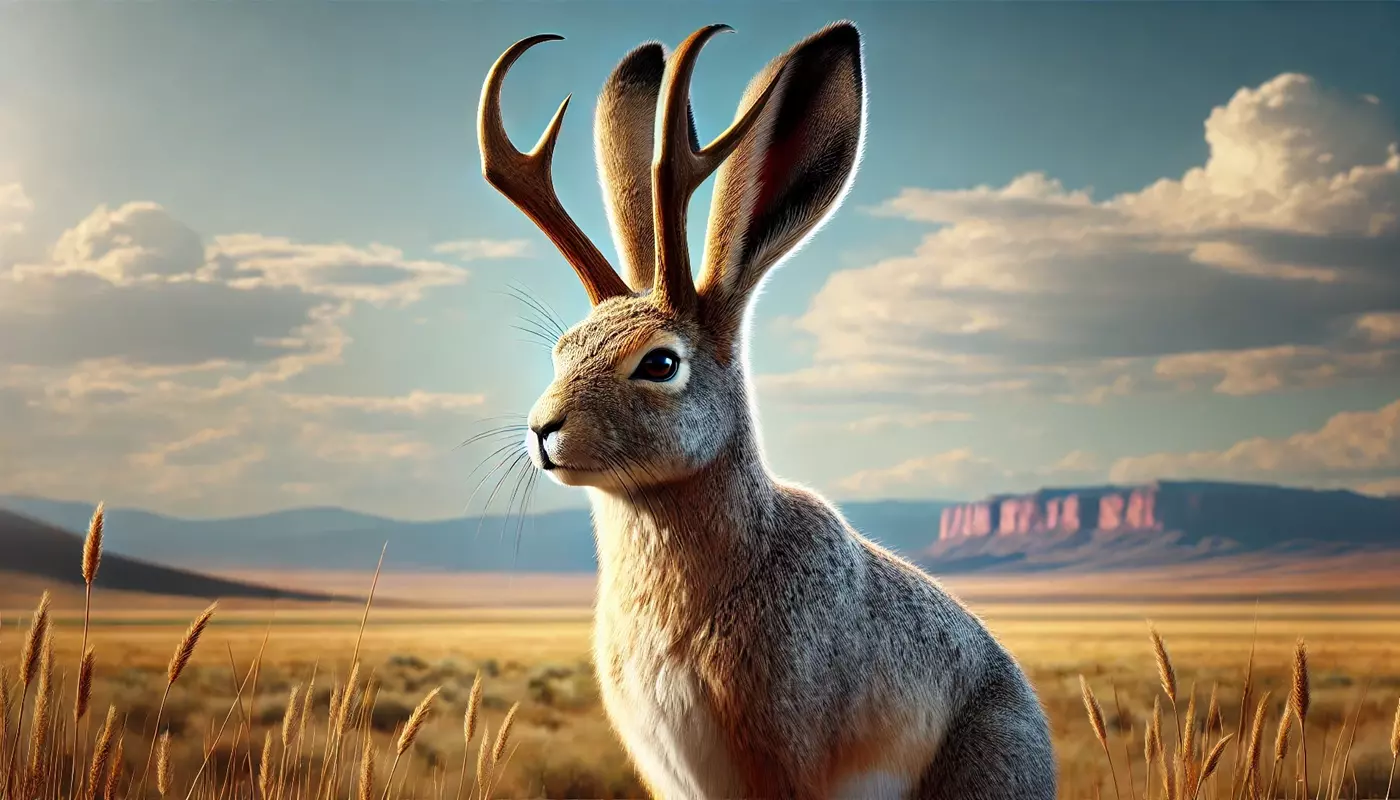
The Jackalope, a creature from North American folklore, resembles the Wolpertinger with its rabbit-like body and antlers. Both creatures are considered mythical hybrids, blending features of different animals.
Skvader
The Skvader, a Swedish mythological creature, combines a hare’s body with a bird’s wings. Like the Wolpertinger, it reflects the playful creativity in folklore, merging animals in imaginative ways.

Chimera
In Greek mythology, the Chimera is a fire-breathing creature with parts from various animals. Although more fearsome than the Wolpertinger, both creatures illustrate the theme of hybridization in myth.
Al-mi’raj
The Al-mi’raj is an Islamic mythical beast, depicted as a large horned rabbit. It shares the Wolpertinger’s rabbit-like appearance, showcasing the cross-cultural fascination with fantastical animal hybrids.
Wolpertinger compared to Jackalope and Skvader
| Aspect | Wolpertinger | Jackalope | Skvader |
|---|---|---|---|
| Origin | The Wolpertinger originates from Bavarian folklore and alpine traditions. | The Jackalope is a mythical creature from North American folklore. | The Skvader is a creature from Swedish folklore, combining a hare and a bird. |
| Physical Features | This creature is depicted with various animal parts, showcasing whimsical features. | The Jackalope is often shown with antlers on a rabbit's body. | The Skvader features the body of a hare and the wings of a bird. |
| Cultural Significance | It symbolizes Bavarian cultural heritage and the region's mythological richness. | The Jackalope represents the playful spirit of American folklore. | The Skvader reflects Swedish cultural narratives and humor. |
| Habitat | Wolpertingers are commonly found in the Bavarian alpine regions. | Jackalopes are associated with the American West and rural areas. | Skvaders are linked to the forests of Sweden. |
| Popularity | The Wolpertinger enjoys popularity in local festivals and souvenirs. | Jackalopes are popular in American culture, especially in tourist shops. | Skvaders have a niche appeal in Swedish folklore and tourism. |
| Folklore Stories | Wolpertinger stories are passed down through oral traditions and art. | Jackalope tales are often humorous and part of American folklore. | Skvader legends are less common but still part of Swedish storytelling. |
Religion/Ritual
No verified sources describe specific rituals or religious practices involving the Wolpertinger. Its role in folklore is primarily secular, focusing on storytelling and local traditions rather than religious significance.
Some interpretations suggest that the Wolpertinger might have been part of informal rituals or local customs, but these are speculative and not based on direct evidence from historical sources.
The creature’s mythical nature may have inspired certain cultural practices, such as storytelling gatherings, where tales of the Wolpertinger were shared. However, these practices are more communal than religious.
In some regions, the Wolpertinger is featured in festivals celebrating local folklore. These events are cultural rather than religious, emphasizing community engagement and the preservation of traditional stories.
Overall, the Wolpertinger’s role in ritual contexts is minimal, with no significant evidence of religious or ceremonial importance in historical records.
Scientific or Rational Explanations
No verified primary sources, historical records, or direct ritual descriptions exist for this aspect of the creature. Modern interpretations are speculative.
Some historians theorize that the Wolpertinger may have originated from taxidermy practices. Specimens were often assembled from various animal parts, creating fantastical creatures that inspired tales.
Anthropologists suggest that the Wolpertinger reflects human fascination with the natural world, blending real and imagined elements. This theory highlights the creature’s role in exploring boundaries between reality and fantasy.
Another explanation posits that the Wolpertinger was a product of local humor and storytelling traditions. It served as a playful way to engage with nature and entertain communities through imaginative narratives.
Some scholars argue that the creature’s origins lie in a blend of cultural exchanges, where different mythologies influenced each other, leading to the creation of hybrid creatures like the Wolpertinger.
Overall, these explanations demonstrate how the Wolpertinger embodies the intersection of myth, culture, and human creativity, illustrating the complexity of folklore development.
Modern Cultural References
Wolpertinger Wochenschau (TV series), Karlheinz Freynik, 1976
A six-part German joke television series that uses the Wolpertinger directly in its title and concept, showing how the creature entered modern screen culture through comedy rather than horror or epic fantasy. (IMDb)
Wolpertinger (short film), Thorsten Frenzel, 2020
A modern short film set in the Allgäu Alps that uses the Wolpertinger name in a contemporary narrative, showing the creature’s continued relevance in regional German screen storytelling and folklore-inspired cinema. (IMDb)
The Witcher 3: Wild Hunt – Blood and Wine (video game), CD Projekt Red, 2016
This expansion includes Wolpertingers in the Land of a Thousand Fables, adapting the Bavarian hybrid beast into a fantasy bestiary and introducing the folklore creature to a global gaming audience. (Witcher Wiki)
The Monster Inn – Alex and the Wolpertinger (book), Koos Verkaik, 2013
A children’s fantasy book that features a Wolpertinger as a central character, showing how the traditional Bavarian hybrid creature has been reimagined for modern family-friendly adventure fiction.
(OUTER BANKS PUBLISHING GROUP)
Conclusion
The Wolpertinger remains a fascinating symbol of Bavarian folklore, embodying the whimsical and imaginative aspects of mythical creatures. Its depiction as a hybrid animal reflects human curiosity and the desire to explain the unknown through storytelling.
While the Wolpertinger may not have the same ancient roots as other mythological beings, its presence in modern culture highlights its enduring appeal.
As a creature largely born from local folklore and taxidermy traditions, the Wolpertinger serves as a playful reminder of the human tendency to blend reality with fantasy. Its continued appearance in various media underscores its role as a cultural icon, bridging the gap between historical folklore and contemporary entertainment.
The Wolpertinger’s legacy is a testament to the power of myth in shaping cultural narratives.
Further Reading
Wolpertinger – Wikipedia
A broad reference overview covering the creature’s Bavarian origins, common physical variants, related folklore beings, taxidermy tradition, and selected modern-pop-culture mentions.
Good as a general starting point. (Wikipedia)
“Beware the Wolpertinger – Bavaria’s legendary hybrid creature”, The Local
A light explainer focused on the Wolpertinger as a Bavarian hybrid beast, with emphasis on local legend, tourism appeal, and the tradition of mounted fake specimens shown in inns and museums. (Wikipedia)
“Countdown to Halloween: The mythical creatures of Europe – Wolpertinger”, Euronews
A short popular-culture feature that introduces the Wolpertinger as one of Europe’s unusual mythic creatures, summarizing its appearance, regional roots, and place within broader folklore curiosity pieces. (Wikipedia)
“Wie entstand die Fabelfigur des Wolpertingers?”, GMX
A German-language article focused on the creature’s origin story, especially the role of Bavarian taxidermists, regional storytelling, and the way the Wolpertinger developed into a recognizable folkloric curiosity. (Wikipedia)
“Wolpertinger”, Hoaxes
A source centered on the Wolpertinger as a fabricated or hoax-like creature, likely discussing assembled specimens and folklore trickery. I could not fully open this page here, so this description is cautious. (Wikipedia)