Lava Elemental – Overview
“Lava elemental” is not a recognized, historically attested beast category in documented mythology. It is best treated as a modern descriptive label requiring qualification rather than an established cross-cultural taxon.
Historically grounded classification depends on specific traditions, names, and recorded functions. Available evidence does not establish a recurring class of supernatural beasts whose defining identity is molten lava itself.
Lava and volcanic fire nevertheless appear in religious interpretation and folklore. Such references concern particular deities, spirits, places, or natural events, and cannot automatically be consolidated into one beast type.
Defining Characteristics
Physical Form and Morphology
No verified sources describe this for this context. Accordingly, a shared body plan, material composition, anatomy, or characteristic appearance cannot be attributed historically to “lava elementals.”
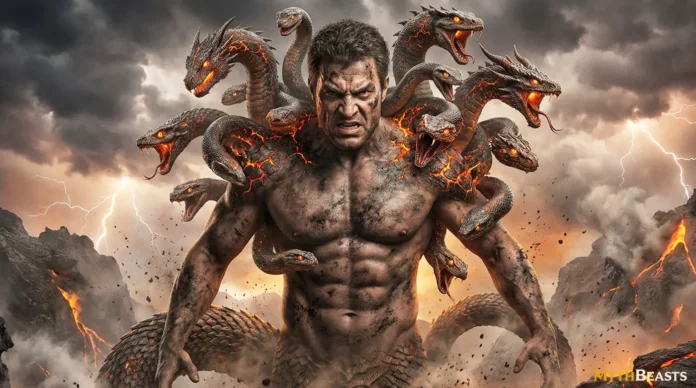
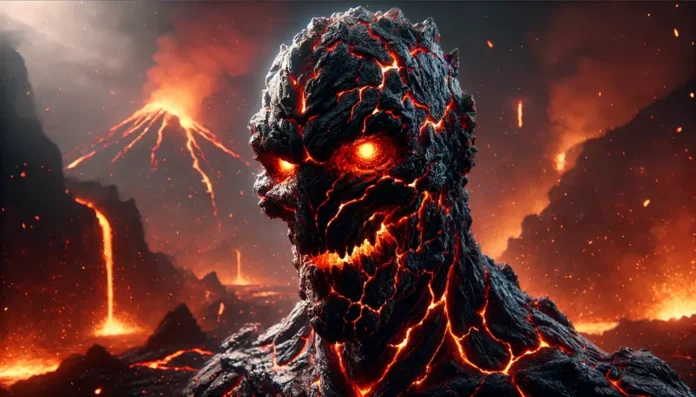
Descriptions of glowing bodies, flowing limbs, or stone-like skin belong to modern visual conventions unless tied to an identifiable historical account. They should not be presented as inherited mythological traits.
Ontological Nature
Because the category lacks historical attestation, its beings cannot be assigned a traditional ontological status. No established evidence identifies lava-born beasts as spirits, hybrids, demons, or cosmic entities.
Different traditions do interpret volcanoes through supernatural frameworks, but their agents remain culturally specific. A mountain deity or volcanic spirit is not thereby an elemental beast.
Mythological Role and Function
Place in Mythological Systems
No documented mythological system establishes lava elementals as a recognized population interacting regularly with gods, humans, or metaphysical boundaries. Claims about such a role exceed available evidence.
Volcanic phenomena may acquire religious significance within particular communities. Their interpretation depends on local cosmology, historical records, and terminology, rather than on a universal lava-creature framework.
Perception and Meaning
There is no supported general cultural perception of lava elementals as threats, guardians, punishers, or omens. Those functions must be established separately for each documented being or tradition.
Volcanic destruction can inform specific religious interpretations, but this observation does not prove a shared symbolic function. Comparative analysis must preserve differences among local explanations and entities.
Distinction from Related Beast Types
Conceptual Boundaries
An elemental is a broad category in later philosophical and esoteric classifications, not evidence for a traditional lava beast. Historical use varies by author and intellectual context.
Volcano-associated deities differ from beasts because they may possess divine status, territorial identity, or humanlike agency. Classification should follow each tradition’s own descriptions, not modern appearance.
Fire spirits, earth spirits, and volcanic beings also require separate treatment. Their domains may overlap natural phenomena, yet overlap alone does not establish identical ontological categories.
Common Sources of Confusion
Modern imagery often combines flame, molten rock, and monster anatomy into a single figure. This synthesis can obscure distinctions between recorded belief and contemporary artistic invention.
Comparative scholars distinguish entities through primary cultural context, terminology, narrative function, and historical documentation. Similar visual features alone provide insufficient grounds for treating beings as one species.
Canonical Beasts Associated with This Beast Type
No historically documented creatures can be confidently identified as canonical examples of a lava elemental beast type. The category lacks established cross-cultural or tradition-specific exemplars meeting this definition.
Named volcanic deities or spirits are not included as substitutes, since divine or place-bound identity does not demonstrate beast classification. No verified sources describe this for this context.
Historical Distribution and Cultural Context
The term “lava elemental” has no demonstrated historical distribution as a shared mythological category. Its current use belongs to modern descriptive language unless a specific source establishes otherwise.
Volcanic landscapes have shaped distinct religious and folkloric interpretations in societies living near active or historically active volcanoes. Those records concern local relationships, not one transregional creature type.
Historical comparison must distinguish geological vocabulary from indigenous categories. Translating local beings as “lava elementals” risks imposing a generalized modern taxonomy absent from their original cultural setting.
Scholarly Interpretation and Uncertainty
Variation in Definitions
Since no stable historical definition is established, variation in the term primarily reflects modern classification choices. Different writers may apply it broadly without documenting a shared tradition.
Academic frameworks may examine fire, earth, spirits, or volcanic religion independently. Such approaches do not validate “lava elemental” as an indigenous category or conventional mythological beast class.
Limits of Available Evidence
The central evidentiary limitation is categorical: available historical documentation does not identify a recognized beast type defined by embodiment of lava. Absence of evidence does not prove universal absence.
Specific local accounts may remain untranslated, unrecorded, or difficult to classify. Without verifiable sources, however, possible exceptions cannot be asserted as established examples or used to populate this entry.
Mythological Role Across Cultures
Recurring volcanic beliefs may reflect communities’ efforts to interpret dangerous geological events, but that broad context does not establish recurrent lava beasts. Each tradition requires independent documentation.
Comparative study becomes more accurate when it contrasts actual local agents rather than presuming shared creatures. This method preserves differences between deities, spirits, ancestors, and natural forces.
As a taxonomy entry, “lava elemental” is therefore most defensible as an unverified modern grouping, not a canonical mythological beast type. Future classification would require specific, attributable evidence.