Mythical Arachnid – Overview
Mythical Arachnid is a comparative category for supernatural or culturally significant beings whose identity depends centrally on spider form, spider behavior, or culturally recognized association with spiders.
It is not a single creature or shared ancient classification. The category groups distinct traditions cautiously, preserving differences in origin, narrative role, and religious or folkloric meaning.
Its most recognizable features include web-making, many-legged anatomy, predatory behavior, and unusual transformations. These traits matter taxonomically only when historical traditions make spider identity central.
Across traditions, spider beings may create, deceive, threaten, teach, or transform. Their functions differ substantially, so no universal moral meaning can be assigned to arachnid imagery.
Defining Characteristics
Physical Form and Morphology
Many examples retain recognizable spider anatomy, including multiple legs, a compact body, and web-related behavior. Such physical markers distinguish them from supernatural beings merely located near spiders.
Some traditions portray spider beings as entirely animal-like; others give them human speech, intelligence, or partial human appearance. These variations reflect particular narratives rather than one shared morphology.
Ontological Nature
Mythological arachnids may be animals enlarged through supernatural significance, transformed humans, or spirits represented through spider form. Their ontological status must be established separately within each cultural source.
Spider identity can connect a being to ordinary nature without making it an ordinary animal. A supernatural spider may cross boundaries between ecological life, human society, and sacred order.
Mythological Role and Function
Place in Mythological Systems
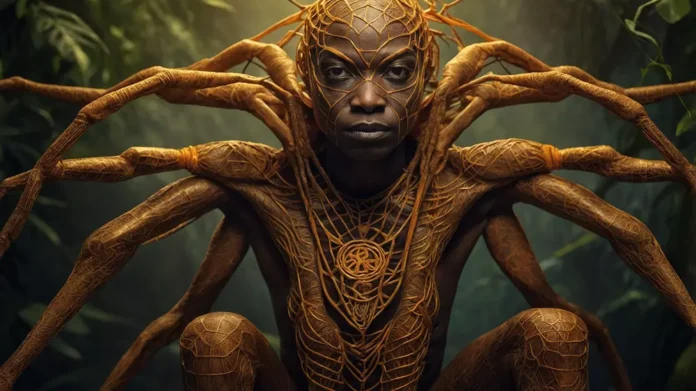
In Akan traditions, Anansi’s spider identity is integral to his character as a clever trickster. Removing that identity would obscure the specific cultural figure and its established associations.
Greek accounts of Arachne instead connect spider form with transformation after a contest involving weaving. This differs from Anansi’s continuing role as a socially active trickster figure.
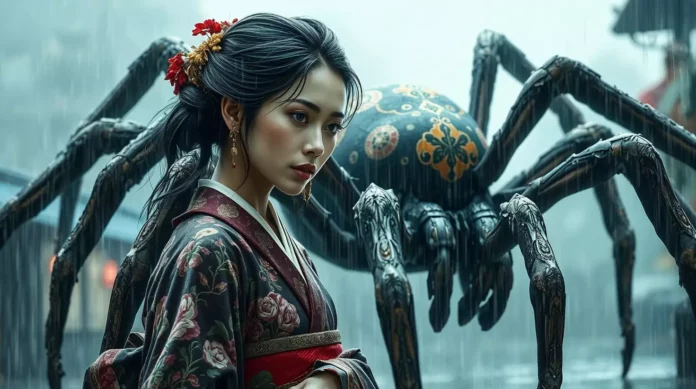
Japanese jorōgumo traditions associate a spider with deceptive human appearance. Their boundary-crossing differs from the Akan trickster’s social cleverness and the Greek transformation account.
Perception and Meaning
Spider beings can embody skill, deception, danger, or transformation, depending on cultural setting. These interpretations arise from specific traditions and cannot be treated as interchangeable symbolic meanings.
Web-making may invite interpretations involving craft or entrapment, but the presence of a web alone does not establish either meaning. Historical context determines its significance.
Distinction from Related Beast Types
Conceptual Boundaries
A mythical arachnid requires spider identity to be taxonomically central. An elemental being, ghost, or humanoid monster does not qualify merely because a story mentions spiders.
Ordinary spiders become relevant to this category when cultural accounts attribute supernatural status, transformation, agency, or distinctive mythological function to them. Biological classification alone is insufficient.
Common Sources of Confusion
Confusion arises when spider imagery appears beside spirits or humanlike figures. Classification should follow the being’s defining identity, rather than isolated visual resemblance or setting.
Comparative analysis separates documented cultural categories from modern umbrella labels. Mythical Arachnid is a present-day analytical grouping, not evidence of a historically universal creature type.
Canonical Beasts Associated with This Beast Type
Anansi
Anansi belongs to Akan and related West African storytelling traditions as a spider trickster. Spider identity is central to his recognized character, not incidental animal imagery.
Arachne
Arachne comes from Greek myth, especially the account preserved by Ovid, where a mortal weaver becomes a spider. Her arachnid form defines the transformation’s outcome.
Jorōgumo
Jorōgumo belongs to Japanese folkloric traditions concerning a spider associated with deceptive human appearance. Spider nature is essential to its identity and distinguishes it from ordinary apparitions.
Tsuchigumo
Tsuchigumo refers in Japanese historical and folkloric contexts to earth-spider beings. Their spider classification is explicit, although accounts and meanings vary across periods and source traditions.
Historical Distribution and Cultural Context
Documented spider beings occur in West African, Greek, and Japanese traditions, among others. Their presence reflects separate cultural histories rather than a demonstrable common origin.
These examples belong to different periods and genres, including oral storytelling, classical literature, and later folklore. Evidence does not support a single continuous arachnid mythology across regions.
Local environments may shape familiarity with spiders, but environmental explanation alone cannot establish why a particular culture assigned supernatural meaning to them.
Scholarly Interpretation and Uncertainty
Variation in Definitions
Researchers may define the category narrowly, requiring an actual spider being, or broadly, including human transformations into spiders. The selected boundary affects which examples qualify.
Traditional names do not necessarily correspond to modern zoological or comparative categories. Translation and changing descriptions can complicate judgments about whether beings share a meaningful classification.
Limits of Available Evidence
Some traditions survive through sources recorded long after their presumed oral circulation. Earlier forms, local variations, and original meanings may therefore remain uncertain or inaccessible.
No verified sources describe a single cross-cultural doctrine uniting these beings. Similar anatomy does not demonstrate historical contact, shared worship, or identical symbolic interpretation.
Mythological Role Across Cultures
Spider beings recur partly because spiders are visible animals with distinctive movement, predation, and web-making. These observations offer culturally available material for supernatural characterization.
Comparative study is useful when it identifies structural similarities without erasing divergent meanings. Anansi’s trickster role, Arachne’s transformation, and jorōgumo’s deception remain distinct.
Recognizing this category helps explain how communities connect animal form with agency, social conduct, or boundary crossing. It does not imply a universal mythological system.