
Summary
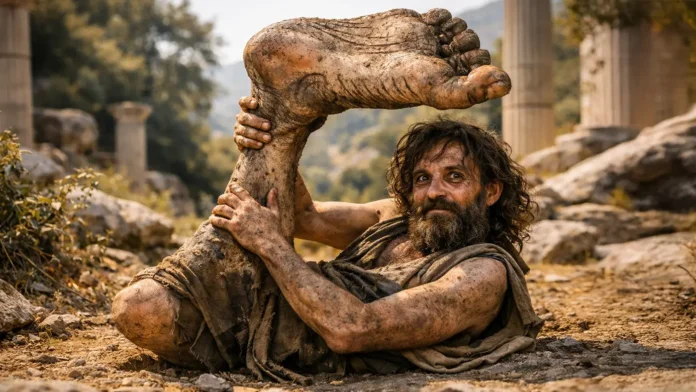
The Monopod, also known as the Sciapod or Skiapod, is a legendary humanoid creature described in ancient Greek and Roman writings. The creature is characterized by a single leg ending in a large foot.
According to classical descriptions, this oversized foot allowed the creature to shade its body from the sun when lying on the ground.
Ancient authors described Monopods as inhabitants of distant lands beyond the known Mediterranean world. Greek and Roman writers typically placed them in regions such as India or Ethiopia.
These descriptions were part of a broader tradition in classical geography that catalogued strange peoples believed to inhabit the edges of the world.
Although modern scholars recognize Monopods as mythological beings, they played an important role in ancient ethnographic storytelling. Their presence in classical literature and medieval maps illustrates how early writers blended travel reports, imagination, and cultural curiosity to explain unfamiliar lands and peoples.
History/Origin
The earliest references to the Monopod appear in ancient Greek accounts describing distant lands beyond the Mediterranean world. These creatures were most commonly known as Sciapods, a Greek term meaning “shadow-footed people.
” The legend emerged from early ethnographic traditions in which Greek authors described unusual tribes believed to live far from the civilized world.
One of the earliest sources mentioning the Monopods was Ctesias of Cnidus, a Greek physician who served at the Persian court in the fifth century BCE. Ctesias wrote a work titled Indika, a description of India based largely on travelers’ reports rather than direct observation.
Although the original text survives only in fragments, later writers preserved many of its descriptions, including the account of one-legged people living in India.
The Roman author Pliny the Elder later repeated and expanded these accounts in his encyclopedic work Naturalis Historia in the first century CE. Pliny described a race of people known as the Monocoli, who possessed a single leg and moved by hopping with remarkable speed.
He also explained the origin of the name Sciapods: because in the hotter weather they lie on their backs and protect themselves with the shadow of their feet.
Greek literature also referenced these strange peoples. The comic playwright Aristophanes mentions them in his play The Birds (414 BCE), demonstrating that the concept of one-footed tribes was already known in Greek storytelling during the classical period.
Later writers continued discussing the Sciapods within broader discussions of mythical races. The philosopher Philostratus refers to them in Life of Apollonius of Tyana, where they are listed alongside other legendary peoples such as pygmies and long-headed tribes.
In that work, an Indian sage states that such creatures were likely mythical inventions rather than real populations.
During Late Antiquity, Christian thinkers also debated these strange races. Saint Augustine mentions the Sciapods in The City of God, questioning whether such beings could exist and whether they would still belong to the human family if they did.
These discussions show that the legend remained part of intellectual debates about geography, humanity, and the limits of the known world.
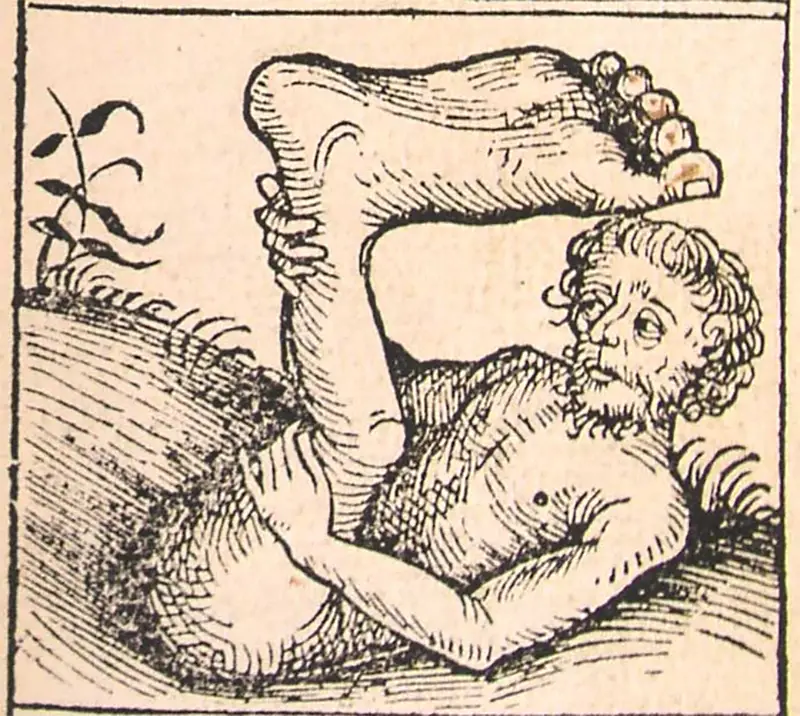
By the medieval period, the Monopod had become firmly embedded in European ideas about distant lands. Medieval scholars inherited the stories from classical texts and incorporated them into maps, encyclopedias, and illustrated manuscripts.
The creature was therefore not merely a mythological curiosity but also a symbol of unexplored regions beyond the boundaries of the known world.
Name Meaning
The name Monopod originates from the Greek words monos meaning “one” and pous meaning “foot.” The term therefore literally means “one-footed.
” This name directly reflects the creature’s most distinctive physical trait.
Another widely used name is Sciapod or Skiapod, derived from the Greek words skia meaning “shadow” and pous meaning “foot.” The translation “shadow-foot” refers to the creature’s ability to shade itself from the sun using its enormous foot.
Roman writers used the Latin name Monocoli, which carries a similar meaning: “one-legged people.” These names remained consistent across many ancient texts and later medieval works, showing that the defining feature of the creature was universally recognized.
Background Story
Unlike many mythological creatures, the Monopod does not appear in elaborate legends involving gods or heroes. Instead, it belongs to a category of beings known in classical literature as the “monstrous races.
” These were imagined peoples said to inhabit distant and unfamiliar parts of the world.
Ancient writers believed that the edges of the earth contained strange tribes whose bodies differed from ordinary humans. Some were said to have dog heads, others had no heads at all, and some possessed enormous ears.
The Monopods were one of these exotic races.
In most accounts, the Sciapods lived in hot climates such as India or Ethiopia. Their large foot allowed them to rest comfortably during the heat of the day.
When lying on their backs, they raised the foot above their bodies to cast shade, protecting themselves from the intense sun.
These stories were not necessarily meant to be purely fictional. In antiquity, geographical knowledge was limited, and travelers often reported strange sights or misunderstood cultural practices.
Writers then combined these reports with imagination, creating vivid descriptions of unknown peoples.
The Monopod therefore represents the ancient world’s attempt to describe lands beyond its direct experience. Rather than serving as villains or heroes, these beings symbolized the mystery and diversity of distant regions.
Similar Beasts
Blemmye
The Blemmye were another mythical race described in classical and medieval sources. Unlike the Monopods, they were said to have no heads, with facial features located on their chests.
Monopod compared to Blemmye and Cynocephalus
| Aspect | Monopod | Blemmye | Cynocephalus |
|---|---|---|---|
| Leg structure | The Monopod has a unique single leg with a large foot. | Blemmye is depicted as having no head and facial features on its chest. | Cynocephalus is characterized by a dog-like head on a human body. |
| Habitat | Monopods are said to inhabit regions beyond the Mediterranean, like India. | Blemmye are often associated with remote areas in Africa or Asia. | Cynocephalus is often linked to regions in Africa and Asia. |
| Cultural significance | Monopods represent the blending of myth and ethnography in ancient texts. | Blemmye symbolize the fascination with human-like creatures in folklore. | Cynocephalus reflects the curiosity about animal-human hybrids in mythology. |
| Physical description | The Monopod's large foot is used for shading while lying down. | Blemmye's lack of a head is a striking and unusual feature. | Cynocephalus's dog-like head gives it a distinctive appearance. |
| Historical accounts | Ancient texts provide the earliest mentions of Monopods in distant lands. | Historical accounts of Blemmye appear in various ancient writings. | Cynocephalus is referenced in classical literature and travel accounts. |
| Modern interpretation | Modern scholars view Monopods as mythological rather than real beings. | Blemmye are considered fictional creatures in contemporary analysis. | Cynocephalus is recognized as a legendary figure in folklore studies. |
Cynocephalus
The Cynocephali were dog-headed people mentioned in ancient travel literature. Like the Monopods, they were believed to inhabit remote lands beyond the known world.
Panotti
The Panotti were legendary people with extremely large ears that could wrap around their bodies like blankets. They appeared in medieval maps alongside other strange races such as the Sciapods.
Cultural Impact
The Monopod became an enduring symbol of the mysterious peoples believed to inhabit the world’s unexplored regions. In antiquity, such creatures reflected the limits of geographical knowledge and the fascination with lands beyond the Mediterranean world.
During the Middle Ages, the legend gained renewed popularity through illustrated manuscripts and maps. Medieval cartographers often filled the empty regions of their world maps with strange races described in classical texts.
One of the most famous examples appears on the Hereford Mappa Mundi, a large medieval map created around 1300, where a Sciapod is depicted among other mythical peoples at the edge of the known world. (markmanders.com)
The creature also appeared in medieval bestiaries, illustrated books that combined descriptions of animals with moral and religious lessons. In these works, the Monopod represented the strange and distant parts of God’s creation that were believed to exist far from the Christian world.
Later Renaissance publications continued this tradition. The famous Nuremberg Chronicle of 1493 includes an illustration of a Sciapod, demonstrating that the legend remained widely known well into the early modern period.
These depictions reveal how ancient stories continued shaping European imagination long after the original sources were written. Even as geographical knowledge improved, the Monopod remained part of cultural traditions that explored the boundaries between myth, curiosity, and discovery.
Religion/Ritual
There is no evidence that the Monopod played a role in religious worship or ritual practices. Ancient authors generally described the creature as part of geographical accounts rather than religious traditions.
However, medieval Christian writers occasionally used the Monopod within theological discussions about humanity. Some scholars wondered whether such unusual races, if they existed, would still belong to the human lineage created by God.
These debates demonstrate how mythological geography intersected with religious thought during Late Antiquity and the Middle Ages.
Scientific or Rational Explanations
Modern historians generally interpret the Monopod legend as a product of ancient ethnographic imagination. Early Greek writers often relied on second-hand reports from traders and travelers, which were then expanded into stories about exotic peoples.
One explanation suggests that descriptions of yogis or ascetics who balanced on one leg during meditation may have inspired the legend. Western travelers unfamiliar with such practices could have misunderstood them and transformed them into tales of one-legged tribes.
Other scholars believe the story emerged from the broader tradition of describing unusual human races at the world’s edges. These descriptions allowed ancient authors to explore cultural differences while also emphasizing the perceived centrality of the Mediterranean world.
Regardless of the origin, the Monopod legend illustrates how limited knowledge of distant lands could produce imaginative interpretations. Rather than being purely fictional inventions, such stories reveal how ancient cultures attempted to understand unfamiliar regions and peoples.
Modern Cultural References
Although the Monopod is less famous than many mythological creatures, it continues to appear in modern literature and media.
One well-known example appears in C. S. Lewis’s novel The Voyage of the Dawn Treader (1952), part of the Chronicles of Narnia series.
In the story, a group of invisible creatures known as Dufflepuds are later revealed to be Monopods after a magical transformation.
The creature also appears in the historical fantasy novel Baudolino by Umberto Eco, which includes a Sciapod named Gavagai among a collection of legendary beings encountered by the protagonist.
These modern appearances show how ancient legends continue inspiring writers and artists. Even today, the image of a one-footed traveler resting beneath the shade of its own foot remains a memorable example of mythological creativity.
Conclusion
The Monopod, also known as the Sciapod, is one of the most unusual creatures described in ancient geographical literature. Characterized by its single leg and enormous foot, it represents the imaginative descriptions that ancient writers used to portray distant lands.
First mentioned in Greek accounts of India and later recorded by Roman authors such as Pliny the Elder, the creature became part of a wider tradition of legendary races believed to inhabit the world’s edges. Medieval scholars preserved these stories in maps, manuscripts, and bestiaries, ensuring that the Monopod remained part of European imagination for centuries.
Today, historians recognize the Monopod as a reflection of early attempts to understand unfamiliar cultures and landscapes. Although it never existed as a real creature, its story reveals how mythology, geography, and curiosity combined to shape the ancient vision of the world.
Further reading
Pliny the Elder. Natural History. Translated by H. Rackham. A classical Roman encyclopedia containing one of the earliest surviving descriptions of the Monopods and their behavior.
https://www.theoi.com/Phylos/Skiapodes.html
Ctesias of Cnidus. Indika. Fragmentary Greek work describing India based on Persian court reports. Includes early references to legendary races such as the Monopods.
https://en.wikipedia.org/wiki/Indica_(Ctesias)
Friedman, John Block. The Monstrous Races in Medieval Art and Thought. A scholarly study examining how creatures like Sciapods appeared in medieval maps, manuscripts, and cultural imagination.
https://press.syr.edu/supressbooks/2670/the-monstrous-races-in-medieval-art-and-thought/
Hereford Cathedral. The Hereford Mappa Mundi. Medieval world map that includes depictions of Sciapods among other legendary peoples believed to inhabit distant lands.
https://www.themappamundi.co.uk/










 - a legendary one-legged humanoid from Greek & Roman. known for using his giant foot as shade while travling.)