
Intro/Summary
The Phoenix is one of mythology’s most enduring icons, a radiant bird that dies in flame and rises from its ashes. Rooted in Egyptian mythology as the Bennu bird and later adopted by Greek and Roman writers, it came to symbolize immortality, rebirth, and cosmic renewal.
Over centuries, the Phoenix grew beyond its origins, appearing in medieval bestiaries, Christian allegory, and modern pop culture. It remains a universal emblem of transformation and resilience.
History/Origin
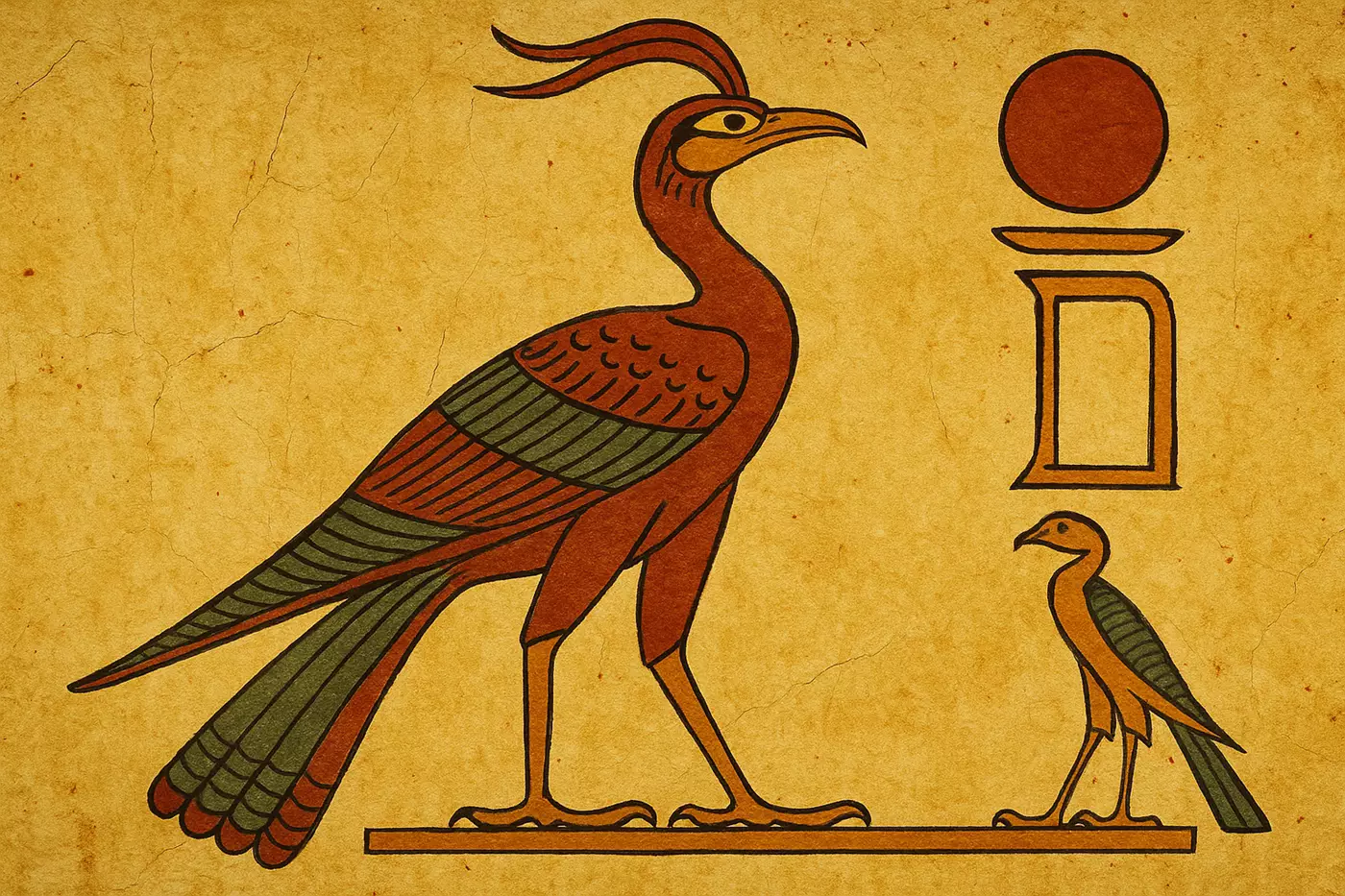
The earliest version of the Phoenix myth begins in Ancient Egypt, where the Bennu bird embodied the sun’s renewal and the cycle of life and death. The Pyramid Texts (c.
2400 BCE) describe the Bennu emerging from the waters of Nun and settling on the benben stone, the mound of creation. As a companion to Ra, the sun god, and linked to Osiris, it represented both creation and resurrection.
When the story entered Greek thought, the Bennu became the Phoenix. Herodotus (Histories, Book II) records a tale of a sacred bird that lives 500 years before building a nest of cinnamon and myrrh, igniting itself in flames, and rising anew.
Later writers such as Pliny the Elder expanded the myth, presenting the Phoenix as proof of nature’s cycles.
“When the Phoenix senses its death approaching, it makes a nest of frankincense and myrrh and is consumed by fire. From the ashes, a new Phoenix arises.”
(Herodotus, Histories, Book II)
In Roman times, the Phoenix became a metaphor for imperial eternity, symbolizing Rome’s resilience and continuity. Later, Christian writers adopted it as an allegory for resurrection and eternal life, embedding it deeply in medieval religious symbolism.
“Like the Phoenix, He was buried, yet rose from the grave; from the ashes of death, life eternal blazed anew.” (Medieval Bestiary, 12th Century)
Name Meaning
The name “Phoenix” derives from the Greek word φοῖνιξ (phoinix), which had multiple meanings, including “Phoenician” and “purple-red.” This links the bird symbolically to flames, imperial dyes, and sunrises.
In Roman texts, the term takes on celestial overtones, associated with solar cycles and eternity.
In Egyptian, the Phoenix appears as Bnꜣ (Bennu), which comes from the root word weben, meaning “to shine” or “to rise.” The Bennu’s association with Ra, the rising sun, and Osiris, the cycle of death and rebirth, makes the name especially meaningful.
The shift from Bennu to Phoenix reflects both linguistic adaptation and theological layering. Greek and Roman writers saw in the Egyptian myth a universal truth, rebranding the Bennu into their cosmology while retaining the essence of solar rebirth.
Appearance
The Phoenix is depicted as a majestic firebird, often larger than an eagle, with radiant plumage in scarlet, gold, and purple. Its eyes glow like embers, and its cry is said to echo eternity.
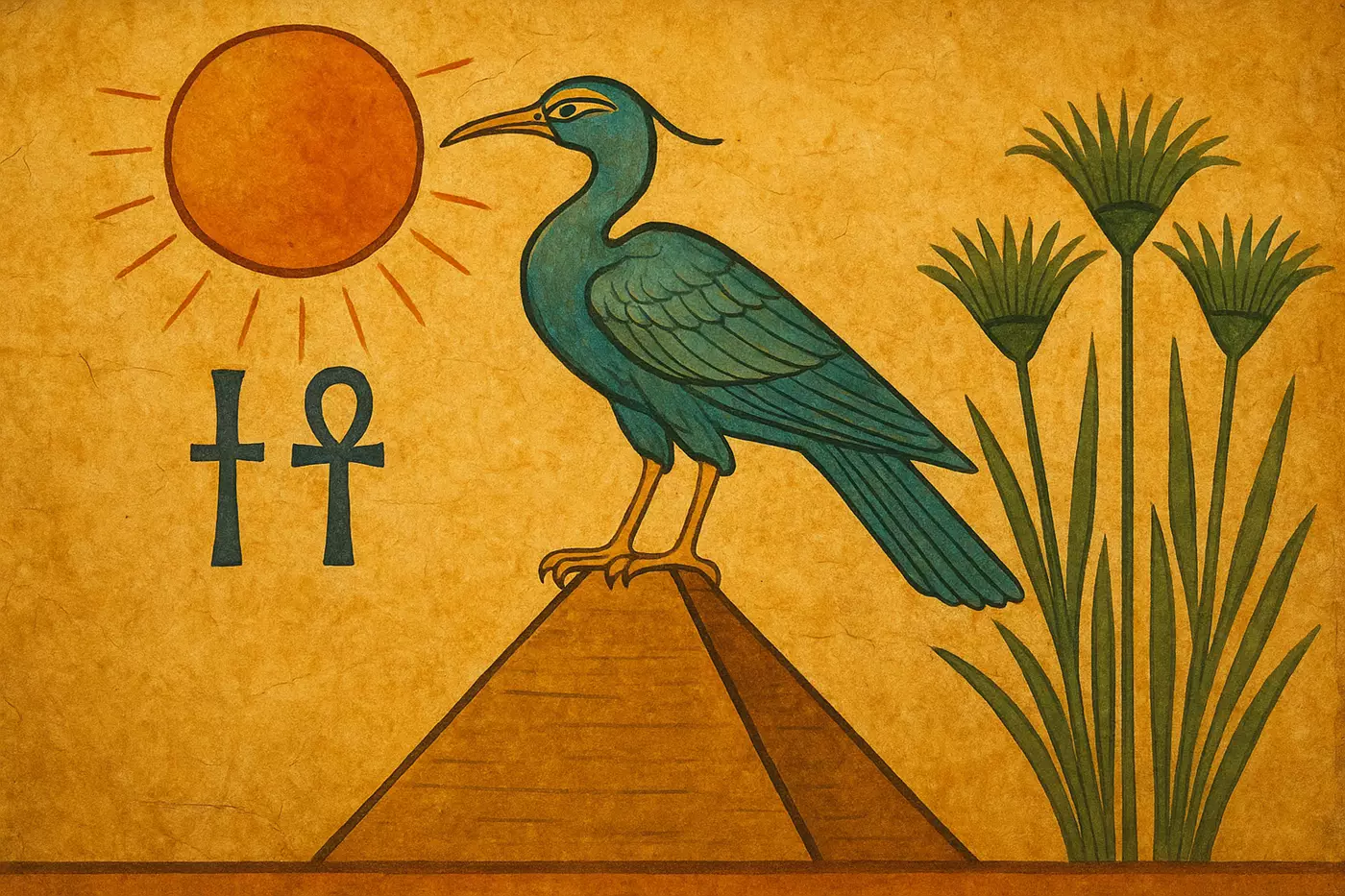
Egyptian depictions of the Bennu show a grey heron crowned with a solar disk, while Greek and Roman sources describe an eagle-like bird haloed by light.
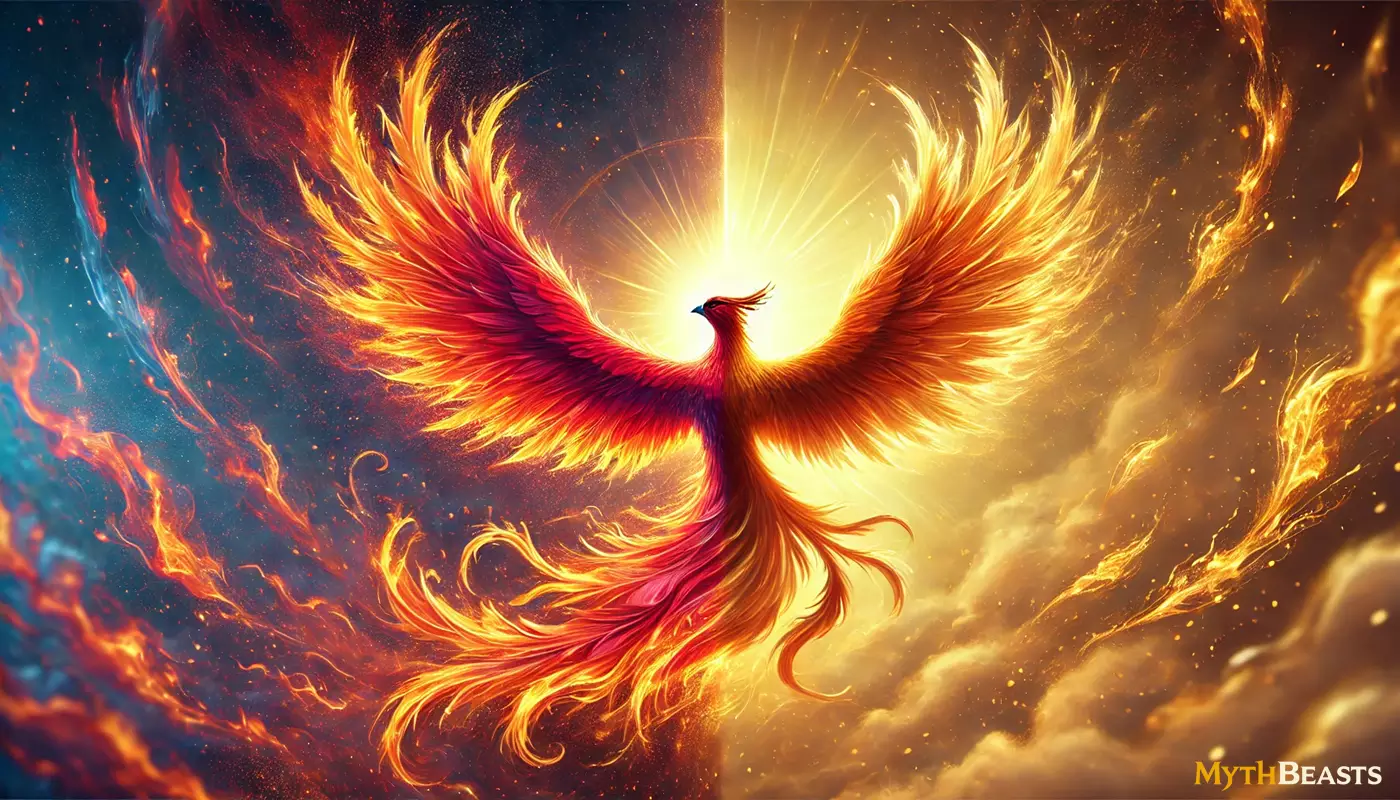
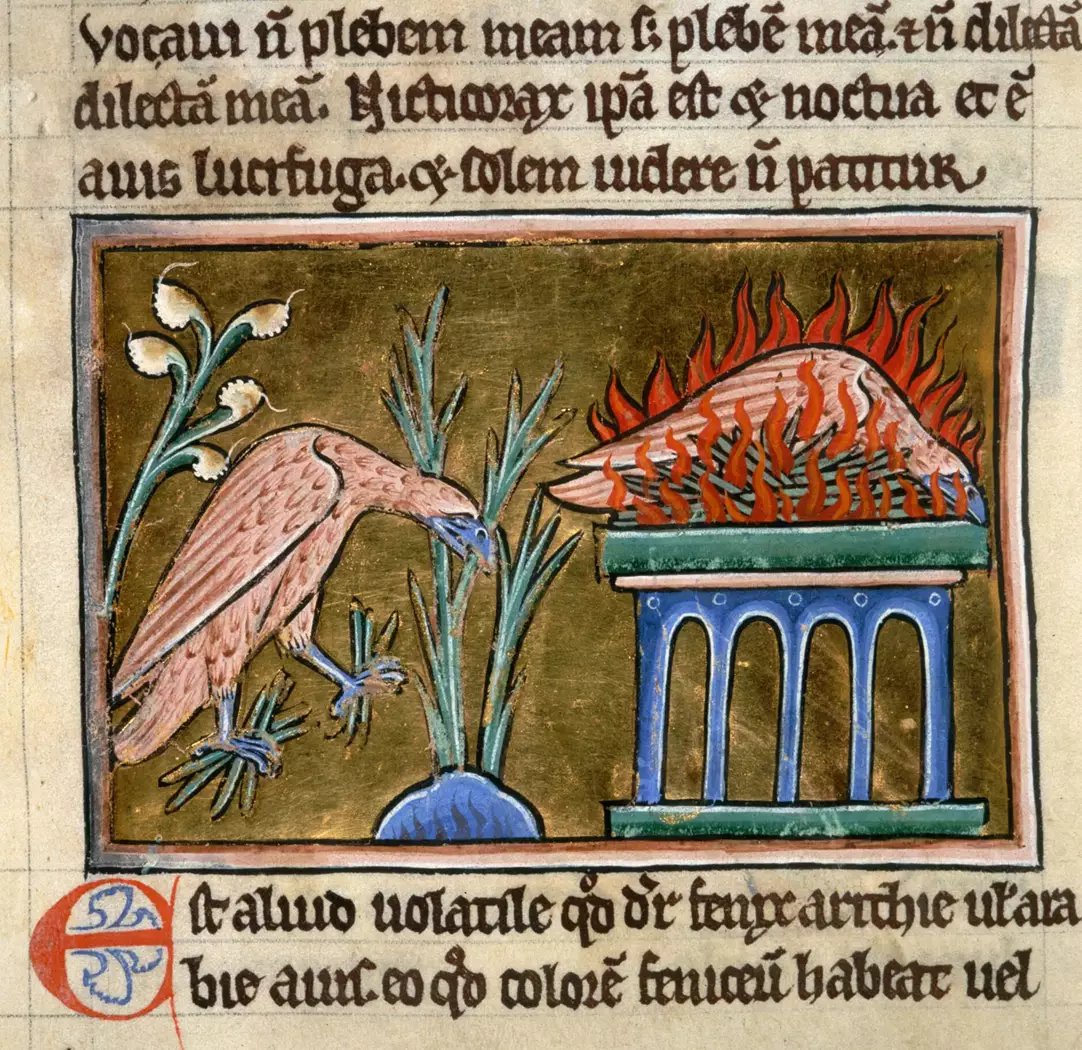
In medieval manuscripts, the Phoenix often sits in a nest consumed by fire, its rebirth captured in vivid imagery. Across traditions, its appearance reflects its essence, dazzling, otherworldly, and beyond mortality.
Background Story
The myth of the Phoenix follows a simple but profound narrative of self-sacrifice and rebirth. When the Phoenix senses the end of its life cycle, traditionally 500 or 1,000 years, it gathers rare spices and aromatic wood such as frankincense, cinnamon, and myrrh to build a nest in a sacred place.
Once built, the bird enters the nest and is consumed by a holy fire, often under the rising sun.
From the ashes, a new Phoenix emerges. In some versions, this reborn bird carries the remains of its predecessor to the temple of the sun in Heliopolis (Egypt) as a sacred offering.
The cycle begins anew, with the Phoenix living another long life before repeating the ritual.
This process isn’t just a biological loop, it symbolizes cosmic renewal, the turning of ages, and spiritual evolution. In Christian allegory, this became a metaphor for resurrection.
In Stoic philosophy, it mirrored the eternal return of the universe itself.
“The Phoenix dies into fire, not as punishment, but to complete its destiny, rebirth is not escape, it is becoming.” (Roman philosopher Claudian, 4th century CE)
Famous Folklore Stories
The Bennu and the Sun Temple
In Ancient Egypt, the earliest known Phoenix tale centers around the Bennu bird, a solar creature linked to the creation of the world. According to Egyptian mythology, the Bennu emerged from the primordial waters of Nun and flew to the top of the benben stone at Heliopolis, where it released a cry that marked the beginning of time.
This event was seen as the dawn of all existence, tying the bird directly to Ra, the sun god, and the rhythm of day and night.
“I came into being from myself… I shone forth in the form of the Bennu, the bird of the sun.”
(Coffin Texts, Middle Kingdom Egypt, c. 2100–1600 BCE)
After this cosmic act, the Bennu would periodically renew itself by building a nest of incense and sacred herbs, igniting itself in fire, and rising anew. Egyptians believed this renewal mirrored the rising of the sun each day.
The myth served as a metaphor not only for solar rebirth but also for the cyclical regeneration of the Nile and all life dependent on it. The Bennu was often associated with Osiris as well, symbolizing death, rebirth, and immortality, becoming one of the most revered birds in the Egyptian spiritual pantheon.
The Phoenix of Heliopolis
As the Bennu myth crossed into Greek culture, it evolved into the Phoenix legend, popularized by Greek historians and philosophers. In Herodotus’ Histories, he recounts hearing of a sacred bird that comes to Heliopolis once every 500 years.
When it knows it is about to die, the Phoenix creates a nest of cinnamon and myrrh atop the altar of the sun god. After igniting the nest and itself in flames, a new Phoenix is born from the ashes.
“It comes all the way from Arabia, they say, bringing the body of its predecessor encased in myrrh to the Sun’s altar.” (Herodotus, Histories, Book II, 5th century BCE)
The Greeks viewed the Phoenix as a divine sign, symbolizing both continuity and cosmic order. Its rebirth wasn’t just physical; it represented moral and philosophical renewal, which suited the Stoic and Platonic ideas flourishing in Hellenistic thought.
By positioning the Phoenix in Heliopolis, the Greeks preserved its Egyptian roots while giving it new philosophical weight. It became a bridge between mortality and eternity, appealing to both religious and intellectual minds.
The Phoenix in Christian Allegory
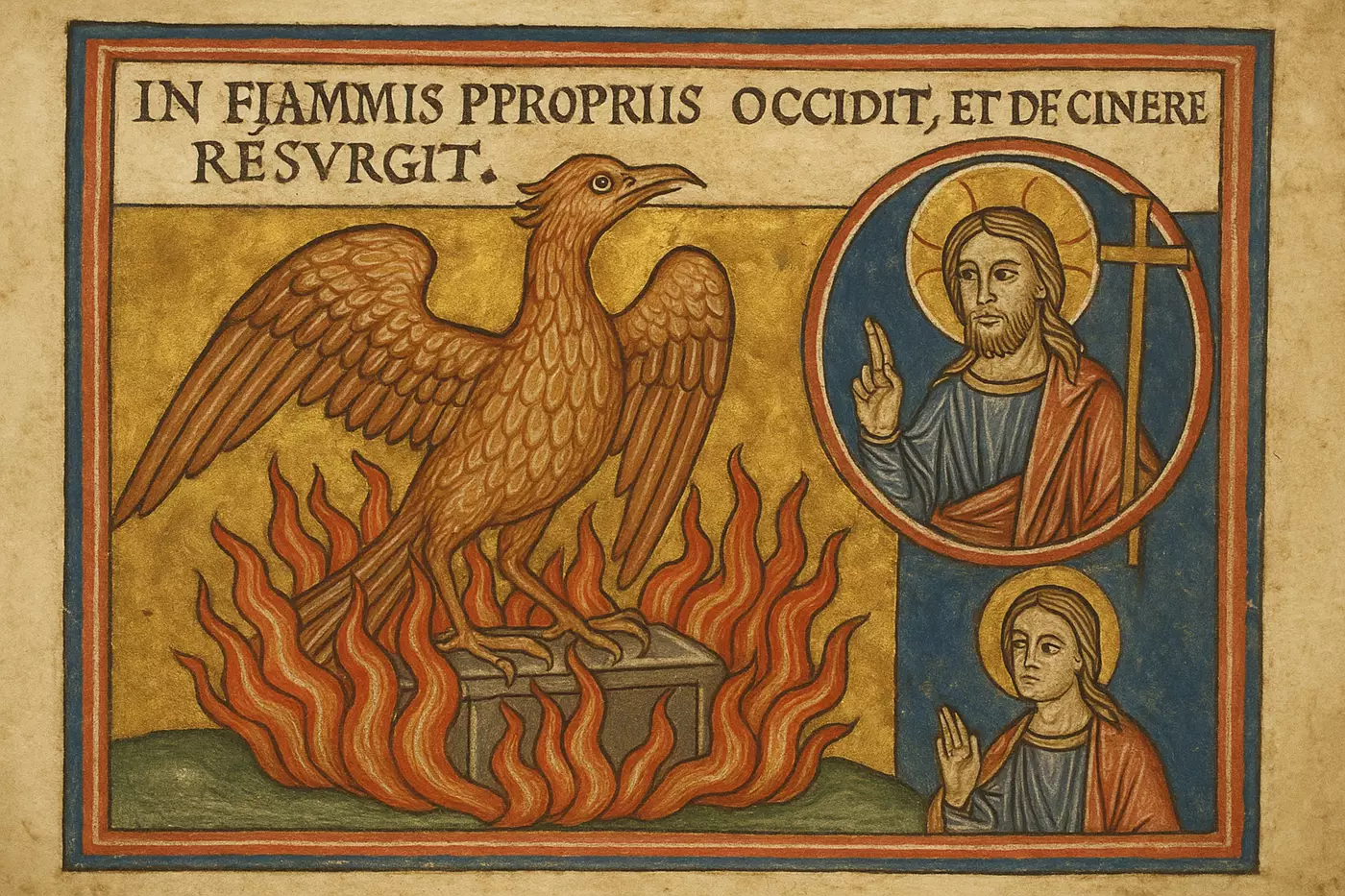
In Late Antiquity and early Christian theology, the Phoenix took on a new symbolic dimension. No longer just a solar creature, it was now a powerful image of Christ’s resurrection.
The early Christian poet Lactantius offered one of the most detailed versions in his allegorical work De Ave Phoenice. He describes the Phoenix’s cycle of death in fire and resurrection in purity as a mirror to Christ’s own sacrifice and rebirth.
“In its own flames it perishes and from the ashes, a new Phoenix is born -undefiled and alone.” (De Ave Phoenice, Lactantius, 3rd–4th century CE)
This story spread widely throughout Christian Europe, appearing in bestiaries and religious sermons. The Phoenix came to represent hope beyond death, faith in resurrection, and the promise of eternal life.
Its myth was retold as a moral lesson: through suffering and sacrifice comes divine reward. While rooted in pagan origins, the Phoenix became an integral part of Christian symbolism, blending theology with ancient myth in a uniquely enduring way.
Cultural Impact
The Phoenix has left a powerful mark on cultures throughout history. In Egypt, it symbolized creation and cosmic order.
In Greece and Rome, it became a sign of eternity and philosophical renewal. Christian writers transformed it into a metaphor for Christ’s resurrection, making it a staple of sermons and bestiaries.
Beyond religion, the Phoenix evolved into a universal symbol of hope and recovery. Cities like Atlanta adopted it after destruction in the American Civil War, using it to represent rebirth from ashes.
In modern times, the Phoenix continues to inspire art, literature, and popular media, standing as a timeless emblem of transformation.
Similar Beasts
The Phoenix is not alone in world mythology. Many cultures envisioned mighty birds that symbolized cosmic order, renewal, or divine might.
While each takes unique form, their shared themes reveal humanity’s fascination with transcendence and transformation.
Hindu Garuda and Bherunda
In Hindu tradition, Garuda is a massive, eagle-like being who serves as the mount of Vishnu. It symbolizes divine power, protection, and the ability to traverse the heavens.
Its cousin, the Bherunda, is a two-headed bird representing duality and cosmic balance. Though not associated with fiery rebirth, their grandeur and divine roles parallel the Phoenix as guardians of cosmic truth.
Persian Simurgh and Near Eastern Rukh
The Simurgh of Persian mythology is a majestic, benevolent bird that heals and grants wisdom. It often appears as a helper of heroes in the Shahnameh.
The Rukh (or Roc), referenced in Arabic and Persian tales such as The Arabian Nights, is a colossal bird capable of carrying elephants. Both symbolize forces beyond mortal reach, akin to the Phoenix’s link to eternity.
Slavic Firebird and Chinese Fenghuang
The Firebird (Жар-птица) is a glowing, radiant bird in Slavic folklore, often both a blessing and a curse to those who capture it. Its fiery plumage glows with eternal light, echoing the Phoenix’s association with fire and destiny.
Similarly, the Fenghuang, the so-called Chinese Phoenix, embodies virtue, grace, and cosmic harmony. Unlike the Western Phoenix, it does not die and resurrect, but it serves as a celestial ruler of all birds, representing balance between yin and yang.

Thunderbird
The Thunderbird, central to many Native American traditions, is a supernatural bird whose wings bring thunder and whose eyes flash lightning. It is seen as a guardian spirit, protecting humanity from chaotic forces like water spirits.
Much like the Phoenix renews through fire, the Thunderbird reshapes the world through storms, cleansing and restoring balance to the land.
“The Thunderbird is a powerful spirit being… it is considered a supernatural bird of power and strength.” (Encyclopaedia Britannica – Thunderbird)
Religion/Ritual
The Phoenix held sacred roles in religion and ritual across time:
- Ancient Egypt: The Bennu’s cyclical rebirth tied closely to solar worship. Priests likely used its imagery during rituals celebrating Osiris and Ra, reinforcing the natural cycles of life, death, and rebirth.
- Christianity: The Phoenix featured in homilies and liturgical storytelling, especially around Easter. Preachers used it as a compelling symbol of resurrection and divine promise.
- Esoteric Orders: Renaissance and later mystical traditions sometimes used Phoenix imagery in alchemical and Rosicrucian contexts, representing spiritual transformation and purification by fire.
In each case, ritual application turned mythic metaphor into lived symbolism, making the Phoenix both a poetic and a participatory figure in religious life.
Scientific or Rational Explanations
Though mythical, the Phoenix aligns with several rational analogues:
- Periodic regeneration: Biology offers parallels, think cicadas’ emergence, trees regenerating after forest fires, or reptiles regenerative power. Though not literal rebirth, these natural cycles echo the Phoenix’s rhythms.
- Astronomical metaphor: Scholars propose the Phoenix might symbolize the sun’s daily rebirth, annual solstice cycles, or celestial events like solar eclipses.
- Psychological archetype: In modern psychology, the Phoenix stands as a symbol of resilience, representing individuals or communities rising from trauma, emerging stronger. This archetype supports healing narratives and motivational frameworks.
These interpretations ground myth in nature, culture, and the human mind, revealing not just how we tell stories, but why they endure.
Modern Cultural References
Harry Potter – Fawkes the Phoenix & Order of the Phoenix
J.K. Rowling’s Harry Potter series features Fawkes, Dumbledore’s loyal phoenix companion, whose tears can heal and whose rebirth inspires hope, and the Order of the Phoenix stands as a resistance symbol.

X-Men – The Phoenix Force
Marvel’s cosmic entity Phoenix Force bonds with Jean Grey, granting immense power and playing out dramatic stories like the “Dark Phoenix Saga.”
One Piece – Marco the Phoenix
In the manga/anime One Piece, Marco gains the ability to transform into a phoenix via the Mythical Zoan-type Devil Fruit “Tori Tori no Mi, Model: Phoenix.”
Neil Gaiman – “Sunbird”
Gaiman’s short story Sunbird asks what happens when you eat a Phoenix, you burst into flames, “and ‘the years burn off you’.”
Symbolic uses in murals and art
The Phoenix appears prominently in a tapestry at the United Nations Security Council chamber symbolizing global reconstruction and unity.
These examples showcase how the Phoenix continues inspiring fiction, art, and storytelling, its resurrection myth transforming across media.
Conclusion
The Phoenix lives on, not only in the scripts of ancient scribes, but in our stories, rituals, and symbols. From sacred Bennu to cosmic comics, it has soared across religions, arts, and cultures.
The bird endlessly rises, not just through myth, but through our imagination. It embodies our yearning for redemption, our fascination with cycles, and our steadfast belief in transformation.
In every rebirth, it offers us a mirror: no matter how complete the ashes, we can rise again.
Further Reading
Here is a curated list of more official and scholarly sources for deeper exploration into the Phoenix myth, replacing informal sources like wikis:
The Phoenix (Mythological Bird)
Author: Encyclopaedia Britannica Editors
Source: Britannica.com
Link: https://www.britannica.com/topic/phoenix-mythological-bird
The Phoenix: A Universal Mythical Bird?
Author: Curationist Editorial Team
Source: Curationist.org
Link: https://www.curationist.org/editorial-features/article/the-phoenix%3A-a-universal-mythical-bird
De Ave Phoenice (The Phoenix)
Author: Attributed to Lactantius; Translation by Rev. William Fletcher, D.D.
Source: EWTN (Eternal Word Television Network Library)
Link: https://www.ewtn.com/catholicism/library/phoenix-de-ave-phoenice-11464
Carmen de Ave Phoenice – Translation
Author: Teresa M. Hooper
Source: Academia.edu
Link: https://www.academia.edu/12447765/Pseudo_Lactantius_Carmen_de_ave_phoenice_translation
The Phoenix in Herodotus’ Histories (Book II)
Author: Herodotus; Loeb Classical Library Edition
Source: LacusCurtius – University of Chicago
Link: https://penelope.uchicago.edu/Thayer/E/Roman/Texts/Herodotus/2B*.html