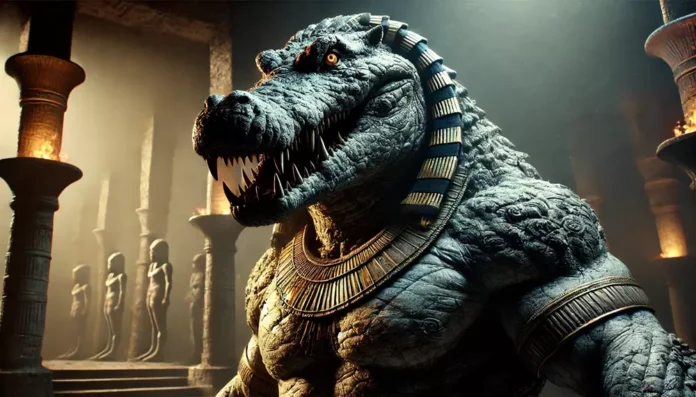
Egypt – an Overview
Egypt was a historical cultural region whose religious traditions developed along the Nile and adjoining desert zones in northeastern Africa over millennia, with distinctive local forms.
Its mythology is reconstructed from archaeological remains, inscriptions, funerary compositions, temple decoration, and other evidence produced across changing political periods.
Egypt belongs in a mythology taxonomy as a historically situated source tradition, not as a single unchanging system or fictional setting.
Historical and Environmental Context
Time Frame and Location
Egyptian religious evidence extends from prehistoric and early dynastic contexts into the Roman period, although surviving sources vary greatly in date and distribution.
The Nile valley and delta concentrated settlement within an arid landscape, making the river’s seasonal flooding a major environmental condition for agriculture.
Political unification is conventionally associated with the early dynastic period, but details of its chronology and process remain subject to scholarly assessment.
Contact and Cultural Exchange
Egypt maintained documented contacts with Nubia, the Levant, and Mediterranean societies through trade, diplomacy, warfare, migration, and changing imperial relationships.
These exchanges affected material culture and religious practice, but evidence does not support treating Egyptian religion as merely borrowed from neighboring societies.
Greek-speaking communities in Ptolemaic Egypt participated in cultural exchange, producing settings where Egyptian and Greek religious forms could interact without becoming identical.
Mythological Framework
Worldview and Cosmological Concepts
Egyptian sources represent ordered existence through ma’at, a concept encompassing truth, justice, right order, and the stability of the created world.
Texts and images associate creation with multiple divine accounts, including traditions linked to Heliopolis, Memphis, and Hermopolis rather than one universally fixed narrative.
The annual Nile inundation connected agricultural renewal with recurring patterns of fertility, although religious interpretations differed across periods and local settings.
Spiritual or Supernatural Categories
Egyptian evidence documents numerous deities whose identities and functions could overlap, shift, or become combined in particular theological and political contexts.
The concept of the person included distinct elements such as the ka and ba, whose meanings are reconstructed from textual and funerary evidence.
Deceased people could be represented as continuing participants in a transformed existence, especially within mortuary texts and tomb practices.
Folklore and Narrative Tradition
Recurring Mythological Themes
Conflict between Osiris and Seth appears in Egyptian religious narratives as a framework for kingship, succession, death, and restoration.
The solar cycle repeatedly presents the sun’s movement as a pattern of renewal, especially in funerary compositions concerning the deceased and the afterlife.
Divine protection is a recurring theme in spells and images, where deities guard vulnerable bodies, places, or stages of transition.
Transmission and Preservation
Mythological knowledge survives in hieroglyphic and hieratic inscriptions, papyri, temple reliefs, tomb decoration, statues, and objects bearing religious imagery.
These records were produced in specific institutional and funerary settings, so they do not provide a complete account of everyday belief.
Oral transmission likely contributed to Egyptian religious life, but its precise contents cannot generally be recovered from surviving archaeological evidence.
Mythological Beasts and Non-Human Entities
Egyptian religious imagery includes hybrid beings and sacred animals, but their meanings depend on specific historical contexts rather than a universal creature taxonomy.
Ammit
Ammit belongs specifically to Egyptian funerary judgment scenes, where images and texts associate her with the destruction of an unjustified deceased person’s heart.
Sphinx
The Egyptian sphinx combines a human head with a leonine body in royal and religious contexts, making its historical meaning distinct from later Greek riddling traditions.
Apis
Apis was a sacred bull associated with Memphis and the god Ptah, so classifying him only as a generic animal obscures his Egyptian cultic identity.
Symbolic Roles of Creatures and Forces
Animal forms could convey divine qualities through recognizable associations, but an animal image does not always indicate worship of that species itself.
Royal sphinx imagery expressed kingship through a human ruler’s association with leonine strength, a function grounded in Egyptian monuments.
The Nile’s inundation signified agricultural renewal within Egyptian religious thought, linking environmental cycles to prosperity without reducing theology to natural symbolism.
Internal Variation and Temporal Change
Egyptian religious traditions changed across dynastic, Persian, Ptolemaic, and Roman periods, as demonstrated by dated inscriptions and shifting political institutions.
Local centers emphasized different deities and theological formulations, although regional distinctions could coexist with broader religious practices across the country.
Funerary compositions also changed over time, with evolving textual collections revealing differences in access, religious expression, and mortuary convention.
Related Cultural Origins and Myth Sources
Egyptian religious history intersected with Nubian traditions through sustained contact, but the evidence supports interaction rather than the collapse of distinct cultural identities.
Greek and Egyptian religious forms met especially in Ptolemaic and Roman settings, yet their associated languages, institutions, and historical meanings remained distinguishable.
Evidence Limits and Scholarly Uncertainty
Surviving evidence is uneven because monuments, texts, and burial materials disproportionately represent elite institutions and particular regions or periods.
Religious texts often preserve specialized compositions rather than comprehensive explanations, leaving many beliefs and practices difficult to reconstruct securely.
Scholars debate how consistently concepts such as ma’at operated across social settings; evidence does not establish one uniform interpretation for every period.
No verified sources describe this for contexts where surviving records provide no reliable account of particular local beliefs or ordinary oral narratives.