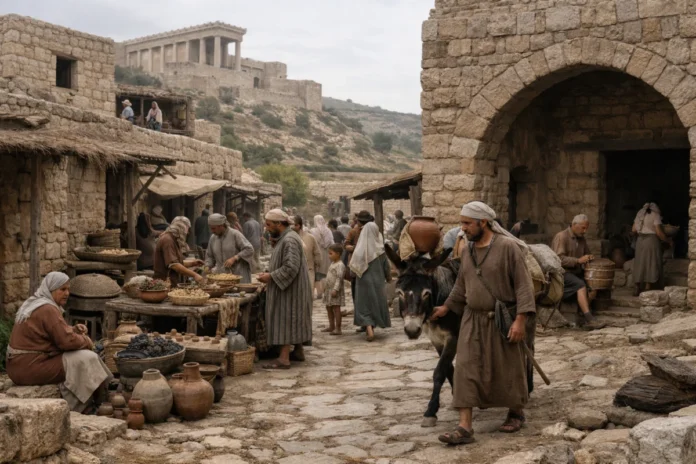
“Hebrews” is a historical designation associated with ancient Israelites and with traditions preserved in the Hebrew Bible. Its meaning changed across periods, so it should not imply one uniform community.
As a mythological source, the term refers here to religious narratives and concepts associated with ancient Israelite culture. These materials require distinction from later Jewish interpretation and from neighboring traditions.
The relevant historical setting spans the Iron Age kingdoms of Israel and Judah, followed by later periods of displacement and textual preservation. Dates and community boundaries remain subjects of scholarly discussion.
Geographically, these traditions developed chiefly in the southern Levant. Their historical contexts included highland settlements, urban centers, and regional connections extending beyond the territories associated with Israel and Judah.
Archaeological evidence documents communities in the southern Levant during the Iron Age, broadly the first millennium BCE. Assigning every archaeological group an Israelite identity remains methodologically contested.
The kingdoms of Israel and Judah are historically attested in inscriptions and other evidence from the first millennium BCE. Their political histories provide context for traditions later preserved in biblical literature.
The region’s varied terrain included Mediterranean coastlands, central highlands, and the Jordan Valley. These environments shaped settlement patterns, but direct links to particular myths cannot always be established.
Inscriptions and material culture attest interaction between Israelite and neighboring societies, including Phoenician, Aramean, and Mesopotamian powers. Such contact formed part of the political environment surrounding religious development.
Comparative study identifies shared ancient Near Eastern imagery in some biblical passages. Similar motifs do not by themselves demonstrate direct borrowing, since regional exchange and common conventions remain possible explanations.
Assyrian and Babylonian imperial expansion affected Israel and Judah through conquest, political change, and displacement. These documented events provide historical context for traditions concerning national crisis and restoration.
Biblical writings present creation as ordered by divine agency, though accounts vary in form and emphasis. These texts are primary evidence for literary theology, not transparent records of every community’s beliefs.
Some biblical passages describe divine authority over the heavens, land, waters, and human life. Their poetic and narrative forms require attention to genre before reconstructing a unified cosmology.
Concepts of covenant, law, and collective history connect social order with divine relationship in several biblical traditions. Their meanings developed across texts and historical settings rather than remaining entirely fixed.
Yahweh occupies the central divine position in much biblical literature. The texts also mention other divine beings, but their status and interpretation vary across passages and periods.
Angels appear as divine messengers or agents in biblical writings, especially in texts reflecting later literary developments. Their roles differ, and the evidence does not support one comprehensive angelic system.
References to spirits, the dead, and other supernatural categories occur unevenly across the corpus. Their meanings depend on specific passages; a single standardized Hebrew belief system cannot be securely inferred.
Creation, ancestral origins, exodus, kingship, exile, and return recur in biblical narrative traditions. These themes organize collective memory, though their historical and theological functions differ among individual works.
Stories about ancestors connect family descent with land, promise, and communal identity. Their literary presentation cannot independently verify every event as a historical occurrence.
Exodus traditions portray deliverance from Egypt as a defining account of collective formation. Archaeological evidence has not confirmed the narrative in all its details or established a single reconstruction.
Biblical narratives survive through manuscripts copied and transmitted across generations. The surviving textual witnesses belong to later periods than many settings represented within the narratives.
Inscriptions and archaeological remains provide evidence for historical language, administration, and material life. They rarely identify the oral transmission of a particular myth or story directly.
The Hebrew Bible contains works composed and edited across different periods. Textual variation and layered composition complicate attempts to assign every tradition a single date or original form.
Israel and Judah were distinct kingdoms for substantial periods, with separate political histories. Their literary traditions nevertheless share themes, while particular emphases vary across biblical books.
Religious language changed over time, as indicated by differences among biblical texts. Scholars debate the chronology and social reach of these changes, especially when literary evidence is indirect.
Exile and subsequent imperial rule altered the settings in which Judean traditions were preserved and interpreted. This history contributes to textual development without proving uniform responses among all communities.
Israelite traditions belong to the wider ancient Near Eastern cultural environment. Shared literary forms and imagery permit comparison, but they do not erase distinctions in theology or political memory.
Phoenician and Israelite societies occupied neighboring parts of the Levant and interacted historically. Their religious evidence is not interchangeable; local institutions and surviving sources differ substantially.
Mesopotamian texts offer comparisons for some biblical cosmological motifs. A parallel establishes neither identical meaning nor direct dependence without stronger evidence for transmission and historical context.
The term “Hebrews” does not designate a consistently bounded population across all historical periods. Its use requires attention to context, since biblical and external sources apply labels differently.
Archaeology documents settlement and political change more readily than private belief or oral narrative. Material remains rarely identify the precise religious meaning assigned by ancient inhabitants.
Biblical texts are essential evidence, yet they are literary compositions with distinct dates, purposes, and editorial histories. Treating them as direct transcripts of uniform belief would exceed what they establish.
Scholars disagree about the historical formation of Israelite identity and the development of particular religious ideas. Available evidence supports qualified reconstructions, not certainty about every period or community.
No verified sources describe this for this context: a complete, uniform system of Hebrew supernatural categories across all periods. The surviving record instead preserves diverse texts and uneven references.