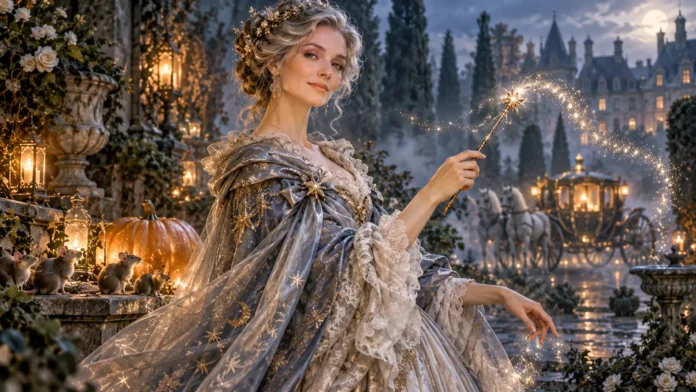
Fae – Overview
Fae is a modern umbrella label commonly applied to supernatural beings in Irish and Scottish Gaelic traditions, especially beings associated with sídhe, otherworldly dwellings, and human encounters.
Historically, the relevant Gaelic categories were not one uniform species called Fae. English-language usage groups varied beings under a shared folkloric classification rather than preserving one indigenous taxonomy.
As a taxonomy term, Fae therefore describes beings whose identities depend on otherworldly status and folkloric relations with people, not a consistent anatomy or single narrative role.
Defining Characteristics
Physical Form and Morphology
Folkloric accounts do not establish one body plan for Fae. Beings classified under the label may appear humanlike, animal-shaped, or difficult to perceive consistently.
Humanlike appearance is prominent in descriptions of sídhe beings, but accounts vary in stature, visibility, and presentation. Such traits cannot define every being grouped as Fae.
Ontological Nature
In Irish and Scottish belief traditions, many beings later called Fae belong to a supernatural population associated with sídhe or otherworldly places, rather than ordinary human society.
Their ontological position is not uniform: particular beings may be treated as spirits, neighbors, dangers, or members of an otherworldly community. No single classification fits all accounts.
Mythological Role and Function
Place in Mythological Systems
Fae-associated beings occupy a boundary between human habitation and an unseen otherworld in Gaelic folklore. This boundary gives encounters a distinct place within local cosmological understanding.
They are not generally equivalent to high gods in the surviving folklore. Their significance instead often derives from proximity to people, place, and ordinary livelihood.
Perception and Meaning
Some Irish and Scottish traditions present interactions with these beings as potentially hazardous, especially when human conduct crosses understood social or territorial limits. Accounts differ by locality.
Other accounts assign particular beings protective or helpful roles. This variation shows that Fae classification does not itself specify moral character or predictable behavior.
Distinction from Related Beast Types
Conceptual Boundaries
Fae differs from elemental categories because its defining basis is folkloric membership in an otherworldly population, not embodiment of fire, water, wind, or another natural substance.
It also differs from undead classifications, which concern the dead returning or persisting. Fae-associated beings are not generally defined by human death or postmortem existence.
Common Sources of Confusion
Translation encourages confusion because English fairy and Fae have been applied to beings with distinct Gaelic names and local histories. The imported umbrella can obscure those distinctions.
Comparative analysis distinguishes beings by their names, recorded functions, and cultural settings. Resemblance alone does not establish that another culture’s spirit belongs within Fae.
Canonical Beasts Associated with This Beast Type
Aos Sí
Aos Sí refers to a collective of supernatural beings in Irish tradition, associated with sídhe dwelling places. The group exemplifies Fae as a modern umbrella, not a single beast.
Púca
The púca is a shape-changing being in Irish and related Gaelic folklore, often associated with animal forms and encounters with people. Its variable appearance fits the broad Fae category.
Bean sí
The bean sí, or banshee, belongs to Irish and Scottish Gaelic traditions as a supernatural female figure associated with forewarning death. Her folkloric identity places her within broad Fae usage.
Historical Distribution and Cultural Context
The strongest historical grounding for Fae lies in Irish and Scottish Gaelic folklore, where named beings and otherworldly communities appear in oral traditions and later written records.
English-language fairy traditions developed through contact, translation, and literary adaptation. Their categories overlap with Gaelic material, but should not be treated as identical historical systems.
Fae is now also used comparatively and in modern popular language. That expanded reach reflects changing terminology, not evidence of one ancient, globally shared creature type.
Scholarly Interpretation and Uncertainty
Variation in Definitions
Definitions vary because Fae may refer narrowly to Gaelic supernatural beings or broadly to fairy-like entities in English. These applications have different historical and analytical limits.
Folklore researchers may prioritize indigenous names and local accounts over later umbrella terms. This approach preserves distinctions that broad comparative labels can flatten.
Limits of Available Evidence
Many accounts were recorded after long periods of oral transmission, making earlier details difficult to establish securely. No verified sources describe a unified Fae taxonomy for all Gaelic communities.
Evidence also varies by region and period. Claims about universal appearance, fixed moral character, or a common origin exceed what the records can reliably demonstrate.
Mythological Role Across Cultures
Otherworldly beings recur across cultures because folklore gives communities ways to describe encounters beyond ordinary explanation. This resemblance does not make distinct traditions instances of Fae.
Within Gaelic contexts, Fae classification highlights relationships between people, place, and unseen neighbors. Comparative study becomes more precise when that local function remains distinct from broader parallels.