Norway – an Overview
Norway is a historical cultural source for Norse mythology and later Norwegian folklore, rather than a self-contained mythology with boundaries matching the present Norwegian state. Its evidence belongs to changing regional and historical settings.
The label therefore identifies a geographic context for traditions documented in Norway, not an exclusive national ownership of narratives shared across medieval Scandinavia. Distinguishing place of evidence from cultural exclusivity is essential.
Relevant materials extend from prehistoric archaeological evidence through the Viking Age and medieval Christian documentation into later recorded folklore. These periods preserve different kinds of evidence and cannot be treated as one unchanged belief system.
Historical and Environmental Context
Time Frame and Location
Norway occupies the western Scandinavian Peninsula, with extensive mountains, fjords, islands, and a long coastline. These conditions shaped settlement patterns, travel, and local communities documented by archaeology and history.
Iron Age and Viking Age evidence is important for reconstructing pre-Christian Scandinavian religion, but it does not establish a uniform Norwegian system. Dating and interpretation depend on the particular object or text.
Medieval Icelandic writings preserve substantial accounts of Norse myth, yet they were recorded outside Norway, chiefly in a Christian literary environment. Their Norwegian relevance must therefore be argued rather than presumed.
Contact and Cultural Exchange
Norwegian communities participated in maritime networks connecting Scandinavia with the British Isles, continental Europe, and the North Atlantic during the Viking Age. Archaeological finds and written histories support this broad contact.
Movement across these routes enabled cultural exchange, but evidence does not permit every imported object or motif to be assigned a specific religious meaning. Material contact alone cannot prove belief.
Christianization changed the circumstances under which older religious traditions were recorded. Medieval authors could preserve pre-Christian names and narratives while presenting them through Christian education and literary conventions.
Mythological Framework
Worldview and Cosmological Concepts
Old Norse cosmological ideas are recoverable chiefly through medieval texts composed in Iceland, including the Poetic Edda and Snorri Sturluson’s Prose Edda. These sources do not directly represent all Norwegian communities.
In these writings, the cosmos includes distinct regions associated with gods, humans, and other beings. The surviving accounts provide literary models, not a complete record of ordinary Norwegian religious practice.
Archaeological objects can indicate symbolic or religious activity, but usually cannot explain cosmological doctrine independently. Interpretations linking imagery to particular myths remain dependent on comparison with textual evidence.
Spiritual or Supernatural Categories
Medieval Norse sources distinguish named divine figures, including Æsir and Vanir, alongside other supernatural beings. These categories derive from texts with Scandinavian relevance, not a securely documented Norwegian institutional pantheon.
Beliefs concerning the dead and supernatural presences appear in Norse literature and later regional folklore. Their forms and meanings vary by source, making a single continuous Norwegian doctrine unsupported.
No verified sources describe a complete, standardized system of supernatural categories practiced throughout Norway. Surviving texts and archaeological remains offer partial evidence rather than comprehensive local theological inventories.
Folklore and Narrative Tradition
Recurring Mythological Themes
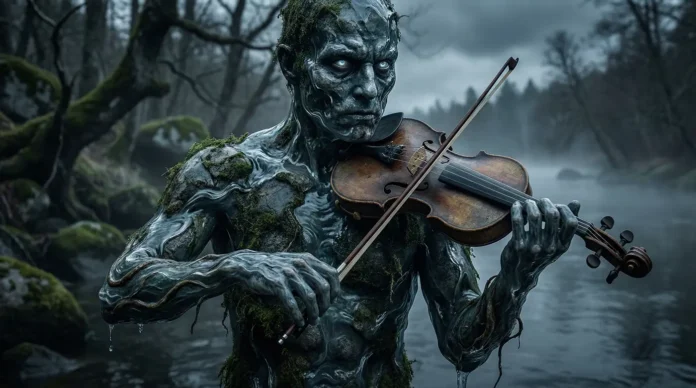
Later Norwegian folklore records narratives about supernatural beings associated with farms, mountains, forests, and waterways. Their local settings connect stories to inhabited landscapes, rather than proving an unchanged pagan cosmology.
Accounts of encounters with hidden or uncanny beings often express concerns about household life, work, and relations with the environment. Such interpretations require attention to the specific recorded narrative.
Motifs shared with neighboring Scandinavian traditions do not demonstrate identical meanings. Norwegian versions must be examined in their own regional and historical documentation before comparative conclusions are drawn.
Transmission and Preservation
Pre-Christian knowledge was transmitted substantially through oral performance, although its precise forms in Norway cannot generally be recovered. Medieval written sources preserve selected materials rather than direct transcripts of pagan recitation.
Christian-era manuscripts provide the most detailed surviving accounts of Norse myth. Their authors wrote within literate Christian society, a context that shaped selection, arrangement, and interpretation.
Later folklore collections preserve narratives gathered from speakers in particular places and periods. They document remembered tradition, but collection dates do not establish when each motif first arose.
Archaeological remains, including burials and images, supplement textual evidence without functioning as direct narrative records. Their meanings are interpreted through context and comparison, and can remain uncertain.
Internal Variation and Temporal Change
Norway’s regional geography and settlement history caution against assuming uniform belief across the country. Evidence is uneven, so regional differences cannot always be mapped with confidence.
Pre-Christian religious practices and later Christian-era folklore belong to distinct historical circumstances. Similar beings or motifs across these periods do not, by themselves, prove uninterrupted survival.
Medieval texts and nineteenth-century folklore records differ in genre, purpose, and distance from the beliefs they represent. Treating them as equivalent evidence would obscure historical change.
Related Cultural Origins and Myth Sources
Norwegian materials belong to broader Norse cultural histories shared in varying ways with Denmark, Sweden, and Iceland. This relationship reflects historical contact and literary connections, not identical local traditions.
Icelandic medieval writings are indispensable for studying Norse myth, but Iceland’s preservation context differs from Norway’s archaeological and historical record. Textual survival should not be mistaken for Norwegian authorship.
Scandinavian comparisons clarify shared names and motifs, while local evidence determines whether a specific practice or narrative can be associated with Norway. Similarity alone does not establish origin.
Evidence Limits and Scholarly Uncertainty
Archaeology rarely identifies the meaning of a religious object with certainty. Burial customs, images, and place evidence support interpretation, but seldom disclose the beliefs of named individuals.
Medieval texts were written after Christianization and survive through selective manuscript transmission. Their accounts may preserve older material, yet the age and original setting of individual passages remain uncertain.
Folklore documentation is geographically and chronologically uneven. A recorded Norwegian story establishes that a version circulated in its documented context, not that it represents all regions or earlier centuries.
No verified sources describe a complete, uniform mythology belonging exclusively to Norway. The evidence instead supports a historically changing Norwegian context within wider Norse traditions and later regional folklore.