Introduction
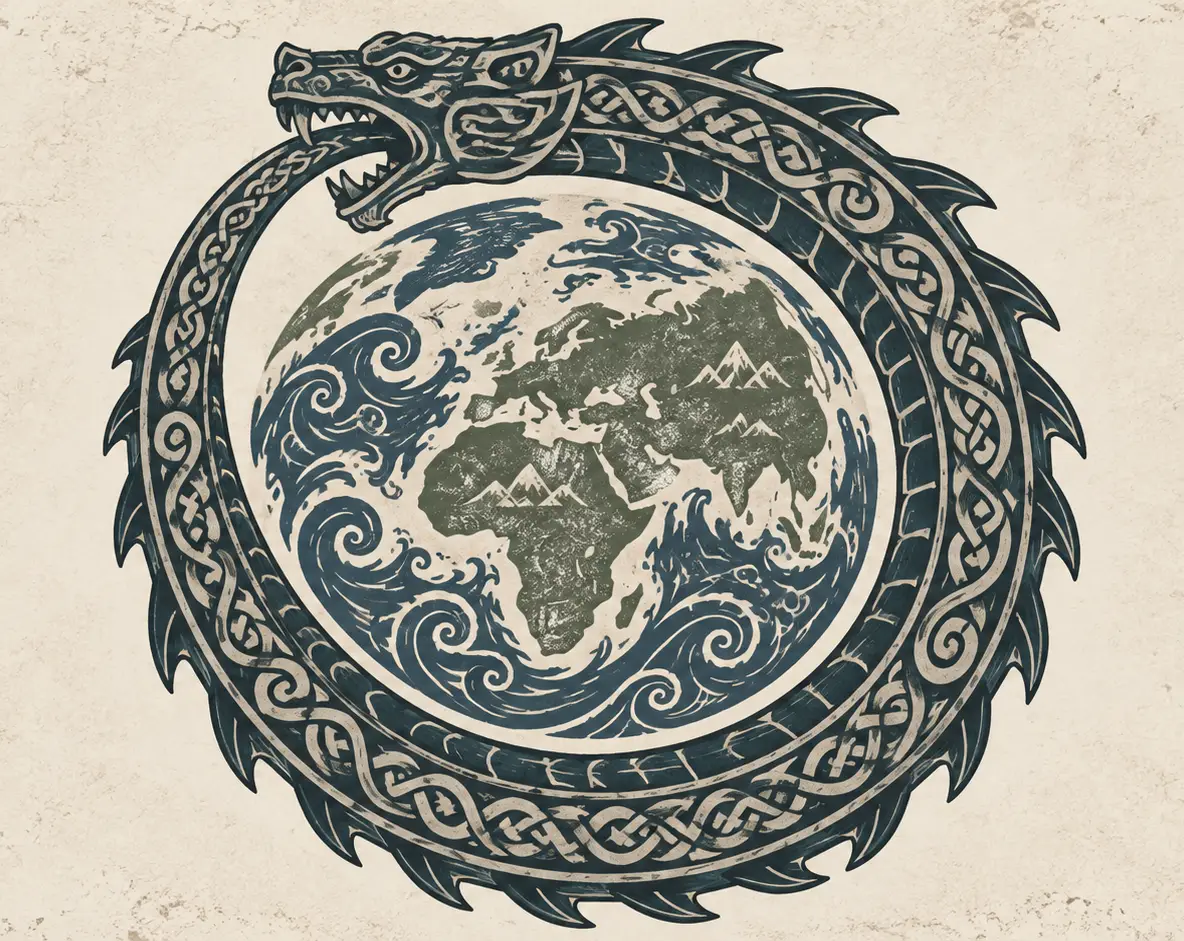
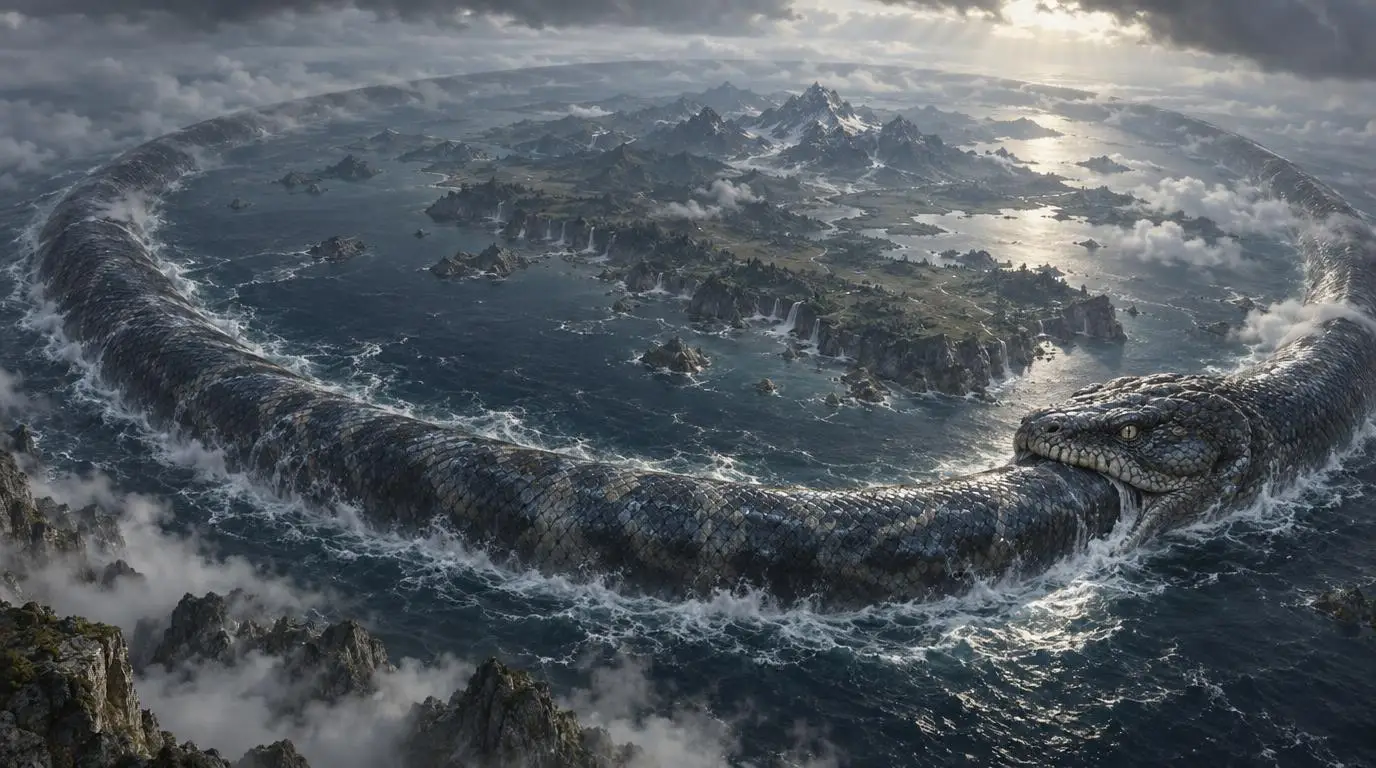
Jörmungandr is the immense sea serpent of Old Norse mythology, also called Miðgarðsormr, the Serpent of Midgard. It inhabits the ocean surrounding the human world and, in the fullest medieval prose account, grows large enough to encircle Midgard and bite its own tail.
The serpent’s principal opponent is Thor, the thunder god. Their encounters connect apparently ordinary activities, including fishing and a test of strength, with forces operating on a cosmic scale.
Their rivalry culminates at Ragnarök, when Thor kills the serpent but dies from its venom.
Jörmungandr belongs to the monstrous family of Loki and Angrboða, alongside the wolf Fenrir and Hel. These relationships place it within a network of beings whose destinies expose the limits of divine power and threaten the established order of the world.
The surviving tradition is substantial but not uniform. Medieval poetry and prose preserve different versions of Thor’s fishing encounter, while Scandinavian carved imagery supplies another form of evidence.
Together, they establish a recognizable mythological figure without providing one completely consistent account of every episode.
History/Origin
Jörmungandr’s tradition survives principally through medieval Icelandic literature, but the surviving manuscripts do not mark the beginning of the myth. The fishing encounter also appears in Scandinavian stone carving, showing that its circulation extended beyond the literary settings in which its fullest narratives were preserved.
The poem Hymiskviða survives in the Codex Regius collection of Eddic poetry and in the manuscript AM 748 I 4to. Its manuscript history is more securely established than its original date of composition, which should not simply be equated with the age of its surviving copies.
Within Hymiskviða, Thor’s confrontation with the serpent forms part of a larger expedition involving the giant Hymir and the acquisition of an enormous brewing cauldron. Whether the fishing adventure and cauldron quest originally belonged together remains debated; their combination is nevertheless part of the surviving poem.
Snorri Sturluson’s Prose Edda, composed around 1220, provides a more connected account of the serpent’s place in the cosmos. In its Gylfaginning section, Odin throws Loki and Angrboða’s serpent offspring into the surrounding sea, where it grows to encompass the human world.
The two fishing accounts should remain distinct. In Hymiskviða, Thor strikes the serpent with his hammer before it sinks into the sea.
In Gylfaginning, Hymir cuts the fishing line; Snorri also acknowledges alternative reports but explicitly favors the serpent’s survival until Ragnarök.
The Altuna runestone in Sweden preserves an important visual counterpart to this literary tradition: Thor’s fishing encounter. Discussed in specialist scholarship on snakes in the Old Norse worldview, such imagery broadens the evidence beyond Icelandic manuscripts without establishing that every pictured detail belonged to every narrative version.
Name Meaning
Jǫrmungandr is the normalized Old Norse form commonly represented in modern English as Jörmungandr. The spelling difference does not indicate a separate creature.
Both forms name the immense serpent whose best-established associations are the surrounding sea, Midgard, and its opposition to Thor.
The historical dictionary of Richard Cleasby and Guðbrandur Vigfússon, published in 1874, glosses Jörmun-gandr as “the Great Monster.” This provides a defensible traditional rendering, but it should not be mistaken for an uncontested, precisely recoverable translation of every element in the compound.
The alternative name Miðgarðsormr is more transparent: it means “Serpent of Midgard” or “Midgard Worm.” Here, “worm” carries an older serpentine meaning, rather than referring to an earthworm.
The name identifies the creature through its relationship with the realm inhabited by humans.
“World Serpent” is therefore an appropriate descriptive English label, especially for the world-encircling form described in Gylfaginning. It is not another being or a separate species.
The geographical title and the personal name emphasize different aspects of the same mythological identity.
Appearance
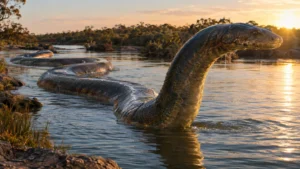
Jörmungandr’s defining form is an enormously elongated serpent associated with the sea. Its significance lies chiefly in its impossible scale and position around Midgard, rather than in a detailed anatomy.
The medieval narratives make its body part of the geography of the mythic world.
In Gylfaginning, the serpent grows until it lies around the inhabited world and bites its own tail. This circular arrangement expresses its world-enclosing size.
It describes the creature’s position in that account, not a pose it must maintain throughout every encounter with Thor.
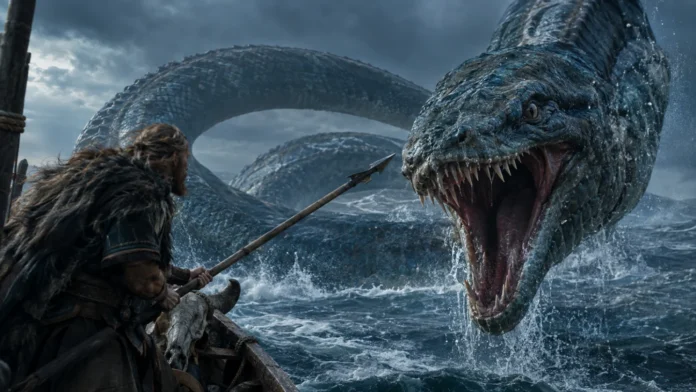
The fishing episode presents a different view: a sea creature caught on a line and drawn toward a boat. Its head, the hook, and the ox-head bait become central visual elements.
The encounter translates otherwise almost unimaginable dimensions into a direct struggle between god and monster.
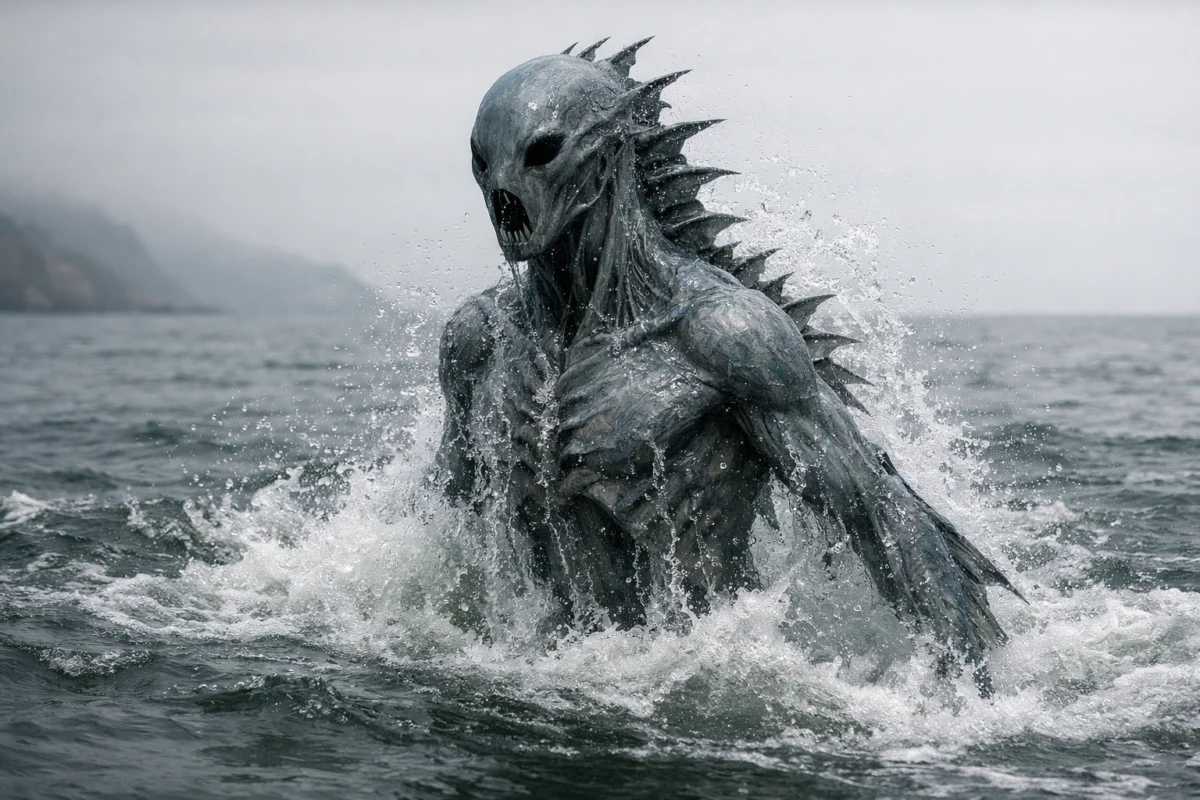
The surviving evidence does not establish a standard color, decorative scale pattern, wings, or horns. Nor does it support replacing the serpent with a human-serpent hybrid.
Elaborate modern designs may serve particular artworks, but their additional features should not be treated as descriptions inherited from the medieval tradition.
A striking exception occurs in Útgarða-Loki’s hall, where Thor tries to lift an apparent cat. Gylfaginning reveals that the animal was the Midgard Serpent concealed through deception.
This is an episode-specific disguise that makes cosmic strength look like a household challenge, not the serpent’s ordinary appearance.
Background Story
Jörmungandr’s background is cosmological rather than biographical. Its ocean home connects it with the outer limits of Midgard, while its enormous body surrounds the human realm.
The creature gives a threatening presence to the waters beyond inhabited land, making the world’s boundary an active mythological force.
Its kinship with Fenrir and Hel reinforces that position. These offspring of Loki and Angrboða confront the gods with dangers they attempt to contain or relocate.
Casting the serpent into the sea establishes its place outside human habitation without removing its eventual threat to divine order.
Thor’s opposition to Jörmungandr brings together the defender of the inhabited world and a creature surrounding it. Their conflict can therefore be understood as more than a contest of strength.
It dramatizes the vulnerability of an ordered world whose boundaries remain occupied by dangerous powers.
The fishing story gives this opposition an everyday setting before revealing its scale. Thor uses an ox’s head as bait while fishing with Hymir, transforming a familiar activity into a confrontation with the world serpent.
The poem and prose differ in how that confrontation ends.
That variation matters to the larger narrative. Hymiskviða lets the struck serpent sink away, whereas Snorri favors its continued survival after Hymir cuts the line.
His account explicitly preserves the opponent needed for Ragnarök, linking an earlier adventure with the final destruction of the gods’ world.
At Ragnarök, Thor’s victory proves fatal: he kills Jörmungandr but succumbs to its venom soon afterward. The serpent’s role thus reaches beyond representing brute menace.
Its final encounter shows that even the gods’ strongest defender cannot overcome the destruction of the existing order without being destroyed himself.
Famous Folklore Stories
Jörmungandr appears in several documented encounters with Thor, preserved in medieval poetry and prose. The headings below describe those episodes rather than reproduce traditional folktale titles.
Their differences matter, particularly where the surviving accounts give different endings to the same confrontation.
Thor’s Fishing Encounter
In Hymiskviða, Thor goes fishing with the giant Hymir and uses an ox-head as bait. The creature he hooks is the Midgard Serpent.
An activity familiar from ordinary life becomes a confrontation between the thunder god and an opponent of world-encompassing size.
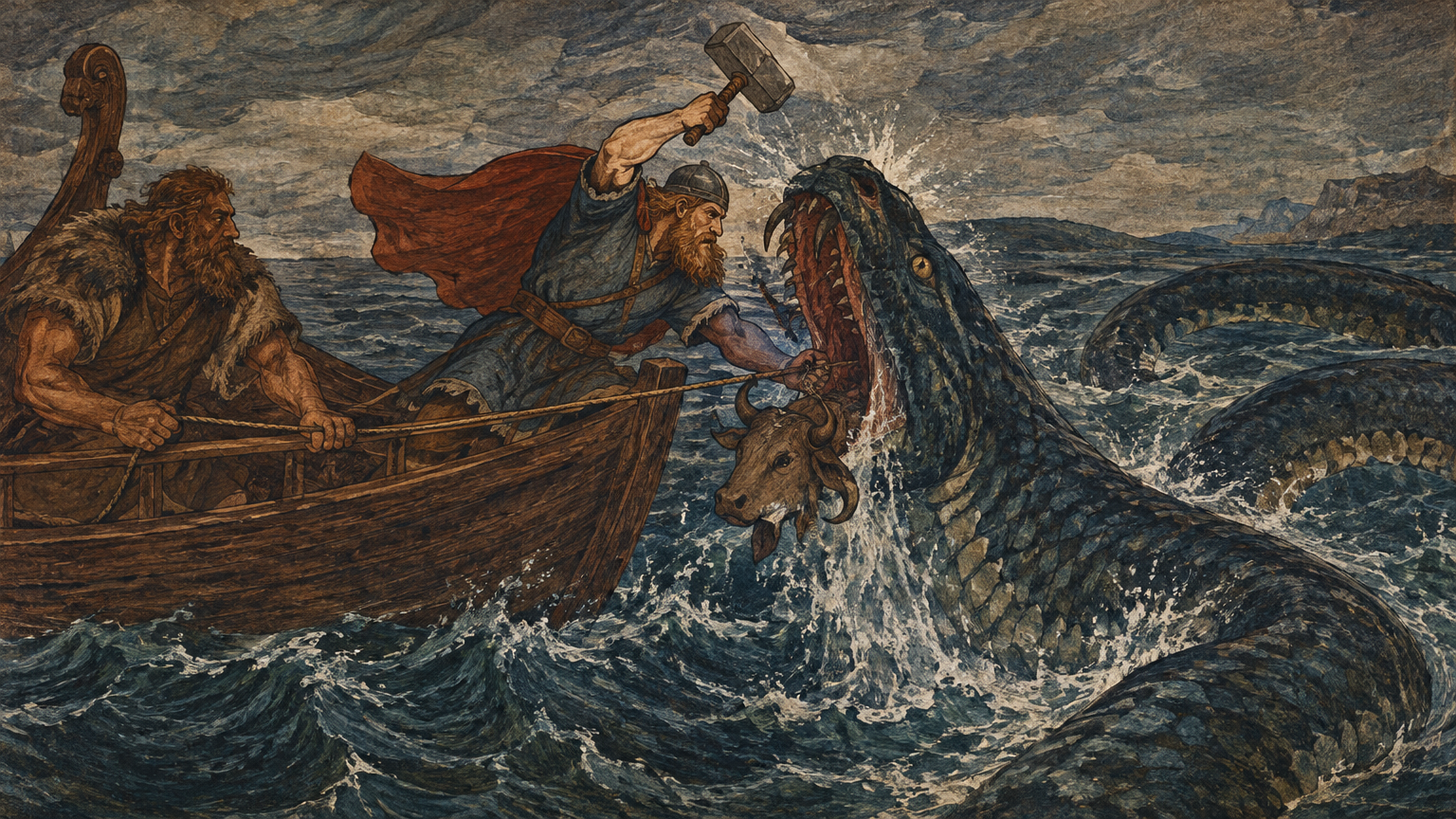
The poem describes Thor striking the serpent with his hammer before it sinks into the sea. It does not describe Hymir cutting the fishing line.
The encounter belongs to a larger narrative involving the acquisition of a giant cauldron, although the relationship between these narrative elements remains debated.
Snorri’s Gylfaginning gives a different ending: Hymir cuts the line as Thor prepares to strike, allowing the serpent to escape. Snorri acknowledges another account involving a hammer blow but favors its survival.
Combining these versions without attribution obscures a genuine difference in the medieval tradition.
The Cat in Útgarða-Loki’s Hall
Another encounter survives in Gylfaginning as part of Thor’s visit to Útgarða-Loki. Thor is challenged to lift what appears to be a cat.
Despite his strength, he cannot lift the entire animal, making the task seem an embarrassing failure.
The apparent cat is actually Jörmungandr concealed by magic. Thor’s effort therefore tests his strength against the serpent surrounding the world, not an ordinary household animal.
The revelation reverses the meaning of the contest: apparent weakness becomes evidence of extraordinary power exercised against a disguised cosmic opponent.
The Final Battle at Ragnarök
At Ragnarök, Thor and Jörmungandr meet in a confrontation that neither survives. Thor kills the serpent, but its venom causes his own death soon afterward.
Unlike an uncomplicated monster-slaying story, this encounter gives the victorious god no lasting escape from his opponent’s destructive power.
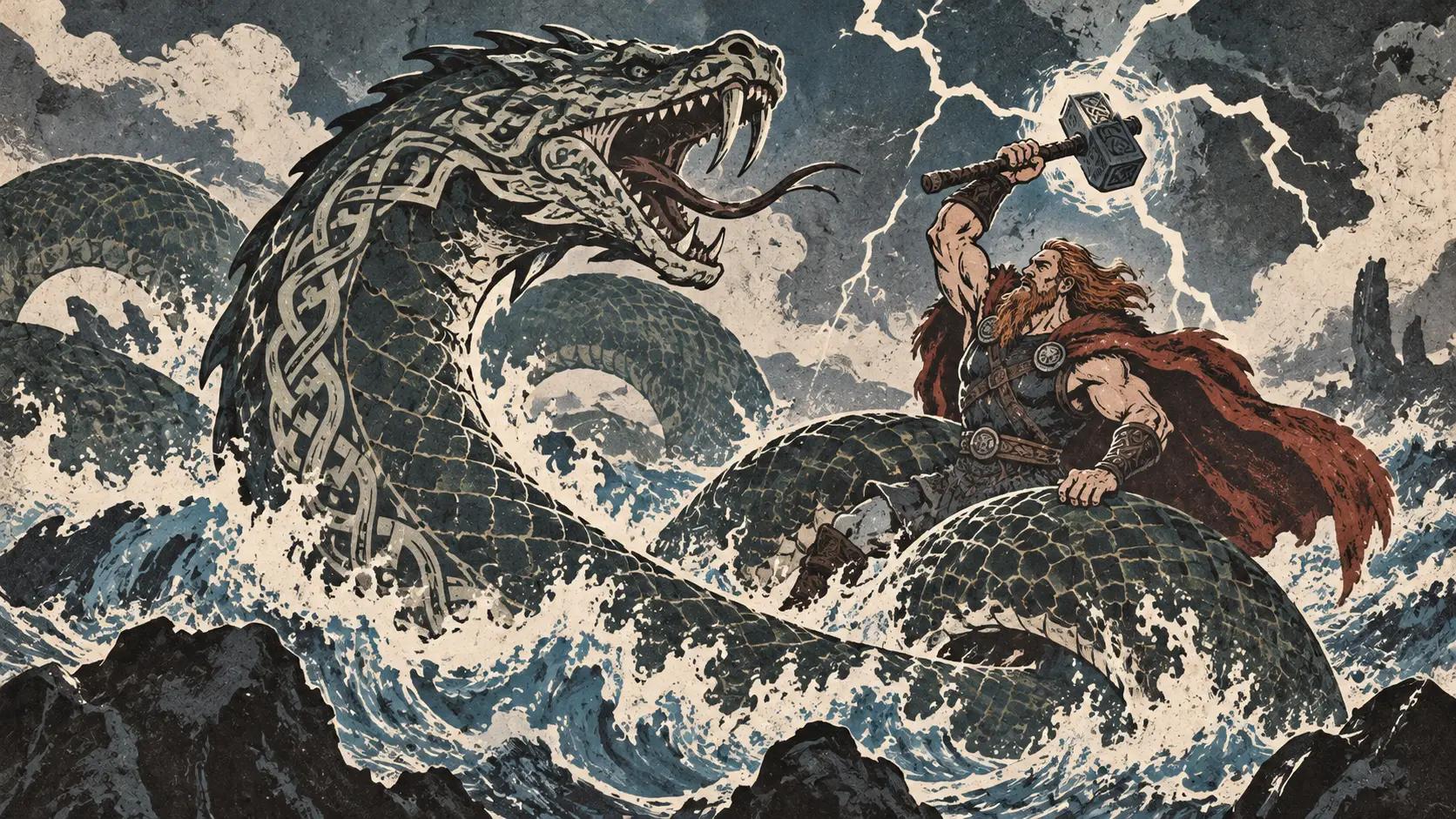
The final battle changes the significance of their earlier encounters. Fishing and deceptive contests become preliminary meetings between destined enemies.
Snorri’s preference for the serpent surviving the fishing expedition preserves this sequence explicitly, leaving the decisive killing for the destruction of the existing divine order.
Cultural Impact
The fishing encounter circulated beyond written storytelling. Scandinavian stone-carving traditions represented Thor’s struggle with the serpent, including the scene associated with the Altuna runestone in Sweden.
Such imagery establishes that the episode had a visual presence as well as a place in medieval literary collections.
The scene brings together recognizable fishing equipment and an impossible catch. Its cultural force lies partly in that contrast: a boat and bait connect the action to familiar experience, while the immense serpent transforms a practical activity into an encounter at the limits of the human world.
Jörmungandr also gives physical form to a boundary. Its body encircles Midgard in the surrounding sea, joining the geography of the inhabited world to a living threat.
Read symbolically, the creature makes the world’s outer limit both an enclosing structure and a source of danger.
Modern scholarship examines the serpent within the broader range of snake imagery in Old Norse culture. The specialist study The Holy Serpent: Snakes in the Old Norse Worldview provides this wider context.
Such interpretation should not make every snake image a depiction of Jörmungandr.
Similar Beasts
Fenrir
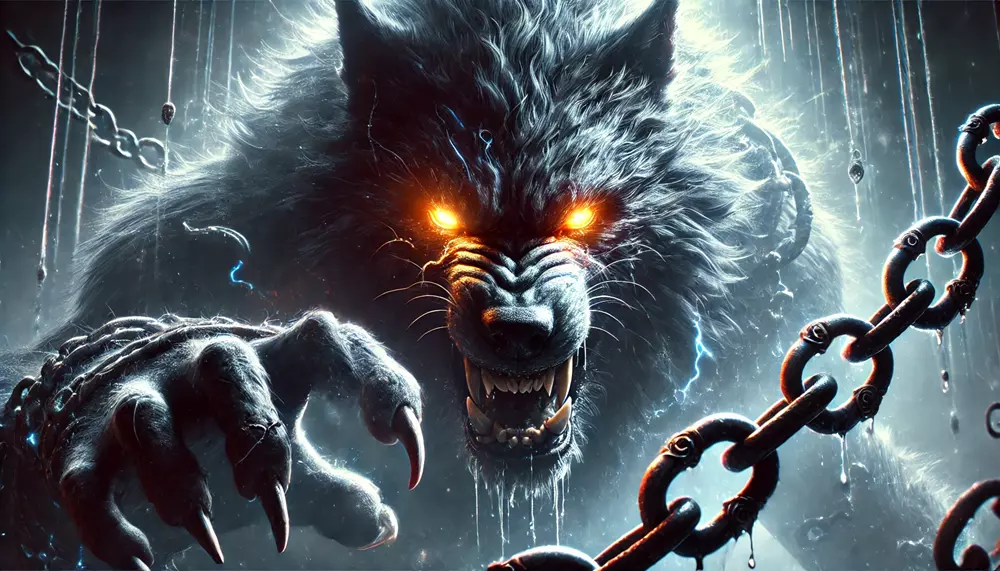
Fenrir is the enormous wolf of Norse mythology, another monstrous offspring of Loki. At Ragnarök, he breaks free and devours Odin, becoming a direct threat to divine authority.
His strongest connection with Jörmungandr is familial and narrative: both confront gods at the final catastrophe. Fenrir remains a wolf, not another serpent form.
Kraken
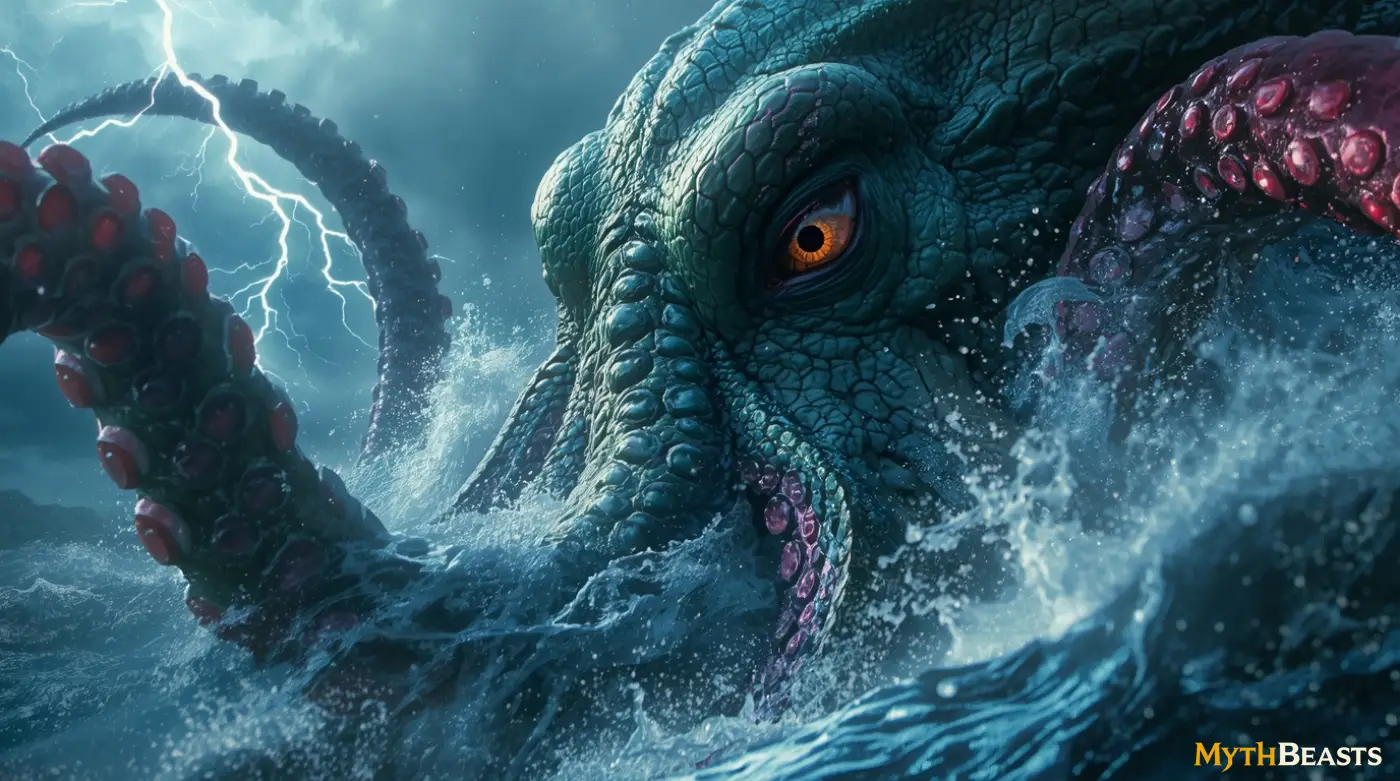
The Kraken is a gigantic sea monster associated with Scandinavian maritime tradition. Its capacity to threaten ships expresses the danger posed by creatures imagined beneath the ocean’s surface.
Both beings make the sea a setting for overwhelming nonhuman power. Unlike Jörmungandr, the Kraken is not defined by encircling Midgard or fighting Thor.
Inkanyamba

Inkanyamba is a massive water serpent in Zulu folklore, associated with storms and whirlwinds. Its serpentine form connects an aquatic supernatural presence with destructive disturbances in the surrounding environment.
The comparison concerns immense aquatic bodies and threatening natural power. It does not establish shared origins or give Inkanyamba Jörmungandr’s role in Norse cosmology.
Yacumama
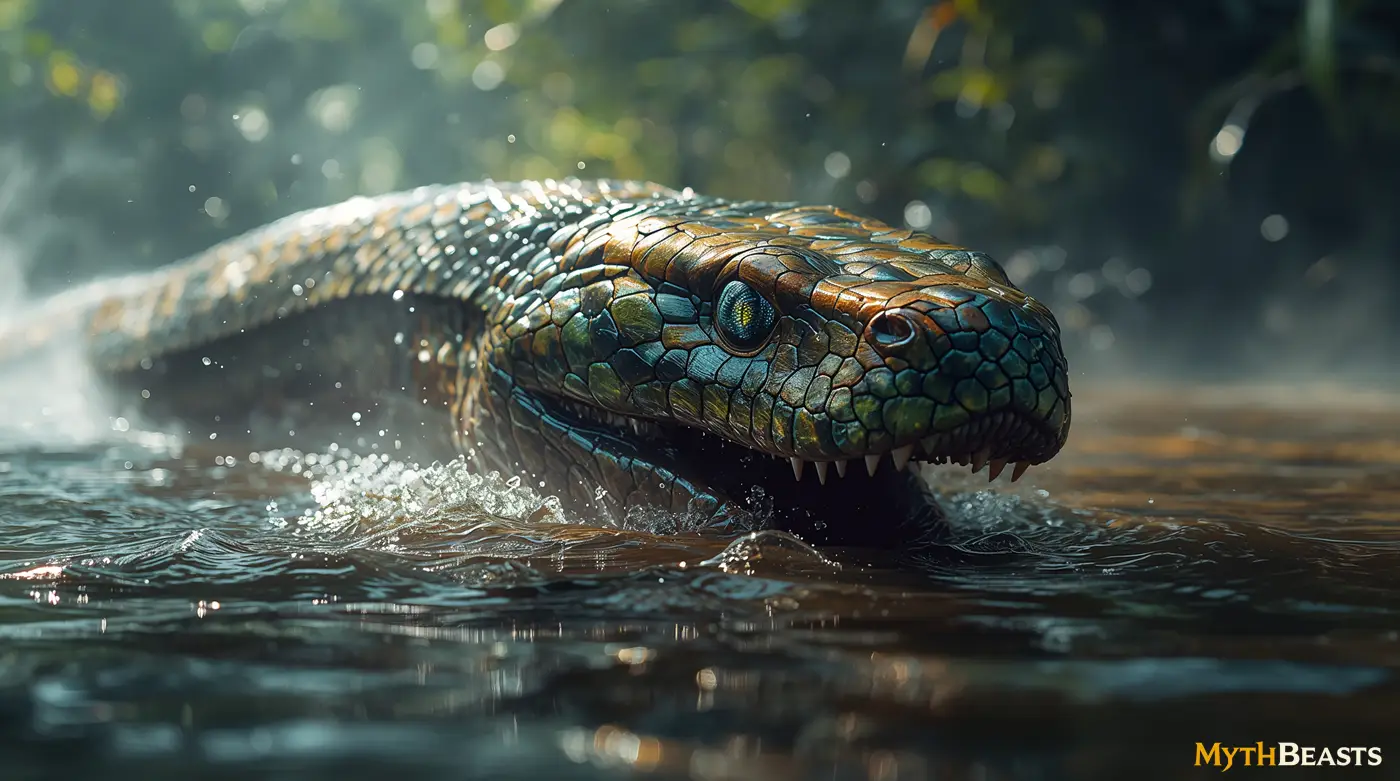
Yacumama is an Amazonian water serpent associated with Indigenous folklore and the supernatural guardianship of rivers. Its identity belongs to river environments rather than the sea enclosing Midgard.
Both figures connect serpentine form with waters beyond ordinary human control. Their functions differ: river guardianship should not be equated with Jörmungandr’s destined apocalyptic conflict.
Religion/Ritual
The evidence reviewed documents mythic narratives and artistic representations, but no specific ritual devoted to Jörmungandr. The serpent’s importance as Thor’s opponent does not by itself establish worship, offerings, festivals, or taboos.
Likewise, a carved encounter scene is not sufficient evidence for a serpent cult.
Scientific or Rational Explanations
Jörmungandr belongs to mythology, not zoological classification. Its world-encircling body and encounters with a god establish a supernatural narrative scale.
Identifying an actual snake species cannot explain those features, and the available evidence does not connect the tradition to a verified animal encounter.
A symbolic reading can begin with the serpent’s position around Midgard. Its enclosing body makes a geographical boundary visible through an animal form.
This is an interpretation of the narrative’s structure, not proof that its creators intended a single, consistently articulated theory of the cosmos.
The fishing episode similarly lends itself to an environmental reading. Familiar maritime work becomes a dangerous encounter with something concealed beneath the surface.
That contrast helps explain the story’s dramatic effectiveness, but it does not establish that a particular storm, catch, or maritime accident originated the myth.
Textual comparison offers firmer historical ground than attempts to identify a real monster. Hymiskviða survives in Codex Regius and AM 748 I 4to, while Gylfaginning preserves a different prose telling.
Their divergent endings demonstrate variation in transmission rather than a single account reproduced without change.
Comparisons with other enormous water creatures can clarify recurring imaginative patterns, but resemblance alone cannot establish borrowing. A shared serpentine shape or aquatic setting is weaker evidence than a demonstrable historical connection.
Jörmungandr is best understood first through its particular relationships with Midgard, Thor, and Ragnarök.
Modern Cultural References
God of War, video game (2018)
Santa Monica Studio’s game brings its ongoing adventure series into a setting shaped by Norse mythology.
Jörmungandr appears as the World Serpent, a character within that reimagined mythological world.
(playstation.com)
God of War Ragnarök, video game (2022)
This sequel continues the Norse mythology storyline developed in the preceding game.
Jörmungandr appears again, extending the franchise’s creative portrayal of the serpent within its own narrative continuity.
(playstation.com)
Thor (1966) #380, comic (1987)
This Marvel comic by Walt Simonson pits Thor against the World Serpent, Jormungand.
Their confrontation adapts the traditional antagonism between thunder god and serpent for superhero comic storytelling.
(marvel.com)
Asgardians: Thor, graphic novel (2024)
George O’Connor’s graphic novel retells adventures of the Norse thunder god in illustrated form.
Thor’s search for the Midgard serpent, Jormungandr, connects the narrative directly with the traditional creature.
(us.macmillan.com)
The Haunted House: The Sky Ghost vs Jormungandr, animated film (2019)
This South Korean animated film was directed by Byeon Young-Kyu and released in 2019.
Its named opponent, Jormungandr, represents a creative screen adaptation rather than a medieval narrative source.
(pro.imdb.com)
NORSE – The Jörmungandr, podcast episode (2026)
Unexplained Realms released this dedicated episode on May 25, 2026, as part of its podcast.
Jörmungandr is its direct subject, representing spoken popular reception rather than a fictional portrayal.
(listennotes.com)
Conclusion
Jörmungandr brings the scale of Norse cosmology into the form of a single immense serpent. Associated with the sea surrounding Midgard, it marks the boundary of the human world while remaining inseparable from Thor’s encounters and final battle.
Its significance rests less on a detailed physical description than on these relationships: ocean and inhabited land, monstrous power and divine resistance, survival and destruction. The serpent’s death does not secure an uncomplicated victory, because Thor also dies from its venom.
The surviving tradition is substantial, but it is not uniform. The different endings of the fishing encounter in Hymiskviða and Snorri’s Gylfaginning show why individual versions should remain distinguishable, even when later retellings combine them.
Modern games, comics, and animation continue to reshape the serpent for different audiences. These adaptations extend its cultural presence without replacing the medieval evidence.
Jörmungandr endures as both a memorable narrative opponent and an image of powers that even the gods cannot overcome without consequence.
Further Reading
Hymiskviða; Snorri Sturluson’s Gylfaginning, Davidw0311.github
In Hymiskviða, Thor goes fishing with Hymir, uses an ox-head as bait, and hooks the serpent.
Thor strikes it with his hammer before it sinks into the sea.
(davidw0311.github.io)
Gylfaginning, Hrafn Wikinger
At the final conflict, Thor fights and kills the serpent, but the serpent’s venom kills Thor soon afterward.
Snorri’s Gylfaginning relates the battle and the serpent’s place in.
(hrafn-wikinger.com)
God of War, playstation.com
game 2018 The game features Jörmungandr, the World Serpent, as a character in its Norse-mythology story.
(playstation.com)
God of War Ragnarök, playstation.com
game 2022 Jörmungandr appears in this sequel as part of the continuing Norse-mythology story.
(playstation.com)
Thor (1966) #380, marvel.com
comic 1987 Marvel’s official issue page identifies the World Serpent Jormungand as Thor’s opponent in the comic.
(marvel.com)
Asgardians: Thor, us.macmillan.com
comic 2024 This published graphic novel retells Thor’s adventures, including his search for the Midgard serpent, Jormungandr.
(us.macmillan.com)
NORSE – The Jörmungandr, listennotes.com
podcast episode 2026 A dedicated episode about Jörmungandr, published May 25, 2026.
(listennotes.com)
The Girdle of the Earth, kobo.com
novel 2026 The publisher listing describes a released novel retelling the Norse myth from Jörmungandr’s perspective; its listed release date is October 1, 2026.
(kobo.com)