Introduction
Fossegrim is a supernatural being in Norwegian folk tradition, associated with waterfalls, water-powered mills, and extraordinary music. His best-known role is that of a mysterious fiddle teacher who can grant a human musician abilities beyond ordinary instruction, provided the encounter follows particular conditions.
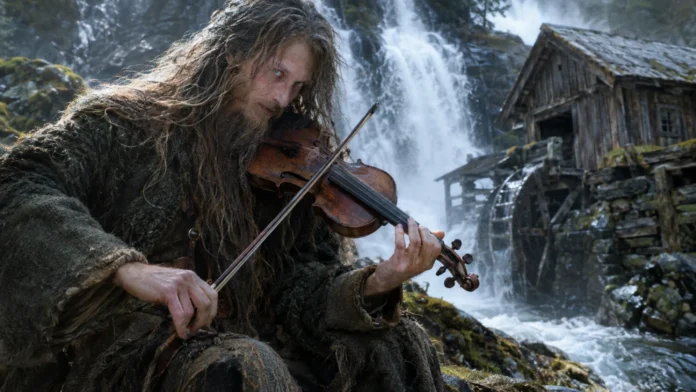
The waterfall is more than a backdrop. It identifies the being’s place within a landscape of running water, while the mill connects him with human work.
Legends place his presence both outside settled life and beside machinery essential to everyday subsistence.
Musical skill defines Fossegrim more consistently than any particular appearance. He can teach, frighten, or obstruct, and early accounts allow him several forms.
A musician beside falling water represents one important aspect of the tradition, not a complete description of every encounter.
Fossegrim belongs to a wider Scandinavian group of supernatural water musicians, including figures associated with Swedish fiddle-teacher legends. These relationships help explain shared motifs, but they do not make every regional water spirit another name for the same Norwegian being.
History/Origin
An important early printed account appears in Andreas Faye’s 1844 collection Norske Folke-Sagn, under the heading “Grim eller Fossegrim.” It brings together musical instruction, waterfall offerings, and encounters at mills, preserving a broader figure than a benevolent supernatural tutor alone.
The publication establishes that these traditions were circulating by the nineteenth century; it does not establish when they began. Faye’s collection presents gathered and edited folklore rather than an unmediated transcript of a single performance, so its grouping of names and episodes also requires attention.
Within that account, Grim, Fossegrim, Fossekallen, and Qvernknurren are names used in different places. Their inclusion shows how local supernatural traditions could overlap.
It does not demonstrate that every community understood the being identically or told the same stories about him.
The musical legends also belong to a wider Scandinavian tradition. Terry Gunnell’s specialist study, “The Fiddler and the Waterfall,” examines supernatural fiddle teachers across regional settings, where names such as Fossegrimen, Näcken, and Strömkarlen occur.
Shared narrative patterns coexist with differences in terminology and distribution.
This regional perspective matters because the Norwegian waterfall musician should not simply be reconstructed from Swedish water-spirit imagery. Similar stories can travel or develop alongside one another without erasing local identities.
Fossegrim’s Norwegian waterfall-and-mill setting remains the clearest starting point for understanding him.
The figure later entered theatrical interpretation. A documented production of Fossegrimen, with a text by Sigurd Eldegard and music by Johan Halvorsen, opened at Det Norske Teatret in 1926.
That production belongs to the history of artistic adaptation, not evidence for the tradition’s original form.
Name Meaning
The name Fossegrim combines a waterfall-related first element, fosse-, with -grim. Its opening element therefore expresses the being’s characteristic location directly.
The name ties the supernatural presence to falling water rather than identifying a particular animal shape or a fixed class of monster.
Det Norske Akademis ordbok identifies the second element as the same word as Norwegian grime. It should not simply be read as the modern English adjective “grim.”
The compound is best understood within Norwegian supernatural vocabulary, with the waterfall association clearer than a neat word-for-word English translation.
Fossegrimen is the definite form, referring to “the Fossegrim,” rather than a separate creature. The shorter Grim also appears in Faye’s account.
These grammatical and naming differences help explain why discussions of the tradition do not always use an identical headword.
Faye additionally records Fossekallen and Qvernknurren, also written Kvernknurren, as local names within his account. Their equivalence belongs to that collected context.
Näcken and Strömkarlen, by contrast, are better treated as names of related regional figures, not automatically added to a universal list of Fossegrim synonyms.
Faye’s 1844 collection provides a nineteenth-century printed witness to the name and tradition. It does not establish an attested Old Norse form or prove medieval origins; the tradition’s beginnings remain unresolved.
Appearance
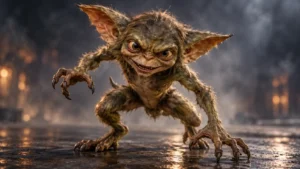
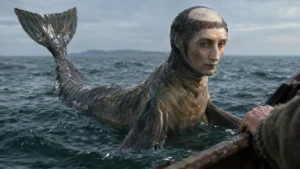
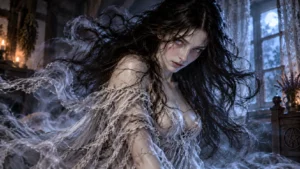
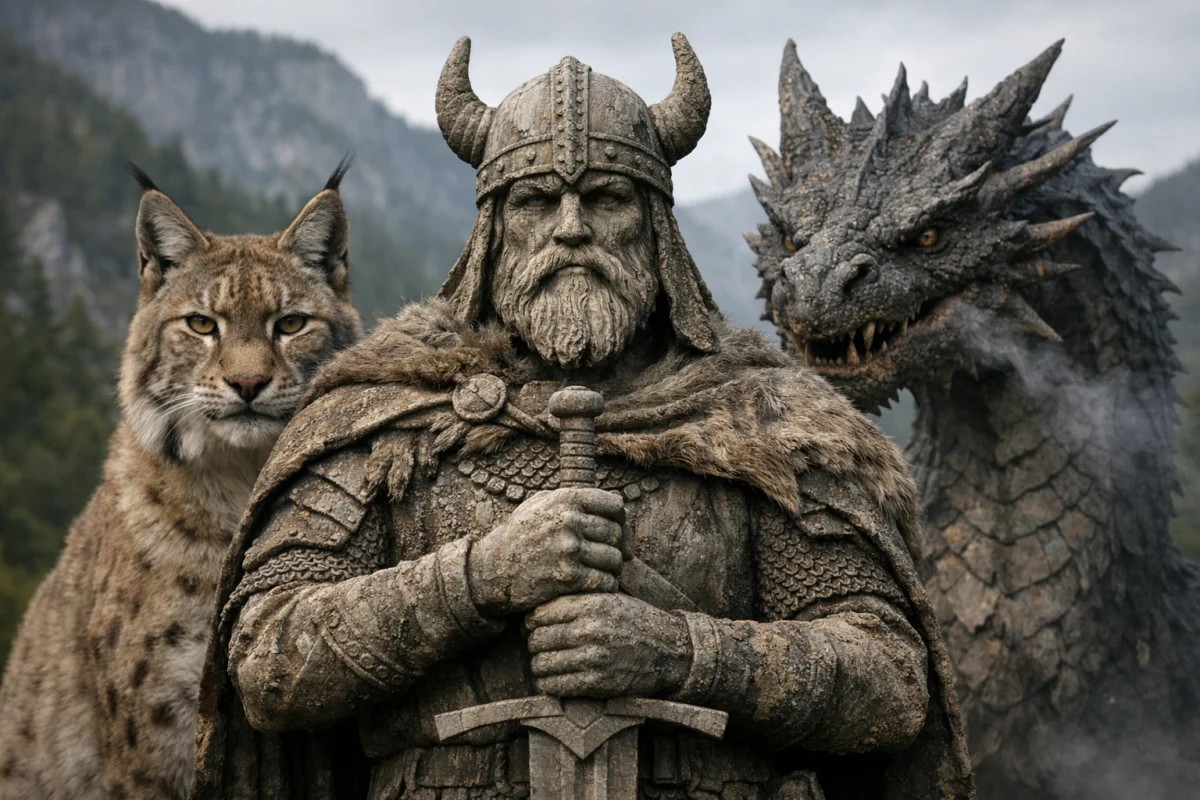
Fossegrim has no single canonical body in the early evidence. His identity rests on supernatural agency, musical ability, and association with waterfalls and mills.
A recognizable setting and characteristic behavior can establish his presence even when the form encountered differs sharply from a human musician.
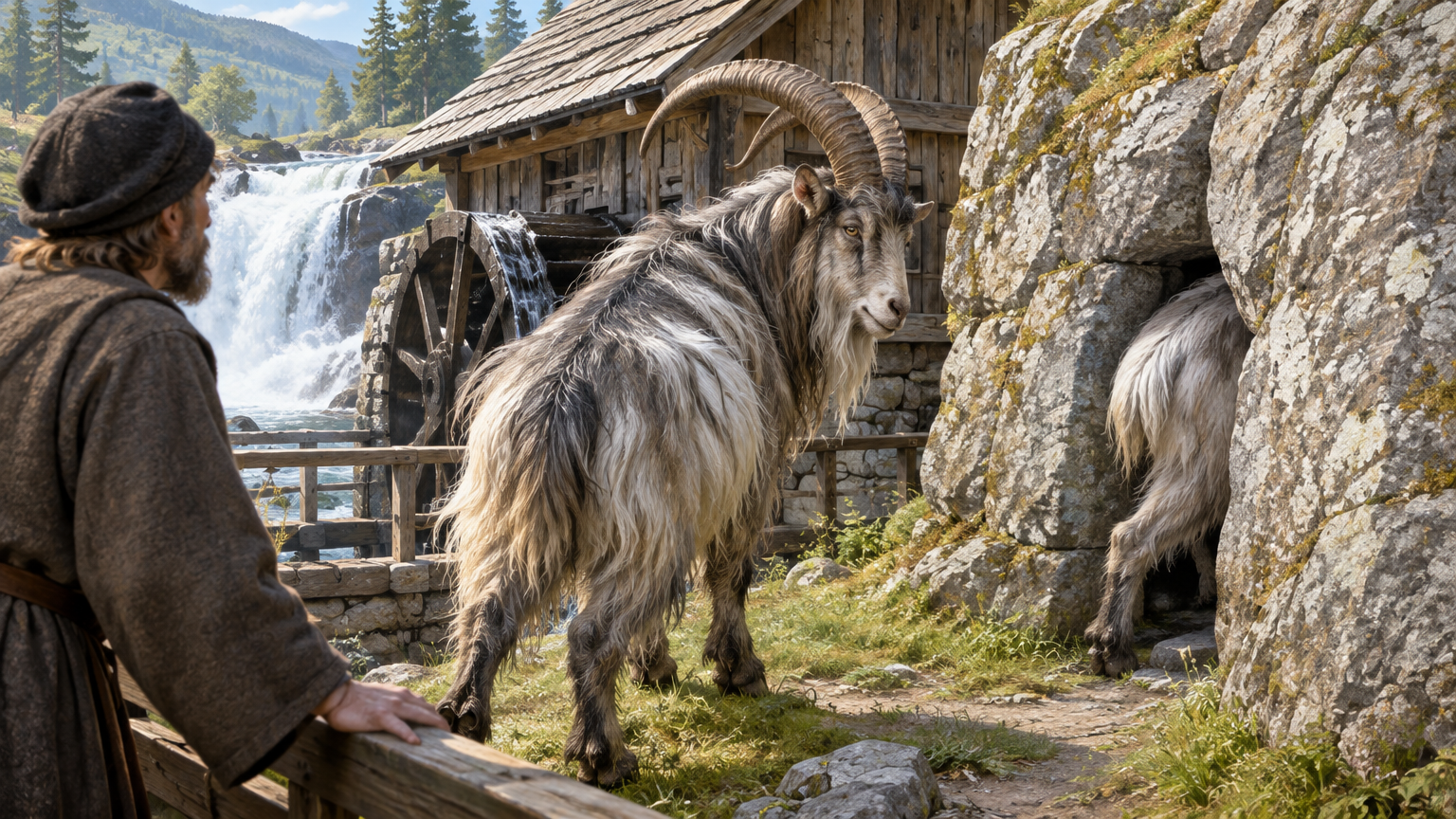
One encounter in Faye’s collection involves an enormous horned billy goat entering a mill. The animal subsequently leaves and disappears into a large stone.
This impossible departure reveals its supernatural character, and the witness identifies the visitor as Fossegrim rather than an ordinary wandering goat.
The goat is a form taken in a particular encounter, not the creature’s permanent anatomy. It must also be distinguished from the white goat kid offered by a prospective musical pupil.
The animal appearing as the spirit and the animal presented as an offering have different narrative roles.
A separate mill episode, attached to the name Qvernknurren, presents a grotesque figure whose enormous mouth spans the doorway. Because Faye groups this name with Fossegrim, the episode belongs to the collected tradition, but its exaggerated features should remain attached to that specific manifestation.
The musical role also supports imagery centered on a fiddle, while Norwegian lexicographic descriptions mention skill with fiddle or harp. Neither instrument establishes a standard costume, age, or bodily form.
The contrast between musician, animal apparition, and doorway-filling presence is itself an important feature of the surviving accounts.
Background Story
Fossegrim’s background is a meeting of water, work, and musical accomplishment rather than a continuous personal biography. Waterfalls supply his characteristic dwelling place; mills bring encounters into the working landscape.
Together, these settings connect a powerful natural force with activities on which people depended.
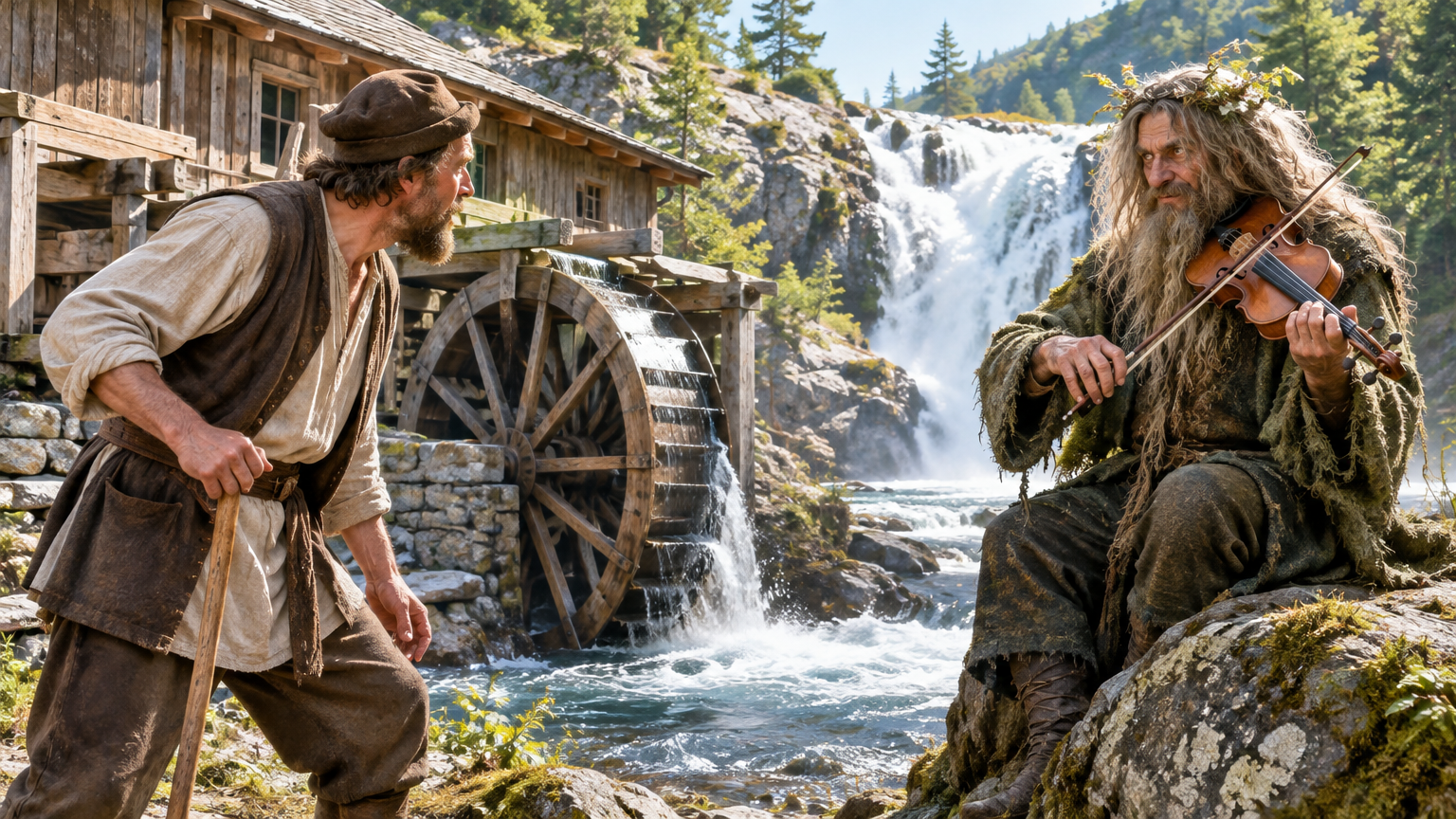
At the mill, supernatural interference provides the basis for conflict. In the Qvernknurren episode, repeated stoppages lead the miller to confront the being he holds responsible.
The spirit is therefore not restricted to granting artistic gifts: he can also obstruct the practical use of flowing water.
The fiddle-teacher tradition places a different human ambition beside the waterfall. In Faye’s version, a would-be pupil brings a white goat kid to a north-flowing waterfall on a Thursday evening.
Direction, timing, and the offering establish the conditions for obtaining otherwise inaccessible instruction.
The offering’s quality determines the result. A lean animal may earn only the ability to tune the instrument, while a sufficient offering brings extraordinary playing.
The distinction makes supernatural instruction an exchange with demanding terms, rather than a gift automatically bestowed on anyone who approaches.
The successful lesson is also physically severe: the teacher guides the pupil’s hand until the fingers bleed. Within the legend, exceptional artistry carries a cost.
This connects the supernatural explanation of musical brilliance with an intensified image of the bodily demands of learning an instrument.
These episodes belong to a broader Scandinavian interest in the mysterious sources of musical ability. Their specific conditions should nevertheless remain attached to their documented versions.
Fossegrim’s background emerges from overlapping local legends about skill, exchange, water, and danger, not from one uniform account shared across Scandinavia.
Famous Folklore Stories
Fossegrim’s surviving narratives include a supernatural music lesson and unsettling encounters at mills. Andreas Faye’s 1844 collection preserves the episodes below.
Their headings are descriptive labels, not authenticated traditional tale titles; the mill episodes are encounter accounts rather than named folktales.
The supernatural fiddle lesson
A would-be fiddler seeks instruction at a north-flowing waterfall on a Thursday evening, bringing a white billy-goat kid as an offering. The outcome depends on its quality: a lean animal earns only enough instruction to tune the instrument, not the extraordinary ability the visitor desires.
A sufficiently rich offering brings a much more demanding lesson. Fossegrim guides the pupil’s hand until the fingers bleed, after which the musician can play with supernatural power.
In this version, exceptional skill comes through an exchange involving both material generosity and bodily suffering.
The goat encountered at the mill
One encounter account concerns a man at a mill who sees an enormous horned billy goat enter. The visitor subsequently leaves and disappears into a large stone.
This impossible departure leads the witness to recognize the animal as Fossegrim rather than an ordinary goat.
Unlike the fiddle lesson, this episode contains no request for instruction or exchange of gifts. Its central motif is recognition through an uncanny event.
The goat belongs to this particular encounter and should not be treated as Fossegrim’s universal appearance, especially since the tradition allows different forms.
The mill obstructed by Qvernknurren
Another account in Faye’s collection begins with a mill that repeatedly stops working. The miller attributes the trouble to Qvernknurren and attempts to drive the being away.
He then confronts a grotesque figure filling the doorway, its enormous mouth extending across the opening.
Faye groups Qvernknurren among locally used names for the being, making this episode relevant to his presentation of Fossegrim. Nevertheless, its threatening mill encounter differs substantially from the musical teaching legend.
Keeping that distinction preserves the range of the collection rather than creating one continuous biography.
Cultural Impact
Fossegrim gives supernatural form to exceptional musical ability. The central legend distinguishes merely tuning a fiddle from playing with extraordinary power.
Read as a story about musicianship, it presents mastery as something remarkable enough to require an explanation beyond ordinary instruction.
The waterfall and mill settings also connect the figure with places where moving water was both conspicuous and useful. These are not interchangeable wilderness backdrops: the teaching episode concerns a waterfall, while the mill encounters bring supernatural interference into a working human environment.
Historical literary usage, preserved in the Norwegian Academy dictionary, shows that the name also circulated beyond encounter narratives. That evidence supports a place in Norwegian literary language, but it does not establish that every literary reference reproduces the same beliefs or the same version of the figure.
The stage offered another setting for reinterpretation. A documented production of Fossegrimen: Trollspel i fire vendingar, by Sigurd Eldegard with music by Johan Halvorsen, opened at Det Norske Teatret in 1926.
Its recorded performances demonstrate theatrical adaptation, not direct evidence of older ritual practice.
Modern comparative scholarship places the Norwegian fiddle teacher within a wider Scandinavian legend complex. Terry Gunnell’s study, The Fiddler and the Waterfall, emphasizes regional names and related motifs.
This approach makes connections visible without requiring every supernatural musician to become the same being.
Similar Beasts
Näcken
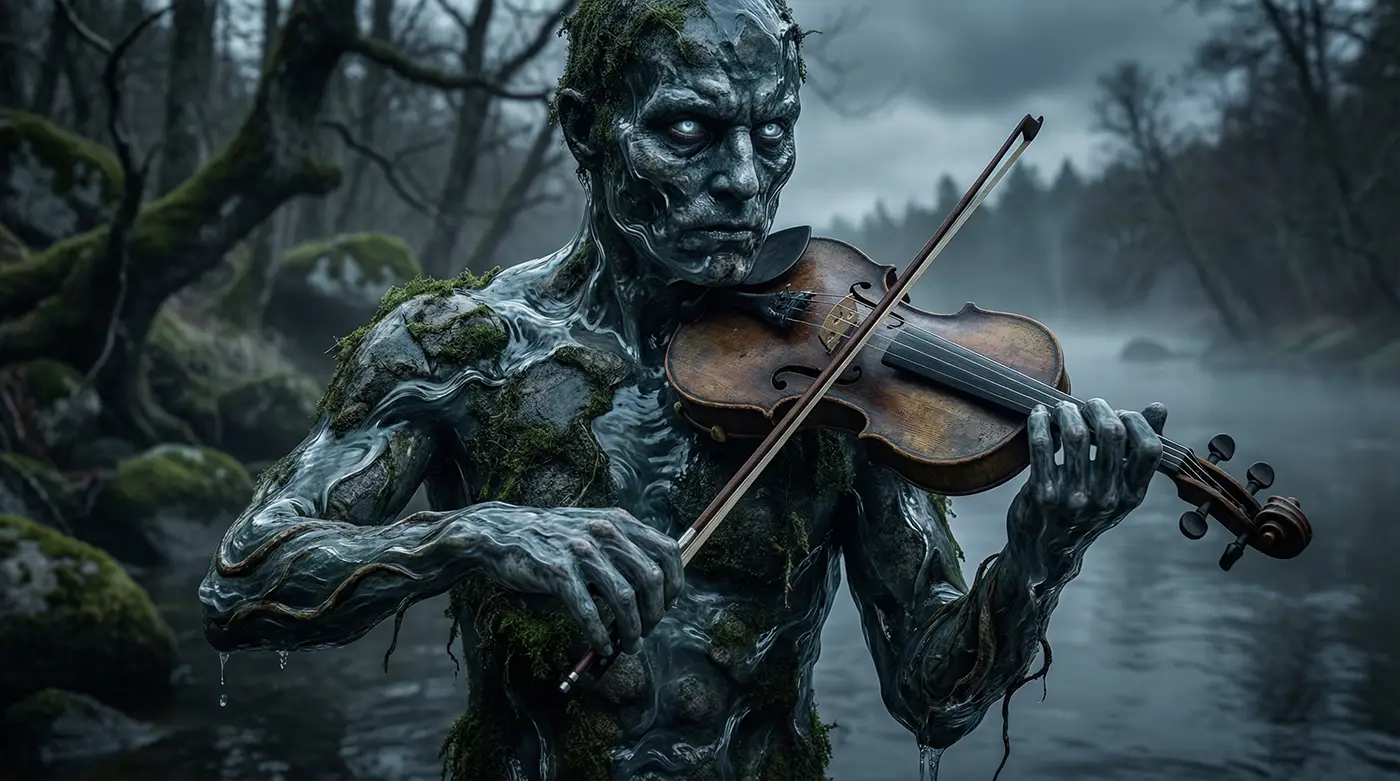
Näcken is a Scandinavian water spirit associated with enchanting music and shapeshifting. Swedish fiddle-teacher traditions place the figure within the same broad narrative complex as Fossegrim’s supernatural instruction.
The musical relationship is close, but regional distinctions matter. Näcken should not simply replace Fossegrim’s name or supply every detail missing from Norwegian accounts.
Kelpie

The Kelpie is a shapeshifting water spirit in Scottish folklore, commonly appearing as a horse and luring people toward danger in the water. Its encounters emphasize deceptive appearances.
Like Fossegrim’s goat encounter, Kelpie traditions make animal appearance an unreliable guide to identity. The Kelpie’s predatory role differs from Fossegrim’s musical teaching.
Vodyanoy

The Vodyanoy is a Slavic water spirit associated with rivers and ponds, known for its temper and dangerous encounters with unwary people. Shapeshifting belongs to its broader characterization.
Both figures make freshwater a setting for encounters with unpredictable supernatural beings. The supplied comparison does not establish a corresponding Vodyanoy fiddle-teacher tradition.
Nøkken
Nøkken belongs to Norwegian water-spirit tradition and is explicitly recognized as related to Fossegrim. That relationship provides a close cultural comparison without making the two figures automatically identical.
Fossegrim’s waterfall, mill, and fiddle-teaching associations remain the clearest basis for distinguishing this article’s subject from the broader neighboring cluster of water-spirit beliefs.
Religion/Ritual
The clearest offering prescription appears in Faye’s 1844 account: a person seeking musical instruction brings a white billy-goat kid to a north-flowing waterfall on a Thursday evening. These conditions belong to that recorded version, not to a demonstrated universal Scandinavian ceremony.
Within the narrative, the offering establishes an exchange with a supernatural teacher. Its adequacy determines the instruction received.
This is evidence of offering lore in folk belief, but the account alone cannot establish how frequently people actually attempted the prescribed action.
The material does not establish an organized religion devoted to Fossegrim, a priesthood, or a standardized public observance. It is better understood as a recorded means of approaching a local supernatural being for a particular benefit, rather than a complete system of worship.
Related Scandinavian fiddle-teacher legends contain varying conditions and offerings. Those differences should remain attached to their documented regional settings.
Combining them into an expanded Fossegrim ritual would produce a modern reconstruction rather than a faithful account of the Norwegian evidence presented here.
Scientific or Rational Explanations
The evidence establishes a documented folklore tradition, not a scientifically verified supernatural entity. Early collections, dictionaries, and later scholarship answer questions about narratives, terminology, and transmission.
They do not independently verify that an encounter occurred exactly as its published account presents it.
A cultural interpretation can read the fiddle lesson as an explanation for outstanding musicianship. The contrast between basic tuning and extraordinary performance makes differences in ability central to the story.
This reading concerns the legend’s meaning, not a proven account of how it originated.
The bleeding fingers can likewise be read as a narrative expression of the cost of mastery. That interpretation fits the episode’s demanding lesson, but it should not become a claim that the story secretly records a particular training technique or documented historical injury.
The mill accounts require similar restraint. A stopped mill is an ordinary technical problem given a supernatural cause within the narrative.
Without independent information about a particular incident, identifying a mechanical failure, misidentified animal, or perceptual disturbance would be speculation rather than an explanation established by evidence.
Finally, the published record itself requires interpretation. Faye’s collection preserves an early printed presentation, not an unedited transcript of one performance.
Comparing its episodes with later regional scholarship helps distinguish collected variants from modern synthesis, while leaving the tradition’s undocumented earlier development unresolved.
Modern Cultural References
Fossegrimen: Trollspel i fire vendingar, theatre production (1926)
This production presented Sigurd Eldegard’s play with music by Johan Halvorsen.
Its documented performances place Fossegrim within Norwegian theatrical reception, beyond the collection and retelling of folk legends.
(arkiv.detnorsketeatret.no)
The Fossegrim | Scandinavian Folklore, podcast episode (2024)
Myths & Magic devotes this episode to the Norwegian supernatural figure.
It introduces Fossegrim as a water spirit, bringing the folklore to listeners through contemporary audio storytelling.
(metacast.app)
UBMC Witch Whisper 143: The Fossegrim, podcast episode (2024)
Uncle Bob’s Magic Cabinet dedicates this instalment to Fossegrim and its folklore.
The episode provides another example of the Norwegian figure’s continuing circulation in contemporary supernatural-themed audio.
(unclebobsmagiccabinet.com)
Nordic Folktale Water Creatures, podcast episode (2023)
Nordic on Tap explores several water beings in this episode, accompanied by a transcript.
Fossegrim appears within that wider discussion, alongside descriptions and related Nordic folklore.
(nordicontap.com)
“Fossegrimen” Poster Edition, art poster
Raymond Heggheim’s poster offers a contemporary artistic portrayal of Fossegrimen. The accompanying description connects the image to the folklore figure and explains its role in the artist’s inspiration.
(raymondheggheim.art)
Fossegrimen, artwork (2024)
Bettina Filius’s illustration depicts Fossegrimen and is offered as a fine-art print. It represents a modern visual interpretation of the Norwegian being, rather than a fixed traditional appearance.
(inprnt.com)
Conclusion
Fossegrim is best understood as a Norwegian supernatural being of waterfalls and mills, distinguished above all by extraordinary musical ability. The fiddle-teacher legend brings its central themes together: a powerful waterside presence, a demanding exchange, and skill that exceeds ordinary human accomplishment.
Other encounters preserve stranger, less predictable forms, reminding us that the tradition never depended on one standardized appearance. Its relationship to neighbouring Scandinavian water spirits is important, but those connections should not erase regional distinctions.
The figure’s lasting significance lies in the connection between landscape, music, and the uncertain source of exceptional talent. Waterfalls and mills provide more than scenery: they locate encounters with a power that may instruct, frighten, or obstruct human activity.
Early collected narratives preserve these possibilities without establishing when the tradition began. Later theatre, audio storytelling, and illustration show its continuing adaptability.
Read together, these forms reveal a durable folklore figure whose musical identity remains clearer than either its anatomy or its ultimate origins.
Further Reading
Andreas Faye, Norske Folke-Sagn, No.wikisource
In Faye’s 1844 account, a would-be musician offers a white goat kid at a north-flowing waterfall on a Thursday evening.
A lean offering may teach only tuning; a.
(no.wikisource.org)
Fossegrimen: Trollspel i fire vendingar, arkiv.detnorsketeatret.no
theatre production 1926 The Norwegian theatre archive documents the production, its opening date, cast, and touring performances.
(arkiv.detnorsketeatret.no)
The Fossegrim | Scandinavian Folklore, metacast.app
podcast episode 2024 A dedicated episode exploring the Fossegrim as a mythic water spirit.
(metacast.app)
UBMC Witch Whisper 143: The Fossegrim, unclebobsmagiccabinet.com
podcast episode 2024 The episode is specifically about the Fossegrim and its folklore.
(unclebobsmagiccabinet.com)
Nordic Folktale Water Creatures, nordicontap.com
podcast episode 2023 The episode discusses the fossegrim among Nordic water creatures; its transcript includes a description of the being and related tales.
(nordicontap.com)
“Fossegrimen” Poster Edition, raymondheggheim.art
product A currently offered art poster depicting Fossegrimen, with the artist describing the folklore figure and the creative inspiration for the image.
(raymondheggheim.art)
Fossegrimen, inprnt.com
artwork 2024 A named illustration of Fossegrimen, offered as a fine-art print; the artist identifies it as a depiction of the Norwegian folklore figure.
(inprnt.com)
“fossegrim”, Det Norske Akademis ordbok
A Norwegian lexicographic entry for the word, its meaning, etymology, and historical literary attestations.
(naob.no)