Construct – Overview
Construct is a comparative category for beings represented as deliberately made rather than born, usually through divine craft, human manufacture, or animation of fashioned matter. It is not a historically universal beast class.
Its defining feature is an origin in fabrication, not a consistent anatomy or shared cultural name. Applying the category requires evidence that making is central to the being’s identity.
Such figures can guard, serve, attack, or mediate between human and divine domains. These functions vary by tradition, so no single purpose defines the entire category.
Defining Characteristics
Physical Form and Morphology
Constructs commonly receive bodies from materials associated with their makers, including metal, clay, wood, or stone. Their material composition distinguishes them from beings described as naturally born.
Many accounts give fashioned beings humanlike or animal-like outlines, but morphology is not a reliable category boundary by itself. The decisive feature remains deliberate creation within the tradition’s account.
Ontological Nature
Mythic constructs occupy varied ontological positions: some are animated artifacts, while others are treated as living beings made through divine or human agency. These distinctions depend on particular narratives.
Creation does not necessarily make a being supernatural in every respect. Talos is a bronze guardian in Greek myth, whereas the golem belongs to Jewish folkloric traditions.
Mythological Role and Function
Place in Mythological Systems
Constructs can express exceptional craft by placing a made being within a world otherwise organized around birth, kinship, and divine generation. Their significance depends on that contrast.
In Greek accounts, Talos protects Crete through assigned guardianship. In Jewish golem traditions, the constructed figure is associated with human making and the limits of that power.
Perception and Meaning
Interpretations range from protective to troubling, but these meanings cannot be generalized across cultures. A construct’s moral status follows its specific narrative and historical context.
Constructedness may foreground questions of agency: whether a fashioned being acts independently, obeys its maker, or exceeds intended purpose. Such questions are documented unevenly across traditions.
Distinction from Related Beast Types
Conceptual Boundaries
Elemental beings are defined chiefly by association with natural substances or forces, whereas constructs are defined by making. A being may overlap categories only where sources support both.
Spirits and undead beings are classified by their relation to souls, death, or immaterial existence. A construct is not automatically a spirit or revenant because it is animated.
Animal-based creatures derive classification from species or hybrid anatomy. A fashioned animal belongs here only when its construction, rather than its animal form, defines its mythic identity.
Common Sources of Confusion
Translations can blur distinctions between crafted objects, animated statues, magical servants, and living beings. Comparative classification therefore depends on narrative descriptions, not modern labels alone.
Scholars must distinguish historical categories from analytical terminology. “Construct” is useful as a comparative label, but it should not be mistaken for a common ancient taxonomic term.
Canonical Beasts Associated with This Beast Type
Only two examples are securely defensible here as prominent, culturally grounded fashioned beings. This limitation reflects the category’s modern comparative breadth, not an absence of related motifs.
Talos
Talos belongs to Greek mythology and is described as a bronze guardian associated with Crete. His fashioned metal body and assigned protective role make construction central to his identity.
Golem
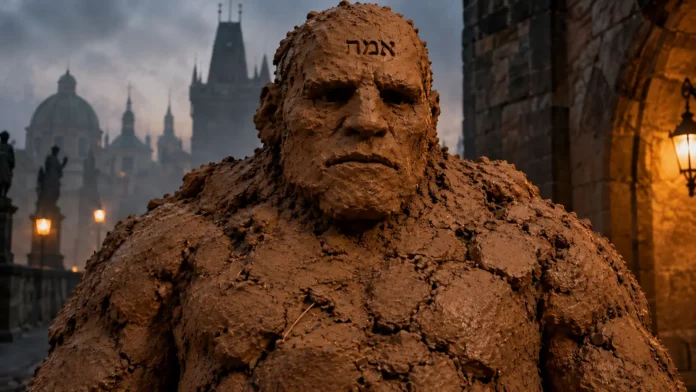
The golem belongs to Jewish folklore, especially later traditions associated with Central European Jewish communities. Its formation from matter and animation through human agency define it as a constructed being.
Historical Distribution and Cultural Context
Accounts of fashioned beings occur in several historically distinct settings, including ancient Greek myth and Jewish folklore. Their distribution does not establish one shared origin or continuous tradition.
Greek traditions portray divine craftsmanship through objects and beings associated with gods such as Hephaestus. Talos fits this context as an artificial guardian, not as evidence for a universal category.
Jewish golem traditions developed within distinct religious and folkloric contexts. Their meanings cannot be reduced to Greek ideas of divine technology or treated as direct historical continuations.
Scholarly Interpretation and Uncertainty
Variation in Definitions
Researchers may use “construct” broadly for any animated artifact or narrowly for a being whose body is deliberately manufactured. The narrower definition reduces mistaken inclusion of spirits.
Historical communities did not necessarily group these beings together. Comparative taxonomy is therefore an interpretive tool, not proof that ancient narrators recognized a unified beast type.
Limits of Available Evidence
Sources differ in date, genre, and detail, limiting confident reconstruction of how audiences understood artificial beings. No verified sources describe this for every proposed cultural context.
Some figures called constructs in modern summaries are artifacts, allegories, or later literary inventions rather than established mythological beings. Each proposed example requires source-specific verification.
Mythological Role Across Cultures
Fashioned beings recur partly because stories can use them to examine boundaries between making and living. This comparative observation does not establish identical beliefs across traditions.
They can also focus attention on human skill, divine authority, and the consequences of creating agents. The balance among these concerns differs substantially between narratives.
Recognizing construction as a defining trait helps compare traditions without erasing their distinctions. It identifies a shared narrative problem while preserving culturally specific meanings and evidence.