Introduction
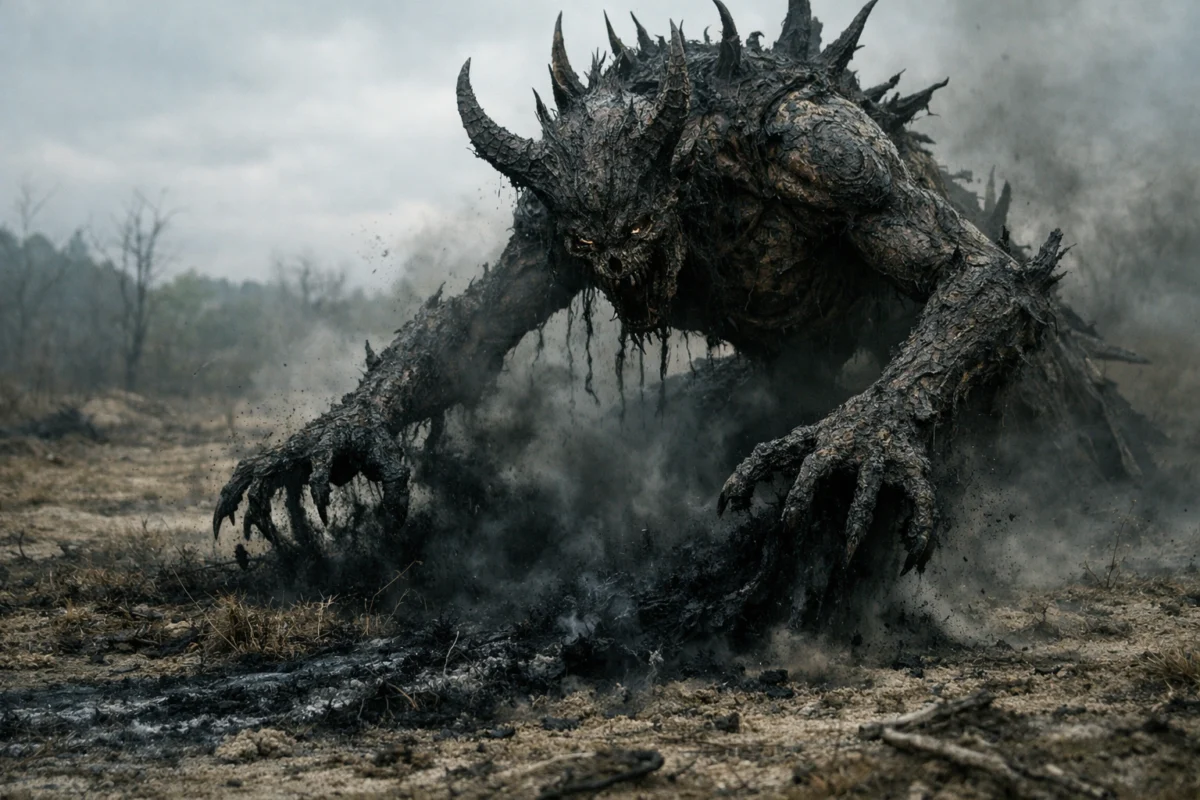
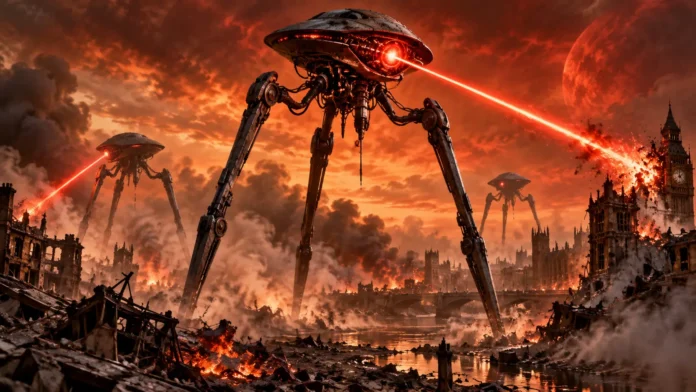
Martian Tripods are the towering alien fighting-machines created by H. G. Wells for The War of the Worlds.
They are fictional military vehicles operated by Martian invaders, not creatures from English folklore, reported cryptids, or beings rooted in traditional mythology.
The machines first appeared when Wells’s story was serialized in Pearson’s Magazine during 1897. The London book edition followed in 1898, establishing the tripods within an invasion narrative that moves through the countryside of southern England and eventually reaches London.
Within the novel, their extraordinary height, rapid three-legged movement, heat-ray, and chemical weapons make ordinary human defenses appear obsolete. Their unsettling mixture of recognizable machinery and almost animal motion helped create one of the earliest enduring images of mechanized extraterrestrial warfare.
The tripods matter because they embody more than technological spectacle. Wells used them to reverse the assumptions of imperial conquest, placing Britain beneath an overwhelmingly superior power.
Their ultimate failure also reinforces the novel’s evolutionary perspective: technological dominance cannot guarantee biological survival.
History/Origin
The earliest direct record of the Martian fighting-machines is Wells’s 1897 serial, published in Pearson’s Magazine from April through December. No earlier folk tradition or alleged eyewitness history underlies them; they originated as deliberately invented technology within a late Victorian scientific romance.
Warwick Goble supplied illustrations for the early serialization, including an image associated with a damaged tripod. These pictures are valuable evidence of the work’s first reception, but they remain artistic interpretations rather than definitive diagrams of the machines described in Wells’s prose.
The first London book edition appeared in 1898, presenting the invasion as the testimony of an unnamed narrator. Its geography is unusually concrete: cylinders fall near Horsell Common, and the fighting-machines advance through familiar Surrey settlements before threatening the capital.
This local precision makes the invented catastrophe feel documented.
Wells developed the machines during a period fascinated by Mars, evolutionary competition, imperial expansion, and increasingly destructive military technology. Contemporary invasion literature often imagined Britain attacked by another European state, but Wells enlarged that anxiety by replacing human rivals with intellectually and technologically superior extraterrestrials.
The tripod form also served the narrative better than an ordinary wheeled vehicle. Its immense legs allow it to cross fields, roads, waterways, and built environments while remaining visible above houses and trees.
That elevated mobility turns the English landscape into terrain exposed to an alien hunter.
Later films, broadcasts, illustrations, games, and sculptures reshaped the machines extensively. Some versions use hovering vehicles, shields, fixed weapons, or different silhouettes.
These adaptations belong to the tripods’ reception history, while the 1897 and 1898 text remains the primary basis for their original identity.
Name Meaning
“Tripod” literally denotes something supported by three feet or legs. The word ultimately derives from Greek elements meaning “three” and “foot,” and it had long been applied to three-legged stands and instruments before becoming a convenient label for Wells’s alien machines.
Wells most characteristically calls the vehicles “fighting-machines.” That expression defines them by military function rather than body shape.
“Martian Tripods” is a useful popular name, but it should not be mistaken for a formal species name or a term from an independent legendary tradition.
“Martian” identifies the machines by the origin of their operators. The vehicles themselves are not living Martians, although their flexible appendages and responsive gait sometimes make them seem animate.
Distinguishing operator from machine is essential to understanding both their appearance and their eventual defeat.
The name therefore combines provenance and structure: Martian indicates extraterrestrial ownership, while tripod describes three-legged construction. It does not imply a three-legged biological monster.
The apparent creatureliness comes from the machines’ movement, scale, and tentacle-like mechanisms rather than from organic anatomy.
Appearance
In Wells’s original description, a fighting-machine is a colossal metallic vehicle carried upon three long, articulated legs. It rises above much of the surrounding landscape, with a hood-like upper body that contains or shelters its Martian operator and associated mechanisms.
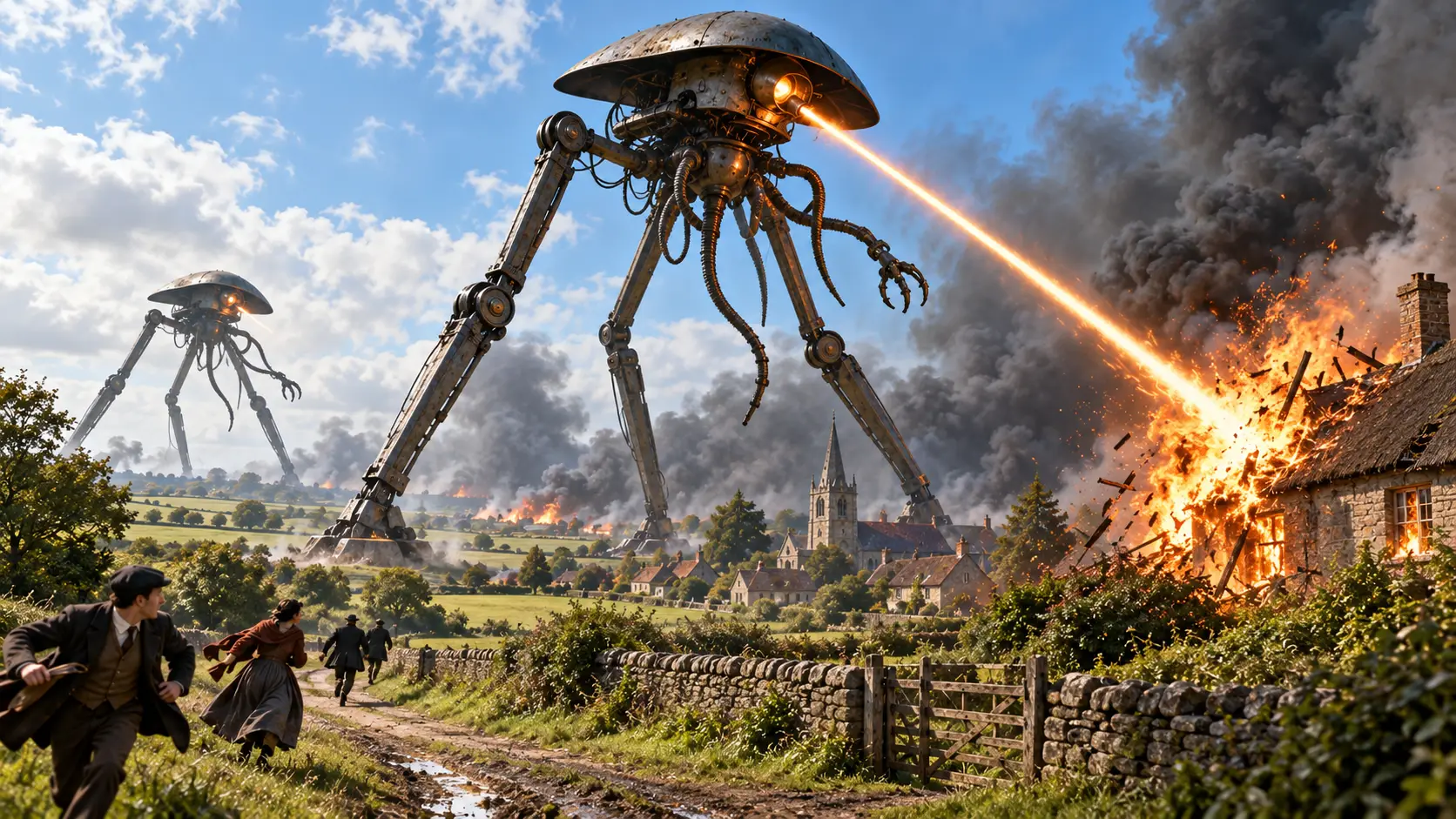
The three supports do not produce a slow, awkward shuffle. The machines stride with alarming speed, balancing dynamically as they sweep across open country and through settlements.
Wells repeatedly emphasizes the strange contrast between their enormous mass and the agility of their forward movement.
Mechanical appendages hang or extend from the central structure. Their flexibility gives the vehicle an organic suggestion, as if industrial machinery had acquired grasping limbs.
This combination of rigid metal, jointed legs, hood, and tentacle-like equipment prevents the tripod from resembling a conventional Victorian engine.
The heat-ray is its most feared weapon. It projects invisible destructive energy that ignites combustible material and kills people at a distance.
The apparatus is associated with a directed mechanism rather than with eyes, breath, or any supernatural power, preserving the machine’s technological character.
The invaders also employ poisonous black smoke against human resistance. Although closely associated with the fighting-machines’ campaigns, the smoke is a separate Martian weapon rather than a natural emission from the vehicle.
Its spreading clouds complement the heat-ray by overcoming troops and populations beyond direct line of fire.
No single later image should be treated as the definitive tripod. Goble’s 1897 illustrations record an early visual response, while screen adaptations often change the legs, hood, weapons, or locomotion.
The canonical baseline remains a towering, swift, three-legged metal war vehicle with manipulative appendages.
Background Story
The tripods belong to an invasion that begins before the Martians are clearly seen. Cylinders launched from Mars cross interplanetary space and land in southern England.
The occupants emerge under Earth’s stronger gravity and assemble or deploy machinery suited to movement and warfare on the planet.
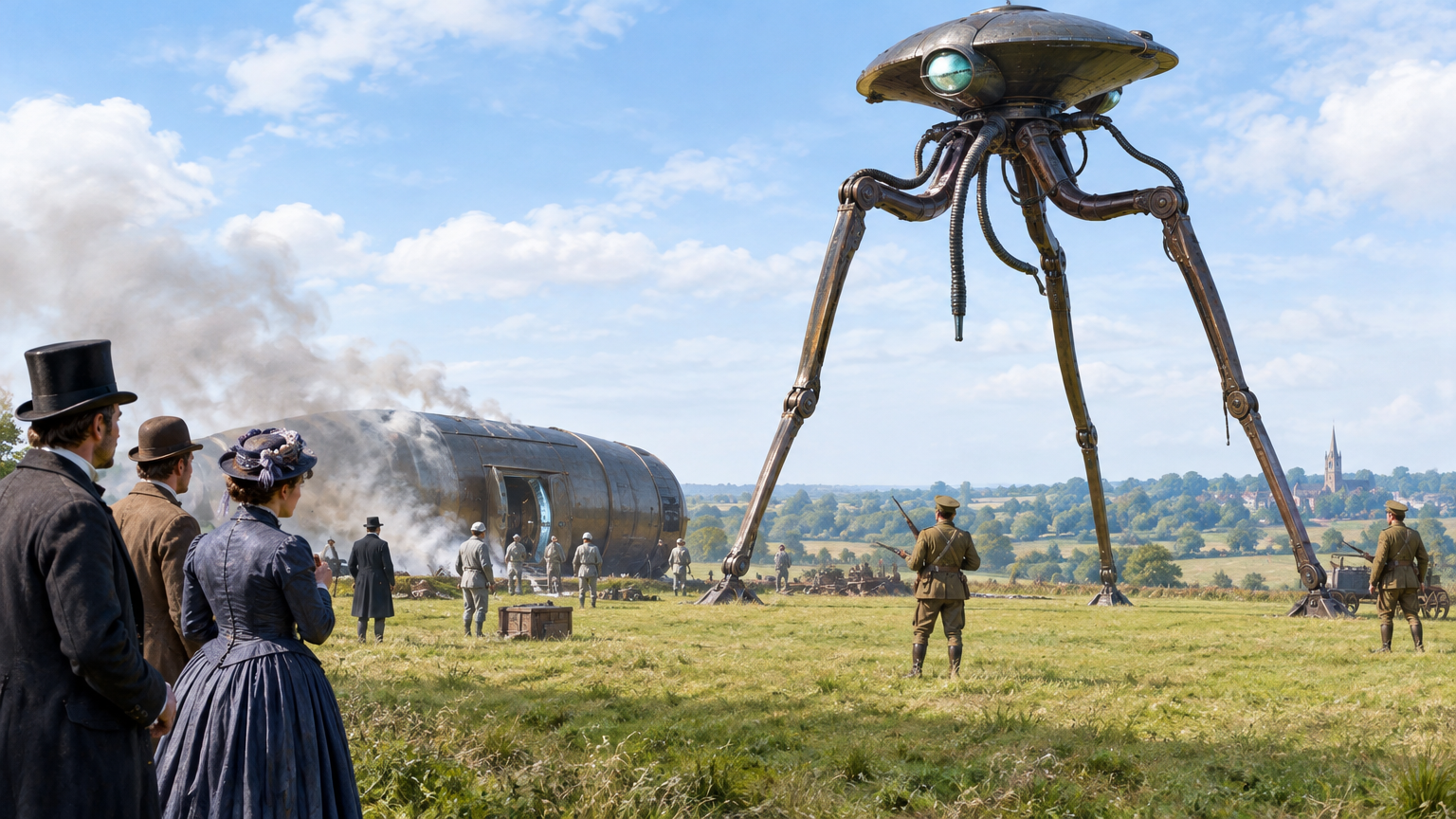
Humanity initially approaches the first cylinder with curiosity, interpreting it as an astronomical event rather than an attack. Once the Martians reveal the heat-ray, familiar civic and military responses collapse.
The fighting-machines then transform a localized encounter near Woking into a widening national disaster.
The vehicles compensate for the Martians’ physical limitations. Wells portrays the invaders as highly developed intelligences whose technology performs tasks once assigned to muscular bodies.
The tripod consequently functions as transportation, armor, weapon platform, and enlarged mechanical body within Earth’s demanding environment.
The invasion also reverses Britain’s imperial position. Instead of directing superior weapons against distant populations, English communities experience displacement, panic, and apparently effortless conquest.
The narrator explicitly places human confidence within a broader history of stronger societies destroying peoples they regarded as weaker.
Yet the fighting-machines are not independently invincible beings. Their effectiveness depends upon vulnerable biological operators. After human artillery and organized resistance largely fail, terrestrial microorganisms infect the Martians, whose bodies possess no acquired resistance to Earth’s bacteria.
Their machinery is left motionless with them.
This ending separates the tripods from supernatural monsters defeated by heroes, sacred objects, or ritual knowledge. Their fall follows the novel’s evolutionary logic: the invaders master engineering but misunderstand the biosphere.
The silent machines become monuments to the limits of technological power.
Famous Folklore Stories
The Martian Invasion of England
This heading is an editorial description, not the title of a traditional folktale. The documented narrative is H. G. Wells’s The War of the Worlds, in which cylinders fall from Mars and release technologically advanced invaders into the countryside of southern England.
The fighting-machines emerge as the Martians’ principal instruments of conquest. Their height, speed, heat-ray, and association with poisonous black smoke allow them to overwhelm soldiers, destroy settlements, and drive civilians toward London.
The events belong entirely to Wells’s invented invasion rather than to oral testimony or local legend.
The machines function as recurring threats instead of individual characters. Encounters emphasize the contrast between their sweeping mobility and the vulnerability of people below.
Human weapons occasionally damage them, but these limited successes do not reverse the invasion or establish a conventional heroic victory.
Defeat by Earth’s Microorganisms
The narrative’s decisive reversal does not come from ritual, magic, or superior human machinery. The Martians and their fighting-machines cease operating after the invaders succumb to terrestrial microorganisms.
Their apparent technological invincibility proves irrelevant against biological conditions for which they possess no immunity.
This conclusion separates the story from legends in which a monster is defeated through a sacred object, secret name, or heroic combat. Wells instead makes ordinary earthly life the unsuspected defensive force.
The abandoned machines become evidence of their operators’ biological failure, not creatures slain in battle.
No independent cycle of traditional tripod tales is documented in the supplied record. Later versions of The War of the Worlds redesign or reinterpret the machines, but these remain adaptations of a known literary narrative rather than regional variants transmitted as folklore.
Cultural Impact
The fighting-machines became one of the most recognizable images associated with The War of the Worlds. Their simple three-legged outline gives the invasion an immediate visual identity, while their towering scale turns familiar English roads, fields, towns, and military formations into vulnerable spaces.
Warwick Goble’s illustration for the 1897 serialization demonstrates that artists were interpreting the machines from the beginning of the work’s publication history. Such images helped establish the tripod as a visual emblem, although no illustration supersedes the details or ambiguities of Wells’s prose.
The machines also transformed alien invasion into a spectacle of movement across an inhabited landscape. Rather than keeping extraterrestrial danger remote or astronomical, the novel places immense foreign mechanisms among commuters, soldiers, homes, and public infrastructure.
Their presence makes technological imbalance visible at a human scale.
Later film, television, and other adaptations have repeatedly altered their silhouettes, weapons, and means of movement. Some versions remain recognizably three-legged, while others depart substantially from Wells’s description.
These designs should be understood as adaptation-specific interpretations rather than evidence for a changing folk tradition.
Woking’s association with the novel has given the fictional invasion a lasting local presence. Michael Condron’s Martian sculpture, unveiled there in 1998, commemorates Wells’s narrative connection with the town.
It represents literary heritage and public art, not belief in an actual visitation.
Modern discussion sometimes treats the tripods as monster-like because they stalk people, loom over buildings, and possess a memorable body plan. Their underlying identity nevertheless remains mechanical.
The fear they generate comes from hostile intelligence expressed through technology rather than from a supernatural animal or spirit.
Similar Beasts
Talos
Talos is a bronze guardian of Crete in ancient Greek mythology. In the Argonautic tradition, he patrols the island and attacks approaching ships by hurling rocks.
His metallic body and defensive violence make him a useful counterpart to the tripods. Talos acts as an animated guardian, however, whereas Wells’s fighting-machines are vehicles controlled by biological operators.
Beholder

The Beholder is a modern fantasy monster from Dungeons & Dragons. Its floating, rounded body has a large central eye and smaller eyestalks that produce dangerous magical effects.
Both figures combine an unmistakable silhouette with destructive attacks directed at distant targets. The resemblance is visual and tactical: the Beholder’s powers are magical, while the tripod’s heat-ray is technological weaponry.
Scientific or Rational Explanations
The direct explanation for the tripods is literary invention. Their documentation begins with Wells’s fiction, first serialized in 1897 and published as a book in 1898.
There is no evidential need to identify an animal, atmospheric event, archaeological object, or reported encounter behind them.
Within the novel, the machines are engineered vehicles operated by Martians. Their articulated legs, hooded bodies, handling appendages, and weapons present them as advanced mechanisms.
Wells supplies enough functional detail to make them imaginable without offering the complete specifications needed for an engineering reconstruction.
The three-legged design creates an unusual compromise between mechanical description and creature-like movement. Readers can understand the machines as vehicles while perceiving them as stalking bodies.
This combination helps explain why they are frequently grouped with monsters despite lacking biological identity of their own.
The heat-ray and black smoke belong to the imagined Martian arsenal. They should not be treated as misunderstood natural phenomena or evidence of historical weaponry deployed in England.
Their purpose is narrative, establishing a technological advantage that contemporary human resistance cannot readily overcome.
The ending uses a biological principle rather than supernatural intervention: organisms may be vulnerable when exposed to an unfamiliar environment. In the story, terrestrial microorganisms kill the Martians, causing their machines to fall silent.
This is a fictional plot mechanism, not a documented experiment involving extraterrestrial life.
Apparent inconsistencies in the machines’ appearance are best explained through adaptation and illustration. Wells’s prose, early serial artwork, later films, television productions, and other reinterpretations visualize the concept differently.
Combining those versions can produce a composite tripod that belongs to no single source.
Their continuing plausibility as fictional threats rests less on verified engineering than on a clear strategic idea: a mobile platform operated by an intelligence possessing superior weapons. The machines dramatize technological imbalance, while their operators’ microbial defeat limits that superiority and preserves the story’s biological reversal.
Modern Cultural References
Later portrayals have translated Wells’s fighting-machines into sculpture, cinema, television, tabletop gaming, and collectible miniatures. These interpretations preserve the tripod concept while often changing the machines’ proportions, weapons, movement, and visual character.
The Woking Martian, public sculpture (1998)
Michael Condron’s public sculpture places a towering mechanical tripod in Woking. It commemorates the town’s importance within Wells’s fictional geography and its enduring association with the invasion.
(gorsehillsurrey.com)
Tripods & Triplanes, tabletop game (2019)
This science-fiction combat game pits Martian tripods against early aircraft and ground forces.
Its miniature machines adapt Wells’s invasion concept to tactical play and an alternative First World War setting.
(aresgames.eu)
WW1 Wings of Glory: T&T Mk.I “Locust” Tripod Pack, game expansion (date not specified)
This expansion supplies a playable Locust fighting-machine miniature with associated game materials.
It develops the Martian tripod into a distinct combat unit rather than reproducing one definitive Wellsian design.
(aresgames.eu)
The War of the Worlds: Episode 1, television episode (2019)
The opening episode of the BBC adaptation brings Amy and George into contact with a Martian tripod.
Its screen design is a modern interpretation of Wells’s mechanical invader.
(youtube.com)
War of the Worlds, film (2005)
Steven Spielberg’s film relocates the invasion to contemporary America and prominently features alien tripod war machines.
Their threatening audiovisual design reimagines Wells’s concept for modern large-scale cinema.
(paramountpictures.com)
Conclusion
Martian Tripods are best understood as literary machines rather than mythological animals, supernatural beings, or cryptids. Wells used their towering three-legged bodies, unfamiliar movement, and overwhelming weapons to make technological invasion appear both alien and frighteningly systematic.
Their importance comes from the clarity of that image: an intelligent enemy remains physically hidden while its machinery strides visibly through familiar English landscapes, turning modern engineering into an instrument of terror.
Their later cultural life demonstrates how a precise fictional idea can acquire the familiarity of a modern legend without becoming folklore in origin. Illustrators, filmmakers, sculptors, television producers, and game designers have repeatedly altered the silhouette and capabilities of the machines, yet the three-legged fighting vehicle remains recognizable.
The enduring tripod therefore symbolizes invasion, technological imbalance, and human vulnerability, while its many visual variants testify to the adaptability of Wells’s original science-fiction creation.
Further Reading
The War of the Worlds, H. G. Wells, Project Gutenberg
The full novel is the primary source for the fighting-machines’ appearance, weapons, Martian operators, invasion of England, and eventual abandonment after terrestrial microorganisms kill the invaders.
Source
The War of the Worlds: A Critical Text of the 1898 London First Edition, Leon E. Stover, Google Books
A bibliographic record for Stover’s annotated critical edition, useful for identifying a scholarly treatment of Wells’s novel and its literary-historical context.
Source
The War of the Worlds: “A leg of the tripod had been smashed.”, Warwick Goble, Google Arts & Culture
A collection record for Goble’s 1897 illustration, documenting an early visual interpretation of the fighting-machines associated with the novel’s serialization in Pearson’s Magazine.
Source
War Of The Worlds And Woking, Gorse Hill
A local overview of Woking’s association with Wells’s invasion story and the public Martian sculpture, useful for exploring the tripods’ presence in the town’s literary heritage.
Source
WW1 Wings of Glory: T&T Mk.I “Locust” Tripod Pack, Ares Games
The publisher’s product page for a playable Martian fighting-machine miniature and its game components, documenting a specific tabletop reinterpretation rather than the machines’ original literary design.
Source
War of the Worlds, Paramount Pictures, 2005
The studio listing for Steven Spielberg’s film adaptation, which features alien tripod war machines in a contemporary American setting.
Useful for distinguishing this screen version from Wells’s original invasion.
Source