Introduction
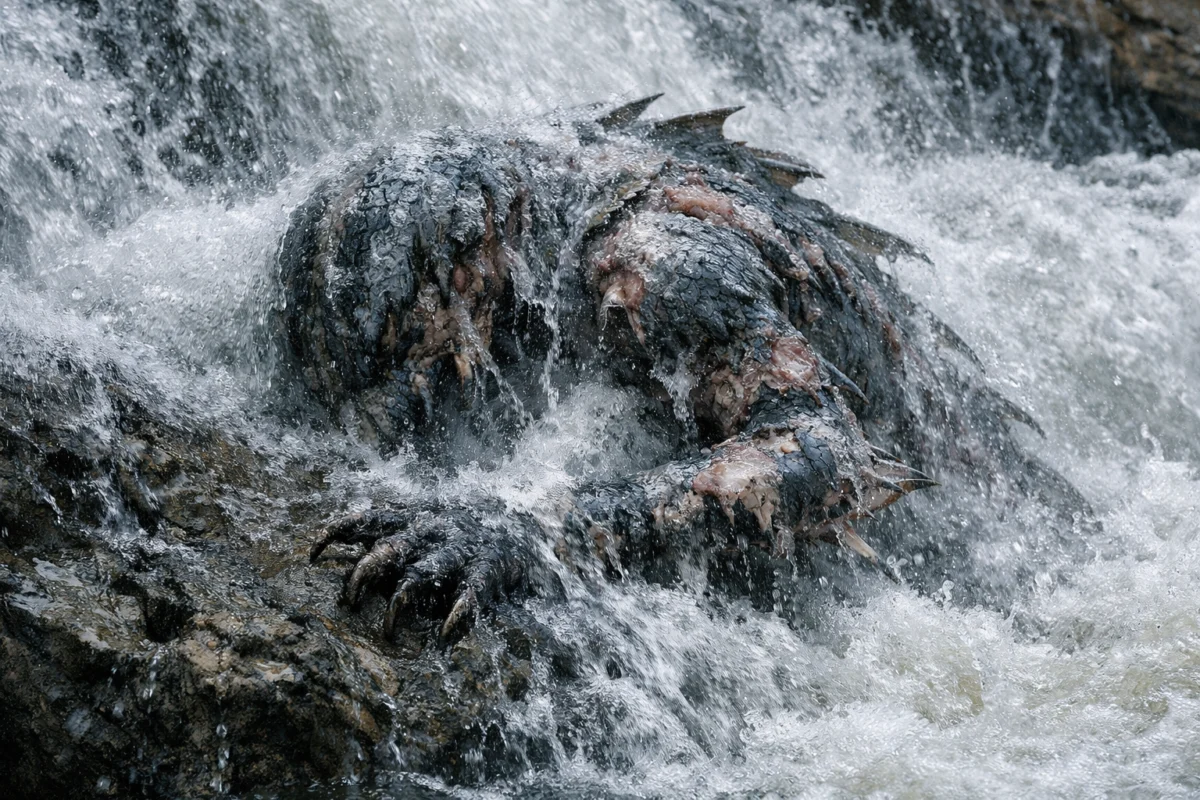
The sandworm is best known as a gigantic, sand-dwelling creature from Frank Herbert’s science-fiction novel Dune. On the fictional planet Arrakis, it is simultaneously a physical danger, an essential part of the desert ecosystem, and a being invested with religious significance by the Fremen.
Its place in a mythological bestiary requires a distinction: the sources assembled here do not establish a traditional Arab or Middle Eastern monster specifically called a sandworm. The securely documented creature belongs principally to modern fiction, where Herbert gives an imagined animal the cultural importance of a sacred beast.
Older desert traditions provide relevant comparisons, but not interchangeable identities. Encyclopaedia Iranica describes the ghūl as a dangerous, shape-changing being associated with misleading travelers and preying on humans.
That tradition concerns a supernatural adversary, not the enormous burrowing animal familiar from Dune.
The sandworm therefore matters as an example of literary mythmaking rather than a recovered ancient species of monster. Its distinctive achievement is to unite the terror of an unseen desert predator with a detailed fictional ecology, making the creature indispensable to the world that fears it.
History/Origin
The clearest historical starting point for this particular sandworm is Herbert’s Dune, published as a novel in 1965 after earlier serialization. The book establishes Arrakis as a desert planet whose valuable spice, melange, draws imperial powers into conflict over its territory and inhabitants.
Herbert’s worms are not incidental obstacles added to an adventure setting. Their movements threaten spice harvesting, their life cycle connects them to spice production, and their presence shapes how people travel across open sand.
Their narrative importance follows from their integration into the planet’s environmental system.
The Fremen relationship with the worms adds a mythic dimension within the fiction. These desert inhabitants possess practical knowledge that outsiders lack, including techniques for avoiding and riding the creatures.
Their reverence for the worm coexists with expertise, rather than replacing observation with superstition.
The documented publication history continues through later Dune books and adaptations. Macmillan identifies Sandworms of Dune, by Brian Herbert and Kevin J. Anderson, as a 2007 science-fiction novel within the series.
This establishes literary continuity, not evidence that Herbert adapted an inherited sandworm legend.
ABRAMS likewise identifies its 2020 Dune graphic novel as an adaptation of Herbert’s work. Its publisher description specifically highlights a massive sandworm maw.
Such records help trace the creature’s transmission from prose into visual storytelling, where its scale becomes an immediately recognizable feature.
A separate development involves the name Sandwalker. A weakly sourced online cryptid entry assigns it to Arab mythology, while Clay Cyanide Miniatures uses the name for a fantasy product in an Arabian Nights-themed range.
Neither establishes a historical connection between Herbert’s worms and traditional Arabic folklore.
Name Meaning
Sandworm is a transparent English compound: sand identifies the creature’s environment, while worm describes its elongated body. The name itself does not indicate supernatural status or enormous size.
Those qualities come from the particular fictional or legendary context in which the word is used.
In ordinary English, sandworm can also name real worms associated with sandy environments, including marine animals. Consequently, a reference to a sandworm is not automatically a reference to a monster.
Herbert’s fictional species must be distinguished from these biological uses of the same descriptive word.
Within Dune, Shai-Hulud is a culturally charged name for the sandworm, associated with Fremen reverence. Herbert’s fictional terminology also includes Maker and Old Man of the Desert.
These expressions characterize the worm’s place in Arrakis society; they are not verified aliases from historical Arabic folklore.
Sandwalker should remain separate as well. Although its English construction suggests movement through a sandy landscape, the supplied sources do not demonstrate that it names the same creature as Sandworm.
Similar wording, desert settings, and fantasy branding cannot establish an etymological or traditional relationship between them.
Appearance
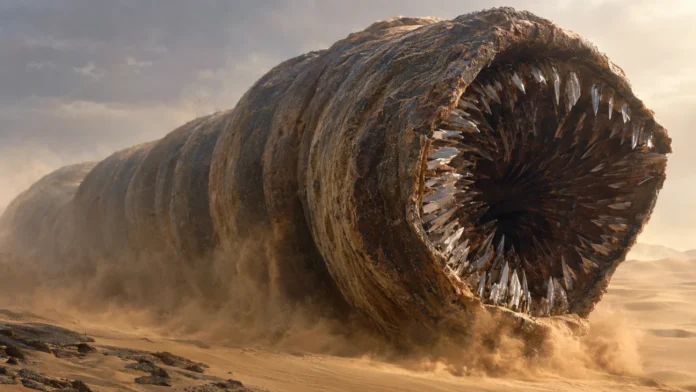
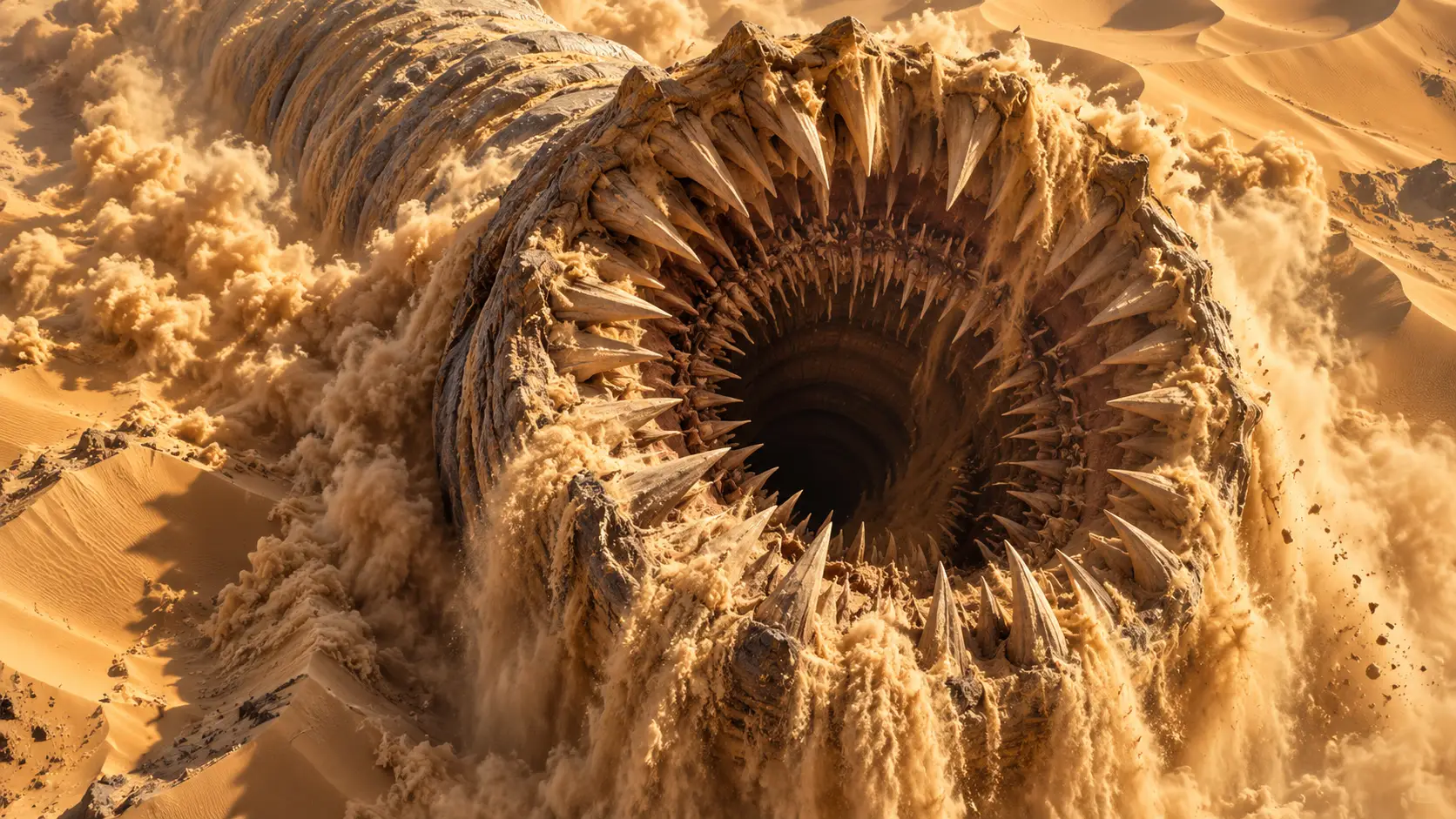
The representative form belongs to Dune: an immense, elongated animal with a segmented body and a vast mouth. Reference descriptions emphasize its ability to move beneath desert sand.
Its wormlike outline distinguishes it from a conventional dragon, which typically possesses a more visibly differentiated head and limbs.
Herbert’s mature sandworms can reach hundreds of meters in length, although their size is not uniform. This scale is central to their effect in the story.
A worm threatens people and industrial harvesting equipment alike, turning the apparently open desert into terrain occupied by much larger animals.
The mouth contains crystalline teeth, a feature with consequences beyond visual menace. Fremen crysknives are made from sandworm teeth, linking a bodily detail to material culture inside the novel.
The creature’s anatomy thus contributes to both the dangers and the sacred objects of Herbert’s imagined society.
Segmentation also matters to the way the worms are ridden. Fremen use hooks to open a gap between segments, exposing sensitive tissue and encouraging the animal to keep that area away from abrasive sand.
The riding technique is a fictional behavior grounded in the creature’s described construction.
The ABRAMS graphic-novel listing confirms the enormous maw as a prominent visual feature, but does not establish one universal design for every adaptation. A traditional Middle Eastern appearance cannot be reconstructed from this material, and the independently designed Sandwalker miniature should not be substituted for such missing evidence.
Background Story
The background that shapes the sandworm is primarily Herbert’s construction of an interconnected desert world. Arrakis is not simply a backdrop for a monster encounter.
Its ecology makes the animal necessary to the resource that sustains interstellar civilization, giving the creature importance far beyond its immediate habitat.
The worm’s life cycle links it with sandtrout, the immature forms that sequester water and help maintain desert conditions. Water is dangerous to adult worms, creating a fundamental tension between the environment they require and efforts to transform Arrakis into a wetter, more habitable world.

Spice intensifies that tension because it is not merely a local commodity. In Dune, it supports functions on which imperial society depends, including interstellar navigation.
The worm consequently connects environmental processes to political power: control of extraction cannot be separated from the survival of the ecosystem producing the resource.
Fremen knowledge supplies another formative element. Outsiders principally encounter the worm as a threat to harvesting, whereas the Fremen incorporate it into travel, weapons, and sacred language.
The same animal therefore expresses contrasting relationships with the desert, one oriented toward extraction and another toward skilled habitation.
Perso-Arabic desert lore offers a comparison in narrative function, not a demonstrated source of the worm’s ancestry. Iranica’s ghūl inhabits traditions of deception, transformation, and dangerous encounters.
Both figures make wilderness threatening, but one operates through supernatural treachery while Herbert’s creature acts within an invented ecology.
The sandworm’s mythic force arises from this combination of animal, resource, and sacred presence. It can be understood as a literary beast through which ecological dependence becomes visible.
Its significance is not that it preserves an ancient desert legend, but that fiction gives environmental relationships the power of myth.
Famous Folklore Stories
The Sandworm does not belong to an authenticated Arab or Middle Eastern folklore cycle. Its best-documented identity comes from Frank Herbert’s Dune, while the Mongolian Death Worm provides a separate folkloric and cryptid comparison from the Gobi Desert.
These narratives should remain distinct rather than being presented as versions of the same creature.
The Spice Harvester and the Approaching Worm
One of the defining Sandworm encounters in Dune begins during a spice-harvesting operation on Arrakis. Activity on the open desert attracts a worm moving beneath the sand, forcing the workers to abandon their machinery before the enormous creature reaches it.
The episode establishes the extraordinary scale of Shai-Hulud. Human machinery may temporarily dominate spice extraction, but it remains vulnerable to an animal large enough to engulf an entire harvesting vehicle.
The encounter also introduces one of Dune’s central ecological ideas: the desert is not empty territory waiting to be controlled. The Sandworm belongs to the environment that outsiders are attempting to exploit.
Paul Atreides Rides Shai-Hulud
Sandworm riding presents a different relationship with the creature. The Fremen use specialized hooks to expose sensitive tissue between the worm’s body segments, causing the animal to rotate that area away from the abrasive sand.
Paul Atreides’ successful ride marks his increasing integration into Fremen society. What outsiders regard primarily as an uncontrollable monster becomes, through knowledge and skill, a means of traveling across Arrakis.

The episode also joins practical expertise with religious reverence. Shai-Hulud is sacred to the Fremen, yet their respect for the creature exists alongside detailed knowledge of its behavior.
The Mongolian Death Worm of the Gobi
The Mongolian Death Worm, commonly called olgoi-khorkhoi, belongs to a separate tradition associated with Mongolia’s Gobi Desert. Stories describe a dangerous worm-like creature supposedly capable of killing humans, although accounts differ considerably in its size, appearance, and abilities.
Explorer Roy Chapman Andrews recorded stories about the creature during his early twentieth-century expeditions in Mongolia. He never obtained a specimen, and the reports available to him were largely secondhand, but later writers and expeditions continued searching for the alleged animal.
Its desert habitat and worm-like form make the Mongolian Death Worm one of the closest folkloric comparisons to Herbert’s Sandworm. There is no established evidence, however, that the Mongolian tradition directly inspired Shai-Hulud.
Cultural Impact
The sandworm’s strongest documented cultural presence belongs to modern literature and its adaptations. In Frank Herbert’s Dune, the creature brings together bodily danger, ecological dependence, and sacred meaning.
It can be read as a symbol of a landscape that outsiders seek to exploit but cannot fully control: the desert’s most threatening animal is also essential to the resource they prize.
Within Herbert’s fictional society, that symbolism takes material form. Fremen crysknives come from sandworm teeth, while worm riding turns a feared animal into a means of travel.
These details make the creature more than an obstacle in an adventure. It embodies the Fremen’s practical and religious relationship with Arrakis, contrasting their knowledge of the desert with outsiders’ emphasis on extraction.
Later publications carry this imagery into new forms. Macmillan lists Brian Herbert and Kevin J. Anderson’s Sandworms of Dune as a 2007 science-fiction novel within the Dune Chronicles.
ABRAMS identifies its 2020 Dune graphic novel as an adaptation and specifically highlights an illustrated sandworm maw. Together, these records document continued literary circulation and the translation of the creature’s immense scale into visual storytelling.
Contemporary fantasy design offers a separate example. Clay Cyanide Miniatures’ Sandwalker appears in an Arabian Nights-themed miniature range, documenting commercial use of desert-monster imagery.
Its thematic setting does not establish that it represents Herbert’s species or reproduces an inherited Arabic being.
Older desert lore provides a comparison rather than a verified ancestry. Encyclopaedia Iranica describes the ghūl through deception, predation, and dangerous encounters with travelers.
Both figures make desert travel threatening, but their cultural roles differ: the ghūl belongs to documented supernatural traditions, while Dune’s sandworm demonstrates how authored fiction can give an imagined animal the significance of a mythic beast.
Similar Beasts
Mongolian Death Worm
The Mongolian Death Worm, or olgoi-khorkhoi, is a reported worm-like creature associated with Mongolia’s Gobi Desert. Accounts describe it as a dangerous animal concealed within or beneath the desert landscape.

It is the strongest folkloric comparison to the Sandworm because both combine a worm-like body, desert habitat, and danger hidden beneath apparently empty terrain. The Mongolian Death Worm belongs to folklore and cryptid tradition, while Shai-Hulud is Frank Herbert’s fictional creation.
Read more about the Mongolian Death Worm
Graboid
Graboids from Tremors are enormous subterranean predators that travel beneath the ground and attack creatures moving above them.
They are a strong modern-fiction comparison because both Graboids and Sandworms turn open desert ground into dangerous territory occupied by unseen giant creatures below the surface. Unlike Shai-Hulud, Graboids do not have the same ecological, cultural, or religious significance.
Religion/Ritual
In Frank Herbert’s Dune, the sandworm holds religious significance for the Fremen of Arrakis. They revere it as Shai-Hulud, while names such as Maker and Old Man of the Desert express its cultural importance.
This sacred status belongs to Herbert’s fictional society, not to a documented historical Arabian tradition.
The worm also connects religious meaning with material life. Fremen crysknives are made from sandworm teeth, turning part of the animal into a sacred object.
Reverence coexists with practical knowledge: the Fremen understand how to avoid and ride the worms. Their relationship therefore combines respect for a sacred presence with skills essential to desert survival.
The sources reviewed do not establish traditional offerings, protective ceremonies, taboos, or observances directed toward a distinct Arab or Middle Eastern being specifically called Sandworm. Religious associations belonging to the ghūl, Nyami Nyami, or other separate figures cannot be transferred to it merely because of a shared habitat or visual resemblance.
Scientific or Rational Explanations
For the sandworms of Frank Herbert’s Dune, the most useful rational interpretation is literary and ecological rather than zoological. These creatures belong to an authored science-fiction world.
Their existence within the story does not require a real animal, a mirage, or a mistaken desert sighting to explain it.
Herbert gives the sandworm importance through its place in an interconnected environment. Its life cycle is tied to spice production, while sandtrout sequester water and help maintain the desert conditions on which the worms depend.
Within the fiction, this makes the creature more than an oversized predator: it connects habitat, valuable resources, and political power. That ecological coherence is a feature of world-building, not proof that such an animal could exist.
The Fremen relationship with the worms also supports a social interpretation. Their reverence coexists with practical knowledge of avoiding and riding them.
The creature can therefore be read as a literary expression of environmental dependence, in which a dangerous animal becomes both a sacred presence and an essential part of desert life.
Other uses of similar names require separate treatment. An online attribution of Sandwalker to Arab mythology remains uncorroborated by the stronger folklore sources reviewed.
Clay Cyanide Miniatures’ Arabian Nights-themed Sandwalker documents contemporary fantasy design; its setting does not establish historical provenance. Shared names and desert imagery are not sufficient evidence that these examples represent one inherited being.
Documented traditions offer comparisons without establishing ancestry. Encyclopaedia Iranica describes the ghūl through desert danger, deception, and threatening encounters, but no direct influence on Herbert’s sandworm is demonstrated here.
Likewise, reports about the Mongolian death worm concern a distinct cryptid tradition, not confirmation of either Arrakis’s worms or an Arabian Sandworm.
The reviewed evidence supports no specific environmental or zoological explanation for an authenticated traditional Arabian Sandworm encounter. Suggestions involving mirages, unidentified burrowing animals, or distorted memories would remain speculative.
The firmer explanation concerns how fiction creates a convincing desert monster and how similar imagery can blur the boundaries between literary invention, commercial design, and separate folklore traditions.
Modern Cultural References
Dune, film (1984)
David Lynch’s adaptation brought the Sandworms of Arrakis to cinema, translating Herbert’s immense desert creatures into a large-scale visual spectacle. The film helped establish the Sandworm as one of the most recognizable creatures associated with the Dune universe.
https://blogs.loc.gov/headlinesandheroes/2024/03/dunes-shai-hulud-and-other-sandworms/
Dune, film (2021)
Denis Villeneuve’s adaptation presents Shai-Hulud as an overwhelming environmental presence rather than simply a giant monster. Its movement beneath the sand emphasizes both the scale of Arrakis and the vulnerability of people and machinery operating in the open desert.
https://wbpinewmedia.warnerbros.com/dune/index.html
Dune: Part Two, film (2024)
Sandworm riding becomes particularly important in Dune: Part Two. Paul Atreides’ ride demonstrates the Fremen ability to interact with Shai-Hulud through specialized knowledge, transforming an apparently uncontrollable creature into a means of desert travel.
https://wbpinewmedia.warnerbros.com/duneparttwo/index.html
DUNE: The Graphic Novel, Book 1, graphic novel (2020)
Brian Herbert and Kevin J. Anderson adapted Frank Herbert’s novel into graphic form, with artwork by Raúl Allén and Patricia Martín. The visual format gives the Sandworm’s enormous size and mouth a prominent role while preserving its connection with Arrakis and spice production.
https://www.abramsbooks.com/product/dune-the-graphic-novel-book-1-dune_9781419731501/
Tremors, film (1990)
The subterranean creatures later known as Graboids in Tremors are unrelated to Shai-Hulud, but they use a comparable modern monster concept: apparently safe ground conceals enormous predators moving below the surface.
https://blogs.loc.gov/headlinesandheroes/2024/03/dunes-shai-hulud-and-other-sandworms/
Conclusion
Sandworm is best understood here as a modern monster concept rather than a securely documented, distinct being from Arab or Middle Eastern folklore. Its strongest documented identity belongs to Dune, while other appearances draw on fantasy invention or reports about the Mongolian death worm.
Keeping those contexts separate preserves what makes each meaningful: literary world-building, contemporary creature design, and cryptid storytelling do not share the same evidential status, even when they employ a similar image of danger beneath desert sand.
As a symbolic figure, the sandworm makes apparently empty terrain conceal an overwhelming presence. That image helps explain its usefulness in modern storytelling without requiring an invented ancient pedigree.
The ghūl belongs to a different, documented tradition and should not be transformed into a worm merely because it also inhabits dangerous desert landscapes. The creature’s lasting relevance therefore rests most securely on its imaginative power and documented modern reception, while claims of a specific traditional Arabian identity remain unsubstantiated by the sources considered here.
Further Reading
Frank Herbert’s Ecology, Oregon’s Dunes, and the Postwar Science of Desert Reclamation, Veronika Kratz
Academic study examining Herbert’s research into dune stabilization in Oregon and how desert ecology contributed to the development of Dune.
https://academic.oup.com/isle/article-abstract/30/3/637/6184617
The Arabic of Dune, Karin Christina Ryding
Scholarly examination of Herbert’s use of Arabic and Arabic-derived terminology in Dune, useful for distinguishing genuine cultural influence from claims of an Arabian Sandworm folklore tradition.
https://benjamins.com/catalog/lal.37.06chr
Dune’s Shai-Hulud and Other Sandworms, Library of Congress
Overview of the Sandworm in Dune, Herbert’s publication history, adaptations, and later appearances of similar giant subterranean creatures in popular culture.
https://blogs.loc.gov/headlinesandheroes/2024/03/dunes-shai-hulud-and-other-sandworms/
DUNE: The Graphic Novel, Book 1: Dune, ABRAMS
Publisher information for the graphic adaptation by Brian Herbert and Kevin J. Anderson, illustrated by Raúl Allén and Patricia Martín.
https://www.abramsbooks.com/product/dune-the-graphic-novel-book-1-dune_9781419731501/
Inside the Decades Long Hunt for the Mongolian Death Worm, Atlas Obscura
Background on the separate Gobi Desert tradition of olgoi-khorkhoi, including Roy Chapman Andrews and later attempts to investigate the reported creature.
https://www.atlasobscura.com/articles/mongolian-death-worm