Introduction
Klingons are a fictional humanoid extraterrestrial people from the American science-fiction franchise Star Trek. They belong to modern screen storytelling, not traditional North American folklore, historical religion, cryptozoology, or reports of unidentified beings.
Their relevance to mythology lies instead in the invented histories, heroic legends, social ideals, and conflicts developed around them within the franchise.
Within the fictional setting, Klingons are associated with the homeworld Qo’noS and an interstellar empire. Later portrayals emphasize honor, military achievement, family loyalty, and the reputation of one’s lineage.
Individual characters frequently expose tensions between these ideals and the practical demands of politics, ambition, survival, or divided allegiance.
Their appearance has changed markedly across productions. Early television Klingons had comparatively smooth foreheads, while later versions commonly feature pronounced cranial ridges.
These differences reflect changing makeup techniques and production choices, as well as later efforts to account for visual variation inside the fictional universe.
The name also identifies Klingon, a constructed language developed for the franchise and subsequently studied by real people. Context therefore matters: “Klingon” may refer to a fictional person, the fictional population, an adjective describing their culture, or the language assigned to them.
The alien population is imaginary, but the language has an established vocabulary, grammatical structure, body of creative use, and community of human learners.
History/Origin
Klingons first appeared in “Errand of Mercy,” an episode of Star Trek broadcast in March 1967. Written by Gene L. Coon and directed by John Newland, the episode introduced them through a conflict in which the Federation and Klingon Empire competed for control of a strategically placed planet.
Their first narrative role was therefore political and military rather than mythological.
Their early presentation belongs to the atmosphere of Cold War television. Competition between large powers, military intimidation, expansion of influence, and the danger faced by smaller societies shaped their dramatic function.
The Klingon Empire offered a fictional opponent through which Star Trek could examine confrontation between rival systems without simply reproducing a contemporary international dispute under its real-world name.
This original role did not establish every feature later associated with Klingon society. The species developed cumulatively as new productions added characters, institutions, conflicts, visual designs, and accounts of the past.
Later writers expanded an initially antagonistic power into a society containing internal disagreements, inherited obligations, political factions, and competing interpretations of honorable conduct. Early episodes and later series consequently do not form one completely uniform cultural portrait.
Star Trek: The Motion Picture, released in 1979, introduced a substantially revised screen appearance and audible Klingon dialogue. James Doohan devised the initial film speech, establishing an alien sound for the characters before Klingon possessed the more extensive grammatical system familiar to later students.
This distinction matters because performed fictional dialogue and a deliberately expandable constructed language represent different stages of development.
Linguist Marc Okrand subsequently developed Klingon for Star Trek III: The Search for Spock, released in 1984. The language was designed so that actors could deliver new dialogue according to consistent patterns rather than rely only on isolated invented sounds.
Vocabulary and grammar made it possible to construct additional sentences, study how the language works, and use it beyond the immediate scenes for which it had been created.
Beginning in 1987, Star Trek: The Next Generation supplied a continuing Klingon perspective through Worf, a Klingon serving in Starfleet. His position shifted the species beyond its original function as a distant enemy.
Questions of cultural belonging, family reputation, institutional loyalty, and conflicting standards of conduct could now be explored through a recurring individual rather than only through confrontations between governments.
This progression, from opposing empire, to visually distinctive alien culture, to society represented by continuing characters and a usable language, explains why Klingons acquired unusual depth within popular science fiction. Their fictional antiquity should not be confused with real antiquity: the legends and customs attributed to them were built through twentieth- and twenty-first-century franchise storytelling.
Name Meaning
“Klingon” has a reported production-world origin rather than an ancient linguistic meaning. A franchise naming account connects it with Wilbur Lee Clingan, a former colleague of Star Trek creator Gene Roddenberry.
On that account, the fictional people’s name adapts a real person’s surname rather than translating a word from a traditional culture.
This origin should not be converted into a definition such as “warrior,” “honorable people,” or “people of battle.” Those associations come from the species’ later characterization.
They do not establish the literal meaning of the English name, and fictional symbolism should remain separate from documented production history.
The Klingon-language form is written tlhIngan in the language’s established Roman-letter transcription. Its unusual mixture of upper- and lowercase letters belongs to that writing convention and should be preserved rather than normalized as ordinary English capitalization.
It is an internal designation within a constructed language, not evidence that the English word descends from an older traditional vocabulary.
In ordinary English, “Klingon” can identify an individual, function as an adjective, or name the language; “Klingons” usually identifies the people collectively. A person may therefore study Klingon without being a Klingon, just as a discussion of Klingon grammar need not concern the fictional population’s biology.
Keeping these uses distinct prevents ambiguity between imagined speakers and the real linguistic system performed and learned by humans.
Appearance
Klingons have a humanoid body plan, allowing actors to portray them through costume, makeup, hairstyling, and prosthetics rather than through an entirely nonhuman bodily design. Their recognizability depends heavily on facial treatment and clothing.
No single appearance, however, accurately represents every period of the franchise.
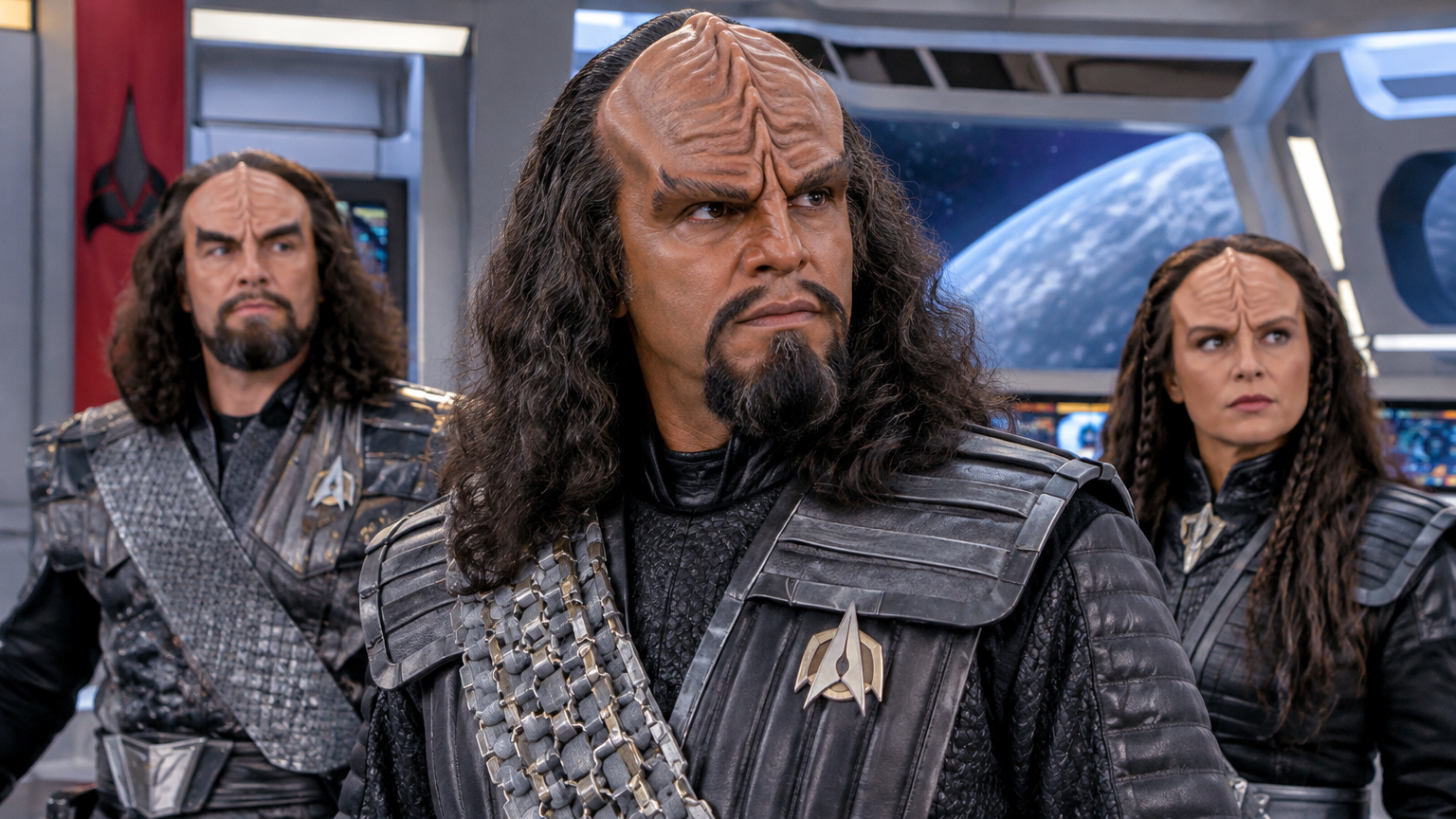
In the original television series, Klingons generally had smooth foreheads and were distinguished through makeup, strongly styled eyebrows, facial hair, and costume. Their faces remained relatively close to ordinary human appearance.
These early portrayals should not be retrospectively described as possessing the prominent ridges that later became the species’ best-known visual marker.
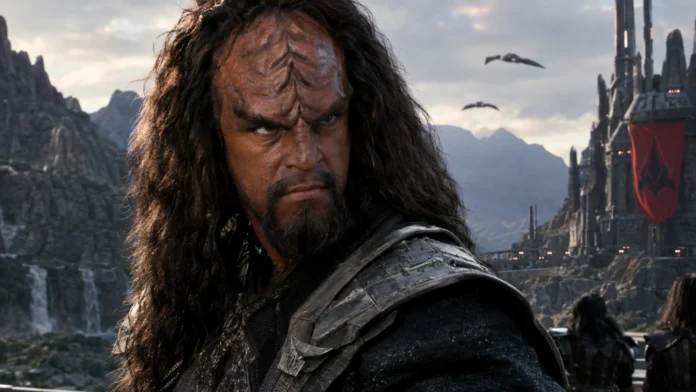
The 1979 film introduced much more elaborate cranial makeup, establishing raised forehead structures as a major identifying feature. Subsequent films and television productions developed the approach further.
Ridges extending across the forehead became especially prominent in designs associated with the later twentieth-century franchise and helped make a Klingon immediately recognizable even outside a full narrative scene.
These characteristic foreheads are prosthetic screen effects rather than observations of an alleged organism. Their patterns and prominence differ among characters and productions; they are not one identical marking applied uniformly to every fictional Klingon.
Hair, facial hair, costume, and the performer’s bearing also contribute to the presentation of an individual character.
The contrast between smoother early faces and later ridged designs illustrates how long-running fictional beings can change with production technology and visual fashion. Later storytelling sometimes addresses those differences from within the setting, but an in-universe explanation does not erase the real production chronology that generated the variation.
The most accurate concise description is therefore a fictional humanoid alien, commonly represented in later Star Trek productions with a ridged forehead. An illustration detached from franchise context could otherwise resemble a generic human warrior or invented alien, because the identifying features derive from a particular body of science-fiction design rather than from folklore iconography.
Background Story
Klingon background combines two distinct histories: the real development of a television civilization and the imagined past assigned to it. The first begins with twentieth-century entertainment production and continues across later media.
The second places Klingon identity within the history of Qo’noS, the Klingon Empire, its political authorities, its families, and its remembered heroes.
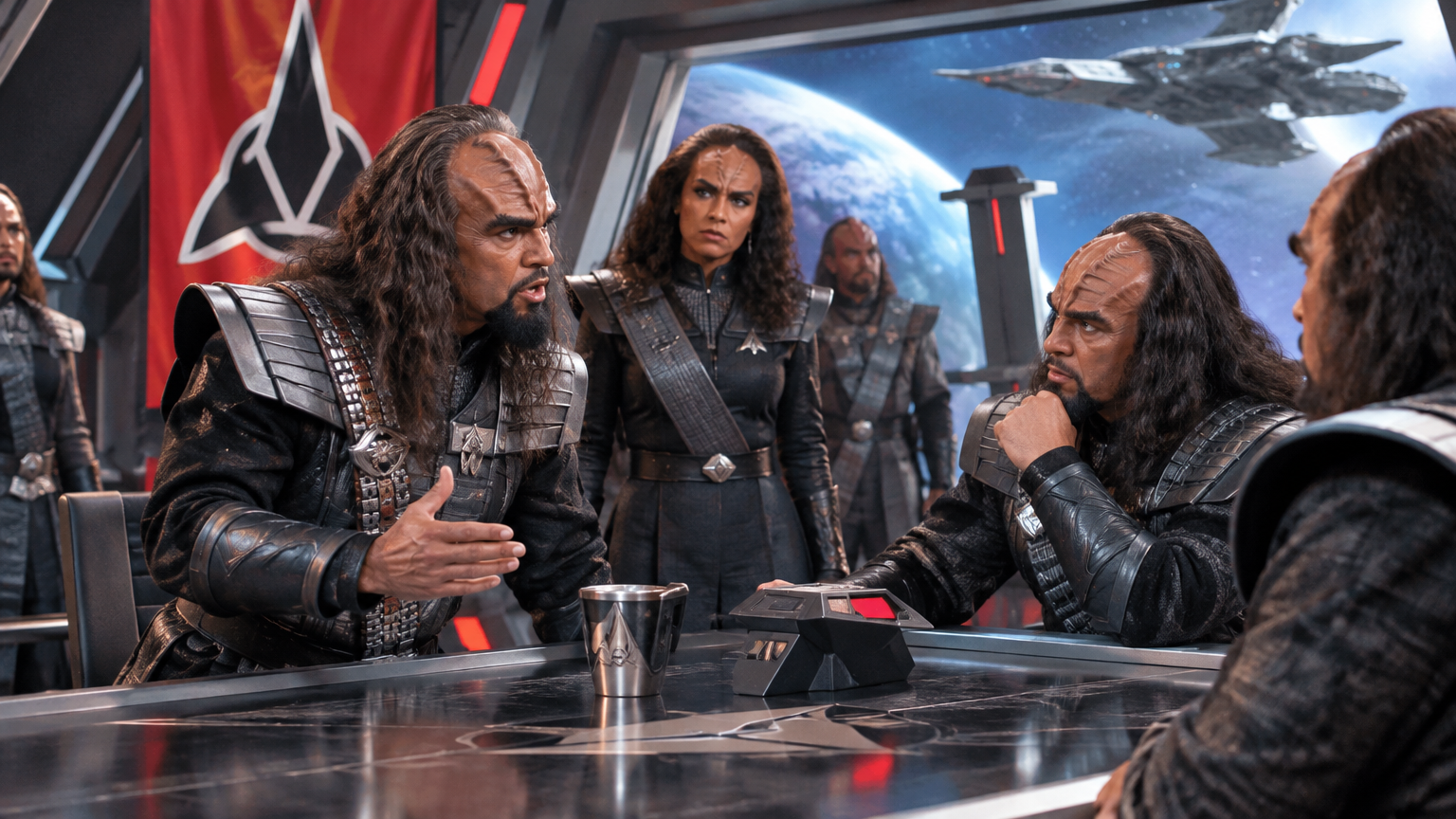
Within that imagined past, Kahless is a foundational figure associated with the unification of the Klingon people and with exemplary conduct. His importance extends beyond a simple account of political beginnings.
Stories and references involving him provide later Klingons with a model against which claims of courage, authority, loyalty, and honor can be judged.
Honor consequently functions as more than enthusiasm for combat. It connects individual reputation with family standing, public memory, and expectations about rightful behavior.
Later narratives gain dramatic force from disputes over what honorable action actually requires, especially when loyalty to relatives, political leaders, comrades, or personal conviction points toward different choices.
The emphasis on family makes Klingon conduct social as well as individual. Achievement or disgrace can affect how a lineage is regarded, while inherited obligations can shape a character’s opportunities and conflicts.
This framework allows stories about warriors to become stories about kinship, reputation, and the burden of living under standards established by earlier generations.
The warrior emphasis also changed the species’ narrative function over time. Early Klingons often embodied the pressure exerted by an opposing empire.
Later portrayals invited audiences to consider Klingon society from within, without eliminating its aggression, political rivalry, or military institutions. Conflict remained important, but characters could now possess motives rooted in family, law, cultural belonging, or competing ideas about their society’s values.
The constructed language reinforced this expansion by giving the fictional culture a recognizable spoken form beyond isolated names and commands. Dialogue could suggest that Klingon society had its own patterns of expression rather than merely using English with alien terminology.
Real learners then carried that linguistic dimension beyond the screen.
Together, language development, recurring characters, changing political relationships, and an elaborated heroic past transformed a television adversary into sustained worldbuilding. Its legendary material can be examined for mythic themes, but it remains authored fiction.
It is not inherited testimony from an ancient Klingon population, nor evidence of historical human belief in extraterrestrial visitors.
Famous Folklore Stories
Klingon legends form part of Star Trek’s modern fictional mythology. Kahless, remembered as a legendary unifier of the Klingon people, supplies an exemplary past against which later warriors measure courage and honor.
Television stories bring that inheritance into conflict with political power, family loyalty, and personal conviction.
Kahless and the First Bat’leth
In the Star Trek: The Next Generation episode “Rightful Heir” (1993), a man claiming to be the returned Kahless recounts the legendary creation of the first bat’leth. Kahless took a lock of his hair, dipped it into volcanic lava, cooled it in a lake, and shaped it into a blade.
The extraordinary act gives a characteristic Klingon weapon a heroic origin, connecting combat with the culture’s foundational figure.
The episode places this legend within a larger crisis of belief. Worf visits the monastery on Boreth, where Klingons await Kahless’s promised return.
When the apparent Kahless appears, his knowledge of sacred stories seems to support his identity. Worf eventually discovers that the clerics have created a clone using genetic material preserved on a relic.
The resolution separates spiritual authority from political rule. The clone becomes emperor as a ceremonial and spiritual figure, while Gowron retains political power as chancellor.
The story asks whether an inspiring ideal can remain valuable when the person embodying it is not the original hero. Kahless’s significance rests not simply on victory, but on the standards his remembered life offers later generations.
Family Honor in “Sins of the Father”
“Sins of the Father” (1990), also from The Next Generation, turns inherited reputation into a concrete dilemma. Worf challenges an accusation that his father, Mogh, betrayed the Klingon colony at Khitomer.
His brother Kurn helps him contest the charge, but the investigation exposes Ja’rod, the father of the politically powerful Duras, as the actual traitor.
Revealing the truth threatens a political crisis. Worf accepts public disgrace rather than force a confrontation that could destabilize the empire, while protecting Kurn’s identity as his brother.
His decision preserves others at the expense of his own standing.
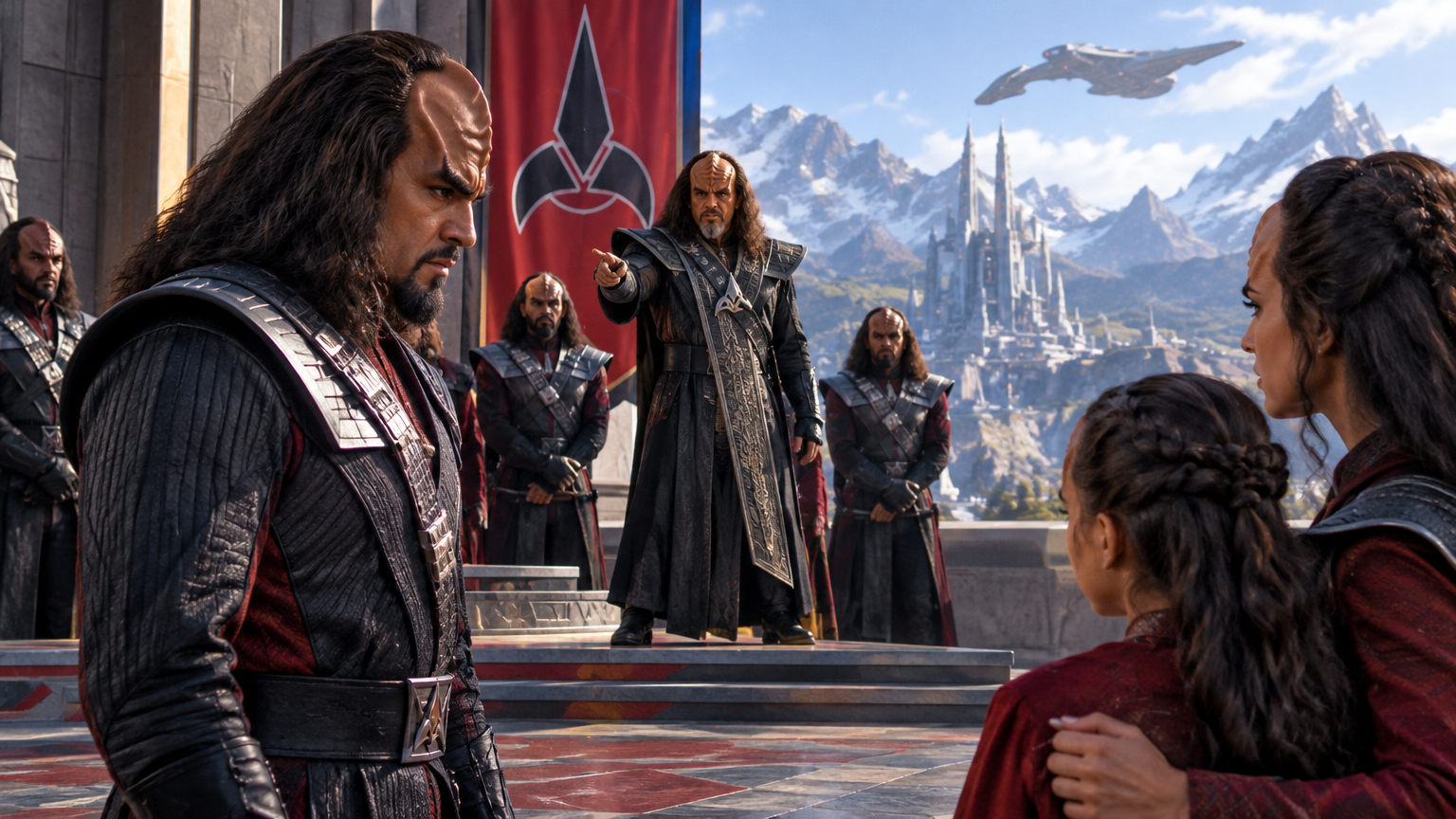
This is a television drama rather than an ancient folktale, but it gives Klingon heroic ideals their dramatic force. Family loyalty, public reputation, and honorable conduct pull in different directions, showing how political authorities can defend tradition while concealing a dishonorable truth.
Cultural Impact
Klingons have a cultural presence beyond their screen roles because their language became something audiences could learn and use. Its vocabulary and grammar allow enthusiasts to construct new expressions rather than simply repeat memorable dialogue.
A detail developed for an imaginary society became a medium for real study, translation, and social exchange.
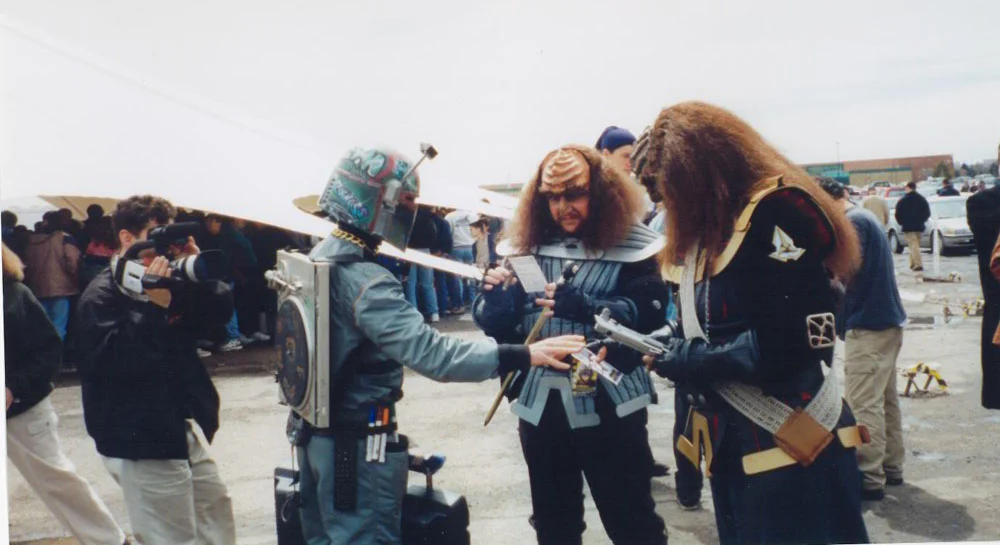
The Klingon Hamlet, a Klingon Language Institute translation of Shakespeare’s play, provides a concrete example. Applying Klingon to an extended dramatic work carries the language beyond the commands and exchanges familiar from television and film.
The project also reverses the usual relationship between a fictional culture and its audience: human participants use the language to reinterpret an existing literary work rather than merely consume another Star Trek story.
The Institute’s annual qep’a’ conference gives that participation a social setting. Learners and experienced speakers gather to practise Klingon, discuss its use, and share their interest in the language.
Such meetings turn an individual enthusiasm into a collaborative activity, with conversation and mutual learning taking place outside the franchise’s fictional world.
Translation, publications, conferences, and creative work demonstrate that Klingon is more than a collection of dramatic sounds. Participants engage with a structured linguistic system and contribute to its continuing use.
These are human cultural activities, distinct from the invented customs and institutions attributed to Klingons within Star Trek.
The language also supplies continuity across changing portrayals. Makeup and costume designs vary between productions, but recognizable speech and transcription conventions provide another way to identify Klingon culture.
Together, visual design and language give audiences several connected points of recognition.
Klingons’ expanding narrative roles contribute to that durability. They appear as enemies, political rivals, allies, relatives, and viewpoint characters.
Worf’s continuing presence, for example, allows questions of belonging, family reputation, and institutional loyalty to unfold through an individual rather than through an opposing empire alone.
Klingon cultural impact therefore includes both sustained fictional worldbuilding and active audience participation. The alien people remain imaginary, while the translations, gatherings, and communities formed around their language are real.
Religion/Ritual
Kahless holds religious significance within Star Trek’s fictional Klingon culture as a legendary unifier and an enduring model of courage and honor. Reverence for him connects memories of the Klingon past with expectations about the future, particularly the belief that he will return.
His importance therefore extends beyond military achievement.
The Star Trek: The Next Generation episode “Rightful Heir” (1993) gives this belief a concrete setting at the monastery on Boreth. Worf visits the religious community during a crisis of faith, while its clerics await Kahless’s promised return.
The monastery brings together a sacred place, custodians of tradition, and a shared expectation that the foundational hero will appear again.
The episode also tests the authority of that belief. The apparent returned Kahless proves to be a clone created by the clerics using genetic material preserved on a relic.
His eventual acceptance as a ceremonial emperor, while Gowron retains political power as chancellor, distinguishes spiritual leadership from government. The resolution asks whether Kahless’s example can still inspire honorable conduct when the person representing him is not the original hero.
This portrayal concerns a particular religious institution and Worf’s encounter with it, not a uniform account of every Klingon’s beliefs or observances. It also remains distinct from real-world Klingon-language conferences, publications, and creative projects, which are human cultural activities rather than the religious practices depicted on Boreth.
Scientific or Rational Explanations
Klingons require a production, literary, and cultural explanation rather than a zoological hypothesis. Their documented context is authored science fiction.
Treating them as possible unidentified animals, hidden humanoids, or extraterrestrial visitors to ancient North America would confuse an entertainment creation with the kinds of witness reports and physical claims examined in investigations of alleged cryptids or unexplained phenomena.
The changing forehead designs are likewise explained first by screen production. Actors were presented through makeup and prosthetics, and those techniques changed between the original television series, later films, and subsequent programs.
Fiction may supply internal explanations for visual inconsistency, but such explanations operate within the story world; they do not replace the observable history of costume and makeup design.
The language presents a different kind of object for study. Although associated with fictional extraterrestrials, Klingon exists as a constructed linguistic system used by humans.
Its vocabulary, grammar, pronunciation, transcription conventions, learning practices, publications, and creative applications can be examined independently of the imaginary species’ biology.
This separates two meanings of existence that are easily blurred. A fictional people need not exist for their language to have real speakers and students.
Conversely, the existence of those speakers does not provide evidence for the people imagined within the stories that motivated the language. The language is real as a human-made cultural artifact, not as proof of alien contact.
A literary interpretation can examine the relationship between Klingon honor, warfare, family allegiance, and political authority. These recurring values make the society intelligible to an audience and create conflicts that can be developed across episodes, novels, comics, and games.
They are narrative and cultural features, not scientific evidence that aggression, loyalty, or honor constitutes an inherited extraterrestrial biological trait.
The species’ longevity can also be explained without appealing to mystery. Recurring characters broadened the original enemy role, changing production designs maintained visual interest, and an elaborated history gave later stories material to revisit.
The constructed language added a participatory dimension unavailable to many fictional species.
Finally, documented study, publication, conferences, and creative production provide repeated opportunities for human engagement. These observable practices offer a grounded explanation for Klingons’ cultural persistence.
The continuing interest is real even though the beings at its center are fictional.
Modern Cultural References
Errand of Mercy, TV 1967
television episode 1967 The Star Trek: The Original Series episode introduces Klingons as characters in the story, not merely as a subject of reference.
(startrek.com)
Star Trek: Klingons, comic 2022
comic 2022 This IDW one-shot tells a Klingon-centered story about Kahless and the meaning of honor; its release is confirmed by a comic catalog record.
(comics.org)
Star Trek: Aliens, book 2023
comic 2023 The published collection includes a story about Kahless and Klingons, alongside stories centered on other Star Trek species.
(penguinrandomhouse.com)
Episode 68: Long Dong and Prosper – Part 1, 2026
podcast episode 2026 The released episode explicitly explores Klingons as part of its discussion of Star Trek.
(shows.acast.com)
Conclusion
Klingons belong to modern science fiction, not to an inherited North American tradition of supernatural beings. Their importance lies in the development of a fictional people whose appearance, history, values, language, and internal legends expanded across successive productions.
Honor, family loyalty, political conflict, and the legacy of Kahless provide recurring narrative foundations. These themes give Klingons a mythic dimension within Star Trek, but their fictional traditions remain distinct from evidence about historical human religions or folklore.
Their lasting cultural significance also extends beyond individual stories. Television, novels, comics, games, and other media offer different ways to explore Klingon society, while the constructed language has acquired genuine use among human learners and enthusiasts.
That distinction is central to the subject: the alien species is imaginary, but the creative work, language study, publication, and audience participation surrounding it are real. Klingons therefore illustrate how sustained fictional worldbuilding can become a shared cultural practice without becoming an ancient tradition or a biological reality.
Further Reading
Klingons
Wikipedia provides a broad overview and a useful reference trail for Klingons, but it works best as a starting point rather than a final authority.
(en.wikipedia.org)
Klingons, Star Trek Archive
Concise overview of the species’ in-universe identity and lore.
(startrekarchive.com)
Development and Use of the Klingon Language, Klingon Language Institute
Explains the language’s fictional origin, development, and real-world use.
(kli.org)