Introduction
Ah Puch is a name historically associated with a Maya death deity. The strongest visual evidence concerns the skeletal or corpse-like figure in Maya codices, conventionally called God A by scholars.
Its identification with the name Ah Puch remains less certain than its association with death.
This distinction matters because images and names survive through different kinds of evidence. Manuscript paintings show recognizable bodily features, while colonial reports and later scholarship preserve names that cannot always be securely matched to the figures and hieroglyphs in those paintings.
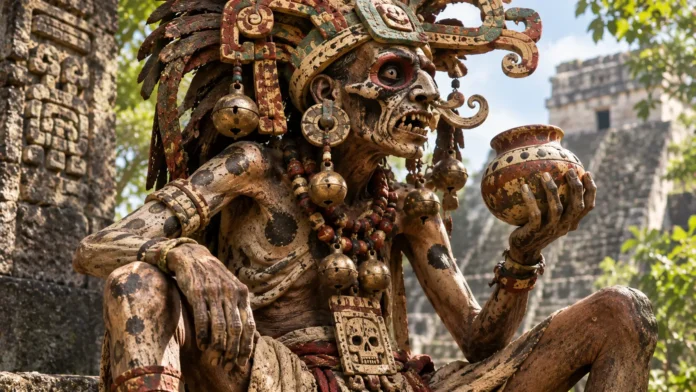
The death-god’s appearance combines exposed bones with attributes of a corpse, sometimes including a swollen abdomen and dark markings. Bells and other ornaments distinguish the supernatural figure from an ordinary skeleton.
Some manuscript scenes use an owl-headed human form instead.
Ah Puch therefore belongs to Maya religious history as a death-deity name, not simply as a monster with a fixed biography. Understanding the figure requires keeping its well-documented imagery separate from uncertain name equivalences and later attempts to assemble one unified identity.
History/Origin
The history of this deity must distinguish the manuscript figure from the written record of its names. The codices preserve a recognizable death-god, but that visual continuity does not establish when the name Ah Puch originated or whether it designated every related representation.
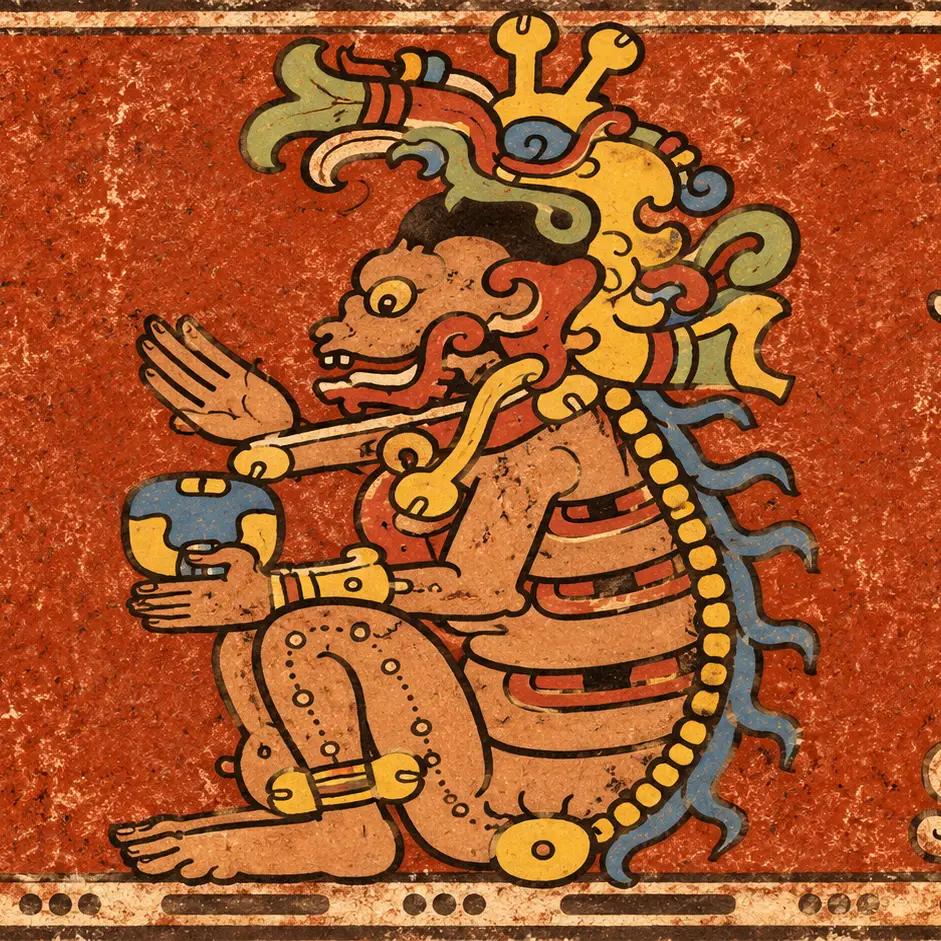
Colonial descriptions provide another strand of evidence. In his study published in English in 1904, Paul Schellhas observed that Diego de Landa mentioned a Maya death-god without describing its appearance.
Such testimony establishes a reported religious role, but cannot independently identify a particular painted figure.
Schellhas also reported that Francisco Hernández called the death-god Ahpuch. Crucially, however, he acknowledged that the recorded names did not explain the codex hieroglyphs.
His use of the scholarly designation God A kept the recognizable manuscript figure distinct from the unresolved question of its traditional name.
A separate account complicates the history. Daniel G. Brinton’s 1882 American Hero-Myths reproduces a report attributed through Bartolomé de las Casas to Hernández in 1545.
It names Eopuco as the killer of Bacab, who rises after three days and ascends to heaven. It does not name Ah Puch.
Later scholarship often brings several death-deity names together. Tomás Pérez Suárez’s 2007 specialist synthesis discusses Ah Puch alongside Kisin and Yum Kimil.
This broader grouping helps explain modern usage, but should not erase regional differences or turn the uncertain correspondence between historical names and manuscript figures into a settled identification.
Name Meaning
The meaning of Ah Puch is not securely established by the historical evidence considered here. Spellings include Ahpuch and Ah-Puch, but differences in spacing and punctuation do not themselves establish an etymology or prove how the name was understood by its original speakers.
Daniel G. Brinton interpreted the name as “the Undoer” or “Spoiler” in A Primer of Mayan Hieroglyphics. He further suggested that it was a euphemism used to avoid uttering an ominous name.
Both the translation and the explanation belong to his historical interpretation, rather than a demonstrated linguistic consensus.
God A has a different status altogether: it is a modern scholarly label for the codex figure, not a translation of Ah Puch. Its value is practical, allowing discussion of a recognizable deity without assuming that an uncertain traditional name has been deciphered.
Other names require equal care. Yum Cimil, also represented as Yum Kimil in modern discussion, belongs to the wider vocabulary of Maya death deities, but its equivalence with Ah Puch is not certain.
Eopuco likewise should not be treated as an established spelling variant merely because it appears in a death-related narrative.
Appearance
The most securely documented form is a humanoid death-deity with a fleshless skull and usually exposed spinal vertebrae. These features make skeletal anatomy central to the figure’s identity.
They provide a firmer basis for description than later illustrations built around a particular interpretation of the name Ah Puch.
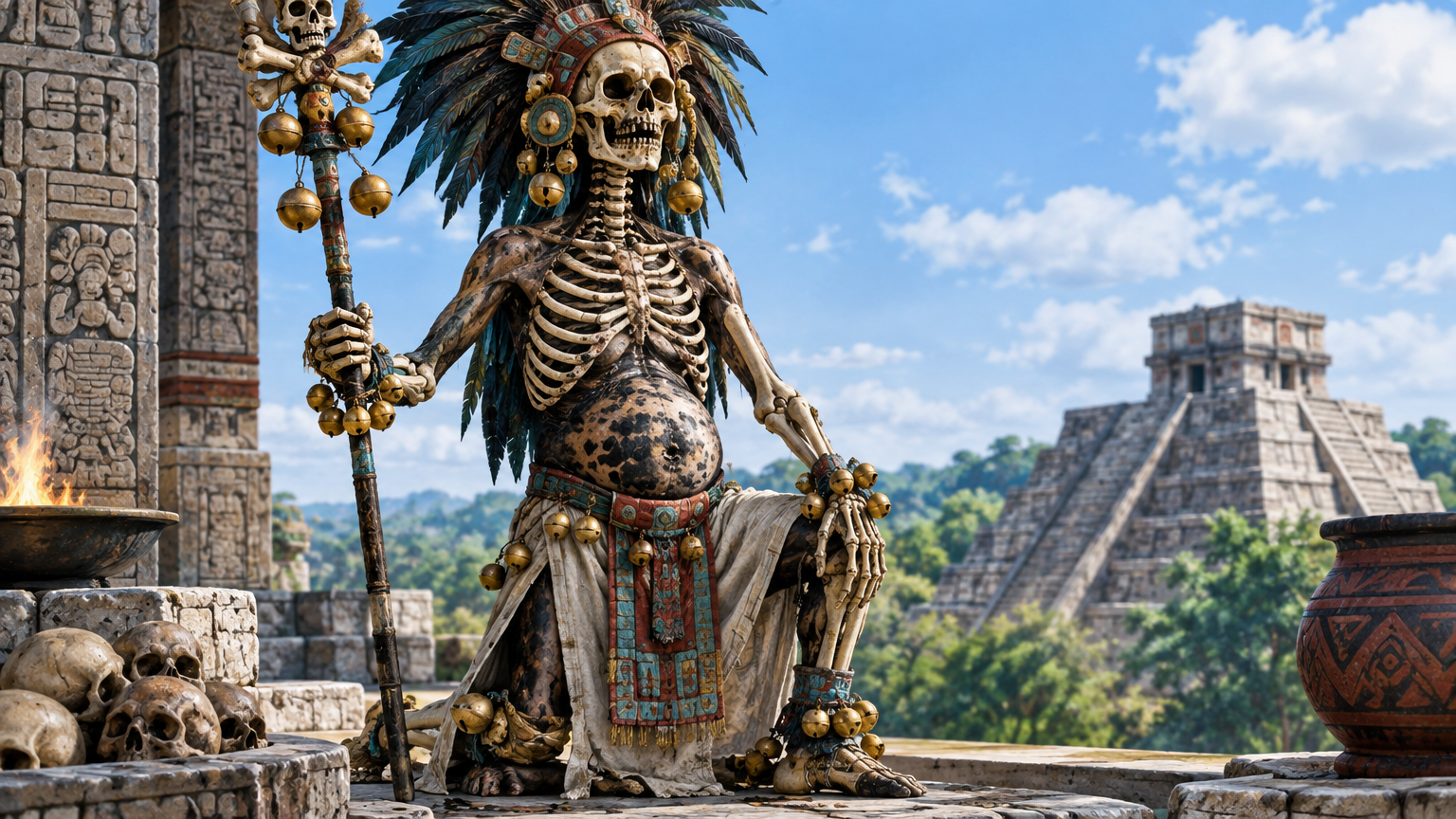
The body is not always rendered as a clean skeleton. Some depictions include a distended abdomen or black spots, combining exposed bones with the appearance of a corpse.
The resulting image brings together different signs of bodily death rather than presenting one anatomically uniform condition.
Ornaments are another important feature. Globular bells can appear on the hands, feet, collar, or head, while a stiff feather collar occurs in some representations.
These details belong to particular manuscript forms; they should not be assembled into a mandatory costume worn identically in every image.
An owl-headed human body substitutes for the death-deity in several Dresden Codex scenes discussed by Schellhas. This is a documented alternative, not the universal appearance of God A. Skull and cross-bone imagery also belongs to the surrounding visual vocabulary associated with the death-god.
A 2014 study in Estudios de Cultura Maya examined this cadaveric imagery through forensic biology, emphasizing the body’s death-related characteristics. That approach helps explain why bone, swelling, and surface markings deserve attention together.
It does not establish that every representation illustrates one precise stage of decomposition.
Background Story
The figure’s background is better understood through religious imagery and historical transmission than through a continuous personal biography. The surviving material brings together manuscript representations, colonial descriptions, and later scholarly comparisons.
These preserve different aspects of a death deity without supplying a single connected account of its life.
Within the codex tradition, death was expressed through both bodily imagery and calendrical signs. Schellhas associated the death-god with Cimi, the day-sign meaning death.
This places the figure within the manuscripts’ organized religious symbolism, rather than limiting its significance to an isolated frightening appearance.
Sacrifice provides another part of that setting. The manuscript figure appears in imagery interpreted as connected with sacrifice, particularly involving captive enemies.
This association concerns the religious representation of death and violence; it does not establish a named ceremony dedicated specifically to a deity called Ah Puch.
The varied body itself contributes to this background. Exposed vertebrae, skull imagery, swelling, and dark markings present death through recognizable bodily changes.
Bells and collars place those features within a supernatural representation. The figure is therefore more than a depiction of human remains, even where its anatomy draws directly on them.
Later synthesis has made Ah Puch a convenient name for discussing this wider material, but convenience can conceal differences. Maya death traditions should not be reduced to one universally named ruler.
The strongest account preserves the relationship between death imagery and religious context while leaving unresolved identifications genuinely open.
Famous Folklore Stories
The narrative record associated with Ah Puch is much thinner than the surviving death-god imagery. A colonial report preserves an episode involving Eopuco, whose identification with Ah Puch remains uncertain; manuscripts provide recurring death-related motifs rather than a securely identified cycle of adventures.
Eopuco and the death of Bacab
This descriptive heading identifies a reported episode, not an authenticated traditional tale title. In American Hero-Myths (1882), Daniel G. Brinton reproduces an account transmitted through Las Casas and attributed to Francisco Hernández, connecting the narrative with a report from Yucatán in 1545.
The recorded sequence is brief: Eopuco kills Bacab on a day called hemiz; after three days, Bacab rises from the dead and ascends to heaven.
The episode cannot securely be presented as an adventure of Ah Puch. Its importance lies in preserving a named agent of death within an early colonial account.
The passage itself neither calls Eopuco Ah Puch nor identifies him as the skeletal deity depicted in Maya manuscripts.
Death and sacrifice in manuscript imagery
The manuscripts preserve a different kind of evidence: repeated supernatural imagery rather than a continuous narrated tale. The skeletal death-god appears within scenes that Paul Schellhas interpreted as connected with sacrifice, especially human sacrifice involving captured enemies.
These are iconographic associations, not recoverable dialogue or plot.
Such scenes establish a relationship between death, divine agency, and ritual violence without supplying a personal biography. They should not be expanded into stories of Ah Puch hunting particular victims, bargaining with heroes, or suffering defeat unless a separate, identifiable narrative actually records those events.
Cultural Impact
The death-god gave mortality a recognizable supernatural form in Maya manuscript culture. Skeletal anatomy and corpse-like features made death visible as an active presence rather than an abstract condition.
Repeated appearances show the figure’s importance within the manuscripts, even where its precise name remains uncertain.
Connections with captive sacrifice place some of this imagery within the cultural expression of organized violence. The relevant scenes concern more than individual bereavement: they associate death with the treatment of enemies.
However, manuscript imagery alone cannot establish the complete meaning or performance of a ceremony.
Later scholarship has brought several death-deity names together under a broad interpretive framework. Tomás Pérez Suárez’s 2007 synthesis discusses names including Ah Puch, Kisin, and Yum Kimil.
Their appearance together is useful for comparison, but does not erase differences of language, region, period, or documentation.
Modern interpretation also extends beyond identifying gods and reading calendrical signs. A 2014 study in Estudios de Cultura Maya examines the death-god through forensic biology.
This approach treats the depicted body as evidence of artistic engagement with death, while remaining a modern analytical perspective.
Similar Beasts
Hel
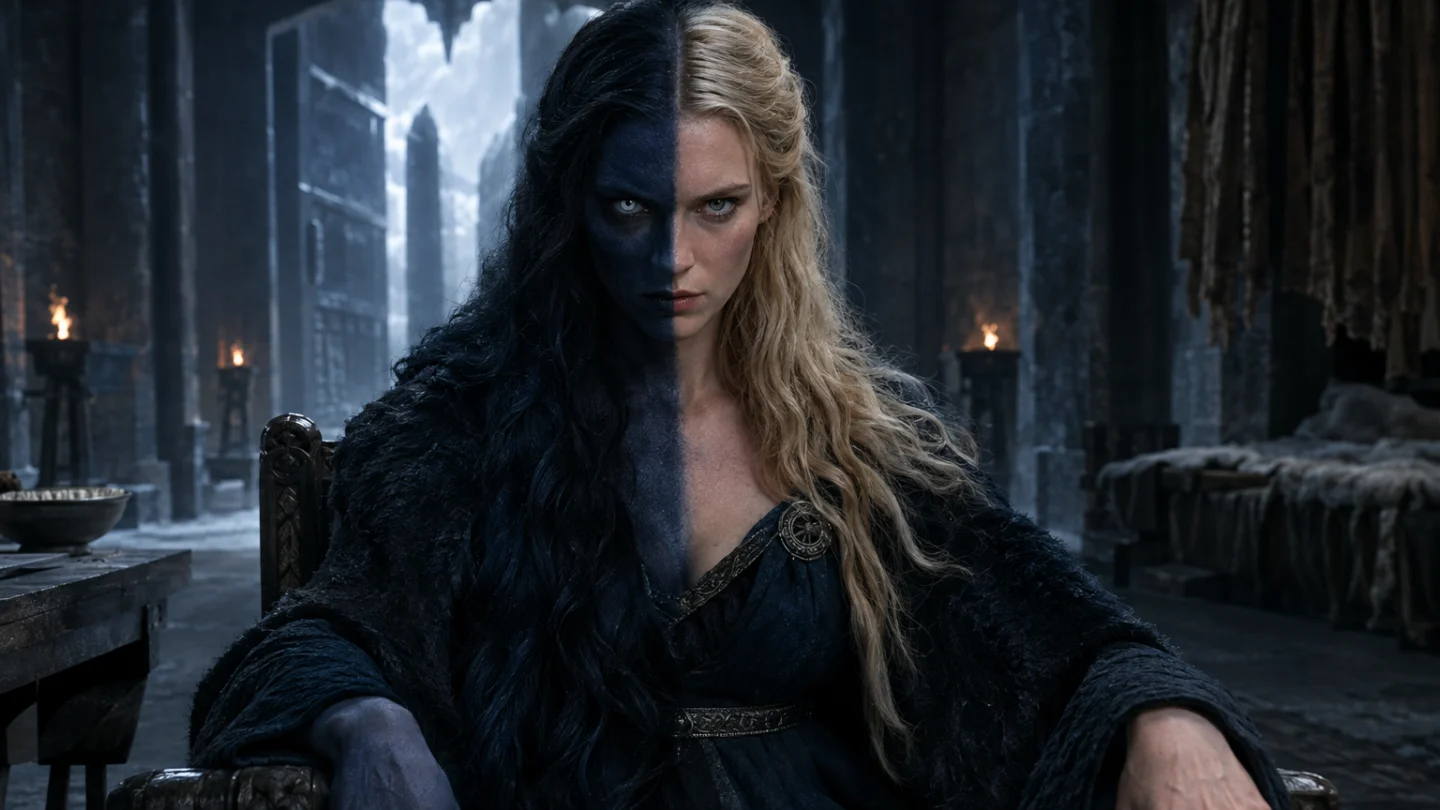
Hel rules a realm of the dead in Norse tradition. Her authority concerns the deceased, making her a useful comparison for a deity associated with mortality and the underworld.
The resemblance is functional, not genealogical. Hel’s established rulership should not be transferred to Ah Puch as proof of equivalent authority across Maya traditions.
Grim Reaper
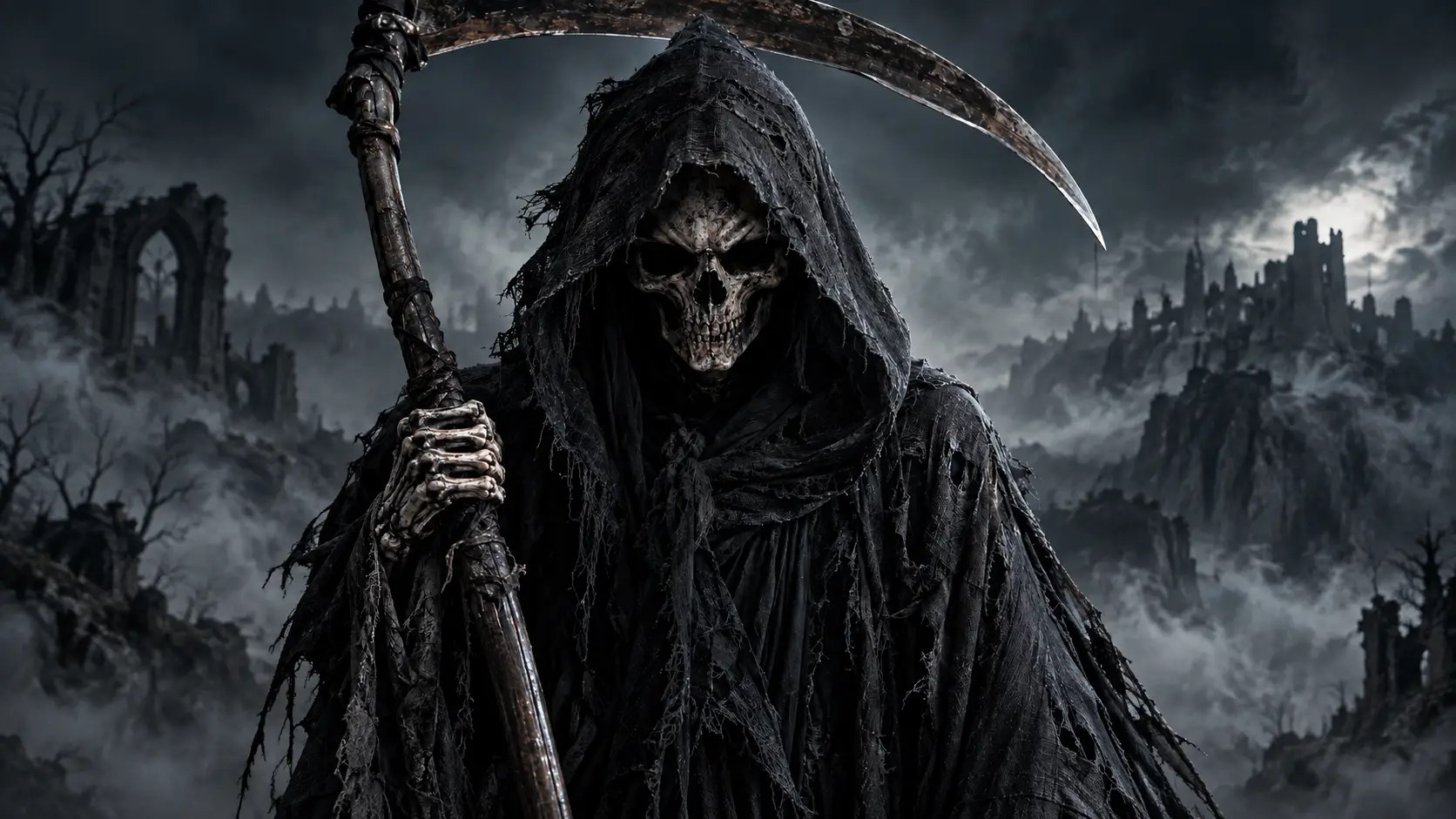
The Grim Reaper is a European personification of death, commonly represented as a skeleton wearing a dark cloak and carrying a scythe. It is not one universally defined deity.
Its skeletal form offers a clear visual parallel with the Maya codex death-god. Shared anatomy does not demonstrate historical borrowing or identical religious meaning.
Samael
Samael is associated with death, judgment, punishment, and temptation in Jewish lore. His character belongs to a different religious framework from that of the Maya manuscript death-god and its associated names.
The comparison concerns supernatural agency over death. It does not establish that Ah Puch acted as an angel, moral judge, or servant within an equivalent hierarchy.
Hun-Came
Hun-Came is one of the Death Lords of Xibalba in the K’iche’ Popol Vuh, alongside Vucub-Came. Their underworld authority belongs to that work’s particular narrative and religious setting.
This is a comparison within the wider Maya world, but not an identity claim. Hun-Came is neither another spelling nor a securely established manifestation of Ah Puch.
Mictlantecuhtli
Mictlantecuhtli is an Aztec god of the dead and the underworld. Schellhas compared him with the Maya codex death-god, providing a historical precedent for discussing their related supernatural functions.
Both figures connect divine identity with death, but they belong to distinct traditions. Their comparison cannot supply missing Maya stories, names, ceremonies, or attributes.
Religion/Ritual
The manuscript death-god is associated with Cimi, the day-sign meaning death. Schellhas connected this sign directly with the deity.
This places death imagery within a calendrical context, rather than restricting it to representations of corpses or scenes of violent death.
Sacrificial associations provide another religious context. Schellhas interpreted manuscript scenes as connecting the death-god with human sacrifice, particularly involving captive enemies.
That interpretation supports a relationship between deity and ritual violence, but it does not identify a complete ceremony dedicated specifically to Ah Puch.
The available evidence does not establish a distinct annual festival, prescribed offering sequence, priestly office, or household observance devoted specifically to that name. Calendrical associations and sacrificial images should therefore remain separate from claims about a fully reconstructed cult and its ceremonial procedures.
Scientific or Rational Explanations
The most relevant scientific approach concerns representation rather than the existence of an unusual animal. The codex figure is a supernatural humanoid with deliberately cadaveric features.
Biological interpretation can investigate the bodily observations behind that imagery without treating the deity as a misidentified species.
The 2014 forensic-biological study examines corpse-like characteristics as meaningful components of the image. Exposed bones, a swollen abdomen, and dark markings invite comparison with bodily changes after death.
Such comparisons are interpretations of artistic features, not direct examinations of the bodies that artists observed.
These images should not be treated as clinical diagrams. They combine anatomical references with ornaments, supernatural attributes, and manuscript conventions.
A distended abdomen or dark spot cannot, by itself, establish one disease, cause of death, or precise stage of decomposition intended by the artist.
Historical interpretation must also distinguish kinds of evidence. Manuscript pictures, colonial reports, and later scholarly classifications answer different questions.
A recognizable skeletal figure can support identification as a death deity without proving that every historical death-deity name refers to that same figure.
The Eopuco episode presents a related problem of transmission. Its surviving account reaches readers through colonial reporting and Brinton’s later publication.
The recorded actions can be summarized, but the passage alone cannot resolve the relationship between Eopuco, Ah Puch, and the manuscript death-god.
Modern Cultural References
Maya and the Three, TV series
Rita Moreno voices Ah Puch in this animated series, set in a fantasy world inspired by Maya, Aztec, and Inca mythology.
The story follows Maya’s quest to save humanity from the vengeful gods of the underworld.
Source
Conclusion
Ah Puch is best understood as a historically attested name associated with the skeletal Maya death deity shown in surviving codices. Those images firmly establish a supernatural figure marked by skull and corpse imagery, exposed vertebrae, and associations with death signs and sacrifice.
What remains uncertain is the ancient name behind that imagery. God A is therefore the cautious scholarly label, while Ah Puch, Yum Cimil, Hun Ahau, and Eopuco should not automatically be treated as interchangeable identities.
This distinction preserves both the strength and the limits of the evidence. The codex imagery demonstrates the importance of personified death within Maya religious thought, yet regional names, colonial reports, and later scholarly interpretations do not combine into one universal biography.
Ah Puch consequently matters not as a completely reconstructed character, but as part of a complex record in which death, bodily decay, calendrical symbolism, and sacrificial imagery were represented through several related, sometimes uncertain divine identities.
Further Reading
Representation of Deities of the Maya Manuscripts, Project Gutenberg / Peabody Museum monograph
Early specialist study describing codex death-god imagery and explicitly discussing the uncertainty of names such as Hunhau and Ahpuch.
(dev.gutenberg.org)
A Primer of Mayan Hieroglyphics, Project Gutenberg
Brinton’s influential early synthesis, useful for tracing the historical “Undoer/Spoiler” etymology and its limits.
(gutenberg.org)
Daniel G. Brinton, American Hero-Myths, Tile.loc
In the account Brinton attributes to Las Casas’s report of Francisco Hernández, Bacab is slain by Eopuco, rises after three days, and ascends to heaven.
The source does not identify Eopuco as Ah Puch.
(tile.loc.gov)