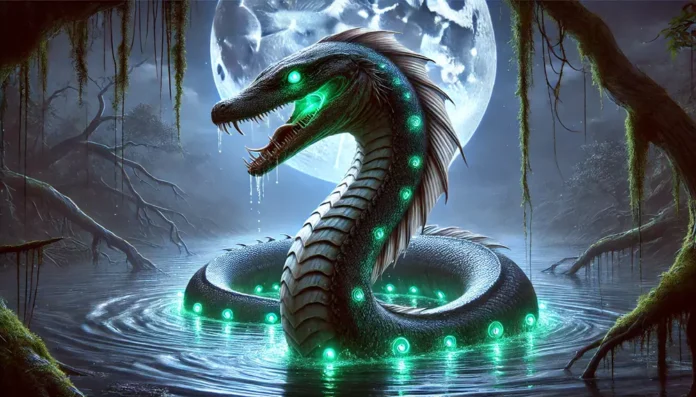
Freshwater Monster – Overview
Freshwater Monster is a comparative category for mythological or folkloric beasts whose defining habitat is inland water, including rivers, lakes, ponds, and wetlands, rather than oceans or seas.
Its classification depends on water being central to the being’s identity, not merely a setting for an otherwise unrelated animal, spirit, or legendary encounter.
Across traditions, such beings may explain dangerous waters, regulate access to resources, or embody uncertainty about environments that sustain communities yet remain difficult to control.
Defining Characteristics
Physical Form and Morphology
Descriptions commonly assign freshwater monsters animal-like bodies, sometimes combining familiar features such as scales, elongated forms, hooves, or exceptional size, without establishing one shared anatomy across cultures.
Some traditions describe recognizable animals altered by supernatural qualities; others preserve uncertain or variable appearances, making habitat and conduct more reliable classifiers than visual resemblance alone.
Ontological Nature
These beings occupy differing ontological positions: particular accounts treat them as extraordinary animals, while others present them as supernatural presences associated with water and its dangers.
No single metaphysical status applies universally; classification must follow each tradition’s own descriptions rather than impose a uniform category of spirit, demon, or biological creature.
Mythological Role and Function
Place in Mythological Systems
Freshwater monsters often mark a boundary between settled human space and aquatic environments whose depth, currents, or concealed hazards limit ordinary knowledge and control.
In some European folklore, dangerous water beings are connected with perilous crossings or bathing places, locating human vulnerability within specific landscapes rather than a universal cosmic conflict.
Other traditions integrate aquatic beings into local accounts of animal life or community conduct, so their position cannot be reduced to antagonism toward humans.
Perception and Meaning
Communities may perceive a freshwater monster as a threat because its habitat carries practical risks, including drowning, unpredictable currents, or isolation from assistance.
In Scottish kelpie traditions, the water horse’s deceptive appearance makes danger socially legible through a recognizable folkloric figure, rather than through abstract hazard alone.
Interpretations vary: a being feared in one account need not represent punishment, protection, or moral judgment in every version of its wider tradition.
Distinction from Related Beast Types
Conceptual Boundaries
A freshwater monster differs from an elemental being when the account emphasizes a particular beast with a localized aquatic habitat, rather than water as an impersonal force.
It differs from an undead entity when its identity does not depend on a deceased human, and from a humanoid monster when animal form defines its classification.
Ordinary aquatic animals do not qualify solely through habitat; supernatural reputation, legendary status, or culturally specific mythological significance must support their inclusion.
Common Sources of Confusion
Conflation occurs because folklore may describe water spirits and animal-shaped monsters in overlapping terms, while later retellings can standardize descriptions absent from earlier evidence.
Comparative analysis distinguishes categories by examining the being’s defining identity, attributed agency, and relationship to water within its own recorded cultural context.
Researchers should not infer shared origins from resemblance alone, since similar aquatic forms can arise independently from distinct landscapes, histories, and narrative conventions.
Canonical Beasts Associated with This Beast Type
Kelpie
In Scottish folklore, the kelpie is a water horse associated with inland waters. Its aquatic habitat and dangerous animal form make freshwater essential to its folkloric identity.
Each-uisge
The each-uisge, recorded in Scottish Gaelic tradition, is a water horse associated particularly with lochs and the sea. Its loch-linked identity supports inclusion, though its habitats are not exclusively freshwater.
Kappa
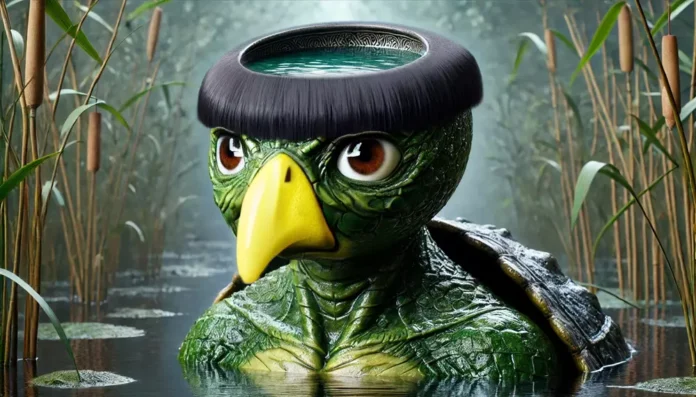
Japanese folklore describes the kappa as an aquatic being commonly associated with rivers and ponds. Its freshwater dwelling is central to its recognizable folkloric classification.
Bunyip
Bunyip traditions among Aboriginal Australian communities are diverse and documented through colonial-era records. Accounts associate the being with waterholes or swamps, although descriptions and interpretations vary substantially.
Historical Distribution and Cultural Context
Freshwater beings occur in geographically separated traditions, including Scottish, Japanese, and Aboriginal Australian contexts, but this distribution does not establish a common historical source.
European water-horse beliefs are documented within regional folklore, while Japanese kappa traditions developed within different cultural settings and use their own local categories.
Australian bunyip reports are especially mediated by colonial documentation, which complicates reconstruction of distinct Indigenous accounts and requires caution about generalization.
Inland waters provide recurring settings for these beings because communities have long relied on rivers, lakes, and wetlands while facing their physical hazards.
Scholarly Interpretation and Uncertainty
Variation in Definitions
“Freshwater Monster” is a modern comparative label, not a universal indigenous category; individual traditions may classify beings as animals, spirits, or other locally meaningful entities.
Some definitions prioritize supernatural agency, whereas narrower taxonomies require an explicitly monstrous animal form, producing different inclusion decisions for ambiguous aquatic beings.
Limits of Available Evidence
Folklore records are uneven in date, language, and detail, limiting reliable comparison between oral traditions and later written descriptions.
For bunyip accounts in particular, colonial observers’ terminology and recording practices complicate claims about original Indigenous meanings; no single standardized description can be securely assumed.
No verified sources describe a universal freshwater-monster category in historical belief systems; the category is useful comparatively but should not be mistaken for an ancient shared taxonomy.
Mythological Role Across Cultures
Freshwater monsters recur partly because inland waters combine necessary resources with concealed hazards, making them productive settings for culturally specific explanations of risk and uncertainty.
Their forms translate environmental concerns into memorable beings, but the meanings attached to those beings depend on particular communities rather than a single universal symbolism.
Comparative recognition clarifies how societies classify dangerous places, yet careful distinctions prevent apparent similarities from erasing different histories, beliefs, and local interpretations.