Introduction
Morgan le Fay is one of the most changeable figures in Arthurian literature. Usually represented as a woman possessing supernatural knowledge, she appears as a healer, an otherworldly ruler, a royal sister, and a dangerous enchantress.
Her loyalties differ substantially between texts.
Her tradition belongs principally to the medieval literature of Britain and France, rather than to accounts of an animal-like monster. Reference works describe her through her relationship with King Arthur, but her earliest named appearance emphasizes an island community of women and extraordinary healing.
Later romances bring Morgan into Arthur’s family and the conflicts surrounding his court. She can threaten the king, expose the court’s concealed relationships, or manipulate adventures from a distance.
Yet her association with Arthur’s final journey to Avalon preserves an older role as his potential restorer.
The University of Rochester’s Camelot Project traces these contrasting functions across medieval works. Their coexistence matters: Morgan is not consistently an evil witch, nor simply a benevolent fairy.
Her enduring importance lies partly in the tension between supernatural assistance and opposition to royal authority.
History/Origin
Morgan’s earliest surviving appearance by name occurs in Geoffrey of Monmouth’s Latin poem Vita Merlini, composed around 1150. Called Morgen, she leads nine sisters living on the Fortunate Isle, also described as the Isle of Apples.
Geoffrey does not identify her as Arthur’s sister.
Taliesin’s account places Morgen within a remarkably abundant landscape, where crops grow without ordinary agricultural labor and inhabitants enjoy long lives. Her knowledge includes medicinal herbs, bodily transformation, and flight.
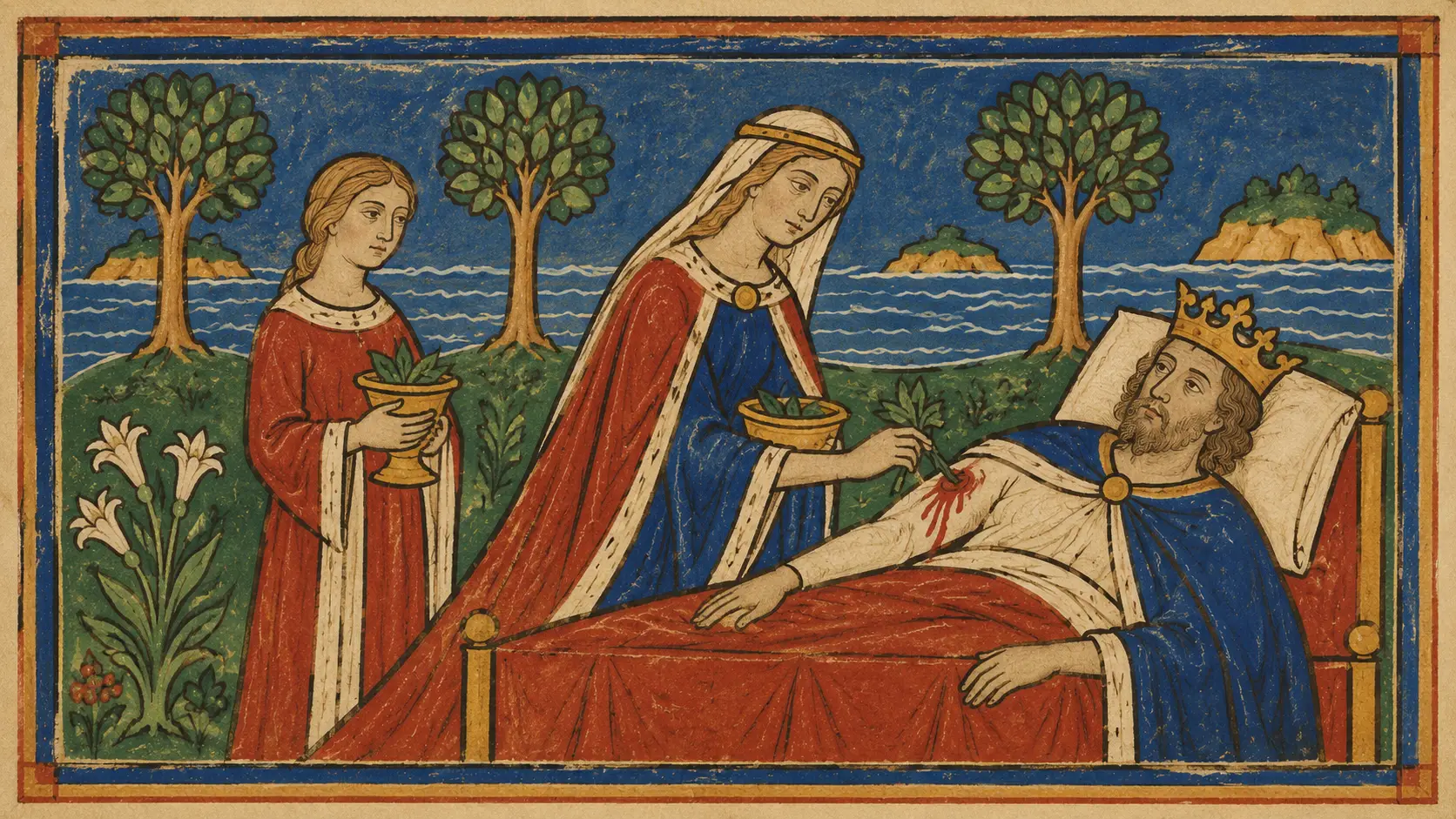
The wounded Arthur reaches this island after Camlann and is entrusted to her care.
In the later twelfth century, Chrétien de Troyes connects Morgan explicitly with Arthur’s family. His romances Erec and Enide and Yvain preserve her reputation for healing through medicinal preparations attributed to her.
These references establish her influence even when she is not directly present in the action.
The thirteenth-century French Vulgate and Post-Vulgate prose traditions develop a more hostile characterization. Morgan becomes involved in magical study, courtly rivalries, and plots against Arthur or his companions.
These cycles expand her narrative agency while retaining elements of the healer and otherworldly woman.
English works preserve further variations. In the late-fourteenth-century Sir Gawain and the Green Knight, Morgan orchestrates the challenge behind the poem’s adventure.
Thomas Malory’s fifteenth-century Morte Darthur includes her treachery but also places her among the women accompanying Arthur on his final departure.
Proposed antecedents include the Welsh Modron and, less securely, the Irish Morrígan. The Camelot Project distinguishes such comparisons from demonstrated origins.
Similar family relationships or supernatural functions may suggest inherited material, but no surviving evidence establishes a straightforward transformation of either goddess into Geoffrey’s Morgen.
Name Meaning
The byname le Fay is conventionally understood as “the fairy,” corresponding to French la fée. It signals Morgan’s association with supernatural knowledge and otherworldly women.
It should not be read as a precise description of her anatomy or as proof that every author considered her nonhuman.
Her personal name appears in several forms, including Geoffrey’s Morgen, French Morgain, and later Morgaine or Morgana. These spellings reflect transmission across languages and literary traditions.
They generally designate versions of the same Arthurian figure, although the surrounding characterization can change considerably.
A Celtic, sea-related derivation has been proposed for the name, often through comparison with Welsh or Breton linguistic forms. The consulted reference material does not settle that explanation.
Translating Morgan confidently as “sea-born” would therefore present a disputed proposal as an established meaning.
Name resemblance also contributes to comparisons with the Irish Morrígan, but resemblance alone cannot demonstrate common identity. Likewise, Argante, the otherworldly queen associated with Arthur’s healing in Layamon’s Brut, occupies a related narrative position without being simply another securely attested spelling of Morgan.
Appearance
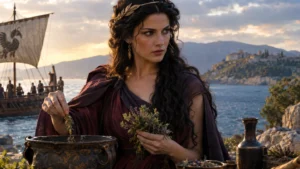
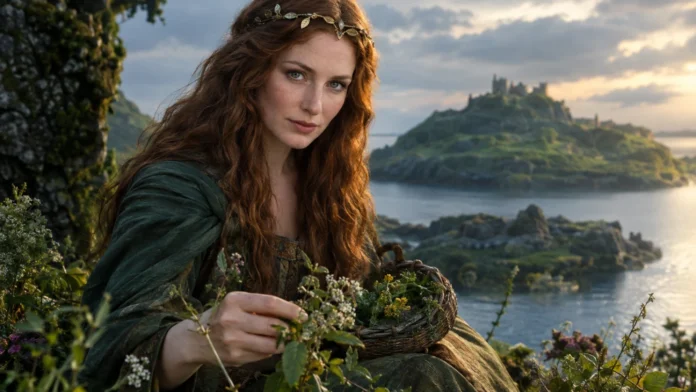
Morgan has no standardized physical design across Arthurian literature. Reference works generally present her as a woman, not a creature with a distinctive nonhuman body.
Her supernatural identity is expressed primarily through knowledge, actions, transformations, and relationships rather than through a fixed set of bodily features.
Vita Merlini provides the earliest clear descriptive statement: Morgen surpasses her eight sisters in beauty. Geoffrey gives no corresponding inventory of hair color, eye color, clothing, or stature.
The passage emphasizes her excellence in healing alongside beauty, making capability more important than detailed visual description.
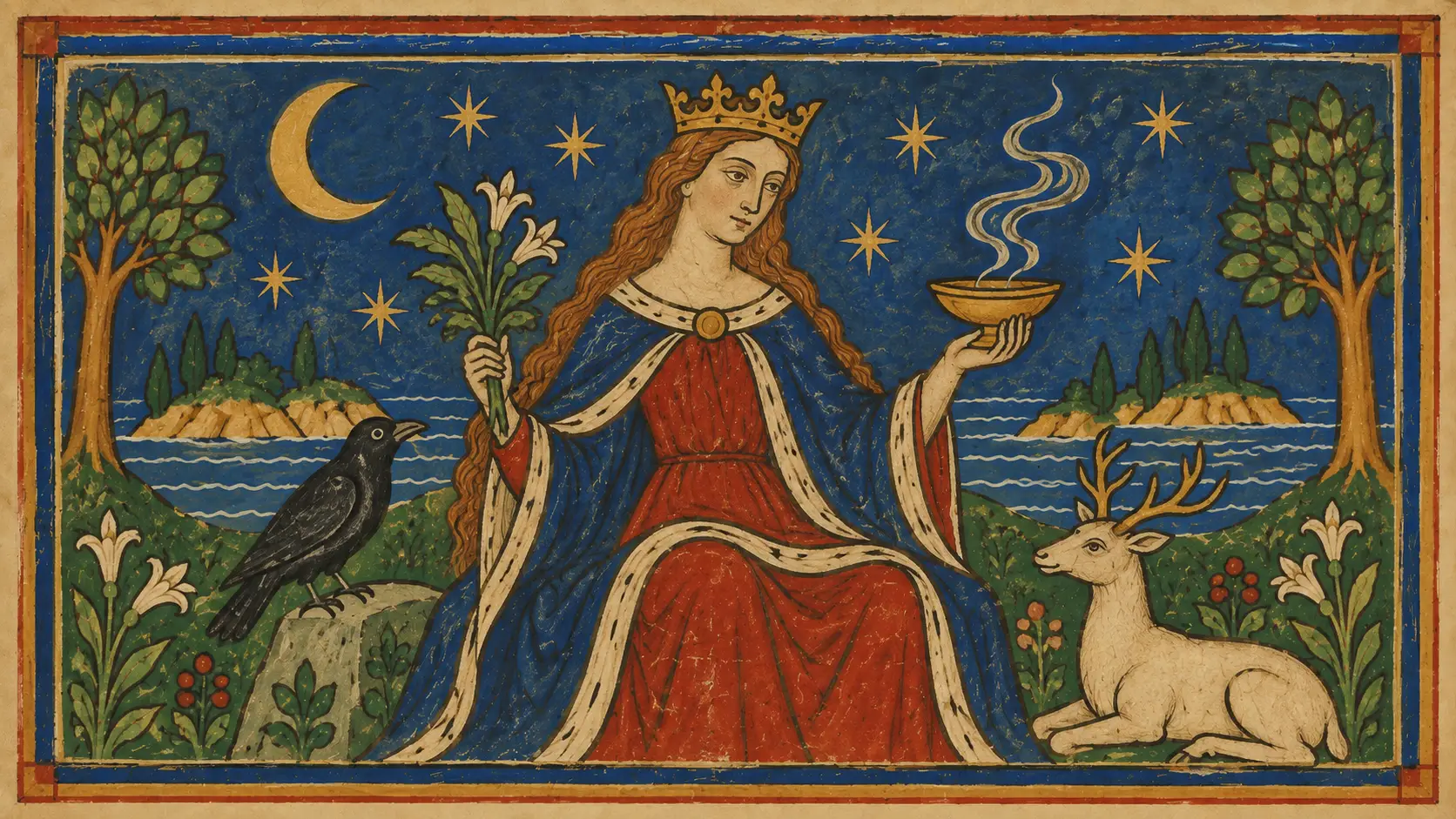
The same account grants her the ability to change shape and travel through the air. The translated passage presented by the University of British Columbia preserves both powers.
Neither ability requires permanent wings, and the poem does not supply a single transformed shape as her defining appearance.
Sir Gawain and the Green Knight offers a striking contrast to Geoffrey’s beautiful island ruler. At Bertilak’s castle, Morgan appears as an elderly woman beside his young wife.
The poem’s contrast between age and youth shows how a particular narrative can reshape her presentation without establishing a universal portrait.
Later art makes its own visual choices. Frederick Sandys’s Morgan-le-Fay, painted in 1864 and documented by Google Arts & Culture, depicts a woman with loose hair and a leopard skin working at a loom.
Its enchanted garment connects her appearance to dangerous magical craftsmanship rather than island healing.
Background Story
Morgan’s background is best understood as the meeting of several literary traditions, not as a single recoverable biography. Geoffrey’s island healer, French romance’s royal enchantress, and English poetry’s hidden organizer belong to overlapping but distinct narrative settings.
Later authors combine these roles without consistently reconciling them.
The Fortunate Isle supplies an important foundation. Its abundance and longevity place Morgen outside ordinary conditions of labor, illness, and mortality.
Arthur’s arrival there makes her knowledge the possible answer to a wound that the world of warfare and kingship cannot adequately resolve.
Geoffrey’s emphasis on herbs also connects supernatural healing with learned knowledge of the natural world. Morgen’s power is not described solely as unexplained spellcasting: she understands medicinal properties and examines Arthur’s injury.
Her authority rests on expertise as well as the extraordinary character of her island.
French prose romance relocates much of this authority into courtly conflict. In the Vulgate tradition, Guinevere’s interference with Morgan’s relationship with Guiomar helps explain their hostility.
Morgan’s efforts to expose Lancelot and Guinevere then turn concealed desire and contested loyalty into central motives for her actions.
The shift from healer to antagonist can be read as a change in narrative function rather than evidence of one coherent moral decline. Morgan’s independent knowledge becomes threatening when directed against the court.
The Valley of No Return, for example, makes enchantment an instrument for judging and restricting knights.
Nevertheless, her restorative association survives these hostile developments. Malory’s inclusion of Morgan in Arthur’s final departure preserves the connection between the king and an exceptional female healer.
The tradition consequently holds destruction and recovery together, allowing the same figure to challenge Arthur’s order and participate in his last journey.
Famous Folklore Stories
Morgan’s best-documented stories survive as episodes within Arthurian literary works, rather than as a single independent folktale. The descriptive headings below identify those episodes, not traditional story titles.
Their differences matter: the same figure can preserve Arthur’s life or threaten his kingdom.
Arthur’s Healing in Vita Merlini
In Geoffrey of Monmouth’s Vita Merlini, Taliesin describes the Fortunate Isle, or Isle of Apples, governed by nine sisters. Their leader, Morgen, understands medicinal herbs and possesses powers of flight and transformation.
Arthur reaches this otherworldly refuge wounded after Camlann.
Morgen receives Arthur, examines his injury, and says that she can restore his health if he remains with her. The episode presents her as a knowledgeable healer, not an enemy.
It offers the possibility of recovery without narrating a completed cure.
The Remedies in Erec and Enide and Yvain
Chrétien de Troyes’s late twelfth-century romances preserve Morgan’s healing reputation through remedies associated with her. In Erec and Enide and Yvain, her medicinal preparations help restore the heroes.
She need not dominate the action for her knowledge to influence its outcome.
These episodes make healing an important part of Morgan’s literary identity beyond Geoffrey’s island narrative. They also connect her with Arthur as his sister.
Their benevolent emphasis should remain distinct from the hostile enchantress developed in later French prose romances.
The Valley of No Return
In the Vulgate-cycle tradition, Morgan’s antagonism toward Arthur’s court includes the enchanted Valley of No Return, where she entraps knights. Her efforts to expose Lancelot and Guinevere’s relationship belong to the same broader pattern of challenging the court through its concealed weaknesses.
Here, enchantment does more than create a dangerous landscape: it places chivalric reputation and fidelity under pressure. Morgan becomes an adversary who targets the court’s contradictions.
This role differs sharply from the healer whose remedies support Arthurian heroes in Chrétien’s romances.
Accolon and the Counterfeit Excalibur
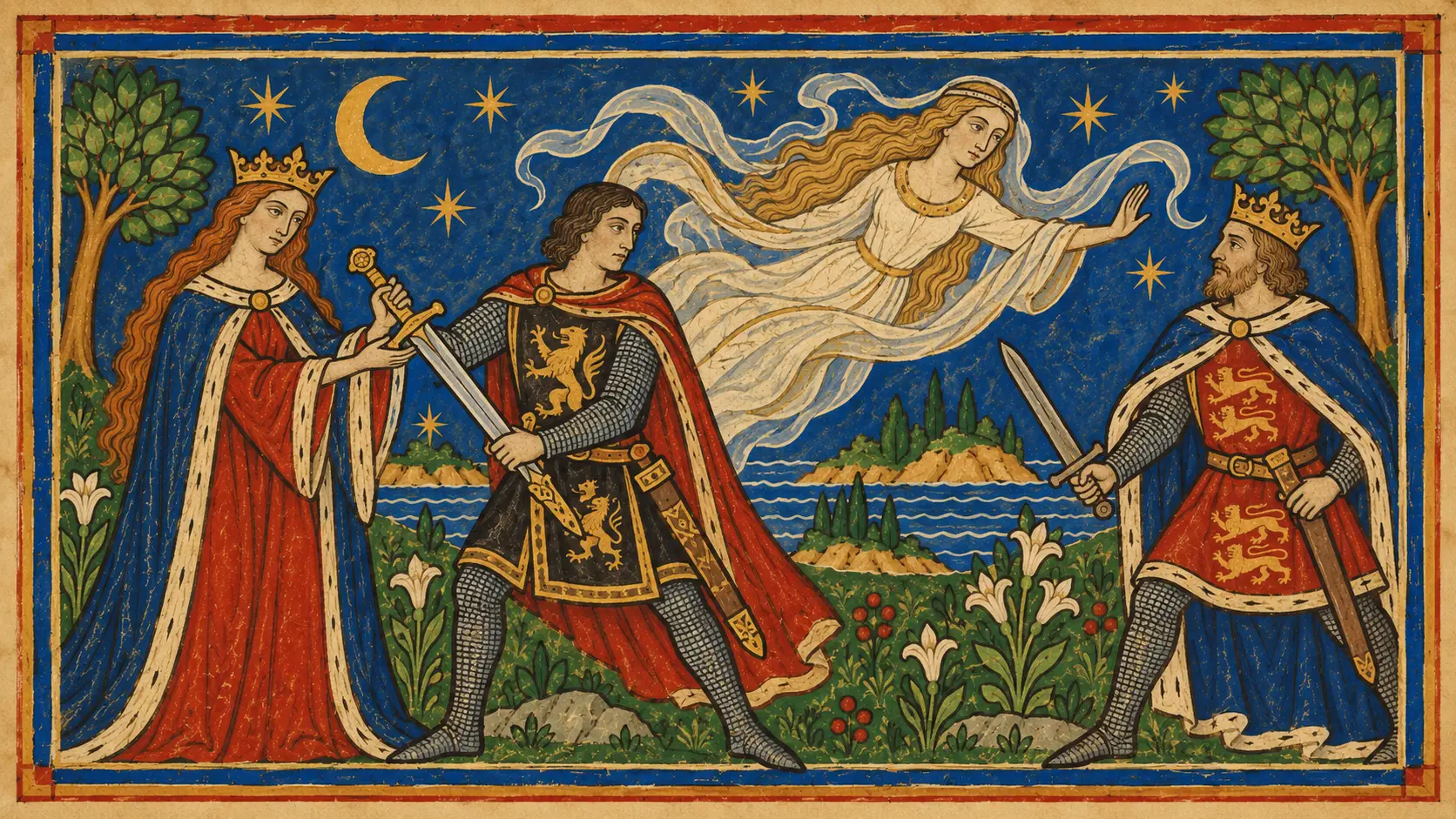
In the Post-Vulgate tradition, Morgan engineers a confrontation between Arthur and Accolon. She supplies Accolon with the genuine Excalibur while Arthur receives counterfeit equipment.
Her scheme turns the king’s own supernatural protection into a weapon against him, creating an apparently unequal contest.
Nimue intervenes to save Arthur, establishing a direct opposition between two powerful Arthurian women. The episode makes Morgan’s hostility unmistakable within this particular narrative.
It should not, however, be treated as the explanation for her conduct in every other version.
The Challenge in Sir Gawain and the Green Knight
Near the conclusion of Sir Gawain and the Green Knight, Bertilak reveals Morgan’s involvement in the adventure. She arranged the Green Knight’s challenge to test the Round Table’s reputation and frighten Guinevere.
Her influence becomes clear only after Gawain has undergone his ordeal.
The revelation makes Morgan an architect of the test rather than its most visible performer. Her hidden intervention connects the apparently separate world of Bertilak’s household with Arthur’s court.
It also complicates an adventure otherwise centered on Gawain’s courage, honesty, and vulnerability.
Arthur’s Departure in Le Morte Darthur
In Thomas Malory’s fifteenth-century Le Morte Darthur, Morgan opposes Arthur during much of the narrative but appears among the women who receive him after his final battle. She participates in carrying her wounded brother away toward Avalon, restoring her association with his last refuge.
This ending does not supply a detailed reconciliation or erase her earlier plots. Instead, it preserves conflicting roles within one work: dangerous opponent and otherworldly sister.
Arthur’s departure therefore recalls the healing tradition without turning Morgan into an entirely consistent moral figure.
Cultural Impact
Morgan gave Arthurian writers a powerful perspective outside the fellowship of the Round Table. Through her, romances could challenge the court’s claims to loyalty, fidelity, and authority.
Her magic sometimes exposes weaknesses that martial strength and public reputation cannot resolve.
Her healing role offers a different cultural meaning: even the greatest king may depend on knowledge held beyond his court. The island healer and the hostile enchantress represent contrasting forms of power, both of which place limits on Arthur’s apparent supremacy.
Victorian art translated that literary ambiguity into a striking human image. Frederick Sandys’s Morgan-le-Fay, painted in 1864, depicts her at a loom with an enchanted garment.
The image gives magical agency a material form through concentrated work rather than battlefield action.
The University of Rochester’s Camelot Project traces Morgan across these changing literary settings rather than reducing her to a stock wicked witch. Such a comparative approach reveals how individual authors select, combine, or suppress aspects of her inherited characterization.
Modern reinterpretations can shift sympathy toward Morgan and foreground her political or spiritual authority. These readings belong to later cultural reception, not automatically to medieval belief.
Their significance lies in revisiting whose motives receive attention within stories traditionally organized around Arthur and his knights.
Similar Beasts
Nimue (the Lady of the Lake)
Nimue is a distinct supernatural woman in Arthurian romance, associated with magic and the Lady of the Lake tradition. Her characterization and naming vary between accounts.
Like Morgan, she can determine Arthur’s fate through supernatural knowledge. Her intervention against Morgan’s Accolon plot makes their separate identities especially clear.
Modron
Modron belongs to Welsh mythological tradition and is sometimes proposed as an antecedent for Morgan. The comparison draws partly on overlapping family relationships within the broader Arthurian material.
Her relevance is genealogical and interpretive, not proof of identity. Morgan’s surviving literary episodes cannot simply be assigned to Modron as an earlier biography.
The Morrígan
The Morrígan is an Irish battle-goddess, distinct from the enchantress of Arthurian literature. Comparisons with Morgan often emphasize the resemblance of their names and associations with threatening supernatural power.
The Camelot Project treats their identification cautiously. Name resemblance and selected thematic parallels do not establish that Morgan developed directly from this Irish goddess.
Mélusine
Mélusine is a supernatural woman associated with water and European legendary traditions. Her stories offer a separate example of relationships between human society and an otherworldly female figure.
She provides a thematic comparison for Morgan’s association with otherworldly realms and water. That resemblance does not make Mélusine another name for Morgan.
Religion/Ritual
The reviewed evidence establishes no historical Morgan-centered cult, offerings, feast days, or prescribed rituals. Proposed connections with Celtic goddesses concern possible literary antecedents.
They do not demonstrate that medieval communities worshipped the Arthurian Morgan or maintained religious observances in her name.
Her stories nevertheless inhabit a Christian literary environment. Some prose accounts place her education in a nunnery, while Malory associates that schooling with necromancy.
These details characterize her unusual learning within fiction; they are not records of convent practices or documented magical instruction.
Scientific or Rational Explanations
Morgan is best investigated through textual history rather than zoology or eyewitness analysis. The surviving evidence concerns a literary character with supernatural abilities, not a reported animal.
Manuscript traditions and adaptations explain how her attributes change without requiring a biological explanation.
Comparison between works provides a practical explanation for her contradictory conduct. Geoffrey’s healer, the French prose cycles’ antagonist, and Malory’s complex sister belong to different narrative constructions.
Treating them as one continuous biography creates inconsistencies that the individual texts need not resolve.
Proposed Celtic antecedents are historical hypotheses about transmission and transformation. The Modron comparison and the Morrígan comparison require separate evaluation, since their supporting parallels differ.
Neither should replace Morgan’s securely documented literary appearances with an assumed, fully recoverable prehistoric identity.
A social reading can examine how her knowledge challenges courtly authority. Healing, enchantment, and the exposure of secret relationships allow Morgan to influence events outside conventional knightly combat.
This is an interpretation of narrative function, not evidence of the authors’ unanimous intentions.
The optical phenomenon called a Fata Morgana is a separate matter. This complex mirage results from atmospheric refraction and takes its name from Morgan.
Its physical explanation concerns distorted distant images, not her literary powers, and supplies no evidence that the enchantress existed.
Modern Cultural References
Later portrayals of Morgan le Fay draw on different parts of her medieval inheritance. Victorian painting emphasizes enchantment, contemporary novels place her perspective at the center, and screen and game adaptations recast her supernatural power within new fictional worlds.
Morgan le Fay in Marvel Comics
Marvel Comics transformed Morgan le Fay into one of its recurring supernatural villains, blending Arthurian legend with superhero fantasy. She first appeared in The Black Knight #1 in 1955, created by Stan Lee and Joe Maneely, where she was already positioned against the heroes of Camelot.

Marvel later expanded her into an immortal, immensely powerful sorceress connected to Avalon, Merlin, and the ancient magical world. She has confronted the Black Knight and the Avengers, formed an unusual relationship with Doctor Doom, and used time travel and magic to interfere with both medieval and modern events.
Later stories pushed her even further into fantasy. In Weirdworld, Morgan becomes the ruler of a bizarre realm filled with monsters, warriors, and magic.
Marvel’s version preserves her Arthurian identity while emphasizing the darker enchantress that developed in later medieval tradition.
Marvel Comics
Morgan-le-Fay, painting (1864)
Frederick Sandys depicts the enchantress at a loom, working on an enchanted garment. The painting gives Morgan a distinctive Victorian appearance rather than a universally authoritative medieval design.
(artsandculture.google.com)
Morgan Is My Name, novel (2023)
Sophie Keetch’s feminist Arthurian retelling narrates Morgan’s early life in her own words.
It makes the enchantress the speaking protagonist rather than viewing her chiefly through Arthur’s court.
(penguinrandomhouse.com)
The Faerie Morgana, novel (2025)
Louisa Morgan’s Arthurian retelling presents Morgana as a powerful priestess and advisor to Arthur.
This characterization foregrounds her authority and counsel rather than reducing her to an antagonist.
(hachettebookgroup.com)
I Am Morgan Le Fay: A Tale from Camelot, novel (2001)
Nancy Springer’s juvenile-fiction novel explores Morgan’s origins and transformation into the legendary enchantress.
It offers younger readers a narrative centered on Morgan rather than on Arthur’s heroic career.
(books.google.com)
Runaways, television series, Season 3 (2019)
The third season features Elizabeth Hurley as Morgan le Fay, a major supernatural antagonist.
This screen portrayal relocates the Arthurian enchantress within Marvel’s contemporary superhero setting and narrative.
(imdb.com)
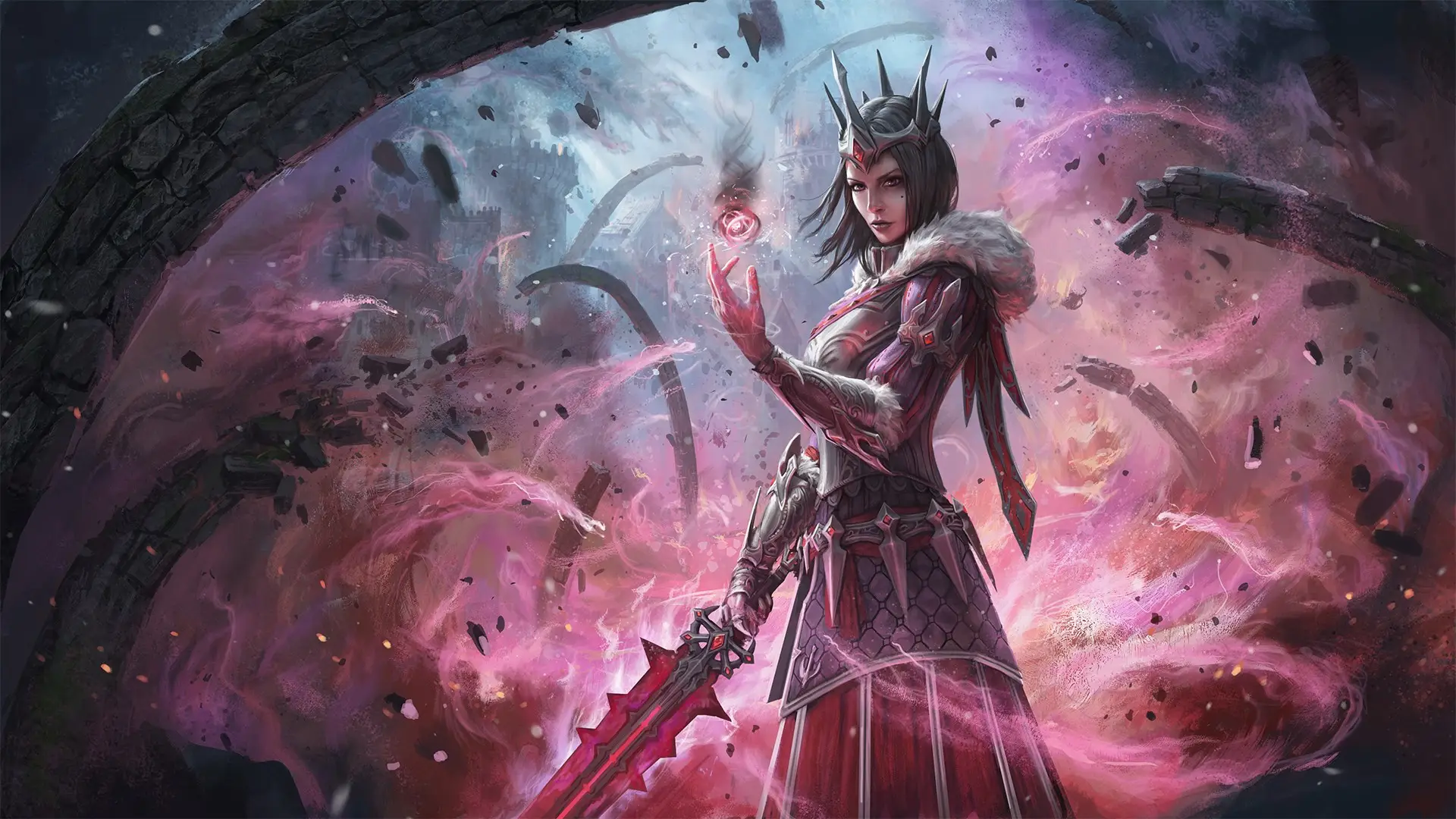
SMITE, video game, Morgan Le Fay playable character (2021)
Titan Forge Games includes Morgan Le Fay as a playable character in its mythological multiplayer game.
Her appearance adapts the Arthurian enchantress for competitive play rather than medieval storytelling.
(smitegame.com)
These works are evidence of Morgan’s continuing creative reception, not independent confirmation of medieval beliefs. Their differences are significant: a priestess, a first-person protagonist, and a superhero antagonist each represent an adaptation’s choices about the same inherited literary figure.
Conclusion
Morgan le Fay is best understood as a changing figure of Arthurian literature, not a beast with a fixed anatomy or a single traditional biography. Her earliest named appearance emphasizes healing and otherworldly knowledge; later narratives place those powers within family conflict, courtly rivalry, and magical challenges.
The contrast between the woman who threatens Arthur and the woman associated with his recovery is central to her significance. Neither role alone adequately represents the surviving tradition.
Her lasting symbolic force lies in that unresolved combination of care, danger, knowledge, and independence. Morgan can stand outside the court’s authority while remaining deeply involved in its fate, making her especially adaptable to later interpretations of power and loyalty.
Proposed Celtic antecedents remain theories rather than established identities, while her medieval literary presence is secure. Modern portrayals continue to select and reshape these possibilities, preserving her relevance without establishing one definitive version of who she must be.
Further Reading
Vita Merlini, Geoffrey of Monmouth; Internet Sacred Text Archive
English translation of the poem containing Morgen’s early named appearance.
Taliesin describes her island, healing knowledge, transformation and flight, and reception of the wounded Arthur.
Source
Morgan le Fay, The Camelot Project, University of Rochester
A guide to Morgan’s changing roles in Arthurian literature, including her healing associations in Chrétien de Troyes and proposed connections with earlier Celtic figures.
Source
Morgan le Fay: Arthurian Enchantress, University of British Columbia
Includes a translated passage from Vita Merlini describing Morgen’s medicinal knowledge, shape-changing, flight, and care of Arthur.
Useful for examining the text behind these attributes.
Source
Morgan le Fay, Encyclopaedia Britannica
A concise reference overview of the Arthurian figure and her literary context, suitable as an introduction before exploring individual medieval accounts.
Source
Morgan, the Fay, The New International Encyclopædia; Wikisource
A historical encyclopedia entry preserved in transcription. Useful for comparing older reference treatments of Morgan with modern scholarship, rather than as a definitive account of disputed origins.
Source
Morgan-le-Fay, Frederick Sandys; Google Arts & Culture
Documents Sandys’s 1864 painting and its depiction of Morgan weaving an enchanted garment.
The accompanying museum account supports discussion of her Victorian visual reception.
Source
Fata Morgana, San Diego State University
Explains the optical phenomenon associated with Morgan’s name. Relevant to the distinction between atmospheric mirages and the enchantress’s supernatural abilities in literature.
Source
The Faerie Morgana, Louisa Morgan; Hachette Book Group, 2025
The publisher’s page for a modern Arthurian novel presenting Morgana as a powerful priestess and advisor to Arthur.
A source for contemporary reception, not medieval belief.
Source