Introduction
Illuyanka is the serpent adversary of the Storm-god in a Hittite myth preserved in two versions. The designation comes from the Hittite word for “snake” or “serpent,” rather than a securely established personal name.
Its importance lies in its ability to defeat a powerful deity.
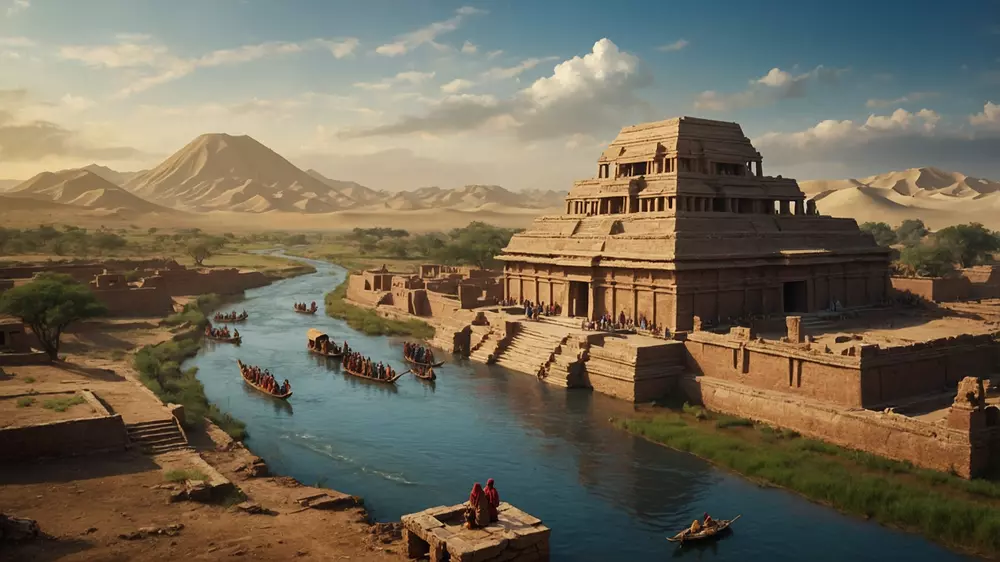
The story belongs to the religious traditions of ancient Anatolia, in what is now Turkey. It was associated with the Purulli festival, whose concerns included the prosperity and protection of the land.
The serpent’s eventual defeat therefore had significance beyond the outcome of an isolated combat.
Both versions begin with divine vulnerability, but they resolve it differently. One turns on a feast, intoxication, and a mortal helper; the other involves the recovery of the Storm-god’s stolen heart and eyes.
These are alternative narratives, not successive adventures within one continuous biography.
Although frequently called a dragon in modern summaries, the creature has no detailed dragon anatomy in the surviving narrative. Its defining characteristics are its serpentine identity, its formidable opposition to the Storm-god, and its place within a story of victory achieved through assistance rather than strength alone.
History/Origin
The Illuyanka myth survives in Hittite cuneiform texts from Bronze Age Anatolia. Modern scholarship catalogues it as CTH 321, a reference identifying the composition within the corpus of Hittite texts.
Its written preservation belongs to the second millennium BCE, although the underlying tradition may be older.
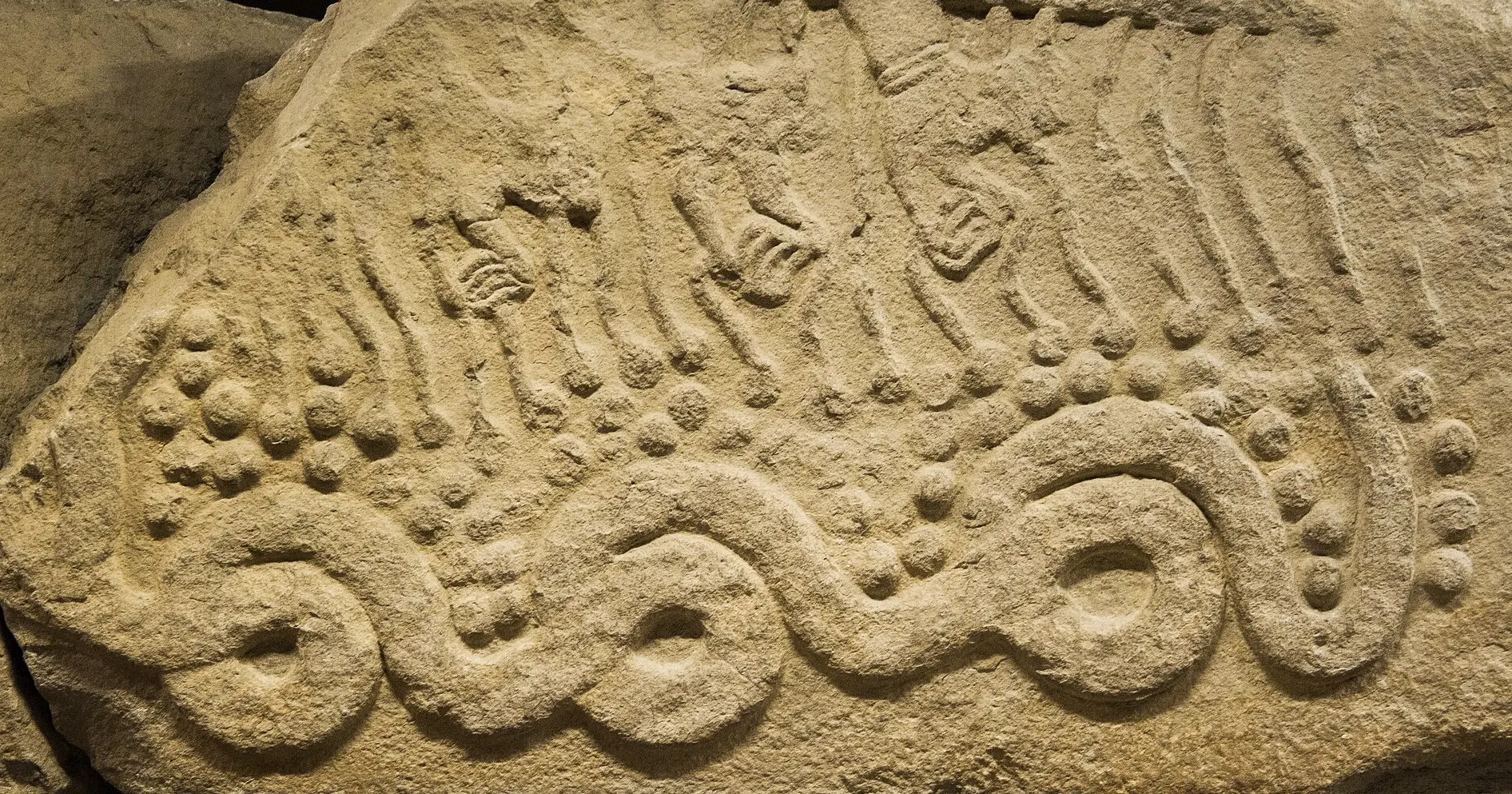
The distinction between preservation and origin matters. A story recorded in Hittite need not have originated entirely among Hittite speakers.
Their religious culture incorporated older Anatolian traditions, including those of the Hattic-speaking population, alongside material from other languages and communities encountered by the Hittite kingdom.
The serpent’s designation offers one indication of that linguistic background. Specialist lexicographic scholarship generally treats illuyanka- as a Hattic loanword.
This supports an Anatolian context for the vocabulary, but a borrowed word cannot by itself establish when the complete narrative developed or how every episode entered it.
The surviving composition preserves two tellings of the conflict rather than one uniform account. Their common structure is an initial defeat of the Storm-god followed by a reversal.
Their different solutions show that the serpent-combat theme could accommodate substantially different ideas about assistance, obligation, and the consequences of victory.
The festival setting is fundamental to understanding why the story was preserved. Its framework connects the telling with the land’s well-being, not simply with entertainment.
Hans Gustav Güterbock’s discussion of Hittite mythology emphasizes this Purulli context while keeping the two narrative versions distinct.
Comparisons with other storm-god and serpent conflicts have made the composition important in comparative mythology. Nevertheless, resemblance does not supply a precise origin story.
Shared motifs must be distinguished from demonstrated borrowing, especially when the surviving written records come from different periods and religious settings.
Name Meaning
The central linguistic fact is straightforward: Hittite illuyanka- means “snake” or “serpent.” In the myth, that ordinary designation identifies the Storm-god’s opponent.
Capitalizing it as Illuyanka is a convenient modern convention, but capitalization should not be mistaken for proof of an ancient personal name.
Gary Beckman’s specialist study, “The Anatolian Myth of Illuyanka,” makes this common-noun status important to interpreting the figure. The distinction changes how the creature is understood: the text presents the serpent confronting the god, rather than necessarily introducing a uniquely named member of a defined monster species.
The word’s deeper origin is less certain than its meaning. The Indo-European Cognate Relationships database summarizes scholarship favoring a Hattic borrowing, while also recording disagreement.
An alternative proposal connecting the word with an “eel-snake” formation has not gained broad acceptance and should not be presented as settled etymology.
The forms Illuyankaš and illuyanka- reflect different ways of presenting Hittite vocabulary, including an inflected form and a lexical stem. “Dragon,” meanwhile, is a broader translation or descriptive choice.
It communicates a monstrous opponent but does not establish wings, limbs, multiple heads, or any particular visual design.
Appearance
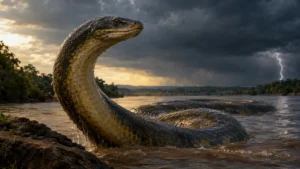
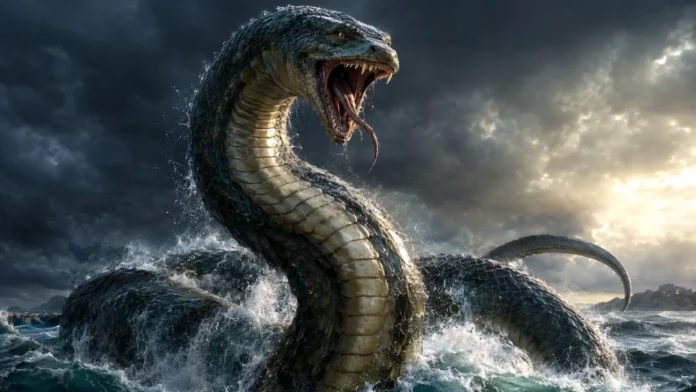
The most secure description of Illuyanka is a serpent. The myth does not offer an anatomical portrait: it supplies neither measurements nor a distinctive color, head count, or arrangement of limbs.
Its physical presence emerges principally through what it does and what happens to it.
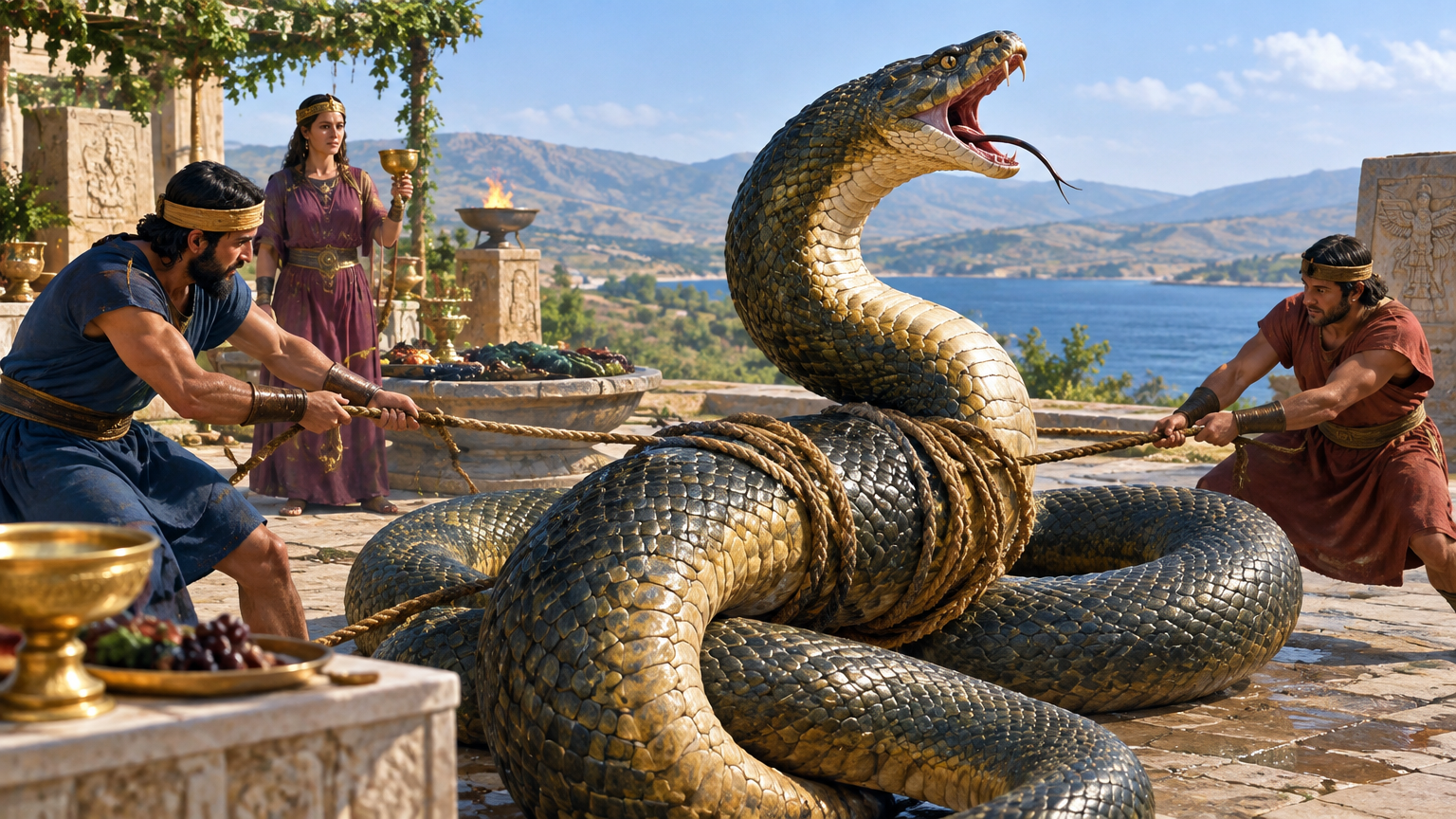
In the first version, the serpent participates in the feast arranged by Inara, becomes intoxicated, and is bound by the mortal Hupašiya. These actions make it a bodily opponent that can be restrained and killed, while also giving it behavior beyond that of an ordinary snake.
In the second version, the serpent takes the Storm-god’s heart and eyes, and the renewed confrontation takes place at the sea. These details establish supernatural power and a narrative setting.
Neither provides a reliable basis for reconstructing specialized aquatic anatomy or identifying a real animal species.
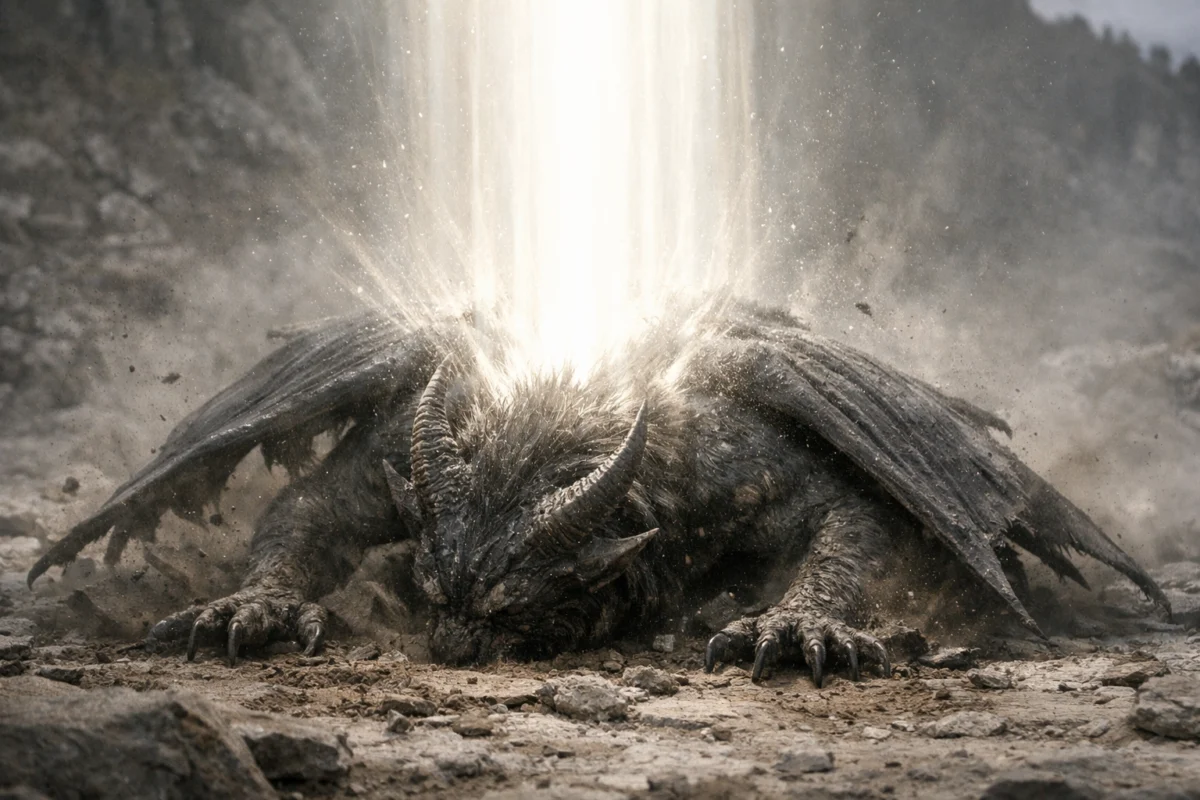
A conservative illustration can therefore use a serpentine form, with the combat or binding episode supplying recognition. Enlargement may communicate its mythic power, but an exact gigantic size is not established.
Added wings, horns, legs, or extra heads would be artistic interpretation rather than recovered textual detail.
Anatolian serpent-fighting imagery requires similar care. A 2023 study in Belleten distinguishes the textual episodes from visual works that have sometimes been connected with them.
A scene showing a deity and a serpentine monster is relevant comparative evidence, but its subject cannot automatically be identified as Illuyanka.
Background Story
The serpent belongs to a religious narrative concerned with restoring divine effectiveness after defeat. Its background is therefore not a personal history of birth, growth, and monstrous transformation.
The surviving material introduces it through a relationship of opposition to the Storm-god and through the means needed to overcome it.
The Purulli framework gives that opposition a wider cultural meaning. The text connects the festival with the land thriving, prospering, and remaining protected.
Read within that setting, the recovery of divine power has implications for collective security, rather than serving only as a demonstration of a god’s martial superiority.
The first version makes cooperation decisive. After the Storm-god loses, Inara arranges a feast and secures Hupašiya’s help.
The drunken serpent is bound before the god kills it. Divine victory thus depends on preparation, deception, and mortal participation, not on a straightforward rematch between equally prepared opponents.
The second version explores recovery through family relationships. Deprived of his heart and eyes, the Storm-god eventually regains them through his son’s marriage into the serpent’s household.
The renewed battle ends with the deaths of both the serpent and the god’s son, giving restoration a tragic human cost.
These differences should remain visible when interpreting the creature’s symbolic role. The feast version foregrounds the overcoming of strength through strategy; the family version entangles victory with obligations across opposing households.
Neither requires the serpent to represent one fixed abstraction, such as drought, winter, or evil in every context.
Broader interpretations connect Illuyanka with the underworld, sometimes described as the “Dark Earth,” and with water passages. These are scholarly readings of Hittite symbolic landscapes, not an explicit biography or anatomical description.
They expand the possible religious context without replacing the securely documented festival and combat framework.
Famous Folklore Stories
The surviving Illuyanka narrative contains two distinct versions of the Storm-god’s struggle with a serpent. The headings below describe their principal episodes rather than reproduce ancient story titles.
These versions should be read separately, not combined into a single sequence.
The Feast and Binding of the Serpent
In the first version, the serpent initially defeats the Storm-god. Recovering divine supremacy therefore requires more than another direct attack.
The goddess Inara prepares a feast and recruits the mortal Hupašiya, whose assistance becomes essential to overcoming an opponent the god could not defeat unaided.
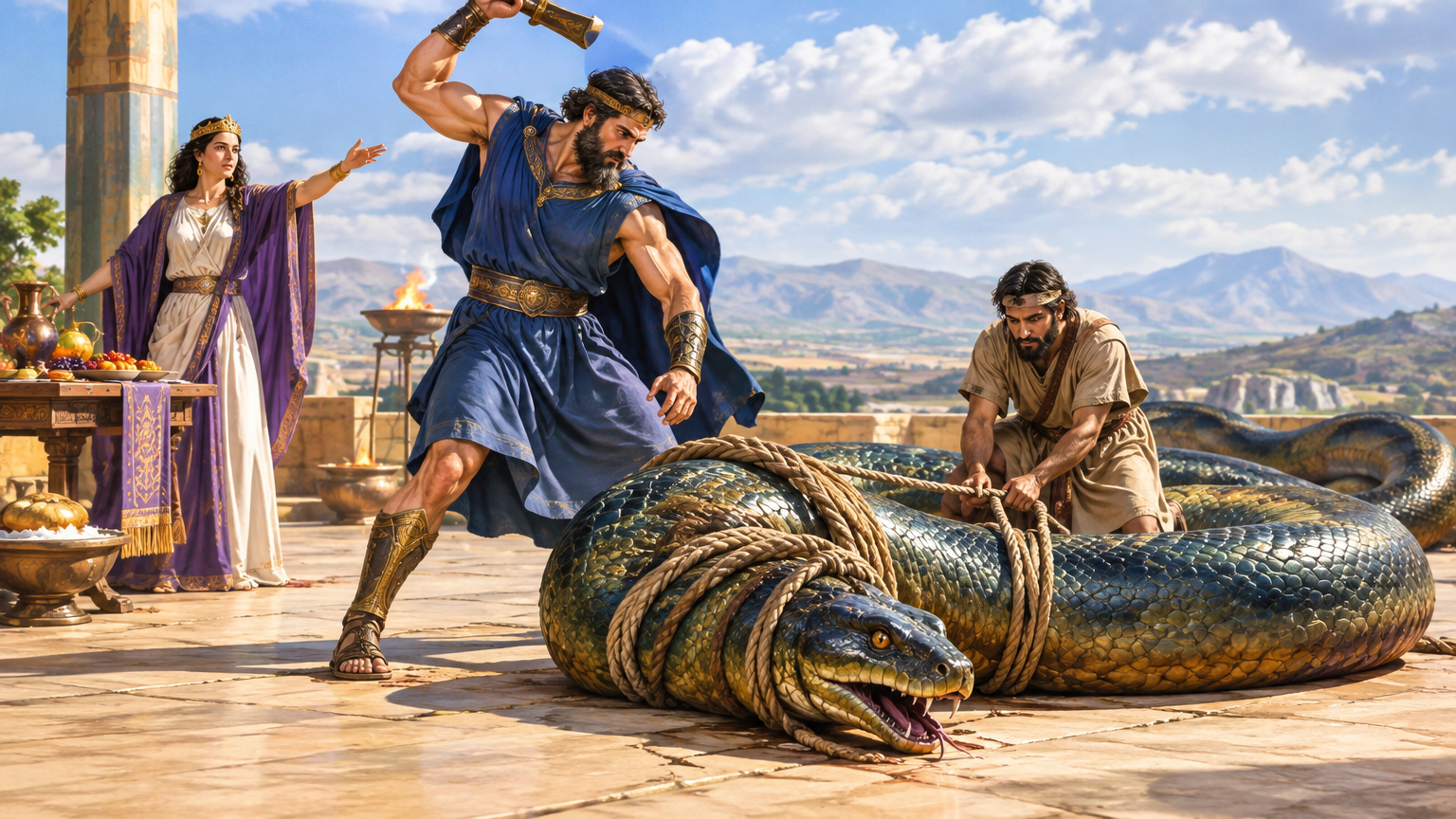
The feast changes the balance of power. The serpent drinks until intoxicated, allowing Hupašiya to bind it. Only after this restraint does the Storm-god kill his adversary.
Divine planning, human participation, and the exploitation of appetite together accomplish what straightforward combat had failed to achieve.
This version makes cooperation central to the victory. Inara supplies the strategy, Hupašiya performs the binding, and the Storm-god delivers the final blow.
The serpent’s defeat is consequently not presented as a simple demonstration that divine strength always prevails without assistance.
The Recovery of the Heart and Eyes
The second version gives the Storm-god’s initial defeat a different consequence: the serpent takes his heart and eyes. The loss leaves him deprived of essential bodily powers.
Their recovery, rather than a feast and binding, becomes the necessary preparation for renewed combat.
The Storm-god’s son provides the means of recovering the stolen organs through his marriage into the serpent’s family. Once the heart and eyes have been returned, the god can confront his adversary again.
Family relationships therefore become instrumental in reversing the earlier defeat.
The renewed battle takes place at the sea and ends with the deaths of both the serpent and the Storm-god’s son. This ending gives restored divine power a tragic cost.
Unlike the first version, its resolution turns on divided family loyalties rather than successful intoxication and restraint.
Cultural Impact
The myth’s clearest historical importance lies within Hittite religious culture. It connects a powerful god’s recovery from defeat with the security and prosperity of the land.
The serpent matters primarily as the opponent through whom divine authority is challenged and eventually re-established.
Human involvement gives the narrative a distinctive character. Hupašiya’s binding of the serpent and the son’s recovery of the stolen organs make mortals essential to both versions.
Divine victory depends on relationships and assistance, not simply on an overwhelming difference in strength.
For modern comparative mythology, the narrative offers an important Anatolian example of a deity confronting a serpent. Comparisons with Greek and Vedic adversaries help identify shared narrative structures, but resemblance alone cannot establish that one surviving story was borrowed directly from another.
Its relationship with ancient art requires particular care. A 2023 study in Belleten distinguishes different Anatolian serpent-fighting compositions rather than treating every combat image as an illustration of Illuyanka.
A serpent and an armed figure are not, by themselves, a secure identification.
Modern descriptions also influence how readers imagine the creature. Calling it a dragon can place it within a familiar comparative category, but the Hittite designation means serpent.
That broader label should not replace the narrative’s limited evidence with a standardized fantasy appearance.
Similar Beasts
Kinioka kia Tumba
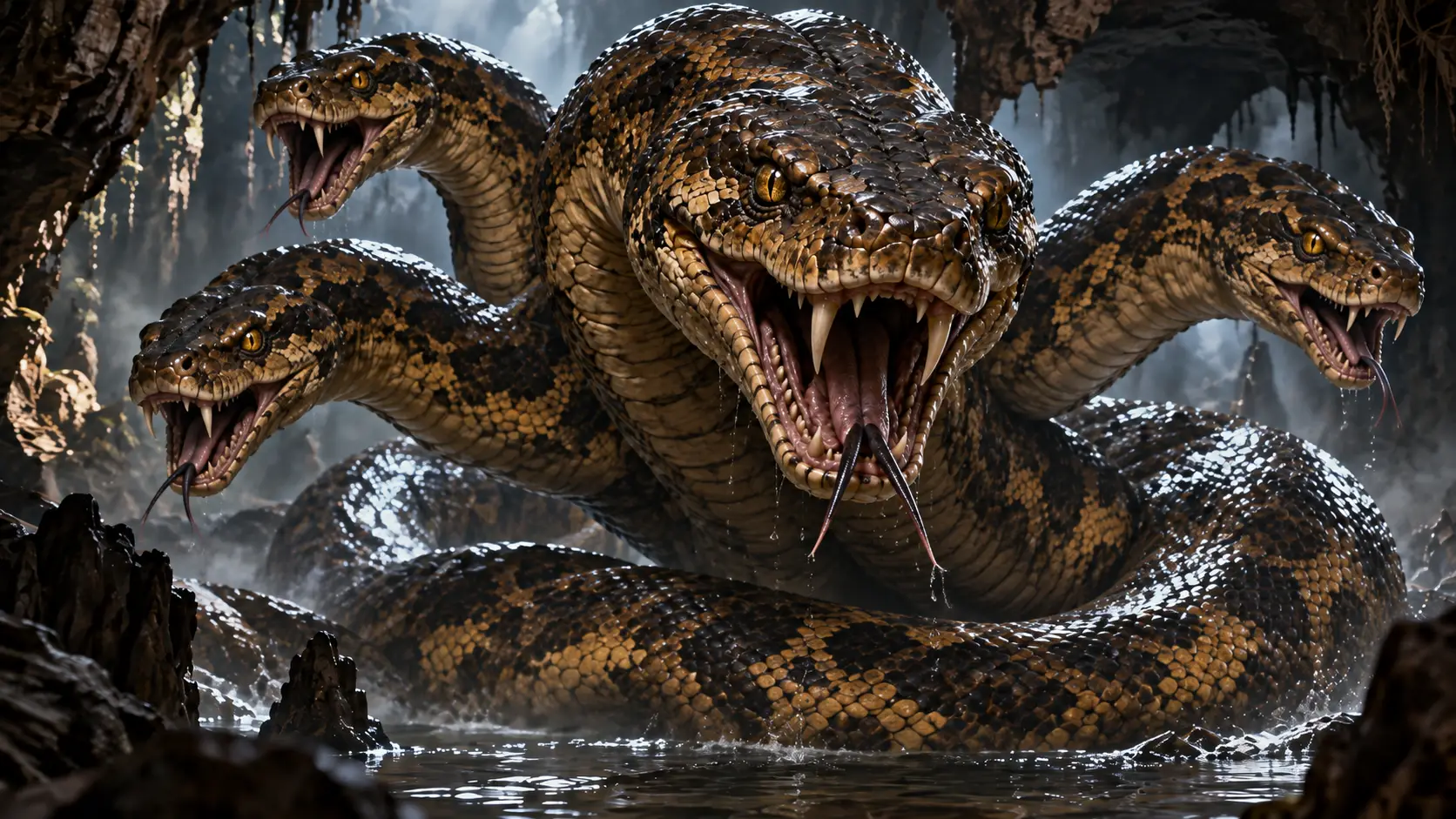
Kinioka kia Tumba is a giant serpent in an Ambundu heroic tale. It guards Kalunga-ngombe’s daughter and battles Sudika-Mbambi, employing insect swarms and repeatedly appearing heads during their underworld encounter.
Its strongest parallel with Illuyanka is narrative function: a formidable serpent must be overcome. The underworld setting and combat details belong to its own tradition.
Read more about Kinioka kia Tumba
Uktena

Uktena is a powerful serpent in Cherokee tradition, distinguished by horns, glowing scales, and a magical forehead crystal. Encounters with it involve danger and the possibility of extraordinary power.
Both figures present serpents as formidable supernatural beings. Uktena’s distinctive anatomy, however, highlights how little physical description survives for the serpent in the Hittite narrative.
Tiamat

Tiamat is a primordial sea goddess in Mesopotamian mythology, associated with both creation and destructive power. Modern representations frequently give her a dragonlike or serpentine appearance, although those images require qualification.
Comparison is useful for exploring supernatural opposition and divine order. Tiamat’s identity as a primordial goddess remains fundamentally different from Illuyanka’s role as a serpent adversary.
Hedammu
Hedammu is a serpent adversary preserved in another myth within the Hittite textual corpus, catalogued as CTH 348. It belongs to a separate narrative, not another version of CTH 321.
This makes Hedammu a close cultural comparison, but not an alternative name for Illuyanka. Shared serpentine identity does not justify transferring episodes or characteristics between them.
Religion/Ritual
The Illuyanka narrative is explicitly connected with the Purulli festival. Its ritual framing concerns the land’s ability to thrive, prosper, and remain protected.
This setting makes the Storm-god’s restored power relevant to collective well-being rather than merely to a private conflict among supernatural beings.
Recitation is the securely documented connection between story and observance. The narrative formed part of a religious occasion, giving the victory a setting beyond entertainment.
Its preservation alongside festival material is therefore essential to understanding why this particular conflict mattered within Hittite tradition.
The two versions offer different routes toward the victorious outcome. One requires a goddess’s planning and a mortal’s binding; the other requires the recovery of stolen organs through family ties.
Their shared ritual setting does not erase those substantial differences in plot and meaning.
The feast inside the first story should not automatically be reconstructed as a festival performance. Likewise, the binding and killing do not establish that worshippers enacted those actions with a living snake.
Narrative events and documented ritual instructions are different kinds of evidence.
Scientific or Rational Explanations
The surviving material documents a religious narrative, not an observation of an unknown animal. Its central actions include the removal and restoration of divine organs, negotiated assistance, and supernatural combat.
Zoological identification would not explain the features that organize either version of the story.
Linguistic evidence provides a firmer starting point than speculation about species. The Hittite word designates a snake or serpent, but does not identify a particular animal.
Neither its meaning nor the narrative establishes a specific venomous snake, aquatic reptile, or otherwise recognizable species.
A historical interpretation begins with the relationship between divine victory and the land’s prosperity. The festival context supports reading the conflict as relevant to restored security and flourishing.
It does not establish a precise equation in which every character represents a particular season or weather event.
An environmental reading may consider the importance of water and the second version’s battle at the sea. A 2019 study of Hittite symbolic landscapes also explores underworld and water-passage associations.
These are scholarly interpretations of mythic space, not proof of the serpent’s natural habitat.
A narrative reading emphasizes vulnerability and dependence. The Storm-god’s initial defeat creates a problem that force alone does not immediately solve.
Strategy, bodily restoration, and relationships make renewed victory possible. These features explain the plot more directly than an unsupported account of an ancient animal encounter.
Finally, comparison must distinguish recurring motifs from demonstrated historical transmission. Serpent adversaries appear in several traditions, but a shared opponent type does not establish a common original story.
Detailed correspondences, chronology, and plausible cultural contact are needed before resemblance becomes an argument for borrowing.
Modern Cultural References
Illuyanka appears in interactive fiction, audio storytelling, and contemporary visual art. These works offer distinct forms of modern reception, not additional evidence for ancient beliefs.
Their use of “dragon” or particular visual features should therefore remain separate from the Hittite text’s less detailed serpent identity.
Illuyanka: A Hittite Story, interactive text game (2024)
NOW IN TIME’s released game lets players experience a Hittite myth through interactive storytelling.
It makes Illuyanka a playable perspective rather than simply the Storm-god’s opponent.
(nowintime.itch.io)
The Legend of Illuyanka: Hittite Mythology’s Fierce Dragon, podcast episode (2024)
This Mythlok episode, hosted by Nitten Nair, was published on August 8, 2024.
It introduces the serpent’s conflict with the Storm-god to a contemporary listening audience.
(podcasts.apple.com)
The Illuyanka Epic #1: The Complete Legend | Hittite Mythology, podcast episode (2025)
Veritas Antiqua’s episode presents the Illuyanka narrative, with its listing dated October 7, 2025.
The ancient serpent conflict supplies the direct subject of this audio retelling.
(imdb.com)
Arrival of Spring Original Linocut Art Print, artwork
Melis Özge Kurtoğlu’s limited-edition linocut is offered under the İreçel name.
Its accompanying description explicitly connects the artwork with Illuyanka’s tale and conflict with the Storm-god.
(hipicon.com)
Illuyanka, Render of Hearts and Eyes, commercial art print
This Displate listing credits SpawnofTyphon and artwork by Nelnes.
It explicitly portrays Illuyanka, turning the ancient serpent adversary into a contemporary image available as a commercial print.
(displate.com)
Conclusion
Illuyanka matters less as a precisely pictured monster than as the serpent adversary at the center of a Hittite religious narrative. The word itself means “snake” or “serpent,” rather than securely identifying a personal name.
Its association with the Purulli festival places the conflict within concerns about the land’s prosperity and protection. Reading the figure in that setting preserves its cultural significance without supplying the wings, limbs, or other features familiar from later dragon imagery.
The two surviving versions also prevent a simple account of divine strength overcoming a helpless enemy. One makes victory depend on a feast, intoxication, and mortal assistance; the other joins the recovery of stolen organs to the death of the Storm-god’s son.
Their differences are essential to the tradition, not gaps to combine into a single adventure. Modern games, podcasts, and artworks continue to reinterpret this material, while its strongest historical foundation remains the Hittite narrative and its ritual context.
Further Reading
Hans Gustav Güterbock, “Hittite Mythology,” in Perspectives on Hittite Civilization, Isac.uchicago
After the Storm-god is defeated, Inara arranges a feast and recruits Hupašiya.
The serpent becomes drunk, Hupašiya binds it, and the Storm-god kills it.
(isac.uchicago.edu)
The Anatolian Myth of Illuyanka, Journal of the Ancient Near Eastern Society
Gary Beckman’s specialist study discusses CTH 321 and the serpent’s designation in Hittite.
(janes.scholasticahq.com)
Cognate Set 7641: snake, Indo-European Cognate Relationships
Provides the Hittite forms and summarizes scholarly disagreement over the word’s etymology.
(iecor.clld.org)
The Serpent-Fighting Imagery of Anatolia in the 2nd Millennium BC and Malatya Serpentine Monster…, Belleten
Compares the textual episodes with Anatolian imagery and cautions against conflating distinct serpent-fighting works.
(belleten.gov.tr)