Introduction
The Turul is a legendary bird of prey associated with Hungarian dynastic tradition, origin mythology, and national symbolism. Medieval chronicles connect a falcon-like heavenly bird with the conception of Álmos, forefather of the Árpád dynasty, and with the ruling lineage’s claims to exceptional ancestry.
Rather than belonging to a single continuous tale, the Turul appears within several related traditions. These include Emese’s prophetic dream, the heraldic bird attributed to early Hungarian leaders, and later narratives linking the bird with migration, conquest, and the establishment of a homeland in the Carpathian Basin.
The surviving evidence is retrospective. Hungary’s medieval chroniclers wrote centuries after the ninth-century events associated with Álmos and the Hungarian conquest.
Their accounts may preserve older oral material, but they also reflect Christian historiography, royal genealogy, and medieval efforts to explain political legitimacy through sacred ancestry.
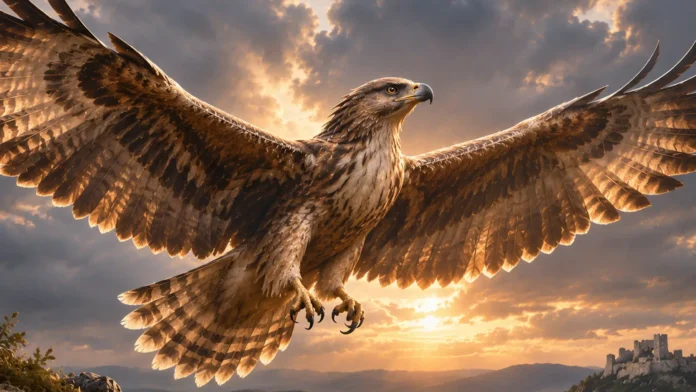
Modern images frequently treat the Turul as a gigantic eagle carrying a sword. Medieval descriptions are less uniform and generally identify it as a hawk, falcon, or comparable raptor.
This difference is important because today’s familiar national emblem combines chronicle tradition with much later monumental and political imagery.
History/Origin
The Turul’s earliest history remains uncertain because no surviving ninth-century account identifies the bird by that name during the Hungarian conquest. Its principal literary evidence comes from medieval Latin chronicles, written after the establishment of the Christian Hungarian kingdom and the consolidation of Árpád dynastic authority.
Around 1200, the anonymous chronicler known as Anonymus described Emese’s prophetic dream in the Gesta Hungarorum. A bird resembling a hawk appeared to her, while a vision of water flowing from her body foretold powerful descendants who would flourish beyond their ancestral homeland.
Anonymus connected the birth of Álmos with the Hungarian word álom, meaning “dream,” because his mother’s vision announced his arrival. The chronicler also offered an alternative interpretation, associating the name with the Latin almus, which he understood in a sacred or blessed sense.
These explanations served the chronicle’s dynastic narrative rather than establishing a reliable linguistic derivation. Modern historical scholarship questions the dream-based etymology, while the Latin interpretation reflects the author’s effort to connect Álmos’s ancestry with the sacred kingship of his descendants.
Anonymus described the visiting bird with the Latin word astur, meaning a hawk-like bird, without explicitly naming it Turul. The traditional identification emerges when readers connect his account with other Hungarian dynastic traditions, rather than from the wording of this passage alone.
Simon of Kéza’s chronicle, composed in the 1280s, provides the clearest medieval identification of the Turul. Kéza describes a crowned bird on Attila’s shield, identified by its Hungarian name, and claims that the emblem accompanied the Huns and Hungarians into battle until Géza’s reign.
The two accounts emphasize related but distinct meanings. Emese’s dream presents a prophetic beginning for a ruling dynasty, while Kéza’s emblem places the bird within a claimed continuity between Hunnic and Hungarian rulers.
Neither text provides a complete account of pre-Christian Turul worship.
During the nineteenth century, Hungarian historical writing and nationalism revived the Turul as a public symbol. Monument builders and artists transformed a relatively sparse medieval figure into an imposing national emblem, especially around the millennium commemorations of the Hungarian conquest.
Later political movements gave the image additional meanings, sometimes associating it with territorial claims, military remembrance, or competing definitions of national identity. These interpretations belong to the Turul’s historical reception and should not automatically be projected back onto the medieval chronicles.
Name Meaning
The name Turul has a well-supported Turkic linguistic background. Hungary’s modern etymological dictionary identifies it as an Old Turkic borrowing and compares it with historical forms such as toγrïl, toγrul, and toğrul, associated with hunting falcons and other predatory birds.
These forms appear in historical Turkic vocabulary, particularly within traditions connected with birds of prey and falconry. However, their meanings do not identify one universally agreed modern species, and their relationship to Hungarian mythology requires more than a simple dictionary translation.
Historian Balázs Sudár examined the word’s cultural and linguistic history in a 2017 study. He argues that its historical distribution was much narrower than its modern fame suggests, with particularly relevant connections to early Turkic-speaking groups and specialized falconry terminology.
The Hungarian evidence also has a complex history. Medieval records preserve forms of the name, including early personal names, while Simon of Kéza uses Turul for the crowned bird associated with ancestral rulers.
Yet the term did not remain an ordinary Hungarian bird name.
Its nineteenth-century revival gave the written form turul renewed prominence. The historical dictionary notes that the now-familiar spelling and pronunciation reflect later reading practices, while the likely earlier borrowed form may have sounded different from the modern Hungarian name.
This distinction matters because the Turul’s linguistic origin and its mythological identity are separate questions. A Turkic raptor name does not prove that Hungarian storytellers imported an entire, unchanged foreign myth or that the same animal carried identical symbolism across different societies.
The modern translation “eagle” is therefore too restrictive. A falcon or comparable powerful raptor better reflects the linguistic evidence, although the medieval bird’s exact species remains uncertain.
The name’s significance ultimately developed through its association with Hungarian dynastic history.
Appearance
The best-supported basic form is that of a large predatory bird. Medieval Latin accounts employ raptor terminology commonly translated as hawk, falcon, or goshawk rather than offering a naturalistic description.
They provide little dependable information about plumage, coloration, size, or distinctive anatomical features.
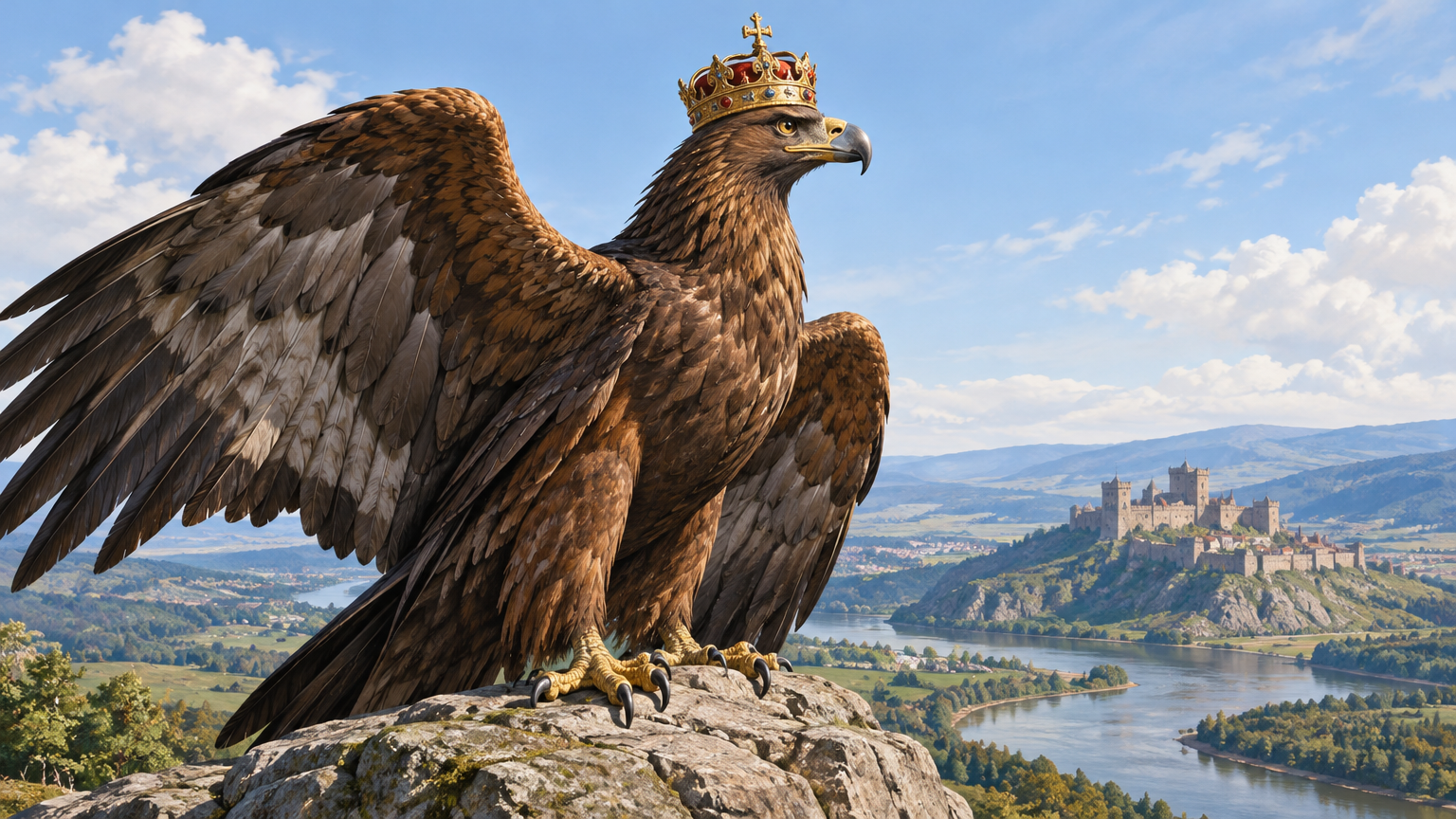
In the dynastic standard tradition, the Turul is represented with a crown upon its head. This detail marks authority rather than biology, turning the bird into a royal emblem.
Its significance lies in rulership and inherited status, not in establishing a universal appearance for every version of the figure.
Emese’s dream presents a less heraldic image. The bird descends or appears from above and becomes the agent of a prophetic conception, but the episode does not describe a monstrous hybrid or an elaborately ornamented beast.
Its supernatural character comes from its action and meaning rather than unusual anatomy.
Medieval manuscript art cannot be treated as a uniform visual record. Illustrators represented ancestral standards and raptors according to their own period’s artistic conventions.
Consequently, surviving images may resemble eagles, hawks, or stylized heraldic birds without resolving which living species, if any, stood behind the tradition.
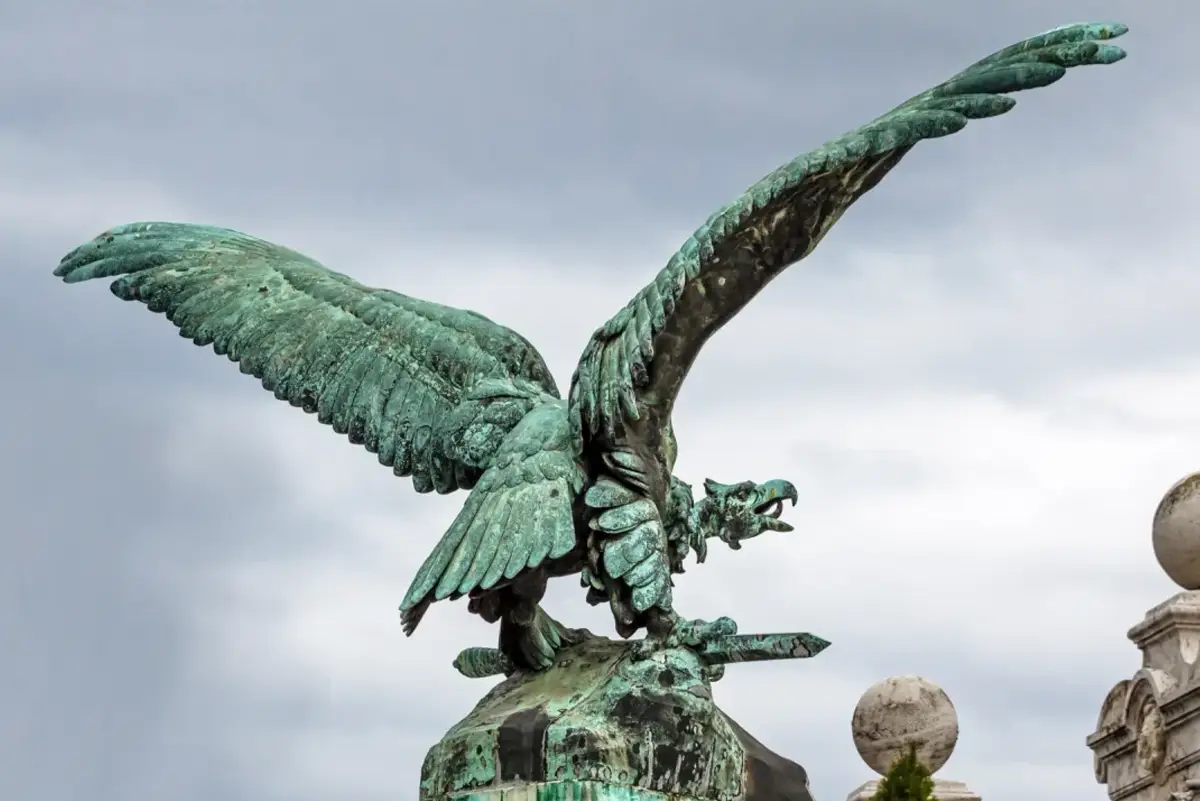
The enormous bronze Turul monuments familiar today belong chiefly to modern commemorative culture. They typically show a muscular, eagle-like bird with spread wings, sharply curved beak, and powerful talons.
Some hold a sword, an attribute connecting the bird with military conquest and defense of the nation.
The sword-bearing form is visually influential but should not be projected unchanged into the earliest texts. Medieval evidence supports a celestial raptor and an ancestral standard bearing a crowned bird.
Colossal scale, fixed coloration, and the sword are products of later artistic interpretation rather than stable mythological traits.
Background Story
The Turul developed within a culture shaped by migration, steppe political traditions, conversion to Christianity, and the need to define legitimate kingship. Its medieval stories look backward from a Christian kingdom toward a remembered pre-Christian past, presenting ancestral power in forms acceptable to later chroniclers and royal audiences.
Emese’s dream supplies the figure’s most important narrative background. The bird’s appearance precedes Álmos’s birth, while the flowing water and distant descendants foretell expansion beyond his birthplace.
The episode makes genealogy itself prophetic, presenting the Árpád line as the anticipated outcome of a supernatural sign.
This story has often been interpreted as preserving traces of a steppe ancestry myth or a tradition of divine conception. Such readings are plausible comparisons, not direct records of an intact pre-Christian Hungarian religion.
The written version was shaped by a Christian author familiar with biblical and classical dream narratives.

The standard tradition places the Turul within a different ideological framework. By connecting the emblem with Attila and subsequent Hungarian rulers, medieval historiography supported an asserted continuity between Huns and Hungarians.
That relationship was politically and culturally influential, although modern historical and linguistic scholarship does not accept it as simple ethnic continuity.
Later national storytelling brought the prophetic bird, the ancestral standard, and the conquest of the Carpathian Basin into a more unified mythic sequence. In popular retellings the Turul may guide the Hungarians toward their homeland or signify that the land was destined for them, but these details vary considerably.
The figure’s background is therefore layered rather than singular. Possible steppe-era raptor symbolism, medieval Christian genealogy, Hun-Hungarian historical claims, and modern nationalism all contributed to its present meaning.
The Turul endured because each period could recast the ancestral bird as a sign of destiny, sovereignty, or collective identity.
Famous Folklore Stories
Emese’s Dream
The best-attested narrative associated with the Turul is the dream of Emese, mother of Álmos and legendary ancestress of the Árpád dynasty. In the medieval Gesta Hungarorum, a heavenly bird appears to Emese in a dream and symbolically initiates a royal lineage.
The dream also contains an image of water flowing from Emese’s womb and of glorious rulers descending from her, though not flourishing in their ancestral land. Her son is consequently named Álmos, a name connected in the narrative with the Hungarian word for dream.
The Latin text identifies the visiting bird as an astur, usually understood as a hawk or goshawk, rather than using the Hungarian name Turul. Its identification as the Turul belongs to the wider dynastic tradition and became especially prominent in later historical and national interpretation.
The Bird of the Dynastic Standard
Another medieval tradition presents the Turul as the emblem carried on the standard associated with Attila and the early Hungarian ruling house. This is not a complete adventure tale, but a recurring historical-mythic motif connecting military authority, ancestry, and legitimate sovereignty.
In this tradition, the bird links the Árpád dynasty with the Huns and with Attila, whose heritage medieval Hungarian chroniclers incorporated into accounts of national origins. The image therefore functions less as an independent character than as a visible sign of inherited power.
Later retellings sometimes turn the Turul into a guide leading the Hungarians toward the Carpathian Basin. Such versions reflect the bird’s established roles as omen, protector, and ancestral emblem, but their details should not be treated as a single uniform medieval story.
Cultural Impact
The Turul became an enduring emblem of Hungarian national identity through its association with the Árpád dynasty, ancestral sovereignty, and the conquest of the Carpathian Basin. Its cultural influence grew especially during the nineteenth century, when historical imagery gained prominence in public commemoration.
Millennial celebrations encouraged monumental representations of the bird. Among the most prominent is Gyula Donáth’s bronze Turul above Tatabánya, commissioned during the preparations for the 1896 conquest millennium and unveiled in 1907, according to Hungary’s National Heritage Institute.
The Tatabánya monument shows the bird with spread wings, a crown, and a sword. Its imposing appearance demonstrates how modern commemorative sculpture expanded the relatively restrained medieval descriptions into a recognizable national image associated with authority and historical remembrance.
The sculpture also became an emblem of Tatabánya itself, appearing in the city’s coat of arms. Such uses illustrate how the Turul can represent local heritage and civic identity, even when its medieval origins remain subjects of historical interpretation.
The symbol’s political reception has been more complicated. During the twentieth century, different nationalist movements adopted Turul imagery, including movements associated with exclusionary ideologies.
Those appropriations do not exhaust the bird’s meanings, but they form part of its documented modern history.
Controversy surrounding Budapest’s Twelfth District Turul memorial illustrates these competing interpretations. Erected in 2005, the monument became disputed partly because its wartime commemorative context included names associated with Hungary’s antisemitic Arrow Cross movement, alongside those of victims.
In 2025, Hungary’s government granted the Budapest monument protected status, following renewed disputes over its possible relocation. The controversy demonstrates how one legendary bird can represent historical continuity to some observers while recalling political exclusion and unresolved remembrance to others.
Contemporary artists have also questioned the use of Turul imagery in national narratives. Their work explores the relationship between ancient legend, historical scholarship, ecology, and modern politics, showing that the bird remains a changing cultural symbol rather than a fixed emblem.
Similar Beasts
Thunderbird

The Thunderbird is a powerful sacred bird appearing in several distinct Indigenous North American traditions. It is commonly connected with thunder, lightning, storms, protection, and the enforcement of spiritual or social order.
Like the Turul, it can signify supernatural authority and communal protection. Unlike the Hungarian dynastic bird, Thunderbird traditions are culturally diverse and strongly associated with weather powers.
Fenghuang

The Fenghuang is an auspicious bird of Chinese tradition associated with harmony, virtue, cosmic order, and exemplary government. Its appearance may signify a peaceful realm or the rule of a worthy sovereign.
Both birds became emblems of legitimate authority. The Fenghuang emphasizes ethical and cosmic harmony, while the Turul is more directly connected with ancestry, conquest, and Hungarian kingship.
Chamrosh

Chamrosh is a guardian bird from Iranian religious tradition, associated with the cosmic tree and the distribution of seeds. Some accounts also make it a defender that destroys forces threatening Iran.
Its protective and territorial functions resemble later interpretations of the Turul. Chamrosh, however, belongs to a different cosmology and has a clearer role in preserving creation.
Longma
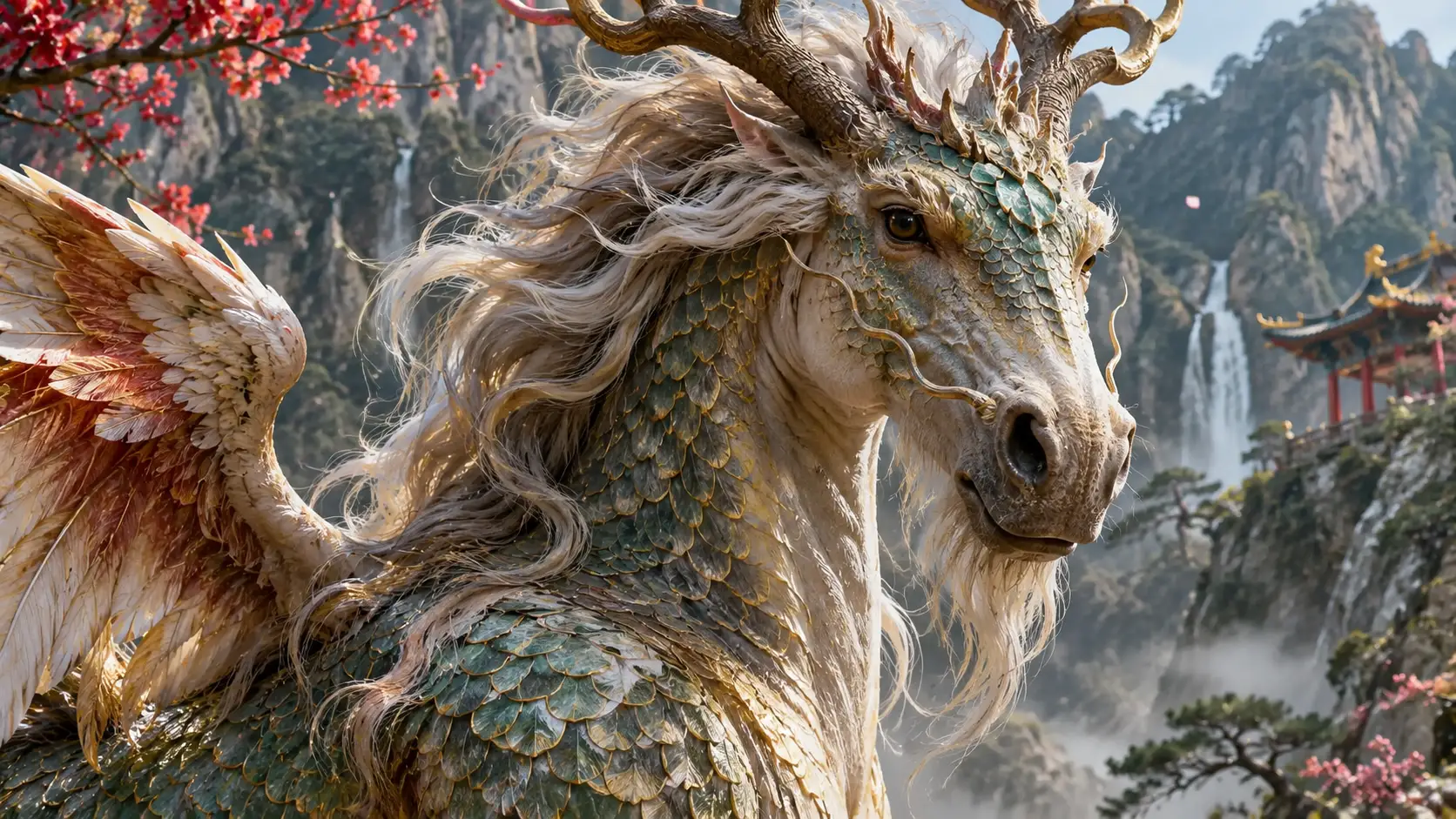
Longma is the Chinese dragon-horse, an auspicious hybrid associated with the appearance of sage rulers and the revelation of ordered knowledge. It is traditionally connected with the Yellow River Map.
Although not a bird, Longma resembles the Turul as a supernatural omen of rightful leadership. Both connect an extraordinary animal appearance with political legitimacy and dynastic destiny.
Religion/Ritual
No securely documented pre-Christian ceremony dedicated specifically to the Turul survives. Medieval chronicles preserve dynastic narratives and emblematic traditions, but they do not provide reliable descriptions of temples, priesthoods, offerings, seasonal festivals, or prescribed acts of worship centered on the bird.
Steppe societies used birds of prey in elite symbolism, warfare, hunting, and displays of rank, creating a plausible cultural environment for a sacred ancestral bird. Nevertheless, falconry, bird-shaped ornaments, and eagle imagery cannot independently demonstrate a distinct Turul cult.
Modern commemorations at Turul monuments may include speeches, wreath laying, flags, or political gatherings. These are civic and national observances rather than evidence for the reconstruction of an ancient rite, even when participants interpret the bird in spiritual or ancestral terms.
Scientific or Rational Explanations
The Turul can be interpreted without assuming that it represents an unknown zoological species. Its likely natural background lies among familiar Eurasian birds of prey, whose height, speed, hunting ability, and command of the sky made them effective symbols of nobility and supernatural power.
Its precise species remains uncertain. The medieval Latin word astur in Emese’s dream commonly indicates a hawk or goshawk, while the Hungarian name is often connected with a Turkic term for a bird of prey, sometimes identified more specifically as a falcon.
These linguistic clues do not produce a single zoological identification. Medieval writers and later translators did not always classify raptors according to modern ornithology, and symbolic birds could combine the perceived qualities of falcons, hawks, and eagles without representing one exact species.
The Emese episode also fits a widespread political pattern in which ruling families receive supernatural ancestry or prophetic birth signs. Such narratives explain authority retrospectively, presenting the dynasty’s rise as destined before the birth of its founder rather than as the result of ordinary political competition.
The bird standard can similarly be understood as dynastic visual communication. A powerful raptor was recognizable at a distance and conveyed aggression, vigilance, elevation, and command.
Chroniclers could then interpret an inherited military emblem as evidence of continuity between legendary ancestors and medieval rulers.
Comparisons with other Eurasian bird symbols suggest cultural exchange across the steppe, where mobile communities shared artistic forms, hunting practices, and ideas of animal power. Similarity does not prove that all such birds represented the same deity, ancestor, or religious system.
Finally, much of the Turul’s familiar modern form results from nineteenth and twentieth-century historical imagination. Monumental sculpture and nationalist literature transformed sparse medieval references into a coherent national icon, giving the bird a visual consistency and ideological reach that the earliest records do not demonstrate.
Modern Cultural References
Emese, animated short film by Krisztina Tóth, 2022.
This Hungarian animated film depicts a giant Turul appearing in Emese’s dream, blessing her with a child and connecting the prophecy with the migration toward the Carpathian Basin.
Source: https://2023.kaff.hu/en/film-adatlap/366
The Legend of Emese’s Dream by Andy Meszaros, Cleveland Hungarian Museum, 2014.
This children’s retelling presents the Turul as a prophetic bird appearing in Emese’s dream, expanding the legend through Attila, ancestral migration, and the interpretation of her vision.
Source: https://clevelandhungarianmuseum.org/legend-emeses-dream/
Greater Hungaries by Szabolcs KissPál, contemporary art installation, 2013.
KissPál contrasts the mythical Turul’s association with Hungarian territorial origins against satellite-tracked movements of saker falcons, exploring the difference between symbolic geography and actual bird migration.
Source: https://www.artscabinet.org/migration/like-a-bird-avian-ecologies-in-contemporary-art
The Rise of the Fallen Feather by Szabolcs KissPál, docufiction film, 2016.
This experimental artwork examines how the mythical Turul became intertwined with modern Hungarian nationalism, using documentary and fictional elements to investigate the transformation of historical symbols.
Source: https://www.emst.gr/statecraft-diamorfonontas-to-kratos/szabolcs-kisspal-from-fake-mountains-to-faith-hungarian-trilogy-apo-ta-apatila-voyna-stin-pisti-oyggriki-trilogia-2016
Conclusion
The Turul remains one of the most consequential creatures in Hungarian legendary tradition. A great bird of prey associated with origins, rulership, destiny, and territorial belonging, it connects the Árpád dynasty with narratives of Emese and the Magyar occupation of the Carpathian Basin.
Its exact species cannot be fixed from the tradition, and attempts to identify it exclusively as a falcon, hawk, or eagle impose a precision that the surviving imagery and texts do not consistently support.
Its importance lies less in a stable zoological description than in the roles successive generations assigned to it. Medieval dynastic memory, later historical interpretation, public monuments, and political symbolism transformed the Turul into a contested emblem of Hungarian identity.
That history requires careful distinctions between early narrative traditions and modern ideological uses. Viewed with those layers intact, the Turul illustrates how a mythic animal can carry ancestry, sovereignty, migration, and collective memory without retaining one unchanging meaning.
Further Reading
TURUL
Hungarian Academy of Sciences research-center essay compares Kézai’s account of the crowned bird emblem with the Emese-dream story, discusses the word’s Turkic background and historical rarity, and cautions that the Turul guiding the conquest is a later, undocumented romantic image.
Source
The Legend of Emese’s Dream
This museum’s retelling gives a detailed version of Emese’s dream, including the Turul’s descent, the flowing waters, the interpretation predicting Álmos, and his later westward journey; it identifies its translation as loosely based on a 1952 Hungarian-language version.
Source
The Rise of a Fallen Feather: The Symbolism of the Turul Bird in Contemporary Hungary
Szabolcs KissPál’s essay discusses the Turul’s modern political and national symbolism, contrasts the Emese-dream and conquest narratives, and considers the bird’s changing meanings in contemporary Hungary.
Source
On the Cultural Historical Background of the Hungarian Word Turul
Balázs Sudár’s peer-reviewed study examines Kézai’s emblem account, the word’s limited use and later rediscovery, and evidence connecting Turkic forms with early falconry texts and the Uyghur-Oghuz context.
Source
Raptor and human – falconry and bird symbolism throughout the millennia on a global scale
Péter Langó’s article reviews scholarship on falconry and bird symbolism and specifically discusses the Turul in later Hungarian chronicles, its description as a falcon-type bird, its association with Emese and the Árpád dynasty, and its connection to Attila traditions.
Source