Introduction
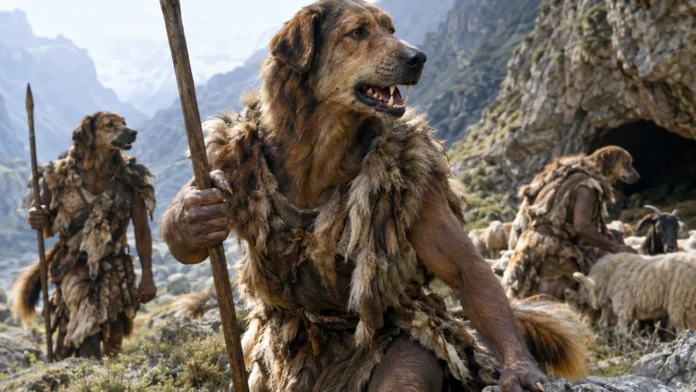
Cynocephali are legendary dog-headed people with human or humanlike bodies, known from ancient geographical writing and later medieval literature. Rather than a single monster with one biography, they form a changing tradition about peoples imagined to inhabit distant parts of the world.
Their supposed homeland differs between early accounts. Herodotus records reports attributed to Libyans about dog-headed people in western Libya, while Ctesias’s account places them in Indian mountains.
These are distinct geographical traditions, not evidence for one consistently described population.
The canine head is their defining feature, but their behavior is not uniformly animalistic. The Indian account combines barking and unusual bodily traits with hunting, livestock keeping, communication, and exchange.
Such details make them more complex than creatures encountered only as dangerous opponents.
Medieval adaptations extended that ambiguity into adventure narratives and Christian saints’ lives. Dog-headed beings could appear as attackers in Alexander literature or, in a few versions of Saint Christopher’s story, as a saint.
Their importance lies partly in this unstable boundary between bodily difference and recognizable humanity.
History/Origin
An early surviving reference occurs in the fifth-century BCE Histories of Herodotus. His description of western Libya includes dog-headed people alongside other extraordinary beings.
Crucially, he presents these as things Libyans report, rather than claiming to have observed the people himself.
This passage establishes an early literary attestation, not the ultimate origin of the tradition. It offers little description beyond the dog-headed designation.
Its Libyan setting must therefore remain separate from the much fuller Indian account associated with Ctesias, another writer of the classical period.
Ctesias’s Indica places the people in mountains extending toward the Indus. The relevant account survives through an excerpt preserved by the ninth-century scholar Photius.
Its ancient subject matter and medieval transmission are both important: the accessible text is not an intact surviving copy of Ctesias’s original work.
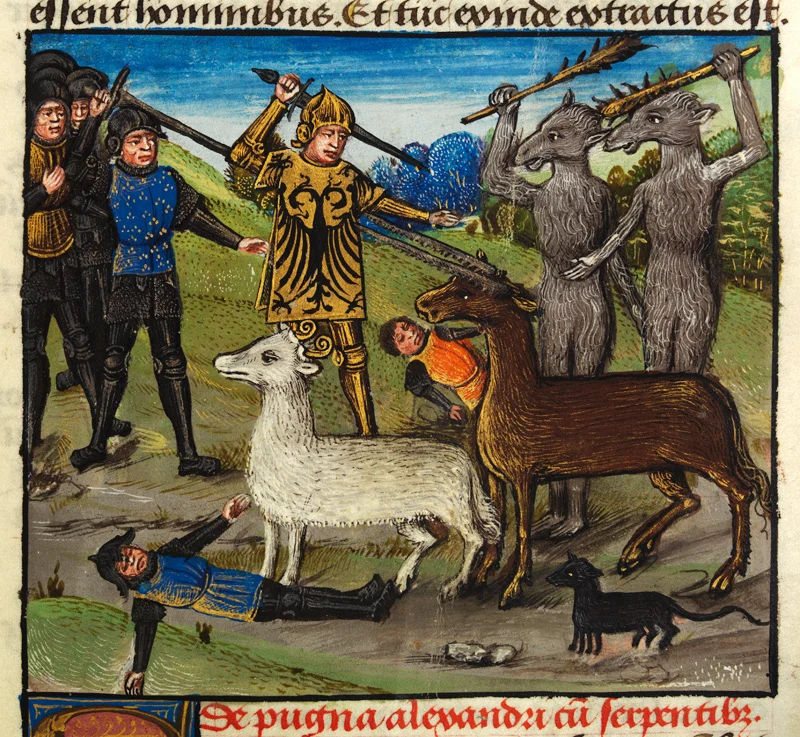
By the early seventh century, the terminology also appeared in a different classificatory setting. Isidore of Seville discussed cynocephali among apes, emphasizing their doglike faces.
This zoological treatment differs from accounts presenting them as an unusual people with social and economic relationships.
Later transmission brought them into Alexander adventure literature. An episode quoted and examined by Claude Lecouteux describes Alexander’s party entering forests full of Cynocephali, who attack and are repelled with arrows.
This is a literary encounter, not a historical record of Alexander meeting such beings.
Christian adaptation produced another role: the dog-headed holy person. Only some versions of Saint Christopher’s life give him a canine head; familiar giant-saint accounts do not require it.
The tradition consequently developed through several genres rather than following one continuous, unchanging narrative.
Name Meaning
Cynocephali means “dog-headed,” a descriptive name identifying the feature shared across otherwise differing accounts. Isidore of Seville explicitly connects the designation with the Greek words for dog and head, giving an early medieval explanation grounded in the creature’s supposed appearance.
The Greek components supplied in that explanation are κύων, meaning “dog,” and κεφαλή, meaning “head.” The name thus describes a bodily characteristic rather than establishing a homeland, ancestry, or religious identity.
Those other features depend on the particular account being considered.
Cynocephali is the plural form used for the legendary people; Cynocephalus refers to an individual. Kynokephaloi is another rendering of the Greek designation.
The familiar English phrase “dog-headed people” communicates the central meaning without implying that every text gives them identical bodies or customs.
The surviving Ctesias excerpt also gives Calystrii as a name used by Indians, distinguishing it from the Greek Cynocephali. That reported alternative belongs specifically to the Indian account.
The passage supplies no explanation of its meaning, so it should not be assigned a speculative etymology.
Appearance
Cynocephali are defined by a dog’s head joined to a human or humanlike body. Beyond that combination, their appearance varies between accounts.
Herodotus’s brief Libyan reference supplies no detailed anatomy, clothing, or coloration from which to establish a standard appearance.
In the Indian account preserved from Ctesias through Photius’s excerpt, the dog-headed inhabitants have a dark complexion and wear the skins of wild animals. These details belong to a particular portrait of mountain-dwelling hunters and herders, rather than to every dog-headed people in ancient and medieval literature.
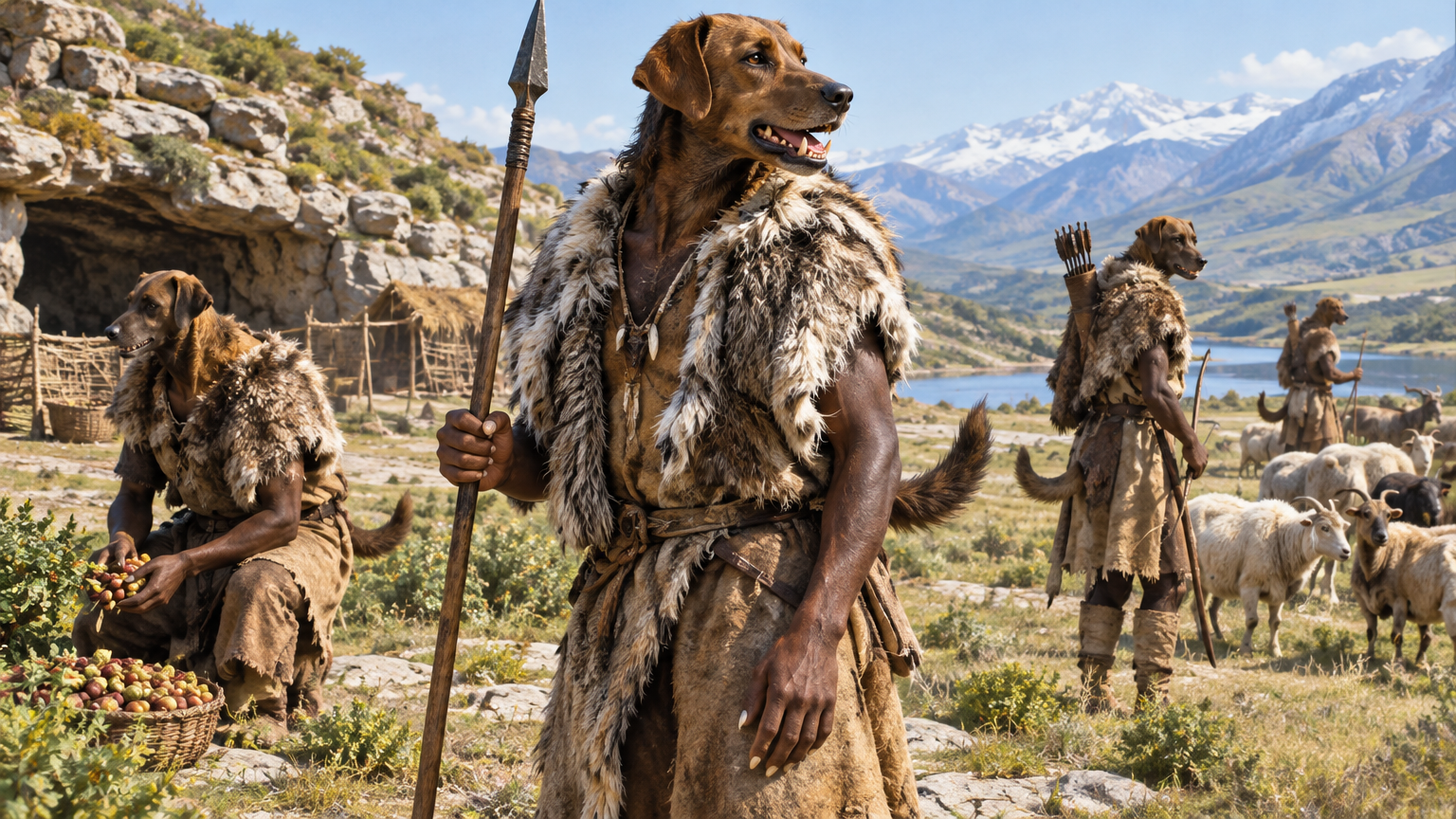
The same account gives them teeth larger than dogs’ teeth and long, rounded nails. These features strengthen the contrast between their canine heads and otherwise humanlike bodies, but they do not establish additional predatory anatomy beyond what the text describes.
Doglike tails rise above their hips in this Indian description. Although visually striking, tails are not a universal feature of the tradition.
A tailed Cynocephalus follows Ctesias’s account more closely than Herodotus’s sparse reference or every medieval portrayal.
Medieval variants could introduce different animal features. An early medieval version discussed by Claude Lecouteux gives the beings horse manes and boar tusks.
Those traits belong to that development of the tradition and should remain distinct from the bodily details preserved in Ctesias’s account.
Christian imagery offers another variation in the dog-headed Saint Christopher. His canine head belongs to a documented strand of the saint’s tradition, not to all versions of his story.
Across these portrayals, the dog-headed form remains more consistent than clothing, tails, additional animal traits, or the identity of the figure depicted.
Background Story
The Cynocephali emerged within writing that combined descriptions of distant lands with reports of extraordinary inhabitants. Their geographical remoteness allowed familiar human activities and unfamiliar bodies to coexist.
The result was not a collective biography but a flexible way of imagining peoples beyond ordinary experience.
In the Indian account, that combination is especially clear in communication. They bark rather than speak, yet understand Indian speech and answer through barking or gestures.
Their difference is therefore not equivalent to complete incomprehension: the narrative gives them ways to understand others and make themselves understood.
Their subsistence also complicates a purely bestial reading. They hunt, keep sheep, goats, and asses, and gather produce.
Cave dwellings and animal skins mark them as unfamiliar, while tools, livestock, and organized activity give their lives elements recognizable within human communities.
Exchange connects them to a wider social world. They gather and dry fruit and send goods by raft to the king of India.
These details place them within relationships extending beyond their mountain homes, rather than depicting an entirely isolated population without contact or cooperation.
Medieval treatments developed the question of humanity in different directions. Early medieval discussions of dog-headed peoples engaged with social organization and civic life, a relationship examined in Sam Ottewill-Soulsby’s City of Dog.
Bodily form alone did not exhaust the possibilities for representing their place within a community.
Adventure and hagiography then supplied contrasting narrative settings. Alexander’s forest encounter makes the beings hostile opponents, while dog-headed Christopher traditions allow an extraordinary body to coexist with Christian holiness.
Neither role defines all Cynocephali; together, they reveal how readily the inherited figure could serve different concerns.
Famous Folklore Stories
Cynocephali appear in descriptions of distant peoples and in literary encounter episodes rather than in one continuous cycle of folktales. The headings below describe documented accounts, not authenticated traditional tale titles.
Their different settings and behavior belong to particular versions.
The Mountain People in Ctesias’s Indica
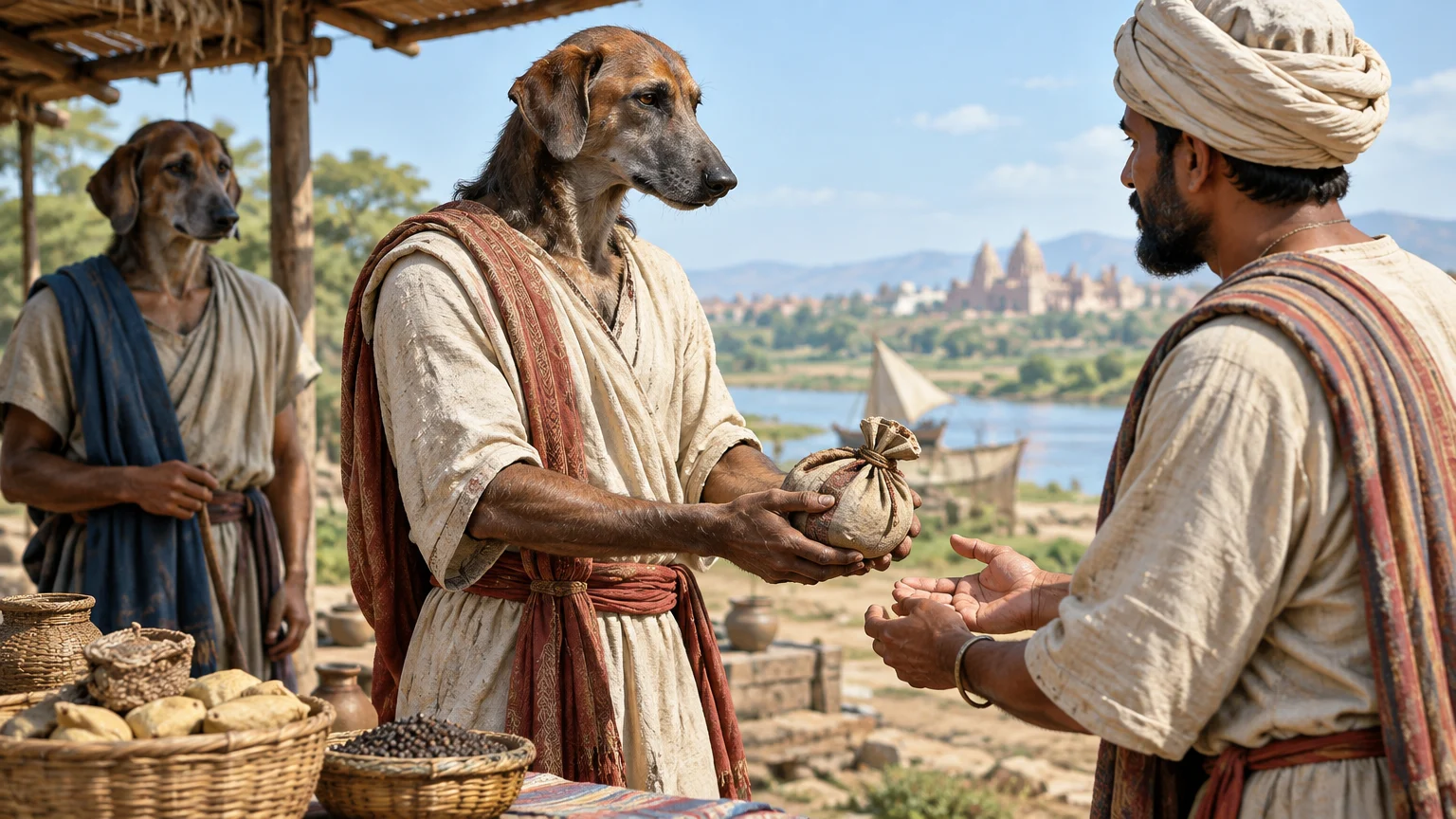
In Ctesias’s Indian account, preserved through the ninth-century excerpt of Photius, dog-headed people inhabit mountains extending toward the Indus. They live in caves, understand Indian speech, and communicate through barking and gestures.
Their unfamiliar voices do not prevent them from maintaining relationships with neighboring people.
The account follows their activities beyond their unusual appearance. They hunt with bows and spears, keep sheep, goats, and asses, and gather and dry fruit.
Goods travel by raft to the king of India, placing these mountain inhabitants within a wider network of exchange.
This is an ethnographic description rather than an adventure with a single protagonist or ending. Its distinctive feature is the combination of animal characteristics with recognizable livelihoods.
The Cynocephali are not merely obstacles for travelers: they form a working community capable of understanding others and trading.
Alexander’s Encounter with Dog-Headed Forest Dwellers
An encounter transmitted within the Alexander literary tradition gives the Cynocephali a different role. Alexander’s party enters forests full of dog-headed beings, who attempt to attack the newcomers.
The party responds with arrows and drives them away, bringing the brief confrontation to its recorded conclusion.
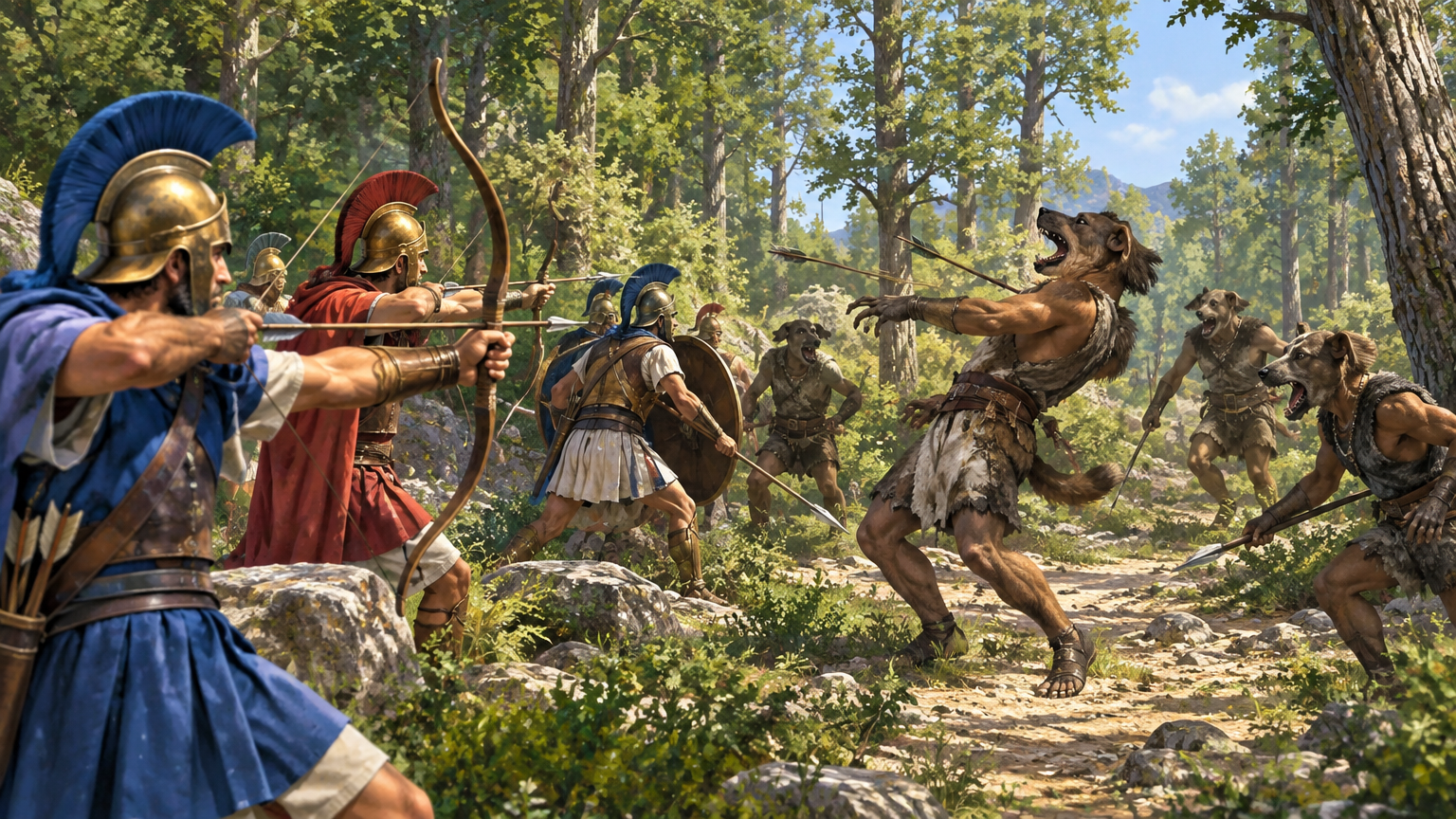
The passage associated with Julius Valerius, quoted in Claude Lecouteux’s study of the tradition, supplies that central sequence without an elaborate individual story. It belongs to literary accounts of Alexander’s marvelous travels, not to contemporary evidence establishing an actual encounter during his campaigns.
Unlike the sustained portrait of hunters, herders, and traders in the Indian account, this episode presents the forest inhabitants through conflict. Their attack belongs to this particular narrative.
It should not become a universal claim that all Cynocephali were violent or necessarily hostile to human visitors.
Cultural Impact
The dog-headed people helped ancient and medieval writers explore the boundaries of the familiar world. Their bodies were strange, but descriptions could give them recognizable occupations and social relationships.
This combination made them useful figures for thinking about difference without placing them wholly outside human society.
Geographical marvels also brought different extraordinary peoples together. Herodotus’s Libyan report places dog-headed people beside headless people with eyes in their chests.
Their proximity reflects a literary arrangement of distant wonders, not evidence that the two groups shared an origin or constituted a single population.
Medieval adaptations changed the questions attached to the figure. Alexander narratives could make Cynocephali threatening inhabitants of unexplored terrain, while Christian hagiography could place a dog-headed individual within sacred history.
The same defining feature therefore supported substantially different narrative and moral roles.
In religious imagery, the dog-headed Christopher offered a particularly striking combination of bodily otherness and sanctity. Nevertheless, this image represents only a limited strand of the saint’s tradition.
It does not replace the more familiar accounts in which Christopher is an extraordinary giant without a canine head.
Modern scholarship examines these contrasts as evidence about historical understandings of humanity. Sam Ottewill-Soulsby’s City of Dog focuses on early medieval relationships between Cynocephali, civic life, and hagiography.
This approach treats their communities and social conduct as important, rather than considering their appearance alone.
Similar Beasts
Monopod

The Monopod, also called a Sciapod, is a legendary one-legged humanoid in Greek and Roman writing. Its enormous foot serves as shade in accounts of distant lands.
Like Cynocephali, Monopods belong to traditions of marvelous peoples. Their defining difference concerns the leg and foot, however, rather than a canine head.
Blemmyes
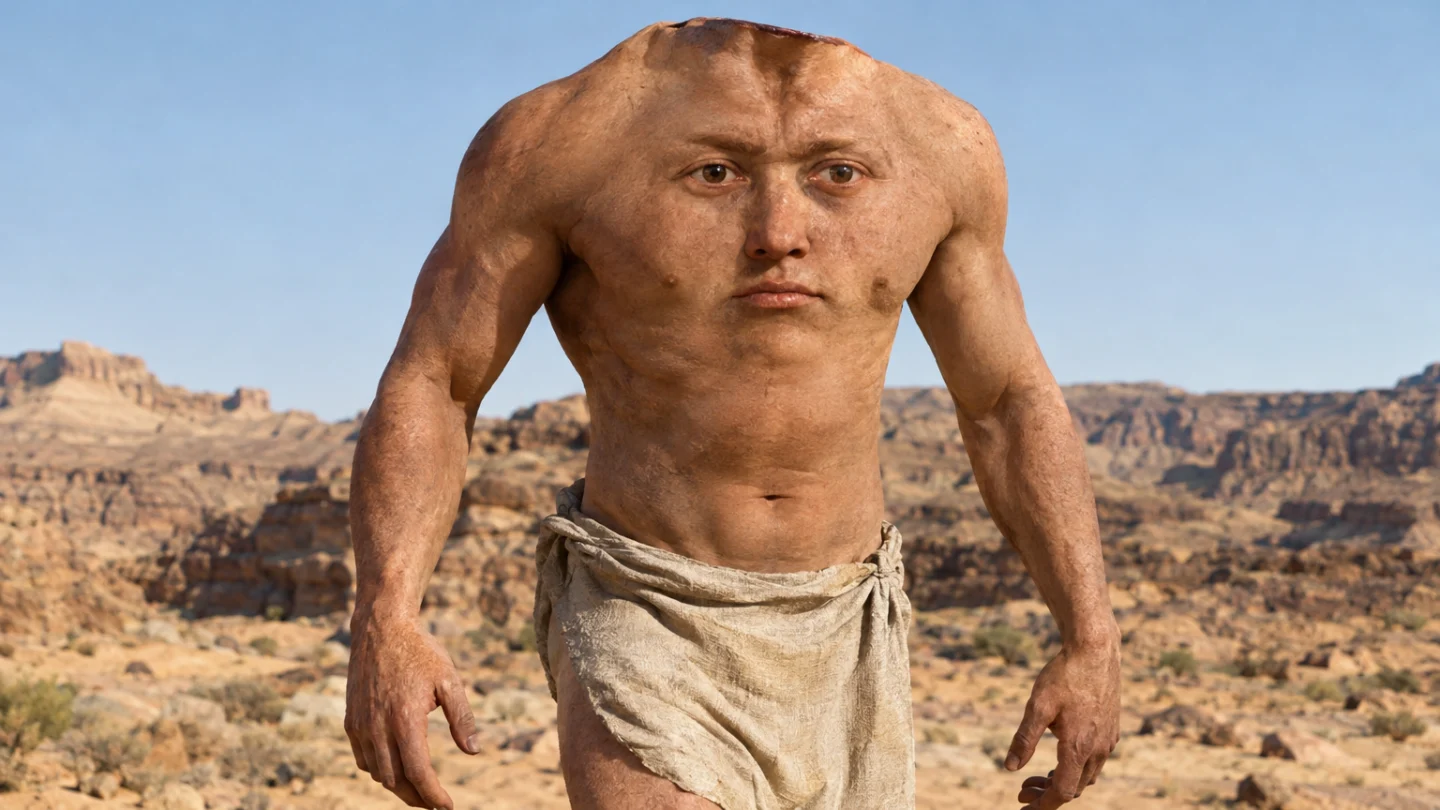
Blemmyes are legendary headless humanoids whose eyes and mouths appear on their chests. Greek and Roman descriptions associate these extraordinary people broadly with distant African lands and geographical marvels.
They provide a close literary comparison because headless people appear alongside dog-headed people in ancient reporting. Their unusual anatomy remains distinct from that of Cynocephali.
Centaur
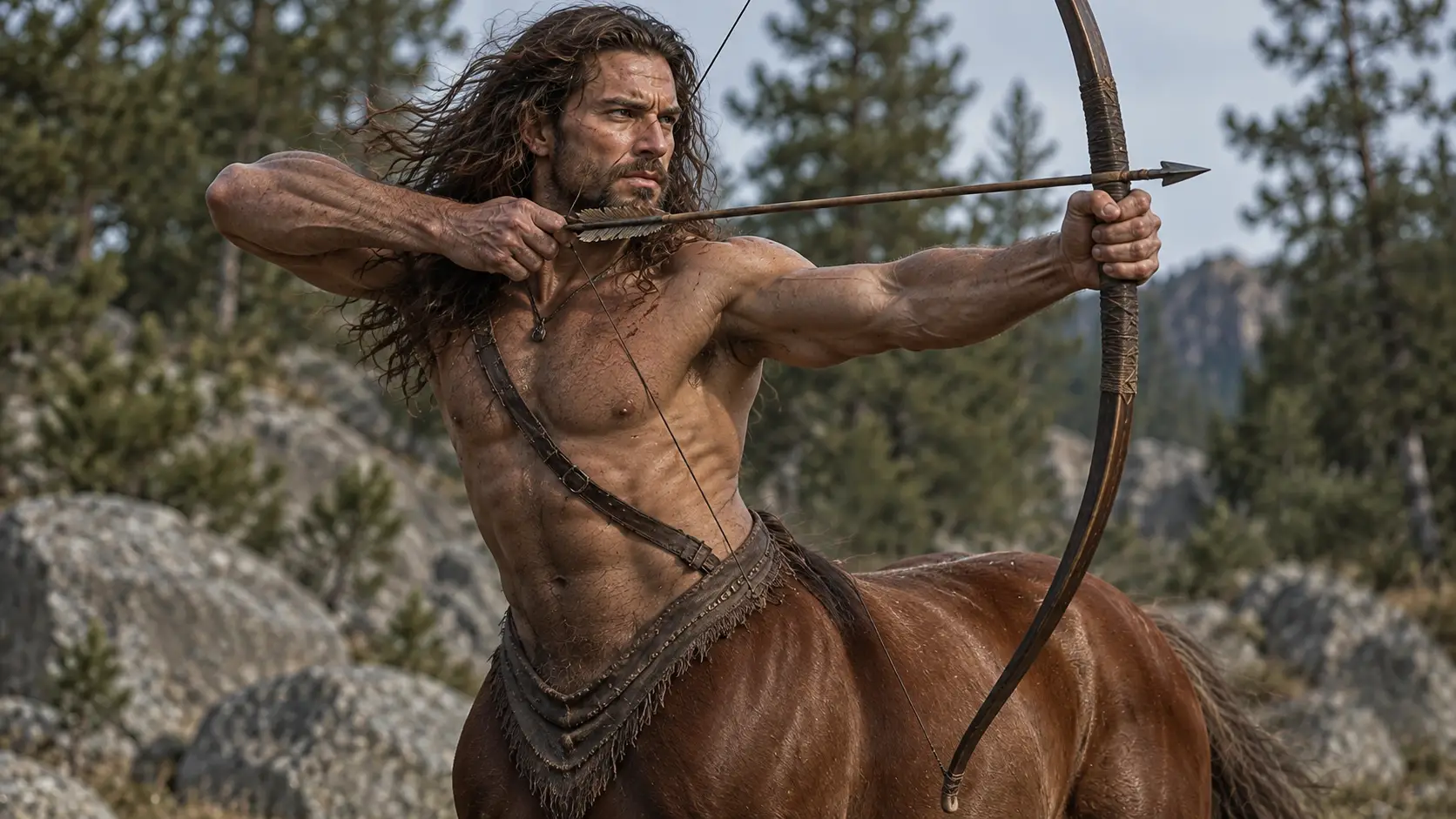
Centaurs are beings from Greek mythology combining a human upper body with the lower body of a horse. Their form joins recognizable human and animal anatomy within one creature.
The comparison is primarily morphological. Cynocephali retain humanlike bodies beneath dog heads, whereas centaurs have equine lower bodies and belong to a separate mythological tradition.
Religion/Ritual
The clearest religious connection is the dog-headed variant of Saint Christopher. Only some versions give him this appearance; the familiar giant-saint tradition does not require it.
His inclusion in Christian hagiography demonstrates that a visibly nonhuman feature could coexist with the status of a saint.
No specific ceremony, offering, taboo, or cult belonging to Cynocephali is established by the consulted evidence. Depictions of a dog-headed saint concern Christian storytelling and sacred imagery, not proof that the legendary people themselves received worship or practiced a documented religion.
Scientific or Rational Explanations
The evidence supports a history of literary descriptions, not the existence of a biological population of dog-headed humans. The most useful explanations therefore concern how reports were framed, transmitted, and adapted.
A surviving passage establishes what a writer recorded, not that its extraordinary inhabitants existed.
Transmission matters especially for Ctesias. His detailed Indian account is available here through Photius’s much later excerpt, rather than an intact surviving original.
That distance requires care when discussing wording and emphasis, although the excerpt still preserves a coherent portrait of the legendary mountain community.
Historical classification also complicates a straightforward zoological reading. Isidore of Seville discusses cynocephali among apes, whereas other accounts describe dog-headed peoples with livelihoods and social relationships.
His classification documents one early medieval understanding of the term; it does not establish the animal behind every earlier report.
A social interpretation asks why animal features accompany otherwise recognizable human behavior. Barking contrasts with understanding speech, while hunting and trade make the supposed strangers intelligible as a community.
Such tensions help explain the figure’s usefulness in discussions of humanity, without identifying a real population behind it.
Literary adaptation provides another explanation for the changing portrayals. A geographical account needs inhabitants and customs; an adventure episode needs encounters and dangers; hagiography concerns holiness.
These different purposes help account for the changing treatment of Cynocephali without requiring every version to preserve one original observation.
Modern Cultural References
The confirmed modern examples here are two podcast episodes devoted directly to Cynocephali. Both place the legendary people within contemporary paranormal discussion, but their presentation should be distinguished from the ancient geographical accounts and medieval religious narratives that preserve the historical tradition.
Cynocephali: The Dog Headed One, podcast episode (2026)
Nick Willard’s Almost Canon Podcast explores the folklore of dog-headed beings.
The episode directly discusses Cynocephali, emphasizing their humanlike character rather than treating them simply as animals.
(podcasts.apple.com)
The Pixelated Paranormal Podcast #237: Paranormal on the Battlefields, Pt 2: The Cynocephali, podcast episode (2022)
This episode explores legendary dog-man soldiers within a paranormal battlefield discussion.
Cynocephali are its explicit subject, connecting the ancient dog-headed figure with a modern military-themed paranormal presentation.
(music.amazon.in)
Conclusion
Cynocephali are best understood as a legendary people whose defining feature, a dog’s head on a humanlike body, remained recognizable across changing accounts. Their geography and customs were never uniform: Herodotus’s reported Libyan tradition differs from the Indian mountain communities described in Ctesias’s account, preserved through Photius.
Later Alexander narratives and dog-headed versions of Saint Christopher belong to further stages of that history, not to one consistent ancient biography. Keeping these distinctions visible preserves the tradition’s complexity without presenting literary marvels as biological evidence.
Their lasting significance lies in the questions their mixed form allowed storytellers and religious writers to explore. A canine face could mark distance and strangeness, while social organization, communication, or Christian faith complicated any simple division between human and beast.
The resulting figure could be threatening, socially recognizable, or holy, depending on the narrative. Modern podcast treatments continue to reinterpret that ambiguity, but the strongest account of Cynocephali remains grounded in the differences among their ancient descriptions and medieval transformations.
Further Reading
Illumination of Saint Christopher, Cambridge University Press, Primary Sources on Monsters
Summarizes the distinction between ordinary giant Christopher accounts and the few dog-headed variants.
(cambridge.org)
Ctesias, Indica, preserved in Photius’ excerpt, Livius
Ctesias describes a people living in Indian mountains who bark, hunt, keep livestock, gather produce, and trade with Indians; the excerpt also describes their bodily traits and cave dwellings.
(livius.org)
Julius Valerius, quoted and discussed by Claude Lecouteux, Persee
A medieval transmission of the Alexander story describes Alexander’s party entering forests full of Cynocephali; the beings attack, and Alexander’s party repels them with arrows.
(persee.fr)
City of Dog, Journal of Urban History / SAGE
Specialist analysis of early medieval ideas about Cynocephali, humanity, cities, and hagiography.
(journals.sagepub.com)