
Introduction
Nāgas are a class of serpent-associated supernatural beings rooted in Indian traditions. They appear in Hindu, Buddhist, and Jain religion, but they are not one creature with a single biography.
Their identities range from powerful serpents to humanlike beings distinguished by cobra hoods.
Water is central to many Nāga traditions. Springs, lakes, and other water sources can be associated with particular serpent beings, whose presence connects a place with supernatural power.
These local relationships are as important to understanding Nāgas as their appearances in major religious texts.
The Sanskrit word nāga can also mean an ordinary snake. This overlap helps explain why translations sometimes present Nāgas simply as serpents, while religious accounts give them speech, royal authority, kinship, and the ability to assume human form.
Individual Nāgas have distinct roles and dispositions. Vāsuki and Takṣaka belong to the serpent narratives of the Mahābhārata, while Mucilinda shelters the Buddha during a storm.
Neither hostility nor benevolence defines the entire class: their significance depends on the particular story, place, and religious setting.
History/Origin
Nāga traditions developed through relationships between localized serpent worship and wider religious systems. No single surviving narrative establishes their historical beginning.
Their association with particular waters and places suggests a religious landscape containing many local powers, rather than one centrally defined serpent mythology.
The Mahābhārata preserves an extensive early literary treatment in its Āstīka Parva. Serpents appear as a related community with named leaders, family obligations, and shared dangers.
This narrative framework gives individual Nāgas identities while placing them within a larger lineage.
King Janamejaya’s snake sacrifice brings that community into conflict with royal and sacrificial power. Vāsuki seeks help from his sister’s son Āstīka, while Takṣaka seeks Indra’s protection.
The episode portrays serpents as participants in a moral and divine world, not merely threatening animals.
Buddhist tradition incorporates Nāgas into a different religious framework. In the Udāna’s Mucilinda episode, a serpent king protects the meditating Buddha from severe weather and subsequently pays homage in human form.
His supernatural power supports the Buddha rather than competing with his spiritual authority.
Regional traditions retain a more explicitly geographical focus. Kashmir legends collected in Indian Serpent-Lore connect Nāgas with springs, lakes, and accounts of the land’s settlement.
One Buddhist version introduces the arhat Madhyāntika into the transformation of a country formerly occupied by a lake.
Nāgas also entered Jain religious traditions, demonstrating their importance beyond any single scriptural community. Their incorporation into several religions did not erase local differences.
Epic serpent lineages, Buddhist protectors, and beings associated with particular waters represent connected but distinct developments within a broad tradition.
Name Meaning
The Sanskrit noun nāga (नाग) can mean a snake or serpent, and mythological texts also apply it to a class of supernatural serpent beings. The English spelling “Naga” omits the macron marking the long vowel ā; that spelling difference does not indicate another creature.
Monier-Williams’s Sanskrit-English Dictionary records another meaning: “elephant.” It also distinguishes ordinary snake usage from a serpent-demon category, showing why the surrounding text matters.
A Nāga mentioned in a religious narrative is not automatically an animal encountered in everyday life.
The same dictionary records descriptions of Nāgas with human faces and serpent-like lower bodies, alongside Buddhist depictions in human form. Such lexical evidence establishes attested usages, not a single original anatomy.
Individual accounts may show a full serpent, a human figure, or a being changing between forms.
Nāgarāja (नागराज) joins nāga with rāja, “king,” to mean “serpent king.” Mucilinda, who protects the Buddha, bears that title.
These established meanings explain how writers use the name; the dictionary entries do not settle the word’s ultimate etymology.
Appearance
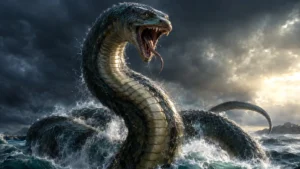
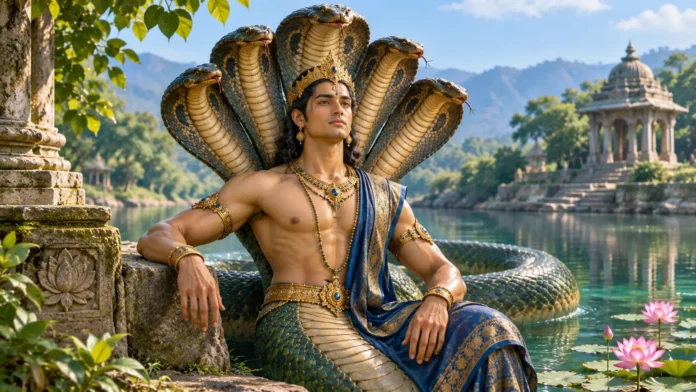
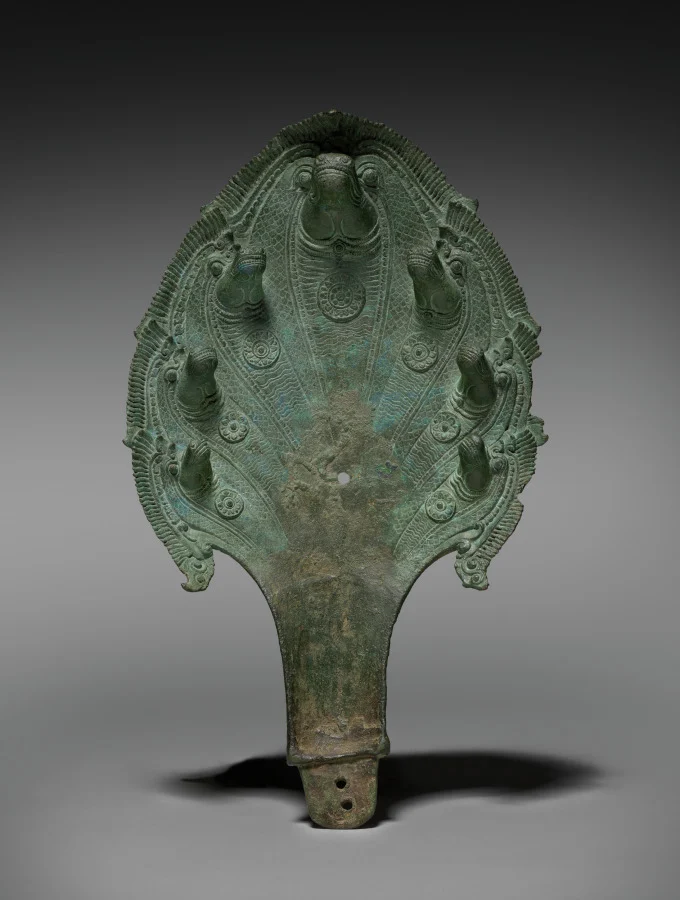
Nāga appearance varies between fully serpentine, humanlike, and hybrid forms. A cobra with a raised hood is a well-supported representation, but so is a human figure with cobra hoods rising behind or above the head.
Neither form should exclude the other.
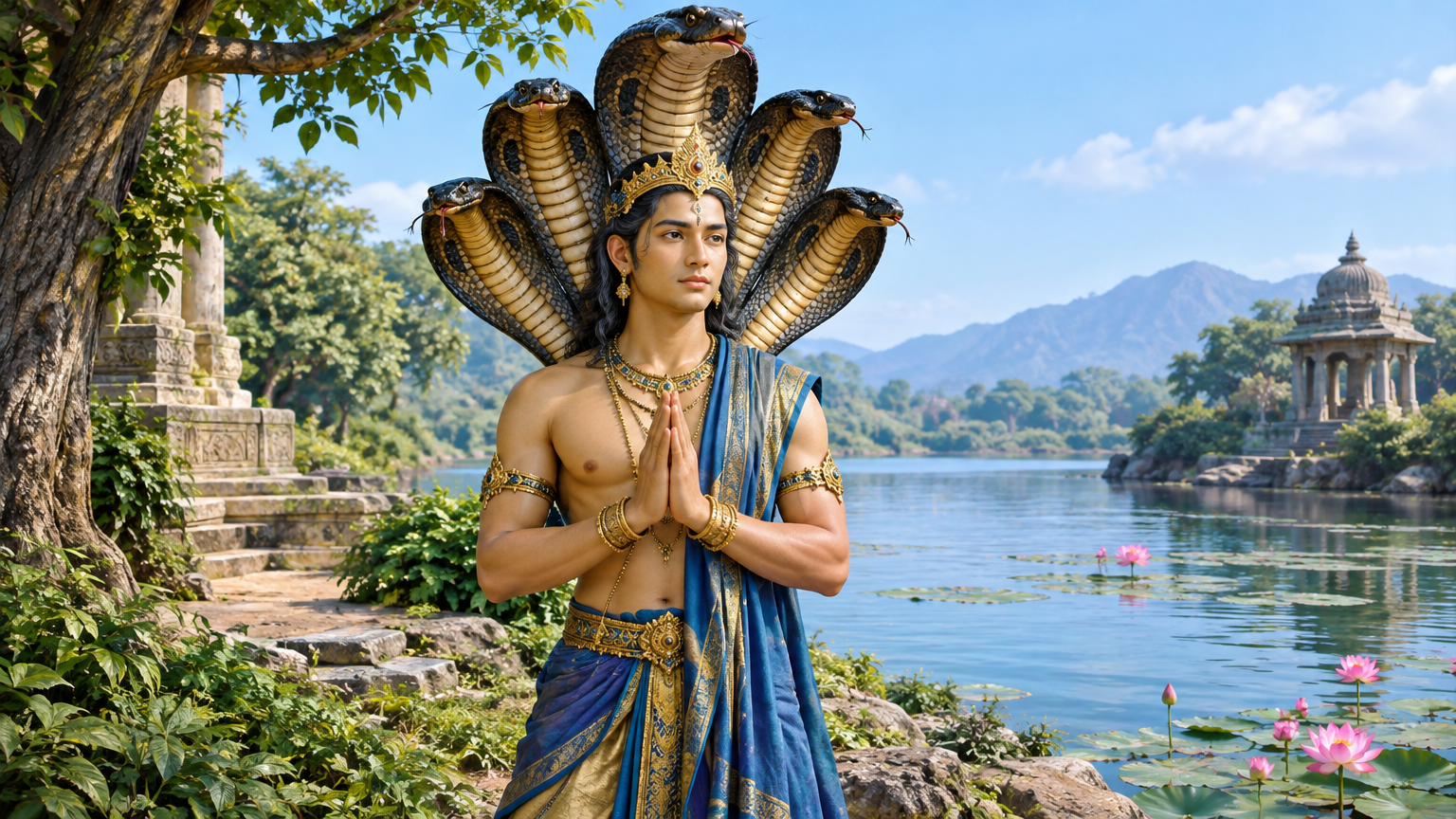
Multiple cobra heads are another established feature of Nāga imagery. Their arrangement can create a canopy above a figure, making the serpent identity unmistakable even when much of the body appears human.
A particular number of heads is not universal across the tradition.
Human-and-serpent combinations belong to this visual range, but the familiar idea of a human torso joined to a snake’s lower body is not a complete definition. Humanlike figures marked by hoods and beings represented entirely as serpents are equally important to the broader identity.
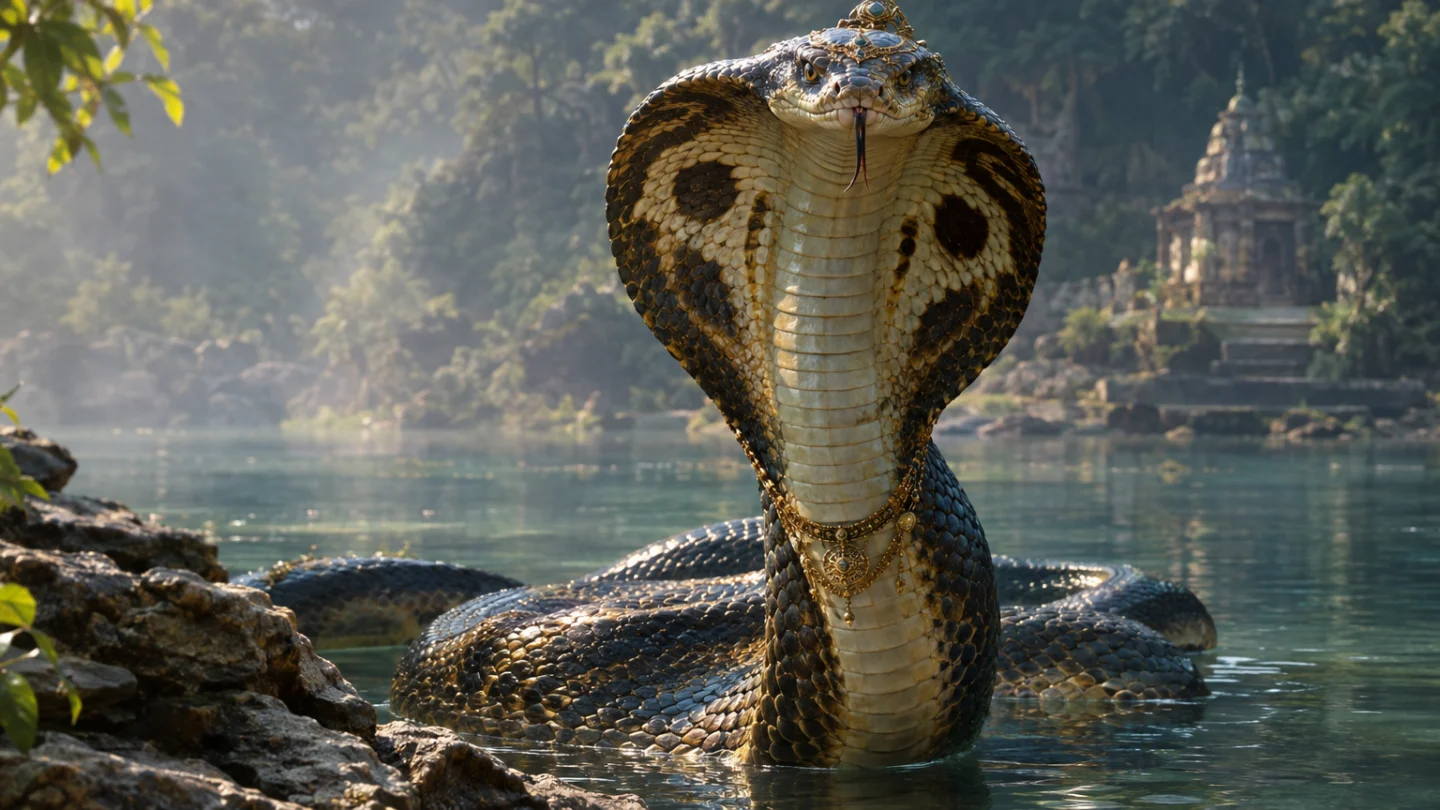
The Udāna gives Mucilinda a clearly serpentine appearance during the storm. He winds his coils around the Buddha and extends his hood overhead as shelter.
When the weather clears, he relinquishes that form and appears as a youth paying homage.
This episode distinguishes transformation in a narrative from hybrid anatomy in an image. Mucilinda’s successive appearances are not simply two descriptions of one fixed body.
They demonstrate how serpent identity and human presentation can belong to the same named being within a particular account.
Water provides a fitting setting for many depictions because of Nāgas’ documented associations with springs and lakes. It is contextual rather than anatomical evidence.
Their appearance is best understood through the relevant figure and tradition, not through a standardized catalogue of colors, dimensions, or bodily features.
Background Story
Nāgas have no collective life story. Their background lies in overlapping traditions concerning serpents, water, local authority, and relations between human communities and supernatural powers.
Literary narratives give these relationships memorable characters, while regional beliefs attach them to identifiable places.
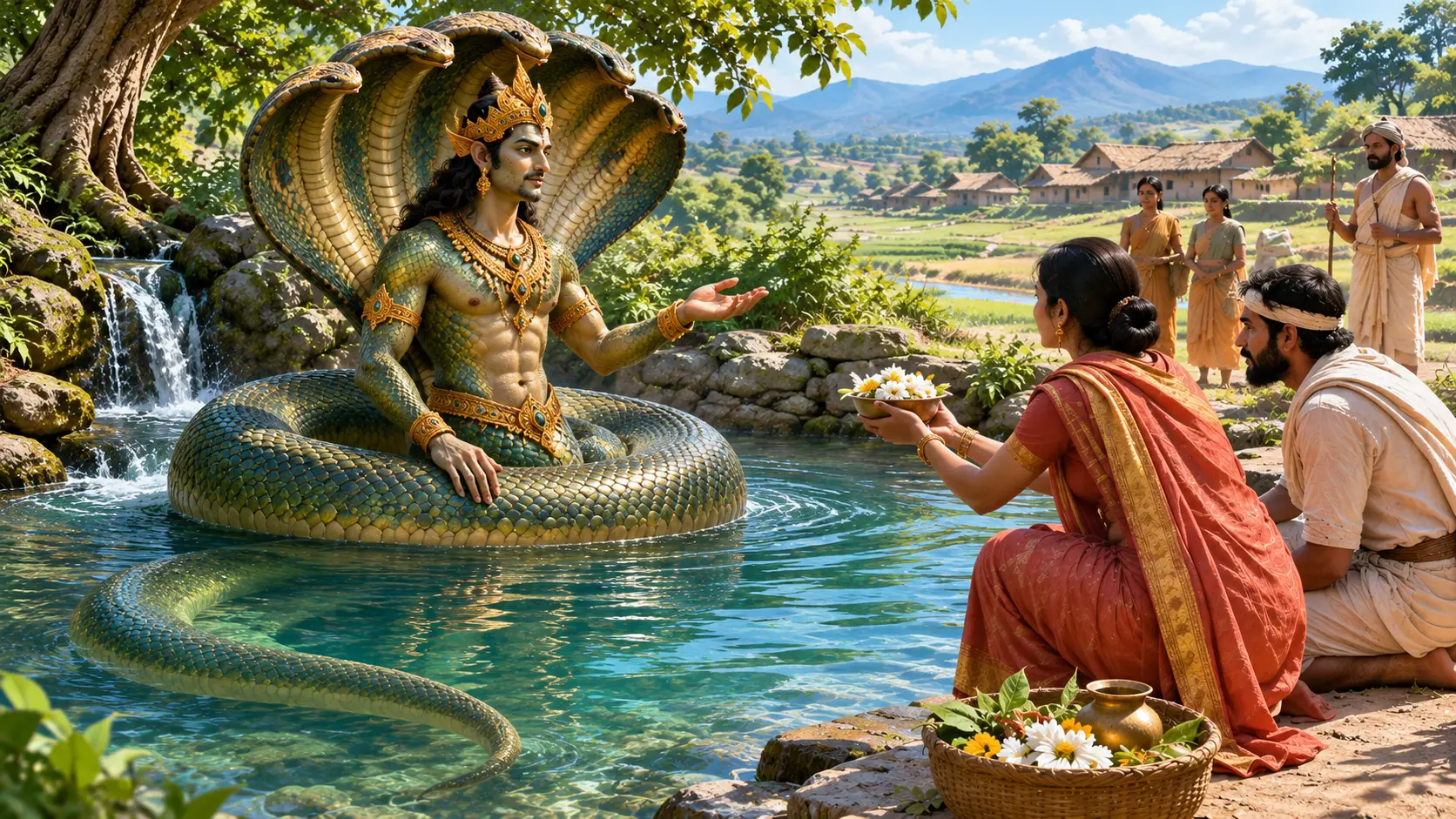
Water associations help explain their importance beyond tales of dangerous snakes. A spring or lake could be understood as the domain of a powerful being connected with abundance or scarcity.
Such beliefs made Nāgas relevant to the conditions sustaining a community’s life.
The Mahābhārata develops a different tension: the vulnerability of an entire serpent lineage to organized sacrificial violence. Āstīka’s intervention prevents its destruction.
The narrative gives Nāgas family relationships and advocates, complicating any interpretation of them as enemies whose elimination is automatically justified.
Buddhist storytelling can instead emphasize the accommodation of supernatural power within a religious order. Mucilinda’s coils and hood become protective rather than threatening.
His homage after the storm places the serpent king in a respectful relationship with the Buddha while preserving his extraordinary nature.
The Kashmir lake legend links Nāga tradition with the establishment of habitable territory and Buddhist presence. In the collected Buddhist version, Madhyāntika participates in the land’s transformation.
This is a regional account of landscape and settlement, not an origin story for all Nāgas.
These settings explain why the same broad class can contain endangered relatives, protective kings, and powers associated with water. Nāgas were shaped by several kinds of religious relationship.
Their diversity is therefore fundamental to the tradition, rather than a problem requiring one definitive body or personality.
Famous Folklore Stories
Nāga narratives survive in epic literature, Buddhist scripture, and regional collections. The episodes below concern particular serpent beings, not a shared biography of the entire class.
The sacrifice and Kashmir headings are descriptive labels rather than authenticated traditional tale titles.
Astika Stops Janamejaya’s Snake Sacrifice
In the Mahābhārata’s Āstīka Parva, King Janamejaya conducts a sacrifice that draws snakes toward the ritual fire. The danger extends beyond a single adversary: numerous serpents face destruction, while Takṣaka seeks protection with Indra.
Vāsuki fears for the survival of his kin.
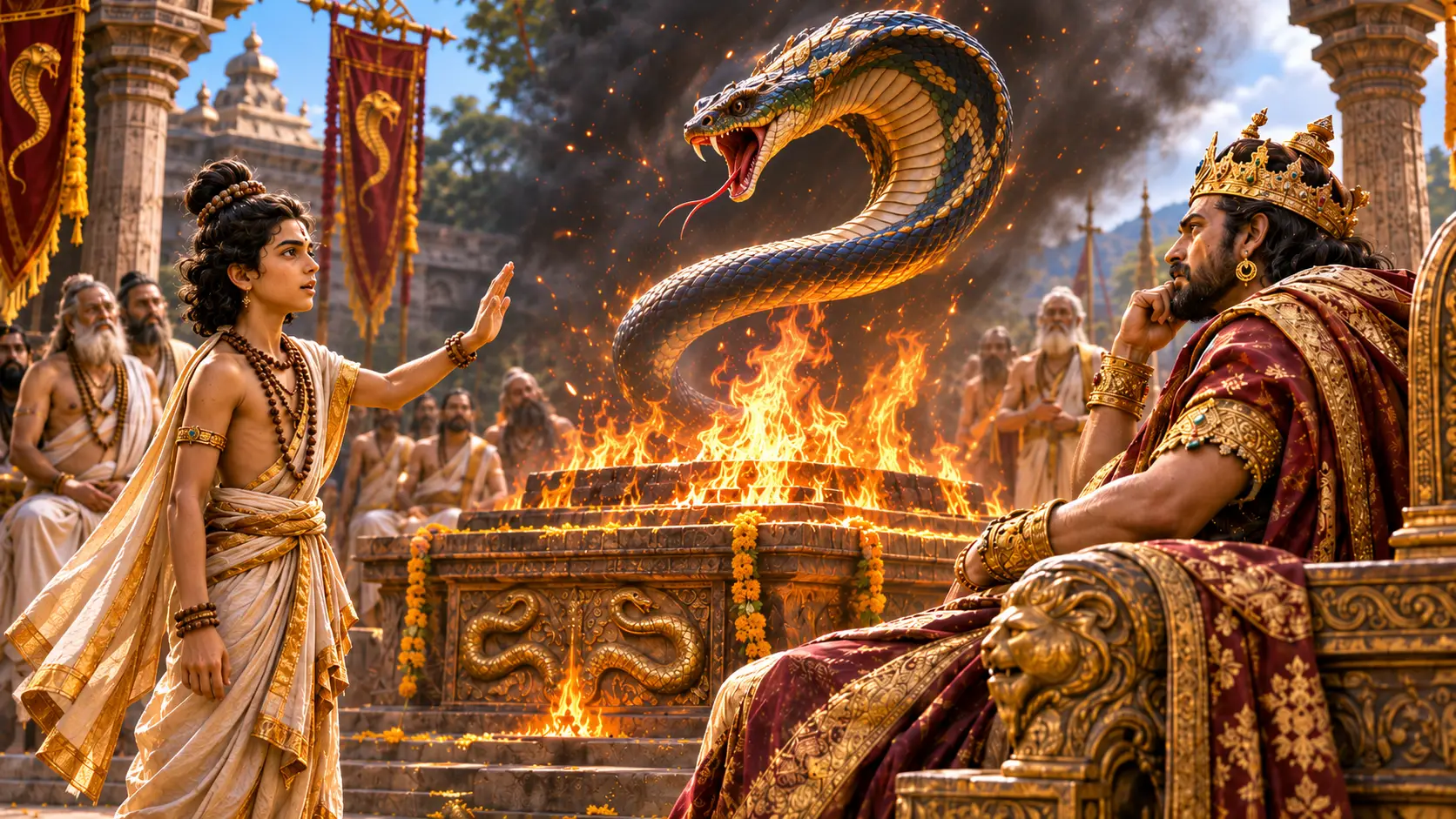
Vāsuki turns to Astika, his sister’s son, whose intervention ultimately brings the sacrifice to an end. Takṣaka and the remaining serpents are spared.
The episode gives the Nāgas family relationships, political leadership, and advocates, making them more than anonymous monsters awaiting defeat.
The story’s resolution depends on stopping destruction rather than completing it. Read as a narrative about restraint, it complicates any simple division between human heroes and evil serpents.
Its named figures nevertheless belong to this epic episode, not every regional Nāga tradition.
Mucilinda Shelters the Buddha
In the Udāna’s Mucilinda episode, a seven-day storm surrounds the meditating Buddha. The serpent king Mucilinda encircles him with his coils and spreads his hood overhead, protecting him from rain and wind.
Here, a powerful serpent acts as a sheltering presence rather than an attacker.
When the weather clears, Mucilinda withdraws his coils, assumes the appearance of a youth, and pays homage. The transformation is part of this particular encounter narrative.
It demonstrates that serpent and human appearances can belong to one Nāga without establishing a universal anatomy for all Nāgas.
The Nāga and Kashmir’s Former Lake
A Buddhist version of Kashmir’s settlement legend, preserved in Indian Serpent-Lore, presents the country as formerly a lake associated with a Nāga. The account introduces the arhat Madhyāntika into the transformation of this watery landscape and its availability for human settlement.
This regional narrative connects religious history with the establishment of habitable land. Its significance lies in the relationship between an existing supernatural presence and a changing landscape.
It should remain distinct from other Kashmir origin traditions rather than being presented as their single authoritative version.
Cultural Impact
Nāga imagery became a durable visual language in South and Southeast Asian religious art. In Cambodian sculpture, the serpent’s expanded hood can shelter the Buddha, making protection visible without depicting a fight.
A known composition therefore became a recognizable religious image beyond its original narrative setting.
The Metropolitan Museum of Art identifies a twelfth-century Cambodian bronze, Buddha Sheltered by a Naga, as a representation of Mucilinda. Its collection notes that Khmer artists widely popularized this composition, particularly during the reign of Jayavarman VII.
The motif’s prominence reflects artistic and religious patronage, not merely repetition of scripture.
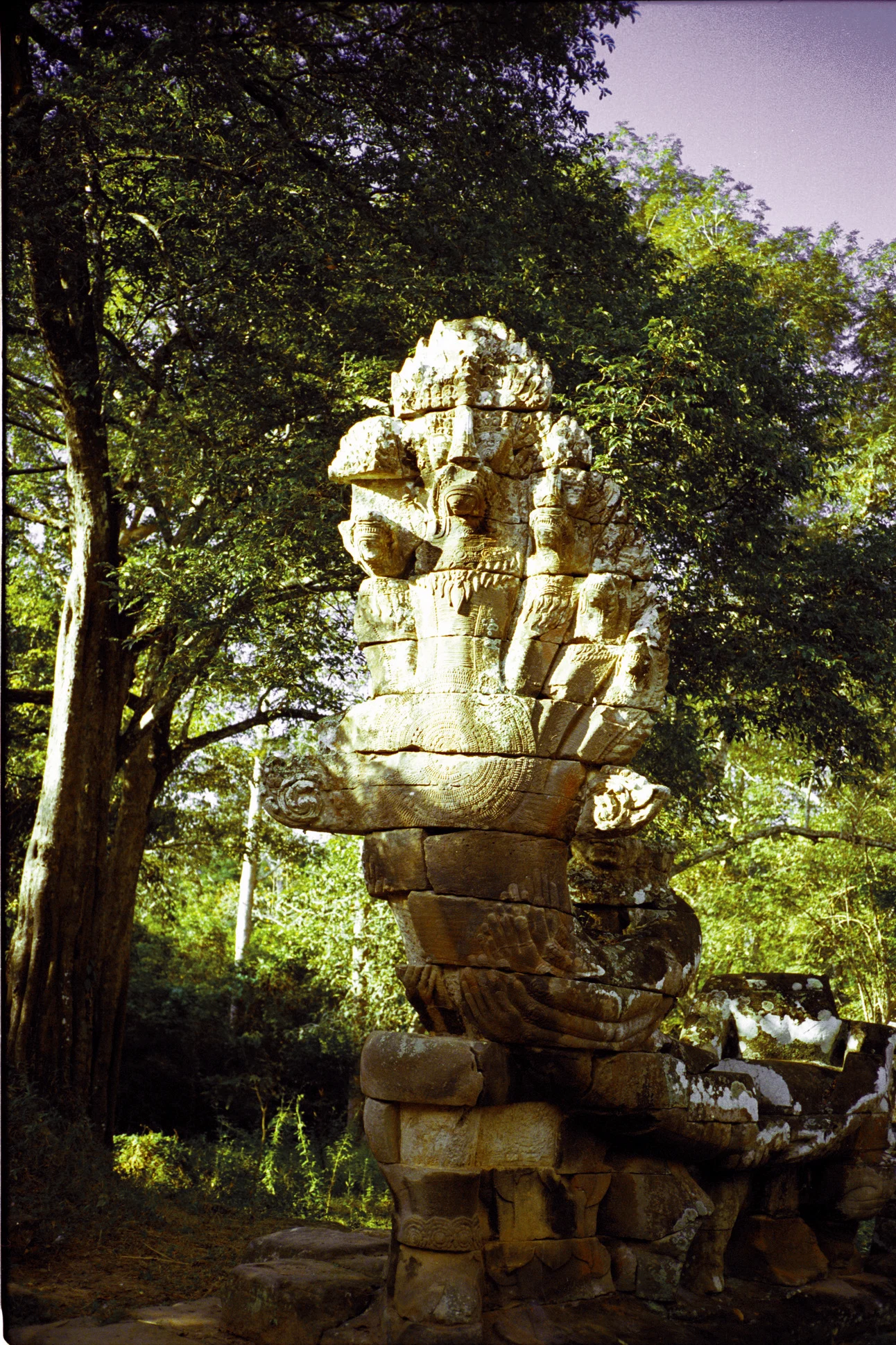
Nāga forms also shaped architecture. The Smithsonian’s National Museum of Asian Art describes serpent balustrades as a hallmark of Angkor-period bridges.
At the eleventh-century Spean Ta Ong bridge, a multiheaded Nāga rises from the end of a long stone railing, bringing supernatural serpent imagery into a practical crossing.
These examples show different kinds of influence: portable sacred sculpture and monumental infrastructure. Artists adapted serpent imagery to the needs of patrons, places, and religious communities.
Their use in Cambodia demonstrates a history of regional artistic development, not a claim that all Nāga traditions share identical meanings.
Similar Beasts
Makara
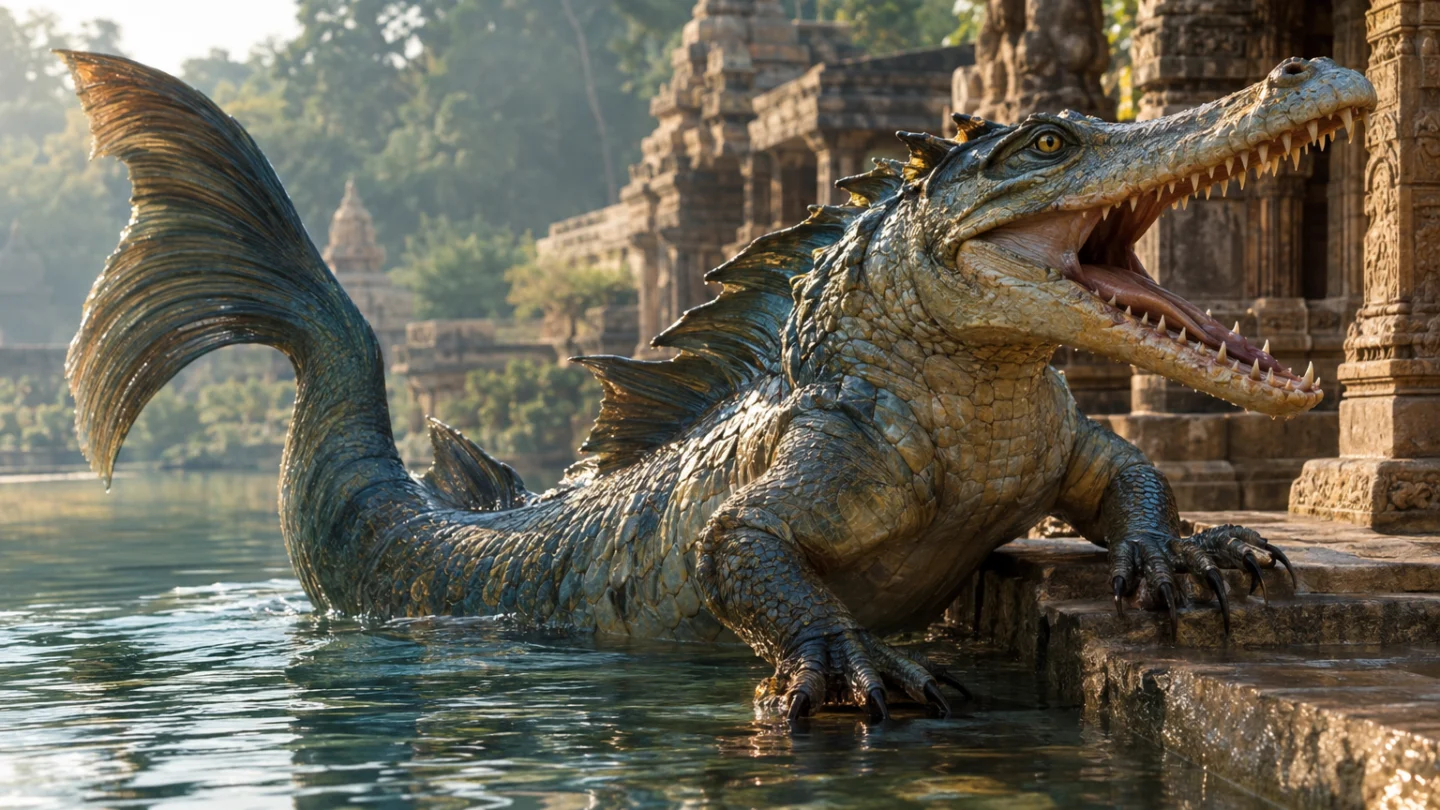
The Makara is a mythical aquatic creature in South Asian traditions, often represented as a composite animal. Its sacred imagery connects water with guardianship and divine authority.
Like many Nāgas, the Makara belongs to a religiously meaningful aquatic world. It remains a distinct creature, however, rather than another serpent king or Nāga form.
Rainbow Serpent
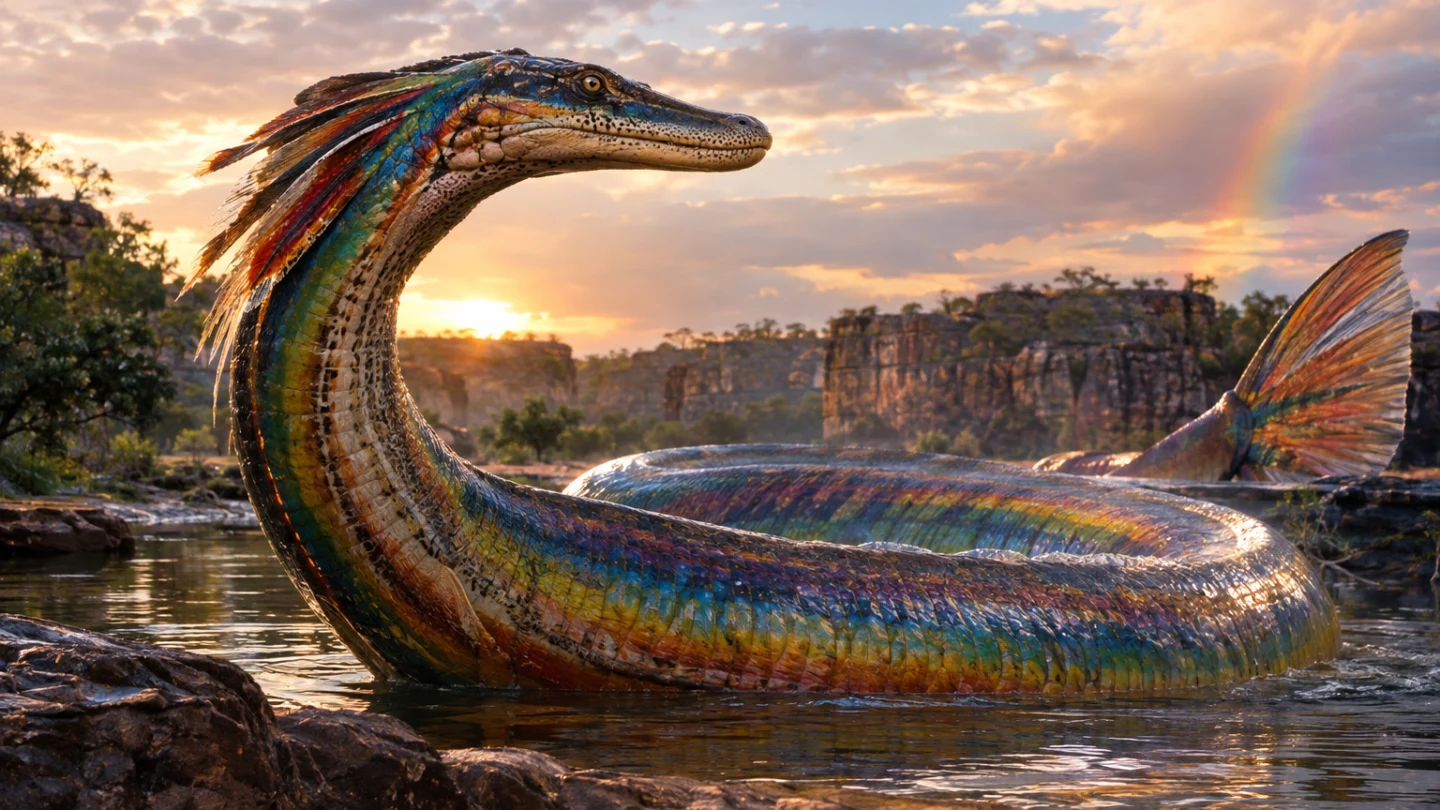
The Rainbow Serpent is a powerful creator being in many Aboriginal Australian traditions. Stories associate this immense serpent with water, fertility, and the shaping of rivers and landscapes.
The comparison concerns serpent imagery and the significance of water. These parallels do not establish a shared origin or make distinct Aboriginal traditions interchangeable with Nāga beliefs.
Read more about Rainbow Serpent
Nyami Nyami
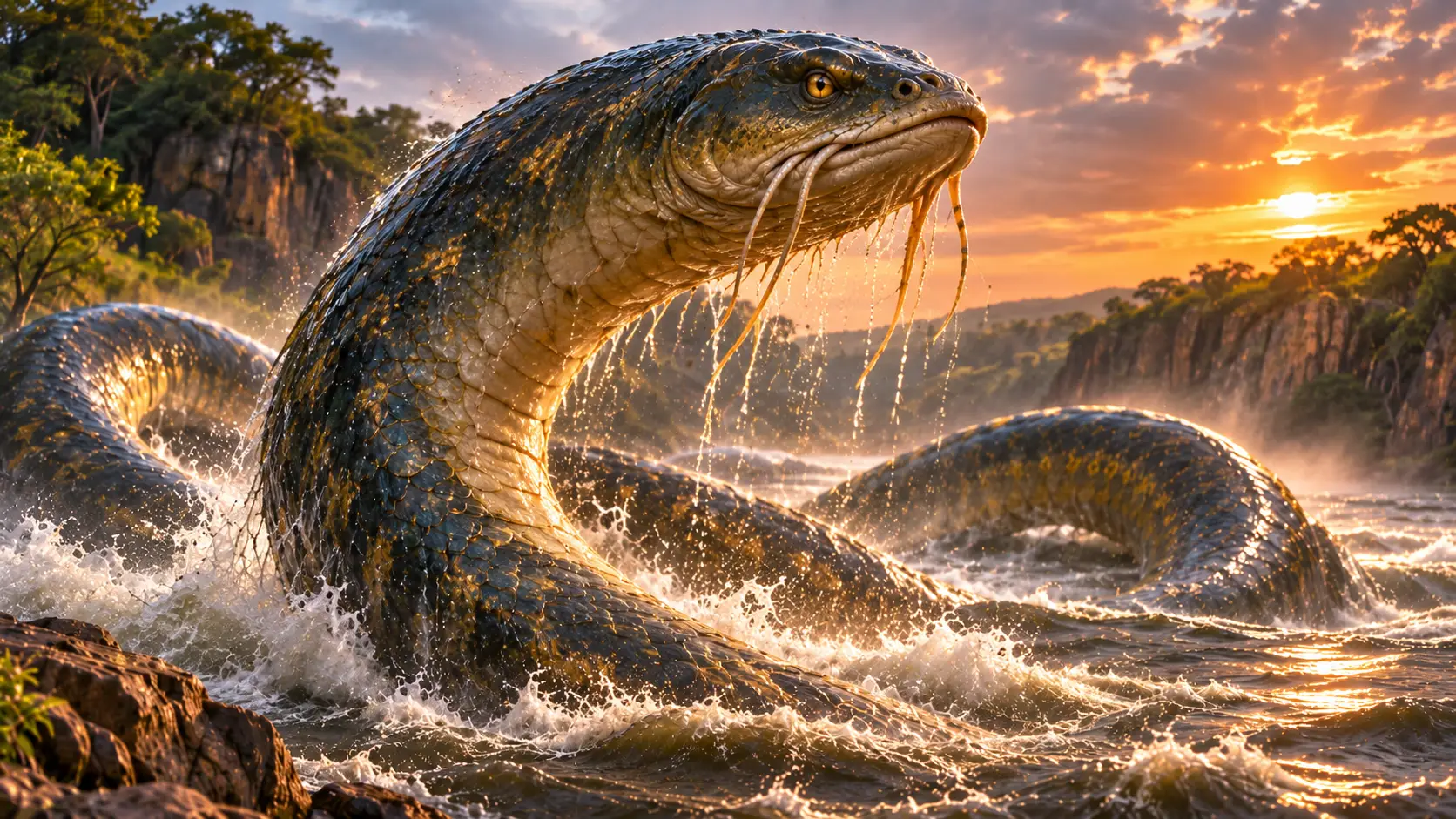
Nyami Nyami is the Zambezi River God in Tonga mythology, described with a snake’s body and a fish’s head. The deity embodies protection and the river’s destructive power.
Like water-associated Nāgas, Nyami Nyami connects supernatural agency with a significant waterway. The comparison is functional, not an identification of the Tonga deity as a Nāga.
Religion/Ritual
Nāga worship includes localized devotion as well as participation in broader religious traditions. Associations with particular water sources give some Nāgas a strongly place-based identity.
This local character matters: the evidence does not support one uniform system of worship observed wherever Nāgas are known.
In Maharashtra, Nagpanchami provides a documented example of continuing serpent veneration. Observances include worship of serpent images and visits to temples.
These practices show that Nāgas remain objects of devotion, not merely characters inherited from ancient literature or subjects of historical art.
The Buddhist Mucilinda encounter expresses a different religious relationship. The serpent king protects the meditating Buddha and subsequently pays homage.
This is a scriptural account of reverence and protection, not, by itself, evidence for a prescribed ceremony that worshippers must reproduce.
Nāga figures also occur in Jain traditions, but their presence should not erase religious distinctions. A shared serpent-associated figure does not imply identical theology or ritual practice.
Specific offerings, prohibitions, and ceremonial sequences require local evidence rather than extrapolation from the broad class-name.
Scientific or Rational Explanations
The evidence establishes Nāgas as subjects of religion, literature, and art, not as a biological species demonstrated through empirical observation. Their changing forms belong to those traditions.
Treating a humanlike Nāga and a cobra-shaped Nāga as competing zoological identifications would misread the material.
Real snakes provide an evident visual reference for serpent bodies and cobra hoods. That resemblance helps explain how an image communicates serpent identity, but it does not establish which encounters originally produced Nāga beliefs or reduce their religious meanings to animal observation.
An environmental interpretation can begin with the documented importance of springs, lakes, and water availability. Nāga traditions connect supernatural power with these settings.
It is reasonable to examine that relationship, but stronger claims about particular floods, droughts, or environmental memories require additional evidence.
A historical interpretation instead considers the incorporation of localized serpent worship into Hindu, Buddhist, and Jain traditions. This offers a framework for understanding continuity alongside variation.
It does not require every regional Nāga to descend from one recoverable original story or cult.
Kashmir’s former-lake narrative likewise belongs first to religious and regional storytelling. It can be studied as an account of settlement and landscape transformation without treating its supernatural events as verified geology.
Distinguishing narrative meaning from physical evidence preserves both the tradition’s significance and the limits of scientific explanation.
Modern Cultural References
Modern media adapt Nāga-related material in different ways. Indian cinema draws on serpent-woman transformation stories, while fantasy games borrow the name, body forms, or supernatural powers for invented characters.
These works should be distinguished from living religious observances such as Nagpanchami.
Nagina, film directed by Harmesh Malhotra, 1986
Rajni, played by Sridevi, is revealed as a shape-shifting cobra. The Hindi fantasy film develops popular Indian serpent-woman storytelling through marriage, revenge, and concealed identity rather than retelling an epic Nāga episode.
Source: https://tv.apple.com/us/movie/nagina/umc.cmc.5ek8guwhd6d4gzmzvxch9134k
World of Warcraft: Rise of Azshara, Blizzard Entertainment, 2019
Blizzard presents the naga as transformed former elves who inhabit an undersea kingdom ruled by Azshara.
Their origin and hostility belong to the game’s invented world, not a traditional Indian serpent lineage.
Source: https://worldofwarcraft.blizzard.com/en-us/story/timeline/chapter-36

Dungeons & Dragons: The Marilith
The Marilith is loosely based on the Naja, combining a powerful female humanoid torso, six sword-wielding arms, and a massive serpentine body.
This fearsome warrior demonstrates how modern fantasy has developed the human-serpent hybrid into a supernatural combatant.
Source: https://www.dndbeyond.com/monsters/16952-marilith?srsltid=AYCX9vKxXl2BVZBdHDPYWf-1EOvh608fP6rrY_3eQPJcJV4LcSrRKBeO
Dota 2: Naga Siren, Valve
Valve’s Naga Siren, Slithice, belongs to the underwater Slithereen and uses her voice as a weapon.
This game character borrows the Nāga name for a distinct maritime fantasy species.
Source: https://www.dota2.com/workshop/requirements/naga_siren?l=english
Dungeons & Dragons: Guardian Naga, Monster Manual, 2025
The game portrays the Guardian Naga as a spellcasting celestial serpent able to return after death.
Its combat rules adapt a protective serpent motif into a distinct fantasy monster.
https://www.dndbeyond.com/monsters/5195066-guardian-naga
Hearthstone: Voyage to the Sunken City, Blizzard Entertainment, 2022
This expansion added Naga as a permanent minion type focused on spellcasting.
Its underwater fantasy creatures extend Blizzard’s fictional interpretation, separate from the devotional serpent traditions described elsewhere in this article.
Source: https://hearthstone.blizzard.com/en-gb/news/23784370/voyage-to-the-sunken-city-is-now-live
Conclusion
Nāgas are best understood as a varied class of serpent-associated supernatural beings, not a single monster with a fixed appearance or biography. Their forms range from serpents to humanlike figures marked by cobra hoods, while their meanings depend on particular texts, places, and religious settings.
Across Hindu, Buddhist, and Jain traditions, their association with water helps connect local landscapes with sacred narratives. That shared association provides continuity without making every Nāga identical in character, power, or purpose.
The surviving traditions also resist a simple division between benevolent guardians and dangerous enemies. The snake-sacrifice narrative, Mucilinda’s protection of the Buddha, and Kashmir’s lake traditions place serpent beings in different relationships with human and sacred authority.
Their lasting significance lies in that range: they can embody danger, protection, abundance, and attachment to particular places. Reading these accounts together, while preserving their differences, reveals a durable religious and artistic tradition rather than evidence for one universal serpent creature.
Further Reading
A Sanskrit-English Dictionary, Monier Monier-Williams, 1899, digital edition, University of Hyderabad
The nāga entry documents serpent-being, elephant, and human-serpent senses used in the article’s name discussion.
Source: https://sanskrit.uohyd.ac.in/SKT/MW/134.html
Buddha Sheltered by a Naga, The Metropolitan Museum of Art, 12th century Cambodian bronze
An identified Cambodian artwork illustrates how Khmer patronage developed Mucilinda’s protective form into a prominent sculptural convention.
Source: https://www.metmuseum.org/art/collection/search/39100
Naga Bridge: Spean Ta Ong, Smithsonian National Museum of Asian Art
Documents an eleventh-century Angkor-period bridge and Nāga balustrade, establishing the motif’s architectural importance beyond religious narratives.
Source: https://asia.si.edu/explore-art-culture/collections/collections-areas/southeast-asian/sacred-sites-in-southeast-asia/naga-bridge-spean-ta-ong/
The Mahabharata, Adi Parva, Āstīka Parva, translated by Kisari Mohan Ganguli
Section 53 supplies earlier context for Janamejaya’s snake sacrifice.
Section 58 records the king granting Āstīka’s request and formally ending the sacrifice, sparing the surviving serpents.
Context, section 53 | Conclusion, section 58
Udāna, Chapter II, “Mucilinda,” translated by D. M. Strong, Sacred Texts
During a seven-day storm while the Buddha meditates, the serpent king Mucilinda winds his coils around him and spreads his hood as shelter.
When the weather clears, Mucilinda assumes the form of a youth and pays homage.
(sacred-texts.com)
Indian Serpent-Lore, Kashmir legends section, Ignca.gov
A collected Buddhist version of the Kashmir origin legend describes the country as once being a lake associated with a Nāga and introduces the Arhat Madhyāntika in the story of the land’s transformation and settlement.
(ignca.gov.in)
Nagpanchami, Incredible India / Maharashtra Tourism
Institutional description of Maharashtra’s festival practices and contemporary veneration of serpent deities.
(incredibleindia.gov.in)