
Crookback Bog Is Not a Folklore Archive
In Crookback Bog, hungry children live under the authority of beings they call the Ladies of the Wood. Protection has a terrible price.
When Geralt reaches this corner of Velen in The Witcher 3: Wild Hunt, supernatural power already governs ordinary lives: food, obedience, survival.
The three Crones, known as Brewess, Weavess, and Whispess, first address him through a tapestry depicting beautiful women. Their eventual bodily presence makes that image grotesquely deceptive.
Nearby Downwarren supplies another unsettling detail: its ealdorman cuts off an ear as payment to the Ladies. Devotion becomes mutilation, made horrifyingly practical.
This is not folklore presented behind glass. It is a designed encounter, using dialogue, visual revelation, and consequences to make the player negotiate dependence.
The resemblance to familiar witches invites comparison, especially with Baba Yaga. But calling the Crones “three Baba Yagas” would erase differences worth investigating.
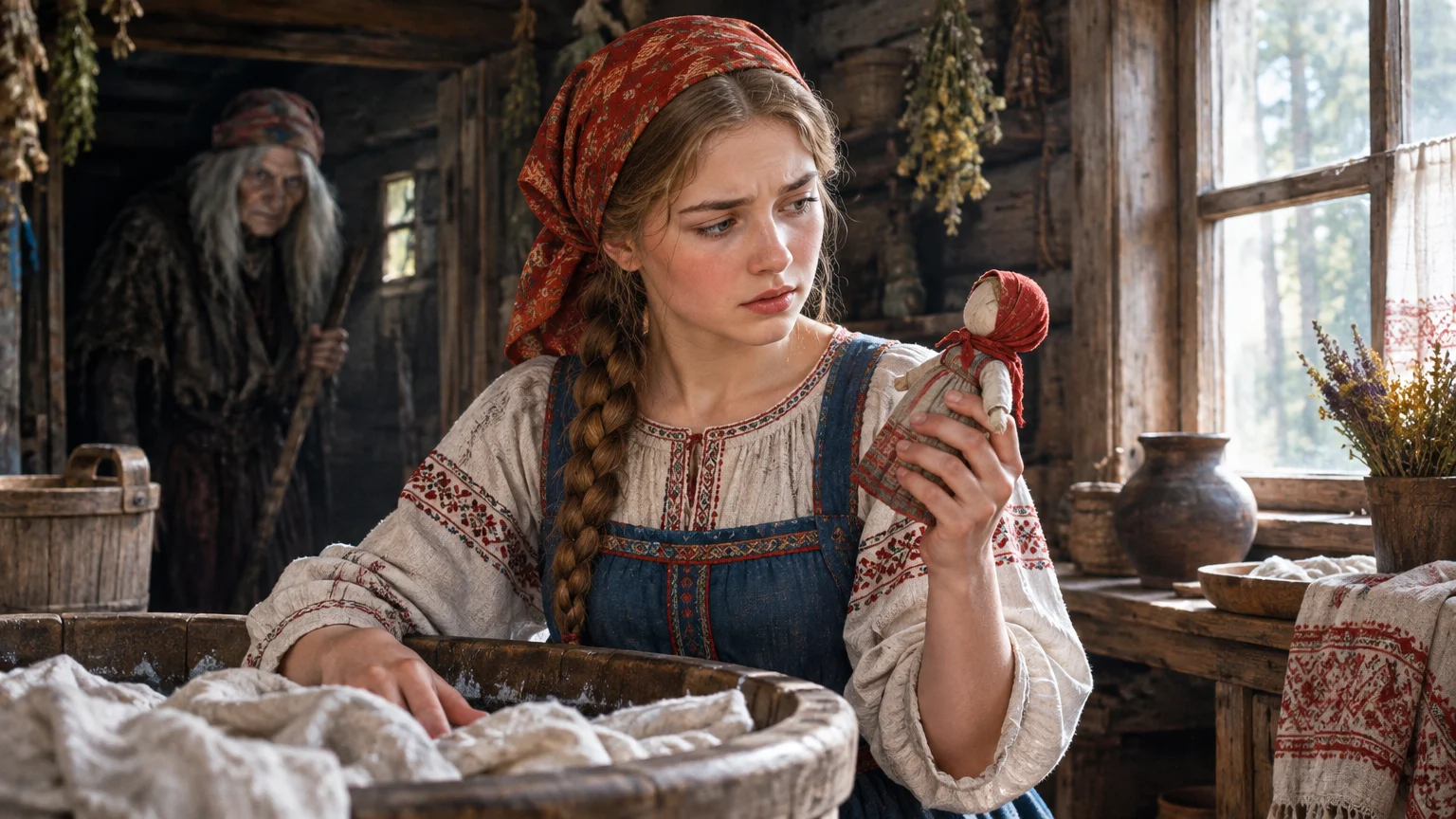
In the Russian tale commonly titled “Vasilisa the Beautiful,” collected by Alexander Afanasyev, a persecuted girl enters Baba Yaga’s domain seeking fire.
There, household labor becomes an ordeal. Vasilisa must complete seemingly impossible tasks, aided by the little doll her dying mother gave her.
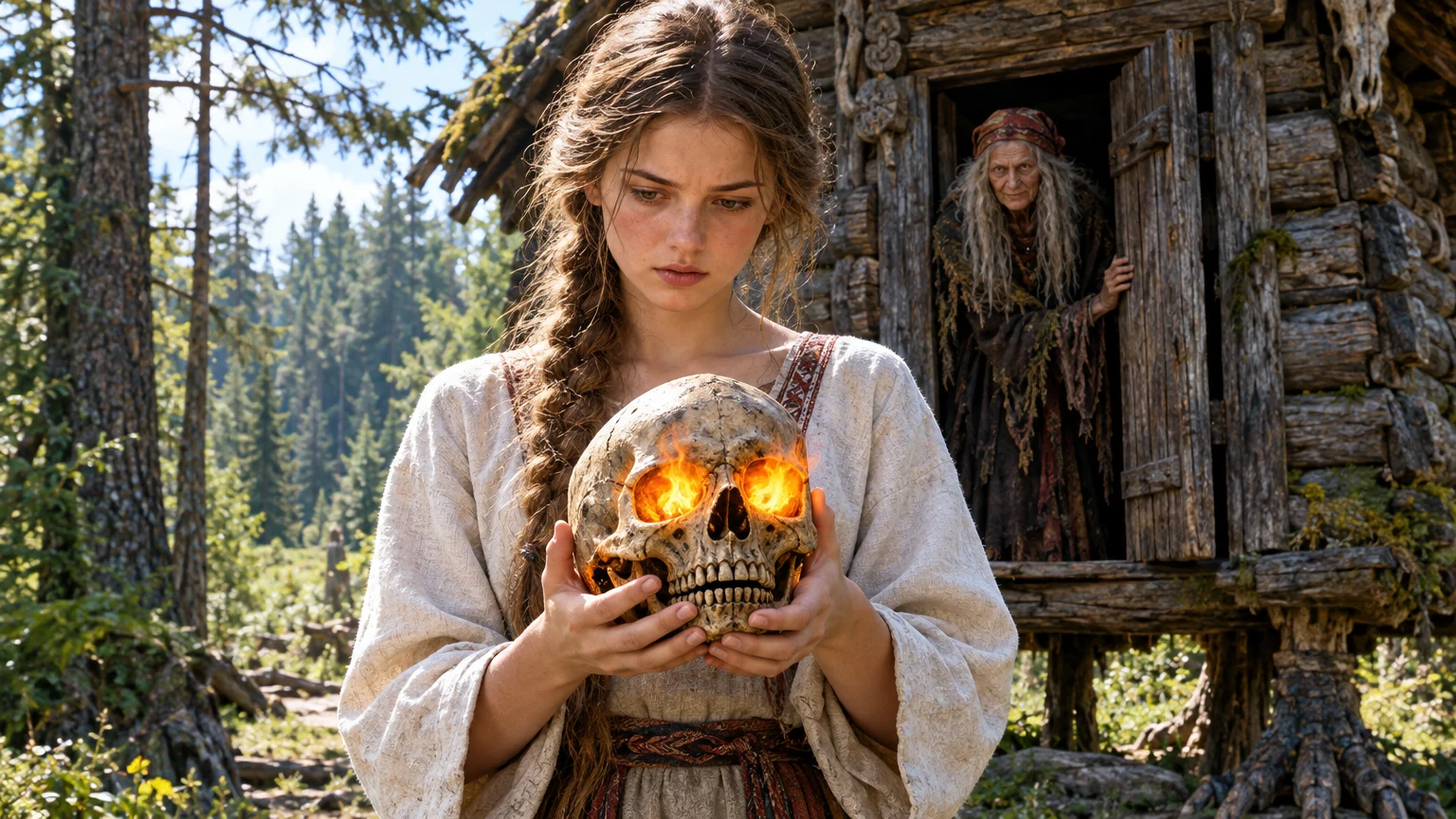
She returns carrying a skull whose burning eyes destroy her tormentors. Baba Yaga’s gift delivers liberation through an object no comfortable household should welcome.
Both narratives make female supernatural authority frightening and potentially useful. Yet Vasilisa’s dangerous acquisition of fire is not the Crones’ system of communal exploitation.
Nor does this comparison establish which particular tale, if any, inspired the developers. Shared motifs offer questions, not a documented chain of borrowing.
That distinction matters because Slavic traditions survive through different kinds of records, including chronicles, songs, charms, and ethnographic collections, rather than one uniform mythology.
A collected wonder tale and a contemporary role-playing quest also ask different things of their audiences. One recounts an ordeal; the other demands intervention.
At Crookback Bog, the fate of children becomes entangled with the imprisoned spirit beneath the Whispering Hillock and the village living nearby.
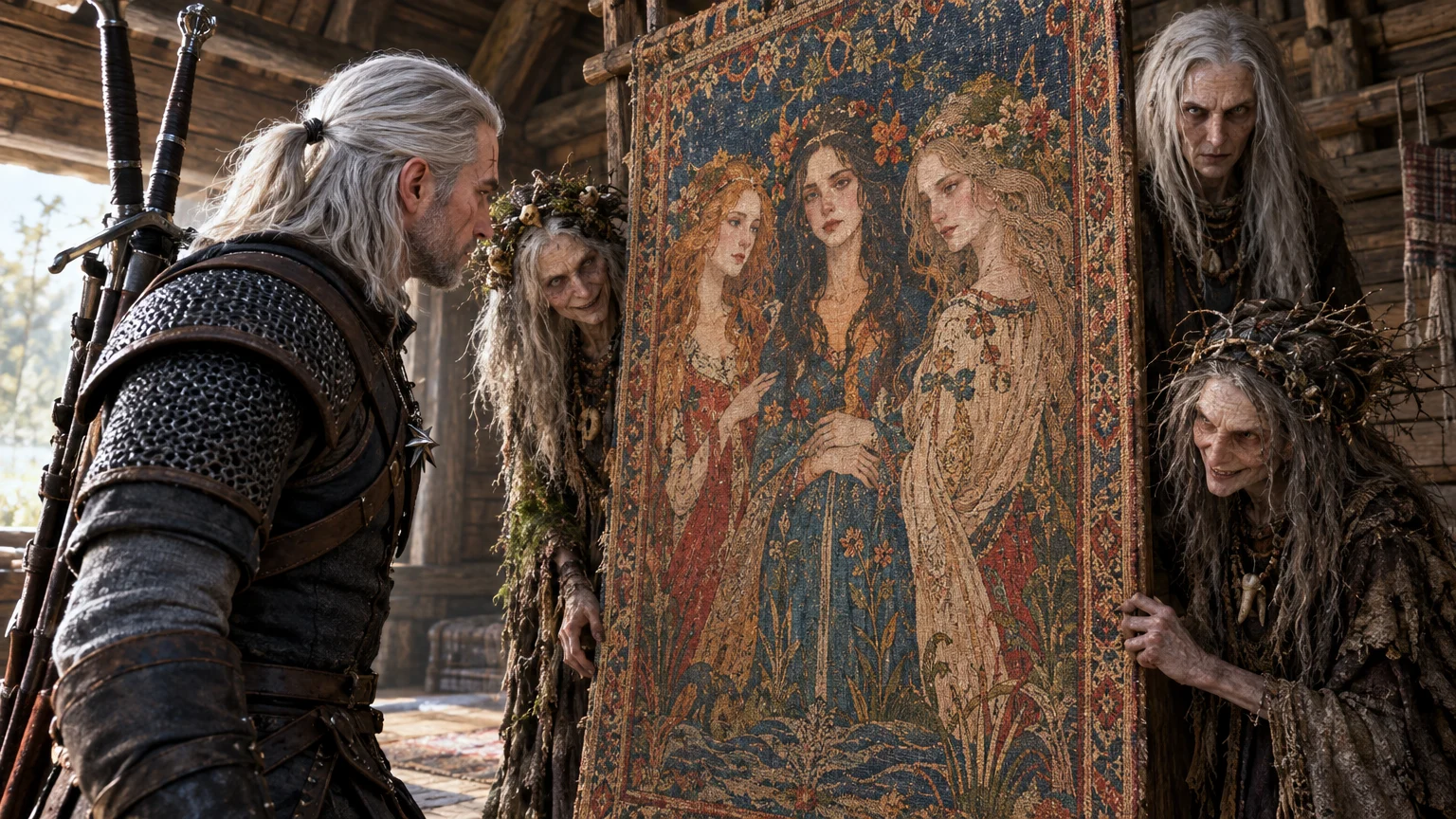
The player must act without possessing a clean moral map. Folkloric dread becomes a structure for choice, uncertainty, and responsibility.
The useful question, then, is not simply whether these monsters are authentic. It is what this new arrangement makes their power mean.
What the Folktale Record Can-and Can’t-Tell Us
Before comparing a game’s witches with “the original folklore,” we need to ask what kind of original survives: a performance, a manuscript, or an edited book?
Alexander Afanasyev’s Russian Folk Tales appeared in eight installments between 1855 and 1863. This landmark collection opened a crowded supernatural world to print readers.
Its materials came through several channels, including Russian Geographical Society manuscripts and contributions from Vladimir Dal. Afanasyev did not personally hear every tale he published.
Collectors, correspondents, and editorial decisions stood between a storyteller’s voice and the printed page. Publication preserved narratives while changing how readers encountered them.
Consider “Vasilisa the Beautiful,” included in Afanasyev’s collection. A persecuted girl enters Baba Yaga’s household carrying a doll inherited from her mother.
The doll helps her complete impossible domestic tasks. Later, the burning eyes of a skull from the witch’s enclosure destroy her stepmother and stepsisters.
Here, supernatural assistance grows from maternal protection, hunger, labor, and household cruelty. Baba Yaga’s danger belongs to a particular story, not a universal character specification.
In another collected tale, commonly translated as “The Magic Swan Geese,” birds abduct a small boy, and his sister pursues them to Baba Yaga’s dwelling.
A stove, an apple tree, and a river offer help; accepting their food becomes crucial during the escape. Rescue depends on reciprocal conduct.
Both tales involve endangered children, but their machinery differs. A modern retelling can select the witch’s house while abandoning the relationships that make it meaningful.
Nor is a wonder tale equivalent to a report of belief. A narrator can tell an impossible adventure without claiming it happened nearby.
Sergei Maksimov’s Unclean, Unknown, and Holy Power, published in 1903, instead gathers accounts of spirits, supernatural dangers, and customary responses, although it too is mediated compilation.
Such material invites different questions: who reported an encounter, where, and under what circumstances? Different source genres preserve different kinds of evidence.
Locality and teller matter because names, actions, and expectations vary. A Russian printed collection cannot stand for every Ukrainian, Polish, Serbian, or Bulgarian tradition.
Responsible comparison therefore identifies a particular text or documented custom. It can trace resemblance and transformation, but cannot recover every vanished performance or establish unchanged ancient belief.
The Witcher’s Folklore Toolkit
Sapkowski’s toolkit includes recognizable fairy tales, but recognition is often bait. Familiar enchantments draw readers toward encounters whose moral terms prove much less comfortable.
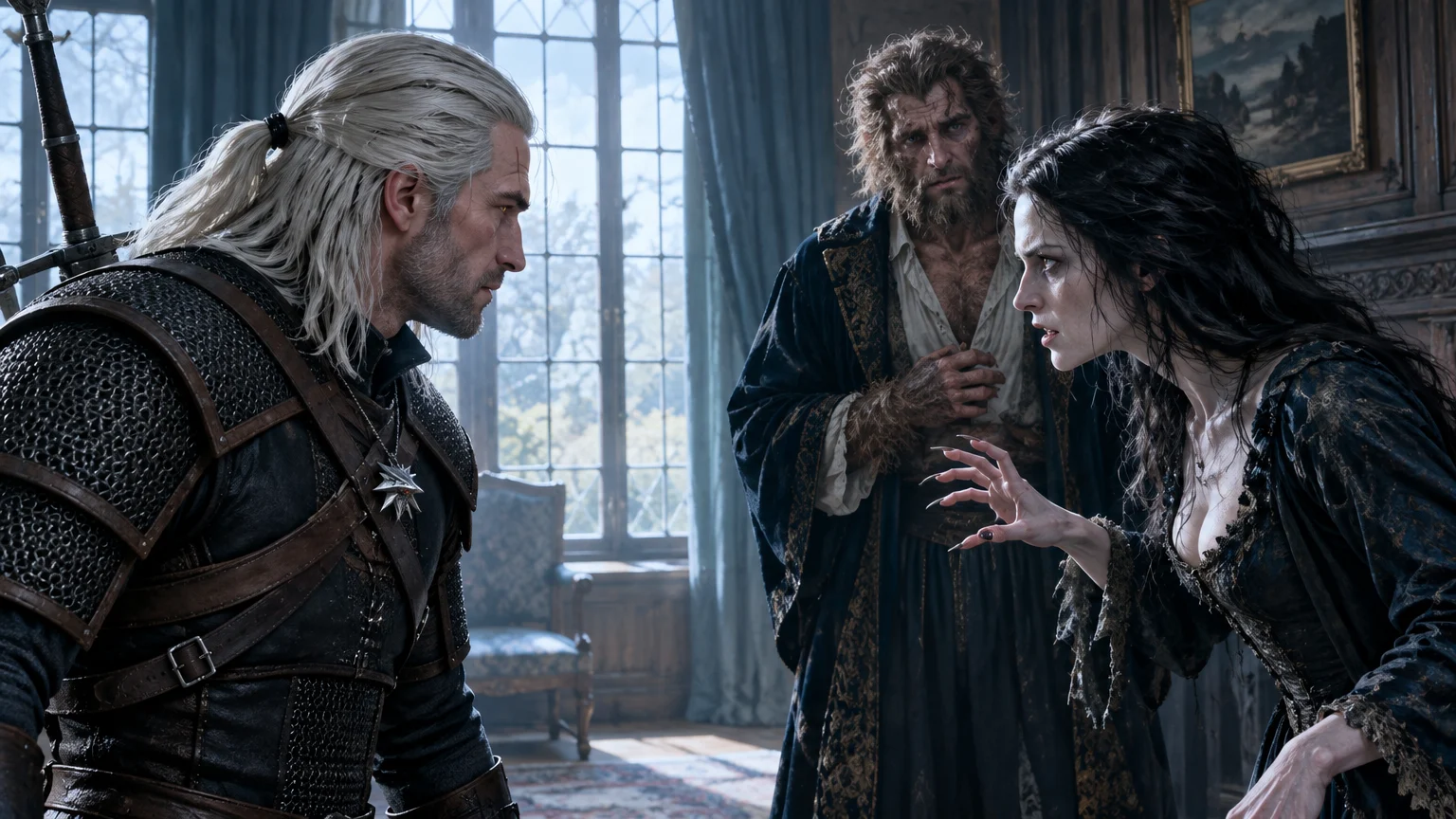
In “A Grain of Truth,” Geralt meets Nivellen, a cursed man living in an isolated mansion. His monstrous appearance initially suggests an enchanted bridegroom.
A useful Russian comparison is Sergei Aksakov’s The Scarlet Flower (1858), a literary rendering of a tale he attributed to his childhood storyteller, Pelageya. It belongs to the wider Beauty and the Beast tradition, rather than representing an exclusively Slavic tale pattern.
There, a merchant takes a flower from a supernatural estate. His youngest daughter subsequently lives with its terrifying master, eventually recognizing the person beneath his appearance.
Her return to the apparently dying creature brings transformation. Affection repairs the separation between frightening exterior and marriageable human identity.
Sapkowski complicates that reassurance. Nivellen’s curse follows his participation in rape and sacrilege; his suffering does not erase the suffering he inflicted.
His companion Vereena is a bruxa, a vampire. During her fight with Geralt, Nivellen impales her; Geralt then beheads her.
Nivellen regains human form, and the ending links the curse’s breaking to Vereena’s love for him, making affection inseparable from the violent confrontation.
The resemblance concerns narrative machinery, not demonstrated borrowing from Aksakov. Both employ an enchanted household and monstrous lover; Sapkowski makes love coexist with predation.
CD Projekt Red’s The Witcher 3 makes a different transformation: a forest spirit becomes the focus of a playable dispute over a community’s traditions.
In the Skellige quest “In the Heart of the Woods,” Harald defends an ancestral relationship with the woodland spirit. Sven demands its destruction.
The creature is a leshen. Following Harald’s proposed response involves offering wolves’ hearts rather than killing it; following Sven’s means hunting it down.
But the hunt also requires identifying a villager marked by the leshen, whose presence would allow it to return. Geralt can urge exile rather than death for that person.
The choice therefore concerns not just how to confront a forest power, but what the community will do to one of its own.
For comparison, Sergei Maksimov’s Russian compilation Unclean, Unknown, and Holy Power records the leshy’s reputation for misleading people in forests.
Turning clothing inside out appears among customary ways of countering such bewilderment. Here, danger involves losing one’s bearings, and knowledge can restore a traveler’s way home.
The game instead supplies a towering, antlered body, combat behaviors, and a bestiary category. These give its forest power a distinctive visual identity and, if the player chooses confrontation, a defined set of combat rules.
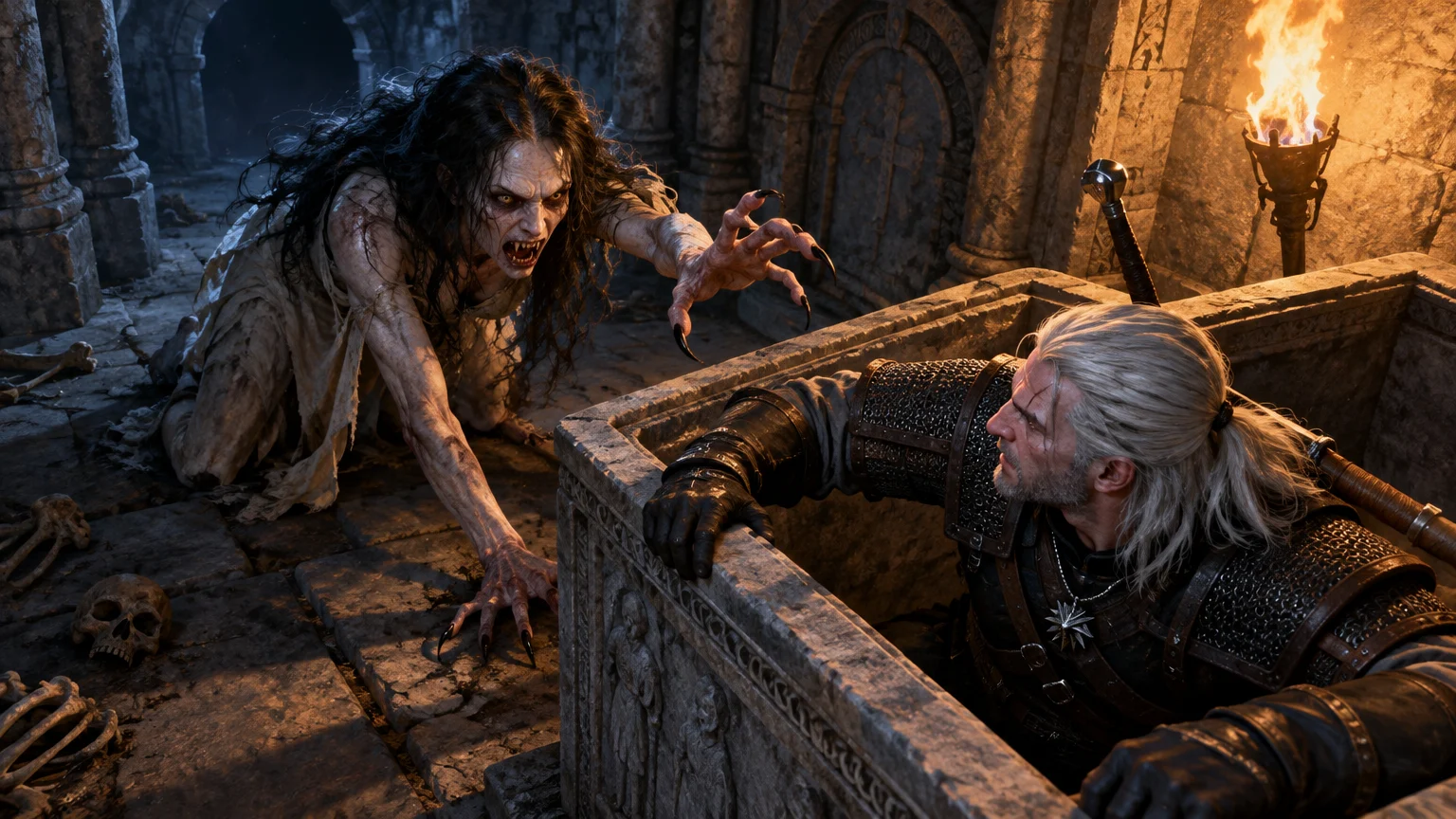 Geralt takes refuge inside the sarcophagus as the striga’s nighttime attack makes survival until dawn a physical struggle.
This Russian evidence neither authenticates fictional Skellige nor explains every feature of the leshen. The comparison reveals changed relationships: customary responses become choices that a professional monster hunter must weigh.
A House Full of Neighbors
The journey home does not end supernatural danger. In Katherine Arden’s The Bear and the Nightingale (2017), home itself depends on unseen neighbors.
Set in a fantastical fourteenth-century Rus’, the novel follows Vasilisa, usually called Vasya, whose ability to see spirits makes ordinary household life extraordinary.
The domovoi belongs to this intimate world. He is not an intruder awaiting a monster hunter, but a presence whose welfare concerns the family.
Small offerings sustain relationships that Vasya recognizes as necessary. Food left for spirits becomes a form of domestic responsibility, not merely picturesque superstition.
There is a recognizable Russian folkloric comparison here. Linda J. Ivanits’s Russian Folk Belief discusses the domovoi among spirits associated with domestic buildings.
Recorded Russian traditions connect him with the stove, household prosperity, and livestock. His favor matters because a household’s security includes its animals.
Accounts of his treatment of horses make that relationship especially tangible: a favored animal might receive care, while a disliked one suffered harassment.
This is protection with conditions, not the unconditional affection of a magical pet. Domestic space contains obligations as well as shelter.
Arden develops that dependence into a communal crisis through Father Konstantin, the priest whose preaching turns villagers against their customary offerings.
As those practices cease, the spirits weaken. What appears to Konstantin as religious correction becomes, within the novel’s supernatural reality, a dangerous dismantling of protection.
His story also involves Medved, the Bear, whose power grows through fear. Private religious anguish consequently acquires consequences for the entire settlement.
Arden makes competing interpretations physically consequential: the beings Vasya sees really exist, while other characters understand them through teachings about demons and salvation.
That certainty belongs to fantasy. Folklore records preserve people’s accounts and explanations; they do not independently verify the novel’s machinery of belief.
The historical distinction matters too. Fourteenth-century Rus’ was already Christian, not a society encountering Christianity for the first time.
Arden dramatizes friction within that Christian world, bringing household custom, ecclesiastical authority, and Vasya’s exceptional perception into a deliberately concentrated conflict.
Nor does later Russian ethnography document every medieval household. It supplies relevant comparisons, not a floor plan for an unchanged, universally Slavic spiritual home.
The adaptation’s achievement is to make neglect frightening: losing these neighbors means discovering how much the apparently ordinary house once asked its inhabitants to maintain.
Koschei Crosses into a New Story
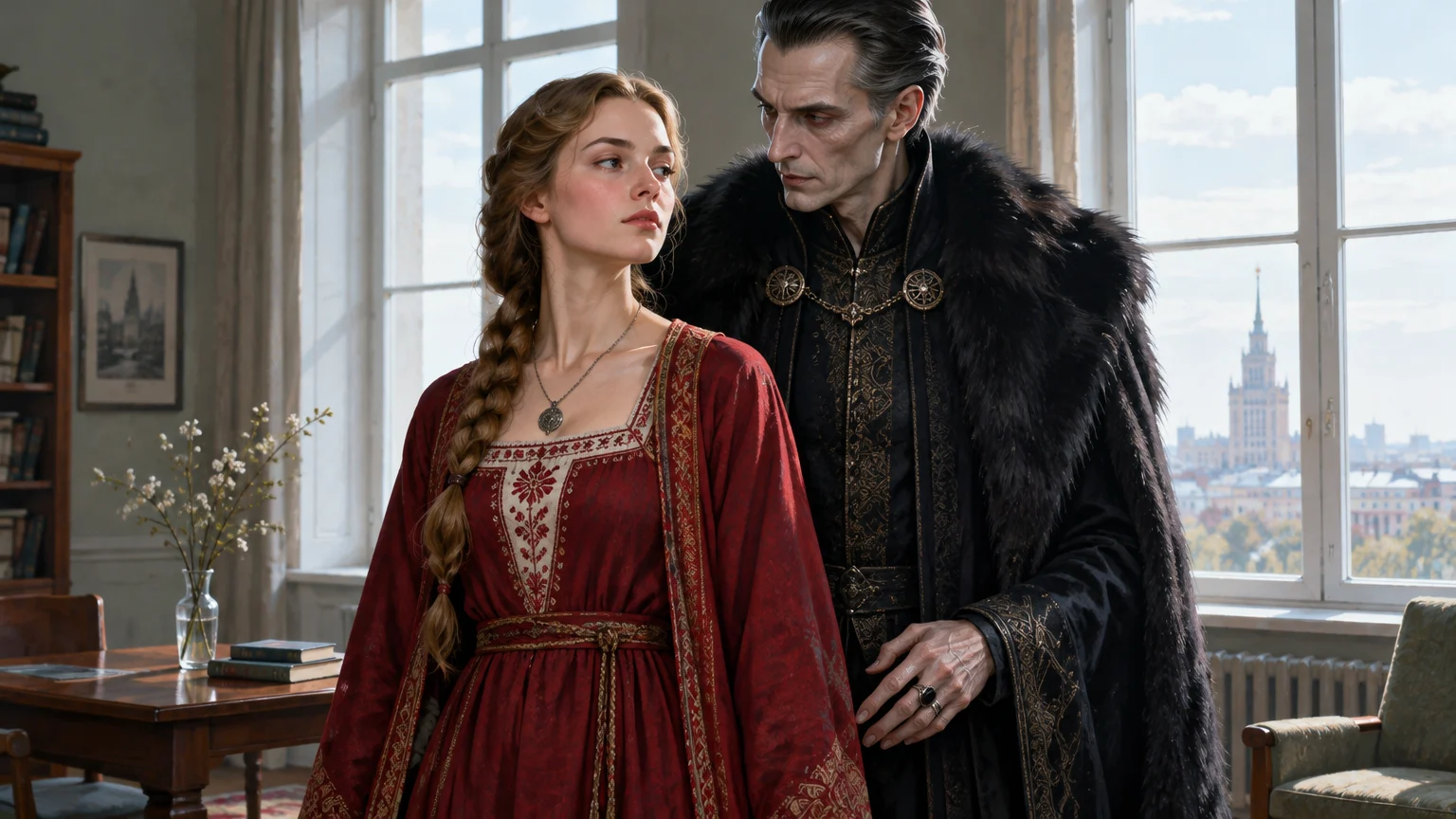
From Arden’s endangered household, Catherynne M. Valente’s Deathless (2011) moves into a stranger marriage: Marya Morevna becomes the bride of Koschei himself.
The change is sharper when set beside “Marya Morevna,” a tale collected by Alexander Afanasyev. There, Marya is a warrior queen who marries Ivan Tsarevich.
Leaving Ivan at home, she forbids him to enter a closet. Inside, he discovers Koschei chained up and begging for water.
Ivan’s pity releases the captive, who recovers his strength and carries Marya away. Compassion becomes catastrophe, setting a rescue story in motion.
Koschei eventually dismembers Ivan, but the husbands of Ivan’s sisters, supernatural bird-bridegrooms, restore him. Rescue depends upon relationships established before the central disaster.
The ending is strikingly physical: Ivan obtains a superior horse through service to Baba Yaga; the animal strikes Koschei dead, and his body is burned.
That is not the same mechanism found in another recorded narrative, “The Death of Koschei the Deathless,” translated in W. R. S. Ralston’s Russian Folk-Tales (1873).
There, Koschei’s death is hidden inside an egg, nested within animals and a chest. Animal helpers make the apparently inaccessible vulnerability reachable.
These stories share an enemy who seems impossible to overcome, but distribute his weakness differently: superior supernatural assistance in one, an externalized death in another.
Valente does not simply transfer either plot into modern prose. She makes the feared abductor a lover and sovereign, the Tsar of Life.
His struggle with the Tsar of Death turns an individual monster’s defeat into an enduring political and cosmic conflict. Immortality becomes a contested dominion.
Marya’s position changes just as decisively. Rather than remaining principally the object of Ivan’s recovery, she occupies the novel’s emotional and narrative center.
Her attachment to Koschei involves desire, discipline, unequal power, and resistance. The reader must inhabit a relationship that a rescue tale organizes around escape.
Valente also brings this marriage into twentieth-century Russia, ultimately confronting the starvation and devastation of besieged Leningrad. Historical mass death unsettles fairy-tale promises.
The result is not an unchanged ancient Koschei wearing Soviet clothes. It is a deliberate literary reconstruction, asking what deathlessness could mean where ordinary survival becomes extraordinary.
From Storytelling to Player Choice
Valente makes readers inhabit a transformed fairy tale. The Witcher 3: Wild Hunt adds another demand: interpretation must become a decision, sometimes before certainty arrives.
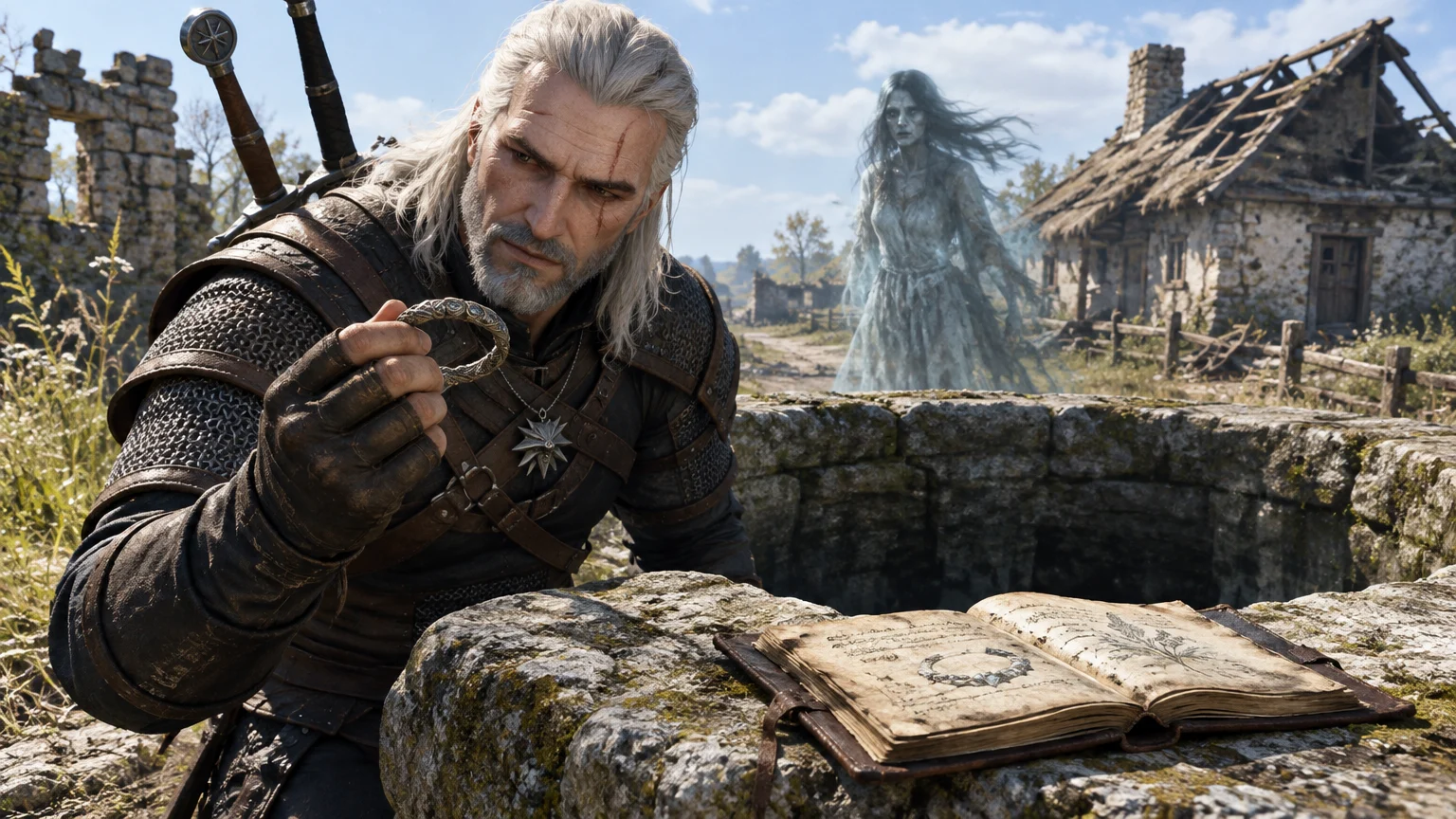
In “Devil by the Well,” Geralt investigates a noonwraith haunting an abandoned settlement in White Orchard. The encounter begins with questions, not sword strokes.
A diary, a corpse, and a bracelet recovered from the well reconstruct a woman’s violent death. Searching turns an apparent monster problem into remembered human injury.
Recovering and burning the remains with the bracelet draws the noonwraith into a confrontation. Geralt’s Yrden sign helps make the spectral enemy vulnerable.
The quest thus joins two kinds of competence: understanding an unfinished history and manipulating combat systems. Compassion alone cannot complete the contract; neither can indiscriminate aggression.
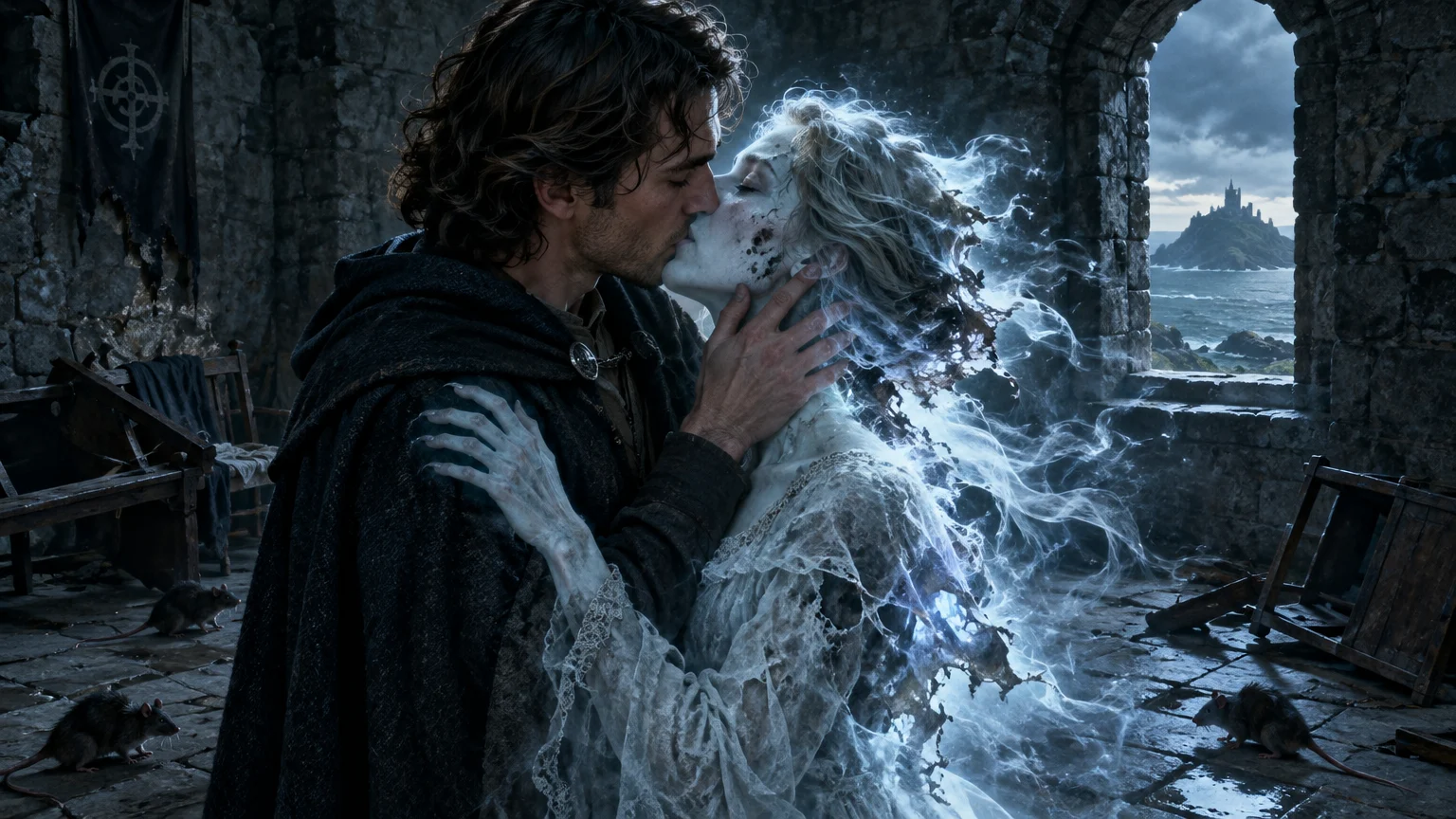
“A Towerful of Mice,” set on Fyke Isle, makes interpretation more treacherous. Geralt’s magic lamp reveals ghostly scenes within a tower scarred by violence.
There he encounters Anabelle, who describes a horrifying death involving rats after a sleeping potion left her unable to move. Her account solicits rescue.
If Geralt trusts her and carries her bones to her lover Graham, the apparent act of reunion releases a plague maiden and Graham dies.
If he challenges her story, another route brings Graham to the tower. Graham’s kiss breaks the curse, but costs him his life.
Neither outcome makes investigation a guarantee of safety. The player must decide whether a suffering speaker deserves belief, while the consequences remain partly concealed.
This differs from receiving a collected folktale whose sequence, however surprising, has already been fixed in print. Here, interpretation helps select the sequence itself.
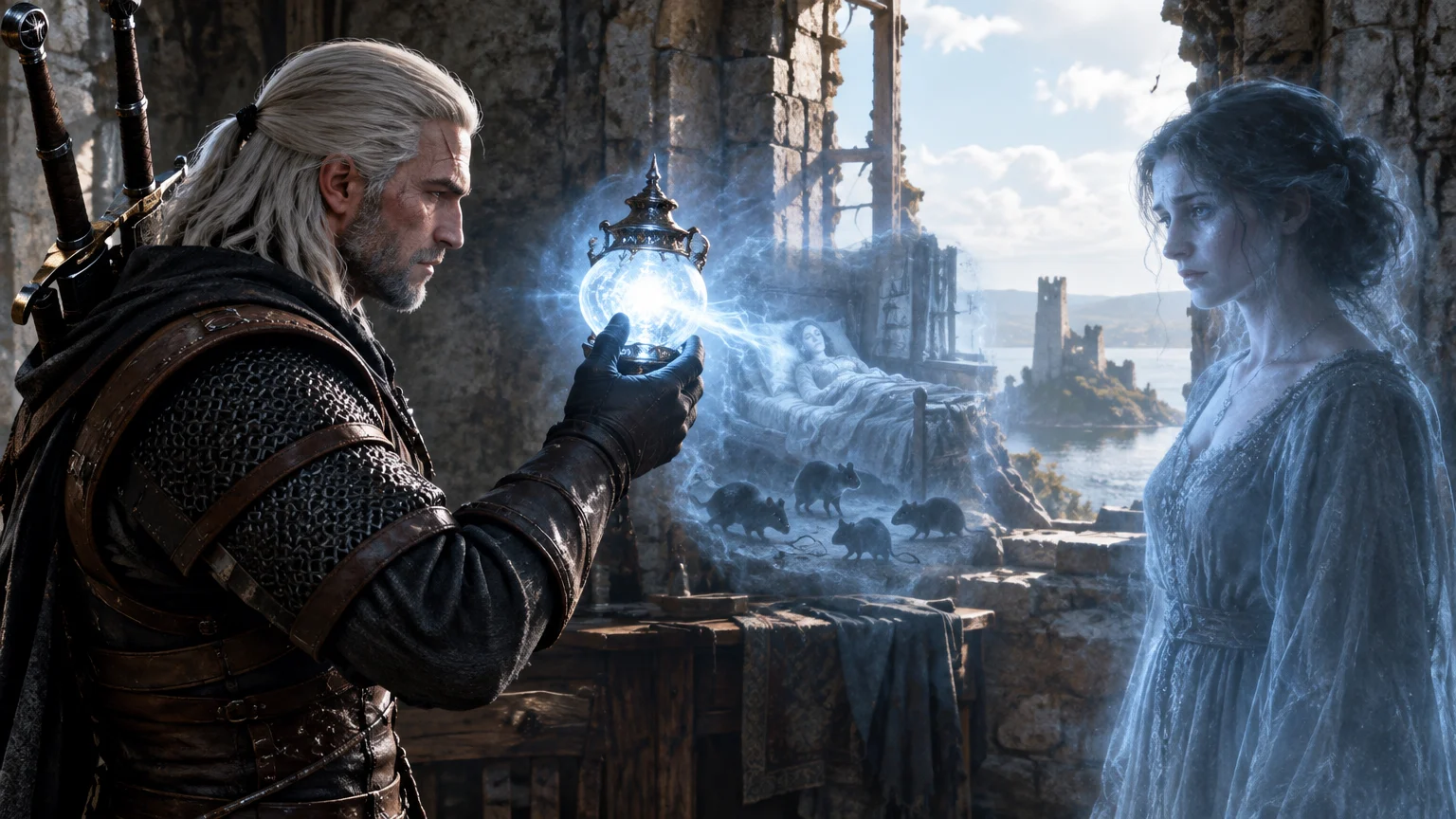 On Fyke Isle, Geralt’s magic lamp reveals a ghostly memory as Anabelle’s account turns investigation into a choice about belief.
Belief accounts serve another purpose: they may report an encounter as credible, explain local danger, or communicate protective knowledge without resolving every uncertainty.
As one source guide emphasizes, different kinds of records require attention to their medium. A remembered encounter and a playable quest make different demands on their audiences.
These comparisons do not establish that particular mechanics descend from folklore. They show how adaptation reorganizes supernatural uncertainty into clues, objectives, choices, and consequences.
The ghost becomes someone to investigate, believe, release, or fight. What changes is not merely the creature’s appearance, but the audience’s responsibility for what happens next.
The Cost of Calling It ‘Authentic’
Once interpretation becomes a player’s responsibility, “authenticity” needs a sharper definition. Fidelity to a creature’s name does not guarantee fidelity to its earlier significance.
A game can preserve a recognizable supernatural figure while changing the encounter into a problem with discoverable causes and selectable outcomes.
A novel can retain household spirits while giving them a continuous place in one heroine’s development. Neither transformation is automatically a betrayal.
The difficulty begins when a creative synthesis is presented as an unchanged inheritance, or when “Slavic” substitutes for naming a particular tradition.
Consider two records outside the fairy-tale collection. The Primary Chronicle preserves material about medieval Rus’; Helmold of Bosau’s Chronica Slavorum concerns Western Slavs.
Both belong to Christian historical writing, not to a single indigenous book of monsters. Their geographical and authorial settings matter to interpretation.
A regional resource catalogue distinguishes these chronicles and recommends reading historical testimony alongside archaeology, with attention to authors’ biases.
That distinction changes the reader’s question. A reference to Rus’ does not explain every Polish, Czech, Serbian, or Bulgarian supernatural tradition.
Nor does a medieval chronicle answer the same questions as a nineteenth-century tale collection. Source selection already shapes the past an adaptation can imagine.
A practical standard therefore begins with which tradition? Ask for a region, language, community, or identifiable body of stories, rather than continental atmosphere.
Then ask whose record? A chronicler, collector, translator, and contemporary novelist occupy different positions. Each selects material and makes some relationships easier to see.
Finally ask what transformation? Look beyond appearance toward narrative function: who receives sympathy, who speaks, and what kind of ending becomes possible.
In Deathless, marriage organizes the encounter with Koschei. In The Bear and the Nightingale, Vasya’s perception binds supernatural neighbors to her unfolding life.
Those are literary structures, not merely containers for folklore. Likewise, a Witcher quest must accommodate investigation and action in ways a reported encounter need not.
The reward of comparison is not a verdict separating pure originals from contaminated copies. It is a clearer view of creative decisions.
Retellings need not reproduce an untouched past to matter. They become more interesting when their inventions remain visible beside the particular traditions they transform.
Further Reading
Folklore and belief: the texts behind the comparisons
Alexander Afanasyev’s tale collections include “Vasilisa the Beautiful” and “Marya Morevna”; titles and selections vary between translations. W. R. S.
Ralston’s Russian Folk-Tales (1873) includes “The Death of Koschei the Deathless.” For scholarly discussion of household and other spirits, consult Linda J. Ivanits’s Russian Folk Belief.
Read these as distinct kinds of evidence, not interchangeable accounts of a single Slavic mythology.
Modern retellings discussed in this article
Read Andrzej Sapkowski’s “A Grain of Truth” in The Last Wish, Katherine Arden’s The Bear and the Nightingale (2017), and Catherynne M. Valente’s Deathless (2011) for the literary comparisons.
CD Projekt Red’s The Witcher 3: Wild Hunt supplies the playable encounters, particularly “Ladies of the Wood,” “In the Heart of the Woods,” “Devil by the Well,” and “A Towerful of Mice.” These works are primary material for examining modern adaptation, not evidence of historical belief.
Slavic Mythology Source Guide | Mythic Archive
An introductory guide to chronicles, oral traditions, and other evidence for Slavic mythology.
Useful for distinguishing the source genres discussed in this article.
Source: https://mythicarchive.org/articles/slavic-source-guide
Resources | Books and Media on Slavic Native Faith
A resource catalogue on Slavic Native Faith and Rodnovery.
When following its recommendations, distinguish evidence for historical practices from modern religious interpretations and reconstructions.
Source: https://slavicnativefaith.com/resource-list/
The Primary Chronicle and Slavic Paganism | Mythologis
A modern introduction to the Primary Chronicle, compiled in early twelfth-century Rus’.
The chronicle preserves important accounts of pre-Christian worship through a Christian historical perspective; it is not a comprehensive record of Slavic religion or monster folklore.
Source: https://mythologis.com/mythologies/europe/slavic/texts/primary-chronicle-slavic-paganism
Slavic Sacred Texts: The Complete Guide | Mythologis
An index currently listing an introductory article on the Primary Chronicle.
Despite its title, this is not a complete collection of Slavic religious texts, nor does the chronicle constitute an indigenous sacred canon.
Source: https://mythologis.com/mythologies/europe/slavic/texts
The Essential Slavic Mythology Reading List: 15 Books That Go Beyond Wikipedia | Dark Slavic Lore
A popular reading guide beginning with Afanasyev’s tale collections and extending to scholarship and fiction.
Use it to discover titles, while keeping collected tales, historical testimony, scholarly interpretation, and modern retellings distinct. Its suggestion that storytellers unknowingly preserved theology should not be treated as proof of direct continuity from pre-Christian religion.
Source: https://darkslaviclore.com/myths/slavic-mythology-books
Migrations in the Slavic Cultural Space. From the Middle Ages to the Present Day | University of Łódź Press
An edited volume by Zofia A.
Brzozowska, Piotr Kręzel, and Izabela Lis-Wielgosz on migration in Slavic cultural contexts. Broader background reading rather than a direct source for the monster traditions or adaptations examined here.
Source: https://doi.org/10.18778%2F8331-033-6.13
Sergei Maksimov, Leshy (1903)
Chapter in Unclean, Unknown, and Holy Power, pp. 68–77. Original Russian text, including the instructions for turning clothing inside out.
Sergei Aksakov, The Scarlet Flower (1858)
Original Russian literary tale attributed by Aksakov to the storyteller Pelageya. Direct comparison for the Nivellen chapter.
Explore Related Beasts
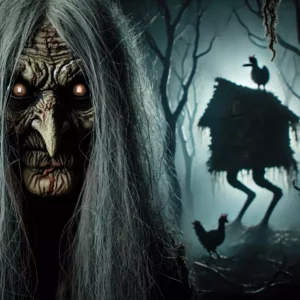 Baba YagaA witch from Slavic folklore who lives in a hut on chicken legs, known for her vast magical powers.
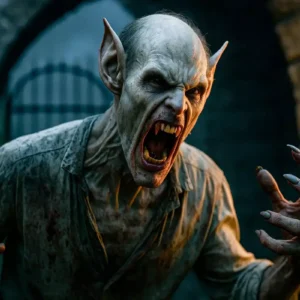 VampireA fearsome undead being from Eastern European folklore, the Vampire feeds on life essence. It is tied to dark…