
The Odyssey: A Journey Home That Took Ten Years
Odysseus spends ten years trying to return to Ithaca after the ten-year Trojan War. For Penelope, his wife, and Telemachus, the son he left behind, that means twenty years without him.
Yet Homer’s Odyssey does not begin with Troy’s destruction or a departing fleet. Its opening finds Odysseus stranded on Calypso’s island, while his household faces a crisis he cannot see.
On Ithaca, suitors compete to marry Penelope, feasting at the household’s expense and consuming its livestock and wine. Odysseus’s uncertain fate has left his marriage, property, and authority dangerously exposed.
Athena asks Zeus to help the absent hero, then visits Telemachus in disguise. She urges him to challenge the suitors and seek news from men who fought alongside his father.
The poem’s first four books largely follow Telemachus, including his visits to Nestor at Pylos and Menelaus and Helen at Sparta. His search connects Ithaca’s troubles with other survivors’ experiences of Troy.
Only in Book 5 does the narrative turn directly to Odysseus. Hermes delivers Zeus’s command that Calypso release him; she has detained him for years, offering immortality while he longs for home.
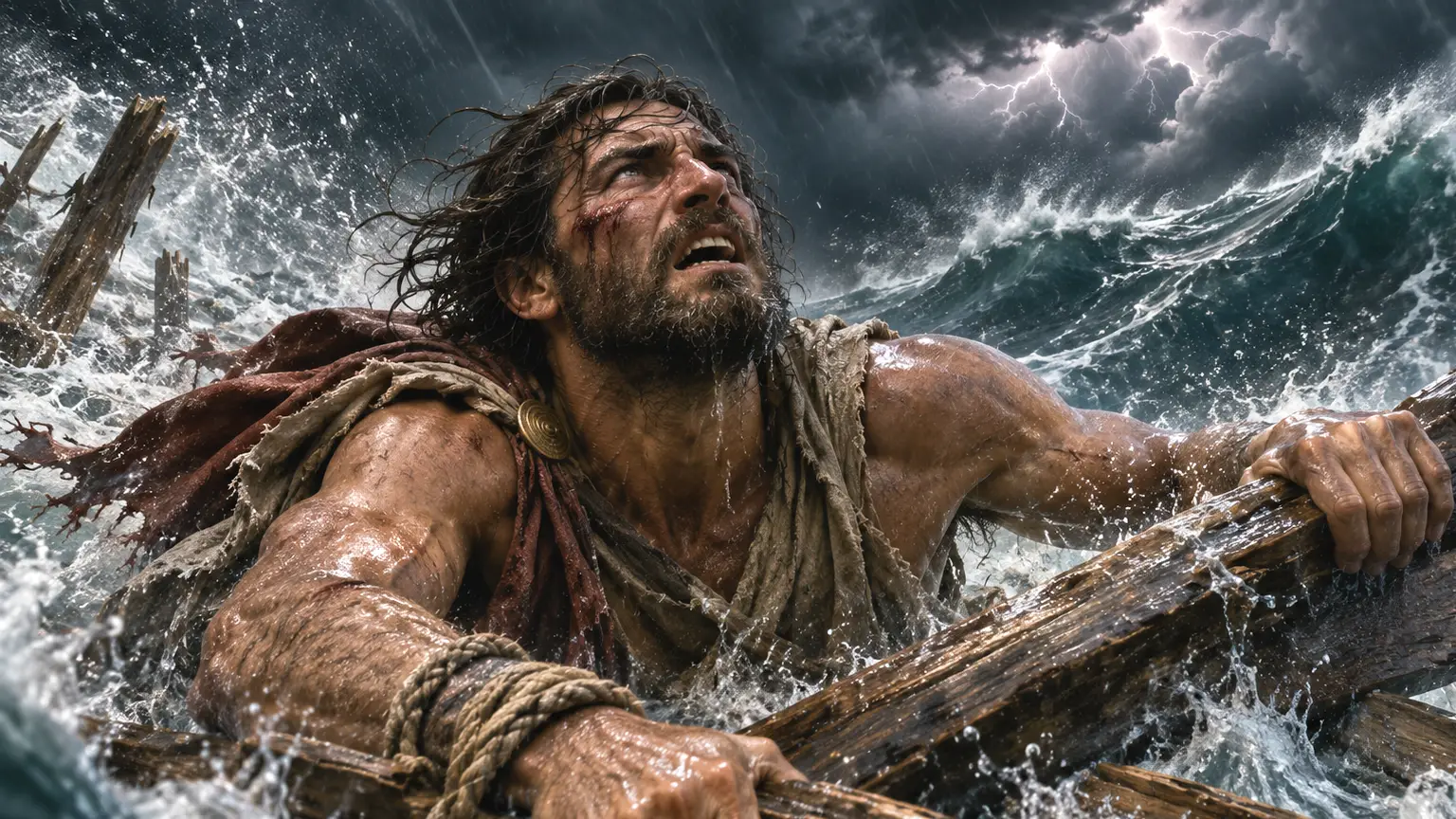
His departure does not end his suffering. Poseidon wrecks his raft, and Odysseus reaches the land of the Phaeacians, where the princess Nausicaa helps him approach the royal household.
There, the singer Demodocus performs stories about Troy. Odysseus weeps, eventually reveals his identity, and recounts his earlier adventures to King Alcinous and Queen Arete.
Much of the famous journey therefore arrives as retrospective narration.
Books 9–12 contain his account of the Cyclops, Circe, the dead, and the Sirens. By the time readers hear these episodes, they already know their devastating outcome: Odysseus has lost every companion.
The Phaeacians finally carry him to Ithaca, but arrival is not restoration. Disguise, recognition, Penelope’s judgment, and conflict with the suitors occupy the remaining narrative, making homecoming a struggle to recover relationships and power.
This structure matters when asking what lies behind the poem. Recognizable places, seafaring, households, and memories of warfare coexist with divine intervention and marvelous adventures.
Their combination demands historical investigation, not treatment as one sailor’s factual itinerary.
Did the Odyssey Really Happen?
Troy’s excavated walls at Hisarlık, in northwestern Turkey, establish the existence of a substantial Bronze Age city, not the historical accuracy of Homer’s war. Archaeology illuminates parts of the poem’s distant setting but identifies no expedition matching Odysseus’s homecoming.
The site contains successive settlements built over earlier ruins. Troy VI possessed imposing stone fortifications, while its destruction around 1300 BCE may have resulted from an earthquake, although the evidence does not settle every detail of its collapse.
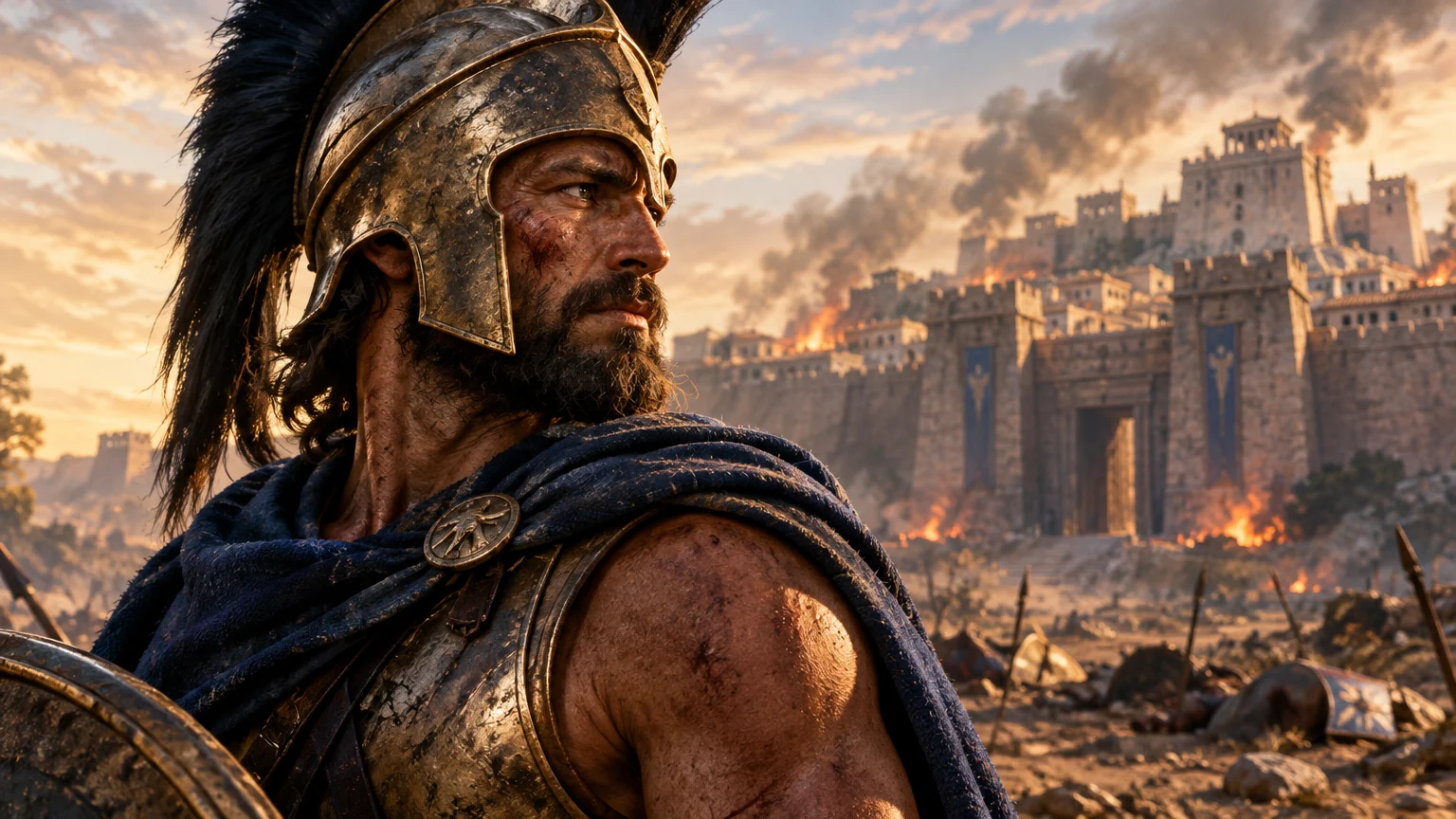
Troy VIIa reused those defenses and contained closely packed houses with storage jars sunk into floors. Its fiery destruction around 1190 BCE makes it another candidate for a remembered conflict, without identifying the attackers or establishing the circumstances of a siege.
Neither destruction layer supplies evidence of Agamemnon’s army or the wooden horse. Even proof of warfare would not establish the coalition, motives, duration, or outcome preserved in Greek epic, whose narrative combines legendary individuals with potentially recognizable geographical locations.
Hittite diplomatic records offer an independent perspective on western Anatolia. A treaty involving Alaksandu, ruler of Wilusa, provides evidence of a kingdom widely associated with Troy.
His name resembles Alexandros, another name for Paris, but the resemblance establishes no historical identity.
The thirteenth-century BCE Tawagalawa Letter addresses relations between the Hittite kingdom and Ahhiyawa, commonly connected with the Mycenaean Greek world. It refers to a previous dispute involving Wilusa and reveals a complex diplomatic landscape that extended across the Aegean.
The letter’s author, usually identified as Hittite king Hattusili III, also complains about the activities of Piyamaradu, a political figure operating in western Anatolia. Scholars debate the diplomatic implications, but the correspondence does not describe Homer’s Trojan War or identify its legendary participants.
Across the Aegean, Linear B tablets from Pylos document an actual palace economy before its destruction around 1200 BCE. They record livestock, textiles, landholding, offerings, and personnel under an administration headed by a wanax, a title inherited in later Greek epic.
These records reveal organized labor and concentrated resources behind the age later remembered through heroic kings. They do not identify Homer’s Nestor, and the palace administration they describe cannot simply be equated with the household politics portrayed in the Odyssey.
Ithaca presents a different problem. The modern island preserves the ancient identification, but reconciling its geography with every Homeric description remains difficult, particularly the island’s position relative to its neighbors in Book 9.
One alternative places Homeric Ithaca on Paliki, a peninsula of neighboring Cephalonia. The proposal requires an ancient sea channel separating Paliki from the larger island, followed by geological changes that transformed the former island into a peninsula.
However, a 2011 geological investigation found that the available landforms and geomorphological evidence contradicted the proposed channel. The study challenges a central requirement of the Paliki identification, although literary interpretation and the broader location debate remain separate questions.
A real city, documented political rivalries, and a particular traveler’s adventures require different kinds of evidence. These discoveries help reconstruct the historical worlds remembered and transformed by the poem, but none establishes that Odysseus undertook the journey Homer describes.
Who Was Homer, and Who Told the Story First?
In Odyssey Book 8, Demodocus sings about the wooden horse while Odysseus listens and weeps. The hero hears his own past transformed into public song, an image of heroic tradition circulating through performance.
Another singer, Phemius, performs in Odysseus’s household. In Book 22, he pleads that the suitors compelled his attendance.
Together, these figures present poetry as skilled work shaped by patrons, audiences, and political vulnerability.
“Homerus” is simply the Latin form of Homer’s Greek name, Homēros, not a different author. Whether that name identifies one monumental composer or a more complicated history of composition remains debated.
No surviving evidence identifies the first teller of Odysseus’s homecoming. The Odyssey draws on inherited heroic traditions, but their earlier performances cannot be reconstructed as a complete sequence of versions.
Scholars commonly place the Odyssey’s major composition in the late eighth or early seventh century BCE, although some favor a later seventh-century date. This places the poem several centuries after the late Bronze Age setting traditionally associated with the Trojan War.
That chronological distance matters because Homeric poetry preserves different historical layers. Memories of Mycenaean palace society coexist with descriptions of households, assemblies, religious practices, and social relationships familiar from the early Greek communities in which epic poetry developed.
The result is neither an eyewitness record of the thirteenth century BCE nor a complete portrait of eighth-century Greece. Homer’s heroic world draws upon an inherited past while incorporating elements that later audiences would have recognized from their own lives.
Herodotus, writing in the fifth century BCE, placed Homer and Hesiod about four hundred years before his own lifetime. This was retrospective chronology, not contemporary testimony establishing either poet’s birth or the composition dates of their works.
Later biographical traditions supplied competing birthplaces, including Smyrna and Chios, and stories of Homer’s blindness. Such accounts reveal ancient communities claiming the poet rather than furnishing a securely recoverable biography.
An influential explanation of Homeric craftsmanship begins with patterned language. Repeated descriptions such as “resourceful Odysseus,” alongside familiar sequences of feasting, welcoming visitors, and preparing ships, provided reusable resources for composing and performing hexameter poetry.
In the twentieth century, Milman Parry and Albert Lord investigated South Slavic singers who composed lengthy traditional epics through performance. Their work demonstrated how established phrases, narrative patterns, and inherited material could support creative composition without requiring memorization of fixed texts.
Those performers were not surviving ancient Greeks. Their traditions offered a comparative model for understanding Homeric language, allowing scholars to investigate how an exceptional poet might work within a body of material transmitted across generations.
The relationship between oral composition and writing remains disputed. Greek alphabetic writing developed during the eighth century BCE, but scholars cannot establish whether the Odyssey first reached its monumental form through oral performance, dictation, writing, or a combination of these practices.
Its eventual written transmission presents another question. Early Homeric papyri sometimes preserve additional lines or alternative readings, showing that ancient copies did not always reproduce identical texts even after the poem had become widely known.
At Alexandria, scholars including Aristophanes of Byzantium and Aristarchus compared readings and marked disputed verses. Their work shaped later textual transmission, but the poem’s composition, first recording, and subsequent editorial development belong to different historical stages.
When the Gods Take Sides
Athena’s advocacy and Poseidon’s hostility make divine power personal, but never simple. In Odyssey Book 1, Athena urges Zeus to remember Odysseus, detained on Calypso’s island despite his earlier offerings.
In Book 5, Zeus sends Hermes to order his release. Yet Poseidon subsequently wrecks Odysseus’s raft, punishing the man who blinded his son Polyphemus.
Divine permission to return does not guarantee safe passage.
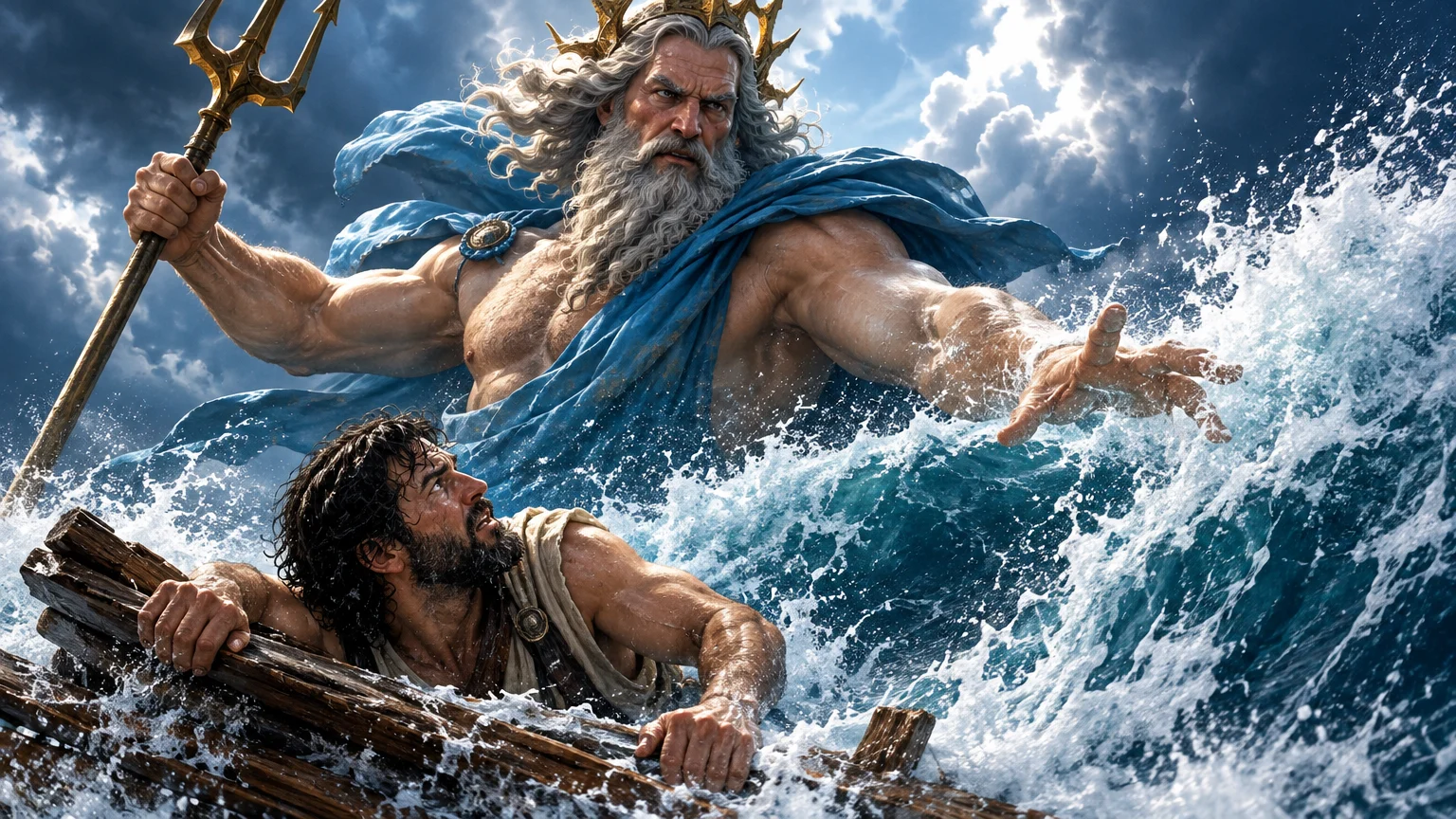
These competing loyalties give suffering a supernatural explanation without making the gods a single moral authority. Athena favors Odysseus’s resourcefulness; Poseidon pursues a family grievance that endangers the same hero.
Human worship operates through more regular obligations. In Book 3, Telemachus reaches Pylos while Nestor’s community sacrifices bulls to Poseidon. The hostile god of Odysseus’s voyage receives honorable worship elsewhere.
Nestor’s son Peisistratus welcomes the visitors into the ceremony, offering sacrificial meat and wine for a libation. Athena, disguised as Mentor, prays to Poseidon before passing the cup to Telemachus.
Sacrifice joins prayer, offerings and shared consumption. Fat-wrapped thighbones burn for the deity, while participants eat other portions: honoring a god also creates a human gathering structured by hospitality and distribution.
The swineherd Eumaeus maintains similar obligations within a humbler household. In Book 14, he welcomes the disguised Odysseus, explaining that strangers and beggars belong under Zeus’s protection.
When Eumaeus sacrifices a pig, he prays for his absent master’s return. He divides the meat into seven portions, setting one aside for the nymphs and Hermes and honoring his guest with the chine.
Such actions express xenia, the reciprocal obligations linking hosts and guests. Food, shelter and respectful treatment precede knowing a visitor’s identity; vulnerability itself gives the stranger a claim upon the household.
Epic therefore connects extraordinary divine interventions with recognizable religious duties. Its ceremonies illuminate Greek expectations about generosity and reverence, but its quarrelling gods do not constitute a handbook of uniform belief or practice.
Monsters, Enchantment and the Price of Knowledge
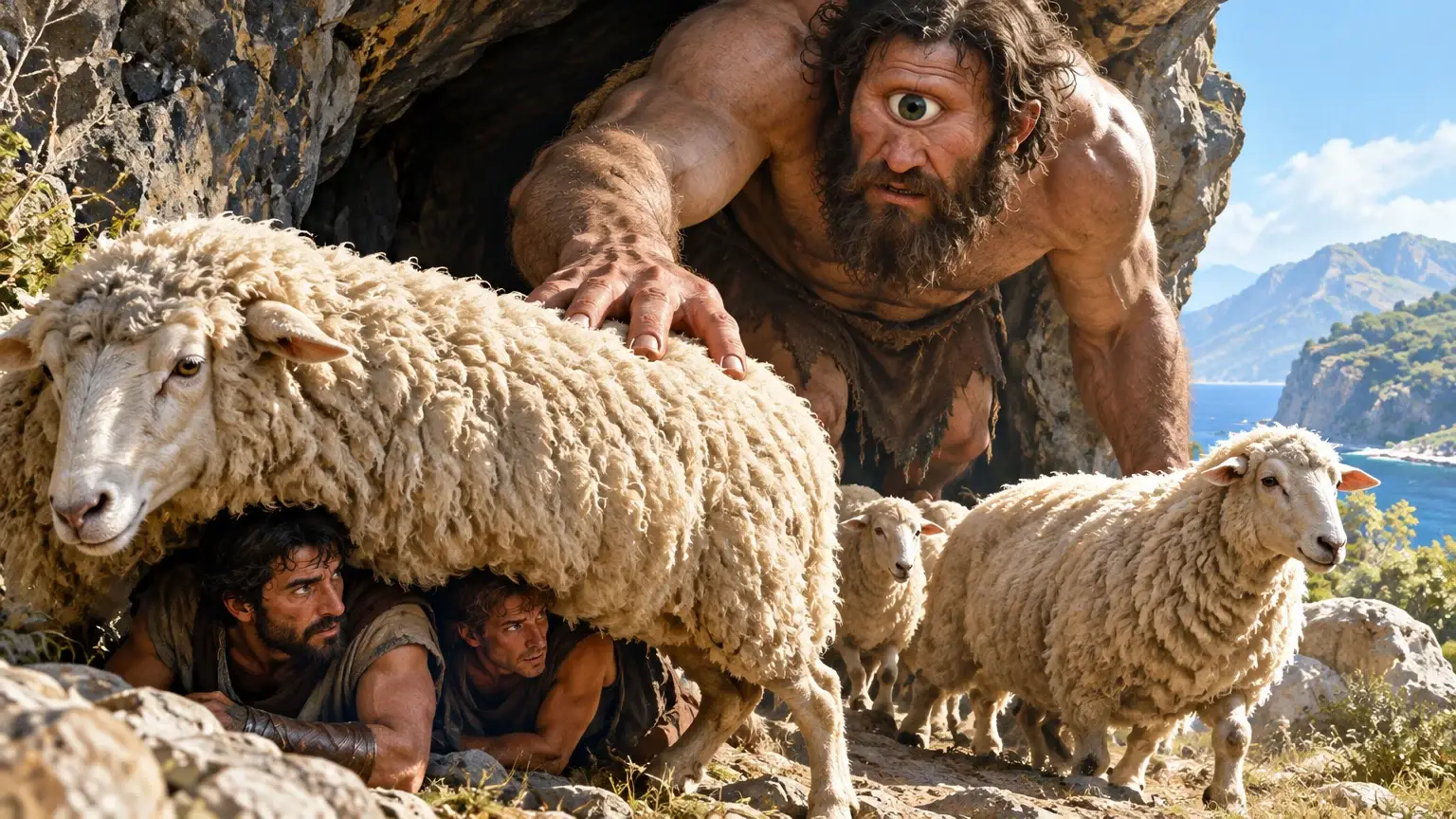
Hospitality becomes a deadly test in Book 9, when Polyphemus imprisons Odysseus and devours his companions. Odysseus blinds the Cyclops after intoxicating him, then escapes beneath the monster’s sheep.
Calling himself “Nobody” initially defeats Polyphemus’s appeals for help. But Odysseus subsequently boasts his real name, allowing the Cyclops to ask his father, Poseidon, to punish an identifiable enemy.
In Book 10, Circe turns another group of companions into pigs while preserving their human minds. Hermes gives Odysseus the protective plant moly and instructions for confronting her enchantment.
Odysseus secures their restoration, but Circe’s hospitality delays departure for a year. She then directs him toward the dead: homecoming requires knowledge unavailable through courage or cleverness alone.
At the boundary of the underworld in Book 11, sacrificial blood enables consultation with the dead. Tiresias warns against harming Helios’s cattle and foretells a troubled return.
Odysseus also encounters his mother, Anticleia, who died grieving his absence. Three failed attempts to embrace her make the journey’s cost intimate: survival cannot restore everyone he has lost.
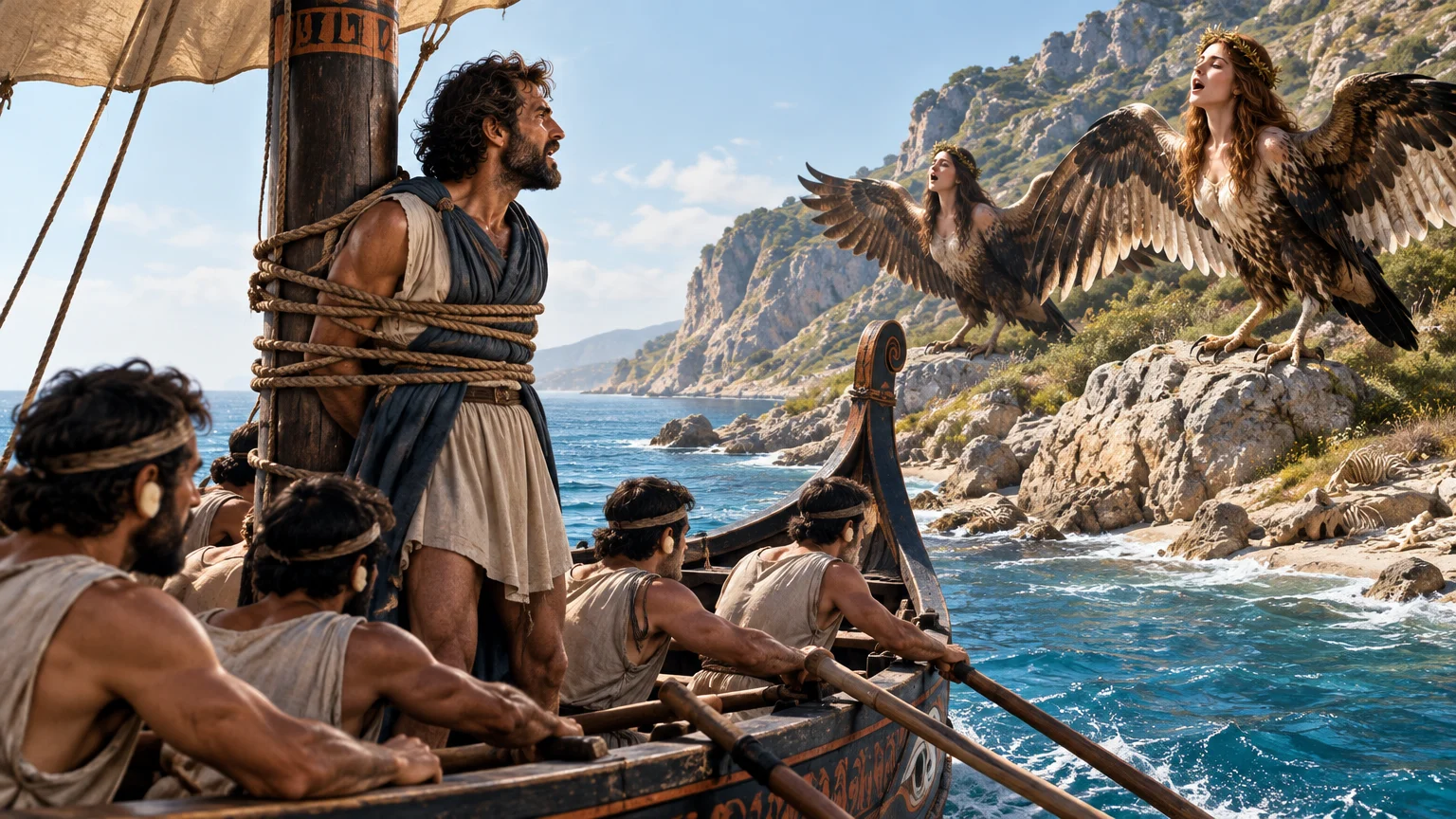
In Book 12, the Sirens promise knowledge of Troy and everything happening upon the earth. Following Circe’s instructions, Odysseus hears them while bound to the mast; his crew’s ears are stopped with wax.
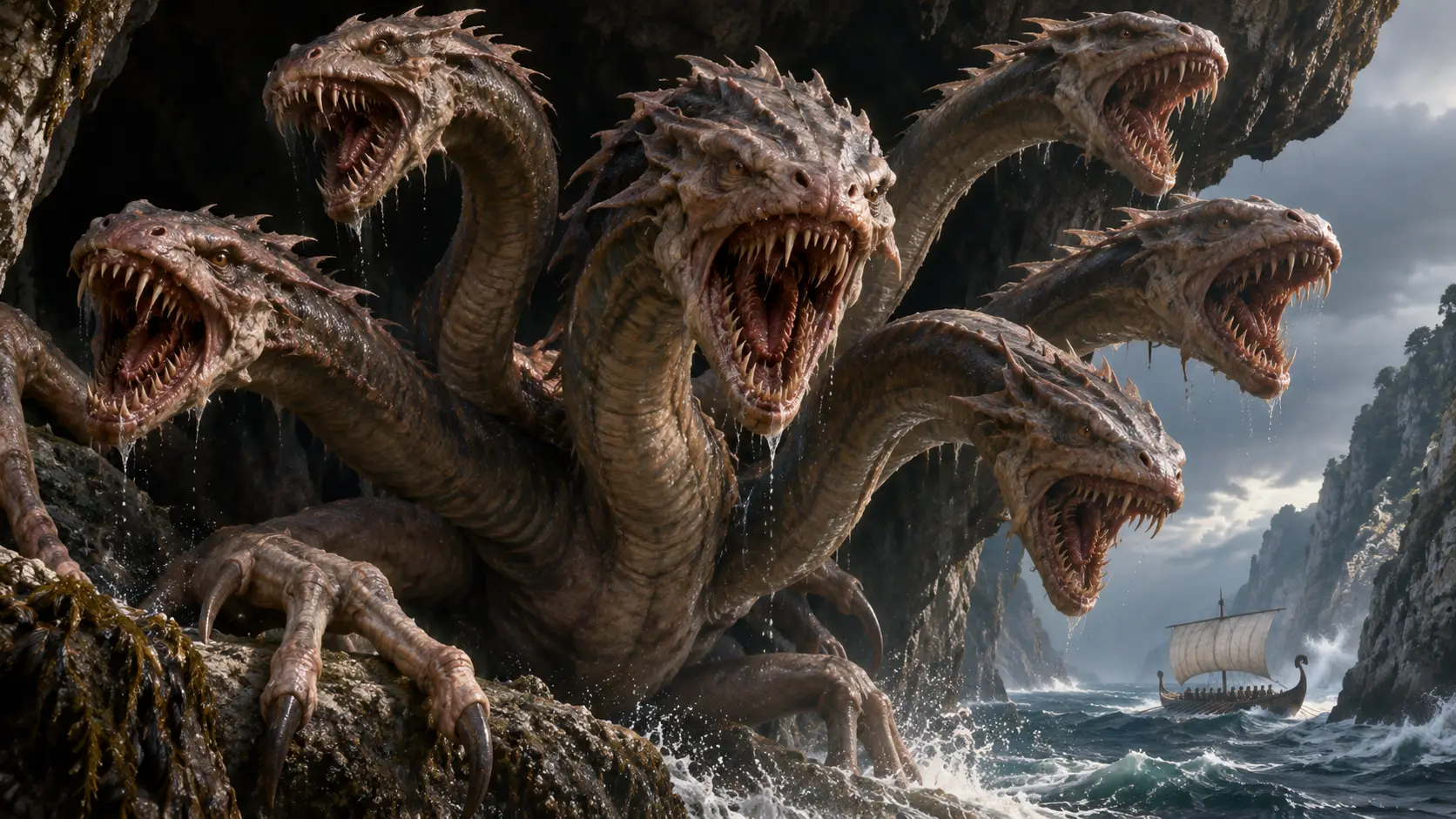
Knowledge here depends upon accepting restraint. The next passage demands a harsher compromise: following Circe’s advice, Odysseus steers nearer Scylla than Charybdis, sacrificing six companions rather than risking everyone.
On Helios’s island, hunger finally defeats obedience. While Odysseus sleeps, Eurylochus persuades the starving crew to slaughter the forbidden cattle, preferring that risk to death through starvation.
Helios demands retribution, and Zeus subsequently destroys their ship with a thunderbolt. Odysseus alone survives, escaping Charybdis again by clinging to a fig tree before recovering floating wreckage.
He eventually reaches Calypso’s island without his companions. These encounters make cunning indispensable but insufficient: pride invites divine hostility, warnings demand endurance, and one survivor’s homecoming becomes inseparable from collective loss.
Ithaca: Who Pays for the Happy Ending?
On Ithaca, survival becomes a struggle over who belongs within the restored household. Odysseus’s reunion with Telemachus in Book 16 joins genuine tenderness to preparations for killing the suitors.
Athena removes his beggar’s disguise, but Telemachus initially mistakes his transformed father for a god. Once convinced, father and son weep together, then plan how to overcome their enemies.
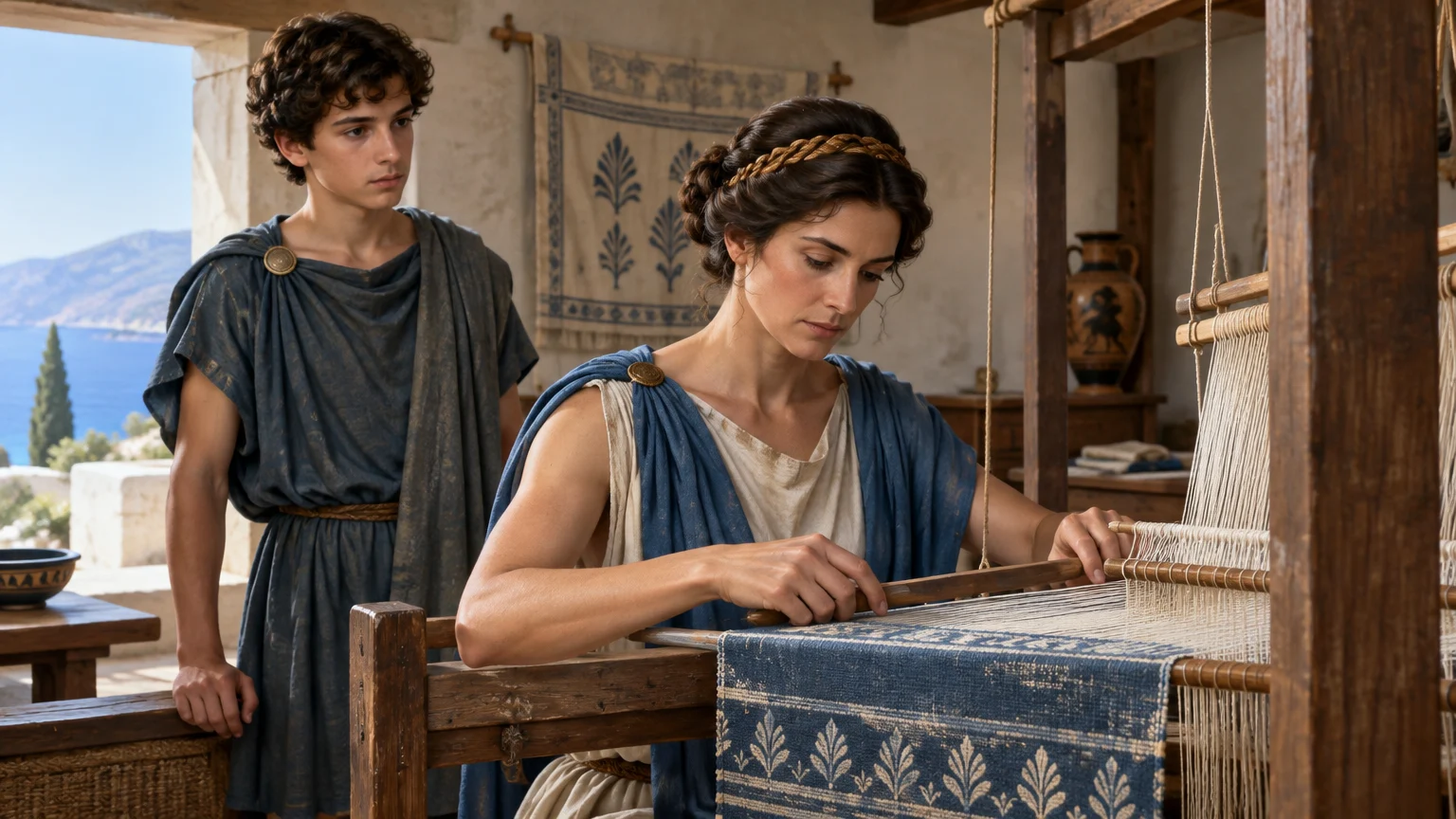
Recognition depends on bodily and domestic knowledge. In Book 19, the enslaved nurse Eurycleia discovers Odysseus’s childhood boar-hunting scar while washing his feet; he prevents her from revealing his identity.
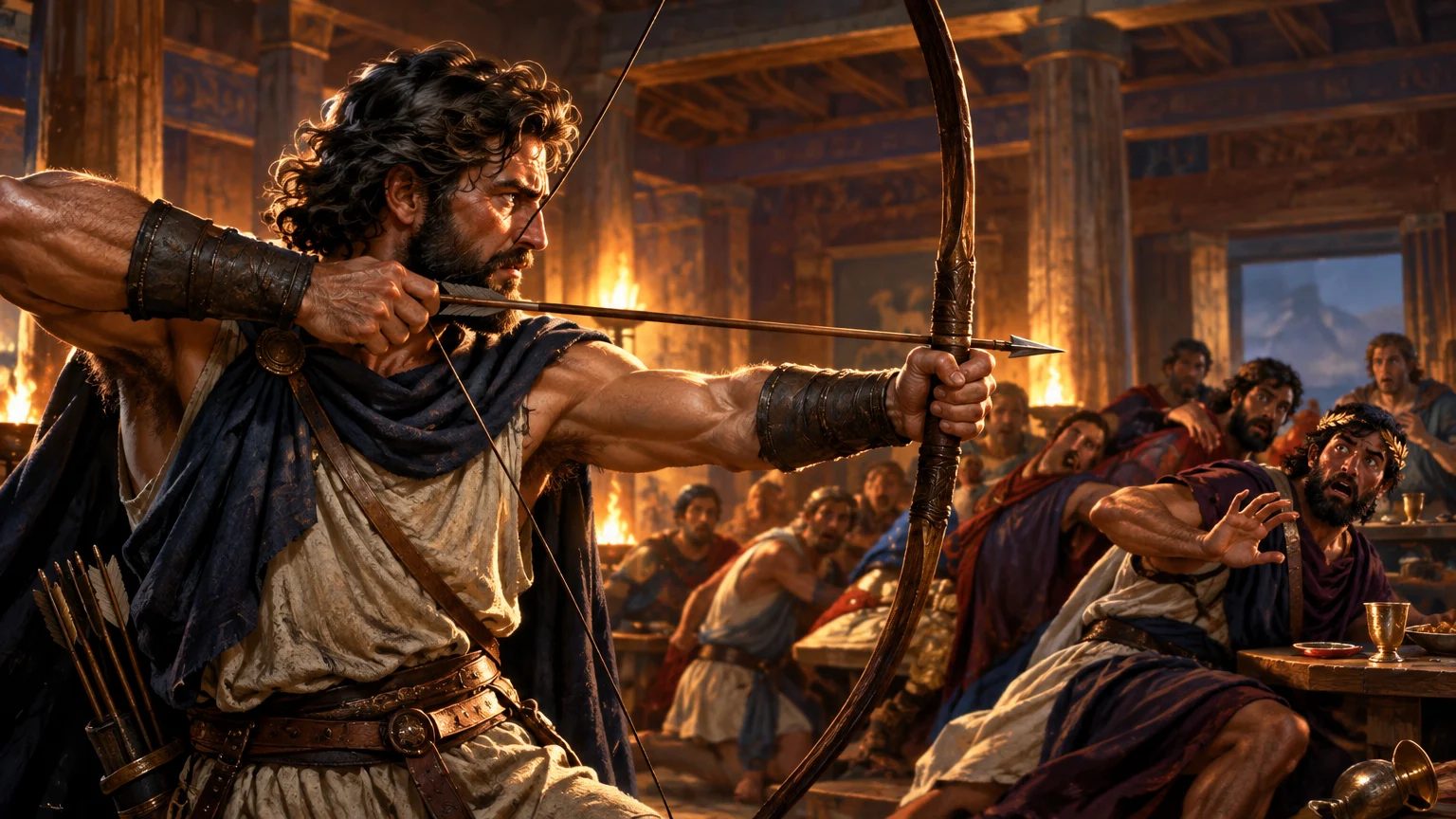
Penelope announces that she will marry whoever strings Odysseus’s bow and shoots through twelve axe heads. The disguised owner succeeds where the suitors fail, turning a marriage contest into vengeance.
Afterward, Penelope demands another proof: their marriage bed. Her apparent order to move it provokes Odysseus’s explanation that he built it around a rooted olive tree, confirming their shared history.
These intimate recognitions surround a much harsher restoration. Odysseus kills Antinous first, rejects Eurymachus’s offer of compensation, and destroys the suitors, whose consumption of his wealth accompanies coercive courtship and murderous plotting.
The punishment extends beyond aristocratic rivals. Eurycleia identifies twelve enslaved women as disloyal; Telemachus hangs them after they remove corpses and clean the hall, rejecting death by the sword.
The poem condemns their sexual involvement with the suitors and contempt for the household. It gives little individual testimony about coercion or consent, although enslavement fundamentally restricts their freedom.
Melanthius, the goatherd who supplies the suitors with weapons, is captured by loyal herdsmen Eumaeus and Philoetius, then mutilated and killed. Household restoration makes loyalty decisive without abolishing slavery.
Nor does vengeance settle public authority. In Book 24, the suitors’ relatives attack; Laertes kills Antinous’s father, Eupeithes.
Athena, acting under Zeus’s direction, finally imposes peace: reunion alone cannot end retaliatory violence.
Beyond Greece: Similar Stories, Different Histories
Odysseus’s adventures belong to a wider world of travelers, marvelous islands, and man-eating adversaries. Comparing traditions reveals shared narrative devices, but resemblance does not establish who borrowed from whom or whether related episodes developed independently.
The Egyptian Shipwrecked Sailor, preserved in Papyrus Hermitage 1115 and generally dated to the early Middle Kingdom, around 2000–1900 BCE, predates Homer. A sailor recounts surviving a shipwreck and reaching an extraordinary island after losing his companions.
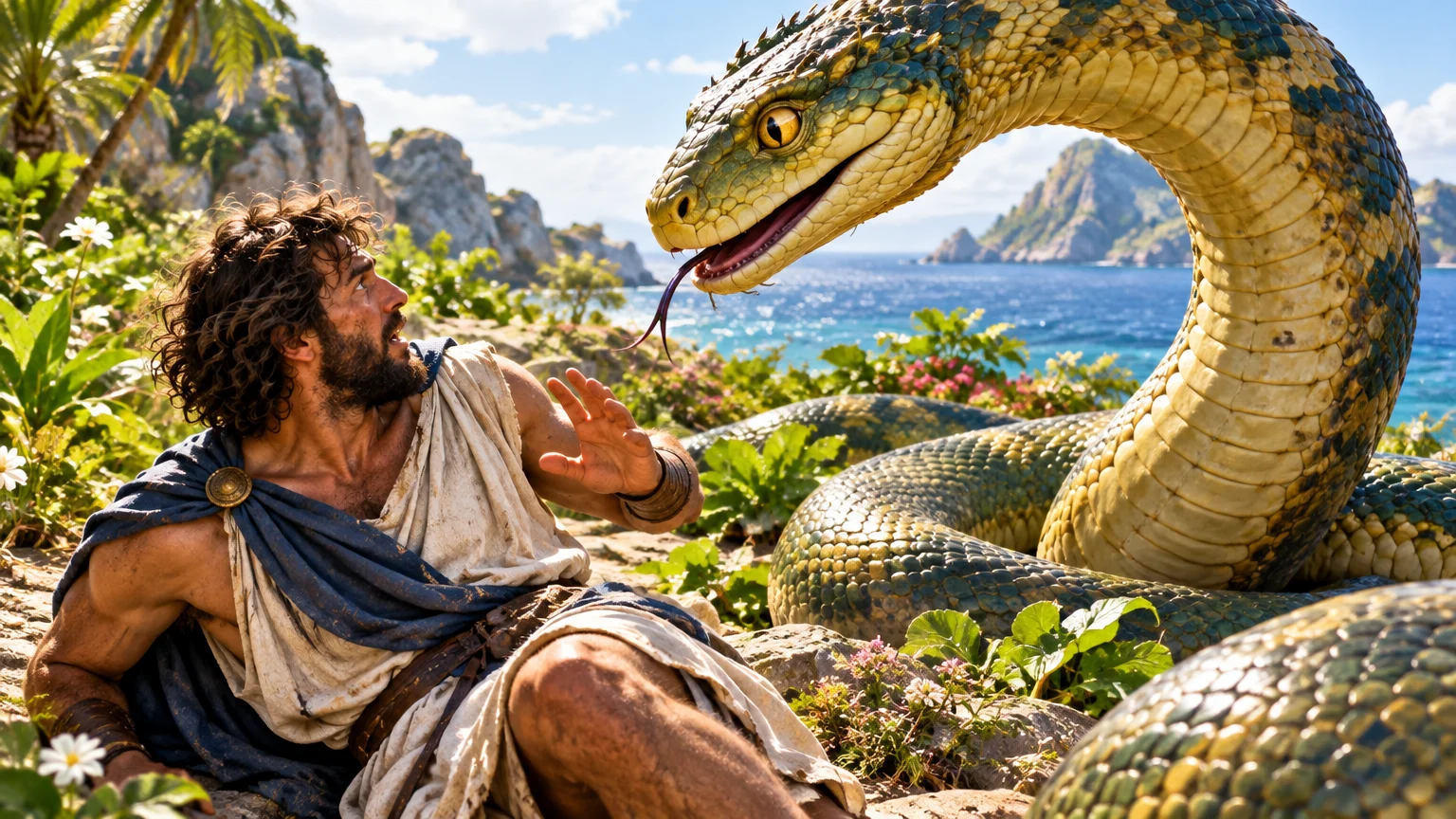
There he encounters an enormous speaking serpent whose body shines with gold and whose eyebrows resemble lapis lazuli. The creature initially threatens the frightened stranger but eventually predicts that sailors will arrive and carry him safely back to Egypt.
The serpent also recounts its own suffering, describing the destruction of its family through a fiery catastrophe. When the Egyptian prepares to depart, the creature provides valuable gifts, although it predicts that the mysterious island will eventually disappear beneath the waves.
The sailor’s adventure forms part of a larger conversation. He tells his story to encourage a troubled expedition leader preparing to address the Egyptian king, suggesting that survival through disaster can provide reassurance during another moment of uncertainty.
Yet the frame narrative closes with the listener questioning whether such encouragement is useful. Unlike Odysseus’s account before the Phaeacians, the Egyptian tale does not clearly establish that recounting an extraordinary journey will secure a favorable response.
A closer monster parallel appears in the Oghuz Turkish Book of Dede Korkut. Tepegöz, a one-eyed giant born from a supernatural encounter, becomes a threat to the Oghuz community and demands a daily tribute of human victims and sheep.
The hero Basat confronts him after ordinary weapons prove ineffective. He blinds Tepegöz with a heated spit, escapes by using a ram’s skin, survives further deceptions, and ultimately kills the giant with his own sword.
The shared episodes resemble Odysseus’s blinding of Polyphemus and escape beneath the Cyclops’s sheep. Their endings differ significantly: Basat destroys his enemy, while Odysseus escapes alive but later provokes the blinded monster by revealing his identity.
Wilhelm Grimm investigated such correspondences in his 1857 study Die Sage von Polyphem. Folklorists classify related narratives under ATU 1137, “The Blinded Ogre,” a tale type identified through recurring plot elements rather than assumed historical descent from one original story.
The surviving Dede Korkut manuscripts are considerably later than Homer, although their narratives draw on older Oghuz oral traditions. Neither their chronology nor their shared escape devices establishes a direct relationship with the Greek poem.
Together, these comparisons reveal how different storytelling traditions use extraordinary journeys, threatening beings, and resourceful survivors. The parallels become most valuable when their distinct cultural settings and narrative purposes remain visible rather than being reduced to a single universal adventure.
From Mississippi to Nolan: Who Owns the Odyssey Now?
In Joel and Ethan Coen’s O Brother, Where Art Thou? (2000), Ulysses Everett McGill’s Mississippi homecoming transforms Homeric adventure into Depression-era comedy. Recognition depends on marriage, music and public reputation.
Big Dan Teague, the one-eyed Bible salesman who beats and robs the travelers, reworks the Cyclops through fraudulent respectability. The riverside singers recall the Sirens, replacing Homer’s promised knowledge with intoxication and sexual temptation.
Penny has told their daughters Everett was killed by a train and plans to marry another man. Penelope also contemplates remarriage, but faces uncertainty about whether Odysseus survives.
The Soggy Bottom Boys’ musical success helps secure a public pardon, turning restoration into electoral spectacle. The Ku Klux Klan episode makes racist violence a defining social danger.
Yet the pardon does not prevent a threatened hanging. Everett prays before a flood saves the travelers, then explains their rescue through planned hydroelectric development, leaving providence and modernization in tension.
Christopher Nolan’s The Odyssey (2026), returns to the poem’s Greek mythological setting. Matt Damon plays Odysseus, Anne Hathaway portrays Penelope, and Tom Holland appears as Telemachus, preserving the central family relationships of Homer’s narrative.
Unlike the Coens’ transplantation of the story to Depression-era Mississippi, Nolan presents the ancient voyage through large-format spectacle. His use of IMAX filmmaking emphasizes the scale of the journey, its supernatural dangers, and the visual possibilities of epic mythology.
The film’s theatrical release also demonstrates how differently audiences encounter the same source material. A modern cinematic epic can reconstruct mythical landscapes and recognizable characters, but spectacle and historical detail remain separate from the literary questions surrounding Homeric poetry.
Neither approach provides an authoritative reconstruction of an actual journey. Each adaptation makes artistic choices about what matters in the Odyssey, whether the emphasis falls on family, survival, divine interference, or the possibilities of retelling an inherited story.
The essential comparison remains how filmmakers interpret reunion. Homer joins familial recognition to divine intervention and household slaughter; the Coens combine Penny’s judgment, public approval and an ambiguously providential rescue.
Reconstructing an ancient world, interpreting its poem and inventing a new work are therefore separate achievements. Homer’s continuing influence rests not on adaptations recovering a single historical truth, but on their changing arguments about homecoming.
Further Reading
The Odyssey – Homer (Open Library catalogue record)
Bibliographic record for a 1946 publication of the poem, useful for locating edition information.
The date identifies a modern publication, not the ancient work’s composition.
Catalogue record: https://openlibrary.org/works/OL26446888W
The Odyssey – Homer, translated by Samuel Butler
Public-domain English translation organized by book, providing direct access to the homecoming narrative, divine interventions, encounters with monsters, and recognition scenes discussed throughout this article.
Selected reading: https://classics.mit.edu/Homer/odyssey.html
Papyrus fragment with lines from Homer’s Odyssey – The Metropolitan Museum of Art
Museum object record for an early Ptolemaic Odyssey papyrus, including textual variants.
The fragment offers material context for the poem’s transmission through ancient handwritten copies.
Museum object record: https://www.metmuseum.org/art/collection/search/248134
Greek Gods and Religious Practices – The Metropolitan Museum of Art
Museum overview of Greek cult and sacrifice; useful for contextualizing Homeric ritual scenes without treating epic as a uniform worship manual.
Selected reading: https://www.metmuseum.org/essays/greek-gods-and-religious-practices
Troy exhibition large-print guide – British Museum (2019)
British Museum exhibition guide exploring Troy’s historical setting and literary afterlife, useful for placing the article’s discussion of archaeology alongside the traditions surrounding the Trojan War.
The Homeric State – The Greek City States – P. J. Rhodes (2007)
Academic sourcebook introduction distinguishing late Bronze Age narrative settings, later Homeric composition, and palace administration known from Linear B.
Publisher’s excerpt: https://assets.cambridge.org/97805216/15563/excerpt/9780521615563_excerpt.pdf
History of the Text – A. M. Bowie, in Homer: Odyssey Books XIII and XIV (Cambridge University Press)
Scholarly discussion of the Odyssey’s textual history, relevant to its oral and written development and the successive stages of copying, editing, and publication.
Publisher’s chapter page: https://www.cambridge.org/core/books/abs/homer-odyssey-books-xiii-and-xiv/history-of-the-text/084C45F1DE0E89B357E966F607D261E2
The Literature of Ancient Egypt – edited by William Kelly Simpson, third edition (Yale University Press, 2003)
Scholarly anthology containing an English translation of The Shipwrecked Sailor, useful for reading the serpent encounter and the framing conversation in their Egyptian literary context.
The Book of Dede Korkut – translated by Geoffrey Lewis (Penguin Books, 1974)
English translation of the Oghuz heroic tales, including Basat’s confrontation with Tepegöz.
It allows readers to compare the blinding and escape episodes with Polyphemus’s story.
The Types of International Folktales – Hans-Jörg Uther (Academia Scientiarum Fennica, 2004)
Scholarly classification reference for ATU 1137, “The Blinded Ogre.”
Useful for identifying related narratives, rather than establishing a direct line of borrowing between particular traditions.
O Brother, Where Art Thou? (2000) – British Film Institute
British Film Institute film record for the Coens’ Mississippi-set adaptation, offering a reference point for its production details alongside the article’s interpretation of Homeric parallels.
Discovering Homer’s Odyssey at The Met – The Metropolitan Museum of Art
Museum essay on visual representations of Odysseus, artifacts and manuscript transmission, grounded in identified collection objects.
Selected reading: https://www.metmuseum.org/perspectives/discovering-homer-odyssey
The Odyssey – Universal Pictures Home Entertainment publicity
Studio publicity link for the film adaptation, listed as a modern media resource rather than scholarship on Homer or the ancient Mediterranean.
Studio publicity: https://www.universalpicturesathome.com/press-release/the-odyssey-press-release
The Hittite Texts: Assuwa, Ahhiyawa, and Alaksandu of Wilusa – Eric H. Cline (Oxford University Press, 2013), chapter
Examines Hittite political records relevant to Troy, including Wilusa, Ahhiyawa, and the historical limits of identifying Homeric events.
Publisher’s chapter abstract: https://academic.oup.com/book/1187/chapter-abstract/139931872
Ahhiyawa, Hatti, and Diplomacy: Implications of Hittite Misperceptions of the Mycenaean World – Nicholas G. Blackwell, Hesperia (2021)
Specialist investigation of the Tawagalawa Letter, diplomatic relationships between Hittites and Mycenaeans, and interpretations of western Anatolian politics.
Journal article page: https://ascsa.edu.gr/publications/hesperia/article/90/2/191-231
Geomorphological Study and Paleogeographic Evolution of NW Kefalonia Island, Greece – K. Gaki-Papanastassiou et al. (Geological Society of America, 2011)
Geological investigation challenging the proposed sea channel between Paliki and Cephalonia, central to an alternative identification of Homeric Ithaca.
DOI link: https://doi.org/10.1130/2011.2476(06)
Material Clues – Barbara Graziosi, in Homer: A Very Short Introduction (Oxford University Press, 2019)
Discusses archaeological indications of Homeric composition and the relationship between heroic Bronze Age traditions and later Greek social circumstances.
Publisher’s chapter abstract: https://academic.oup.com/book/28440/chapter-abstract/228954776
Studies in the Epic Technique of Oral Verse-Making: I. Homer and Homeric Style – Milman Parry, Harvard Studies in Classical Philology (1930)
Foundational analysis of recurring formulas in Homeric hexameter and their relationship to traditional oral composition techniques.
Selected reading: https://www-current.chs.harvard.edu/curated-article/milman-parry-studies-in-the-epic-technique-of-oral-verse-making-i-homer-and-homeric-style/
Performance and Text in Ancient Greece – Gregory Nagy, Center for Hellenic Studies
Explores the relationship between oral performance, the work of Parry and Lord, and the development of written epic traditions.
Selected reading: https://www-current.chs.harvard.edu/curated-article/gregory-nagy-performance-and-text-in-ancient-greece/
Explore Related Beasts
 CharybdisCharybdis, the deadly whirlpool in Greek mythology, symbolizes the unavoidable perils of the sea, alongside its counterpart Scylla.
 CyclopsThe Cyclops are one-eyed giants known for their immense strength and hostility towards humans. Famous for encounters with heroes,…
 ScyllaScylla is a six-headed sea monster of Greek mythology, living in a cliffside cave opposite Charybdis. In Homer's Odyssey,…