What Makes a Trickster God? Hermes, Eshu and Anansi
Hermes can steal without ceasing to be a god; Eshu can provoke confusion while remaining indispensable to religious communication. Their apparent contradictions make “trickster” useful, provided the label does not erase their different responsibilities.
“Trickster” is a comparative category, not a religious office shared across cultures. It groups figures whose cunning unsettles expectations, but does not establish that their worshippers understood deception, authority or divine power in identical ways.
In Greek tradition, Hermes belongs to the Olympian divine family as the son of Zeus and Maia. The Homeric Hymn to Hermes makes precocious deception part of his arrival among the gods.

His identity nevertheless extends beyond mischief. As messenger, guide of souls and patron associated with roads and boundaries, Hermes performs services that help the divine and human worlds remain connected.
Eshu’s responsibilities in Yoruba religion demand a different emphasis. An orisha associated with communication, offerings and consequential choices, he cannot adequately be described as a comic troublemaker attached to an otherwise orderly pantheon.
Accounts of Eshu’s place in Ifa divination connect his disruptive capacities with ritual obligations. Honoring him concerns the successful passage of communication and sacrifice, not simply protection against an unpredictable prank.
Ananse, often written Anansi in English, offers a revealing contrast. In Akan storytelling, especially associated with present-day Ghana, the spider is predominantly a folkloric protagonist rather than a straightforward counterpart to these deities.
That distinction does not make his stories religiously empty. In a widely circulated tale, Ananse approaches Nyame, the sky god, seeking ownership of the stories that belong to him.
Narrative authority becomes something negotiable.
Nyame demands formidable captives: a python, a leopard, hornets and a supernatural being commonly translated as a fairy. The English term should not imply that this figure belongs to European fairylore.
Ananse makes the python measure itself against a pole, enabling him to bind it. He also offers the hornets shelter in a gourd after simulating rain, turning apparent assistance into capture.
Having met Nyame’s demands, he acquires the stories. This account of the origin of Ananse stories makes intelligence capable of obtaining what strength alone could not secure: a recognized right to cultural treasure.
The comparison therefore begins with different kinds of authority: Hermes’ divine membership, Eshu’s ritual responsibilities and Ananse’s acquired storytelling rights. Their documented adventures reveal not one universal personality, but distinct arguments about what cunning accomplishes and costs.
Hermes: The Cattle Theft, the Lyre and Apollo’s Bargain
In the Homeric Hymn to Hermes, cunning wins a newcomer recognition among established gods. Hermes does not overthrow Olympus; he forces its rulers to acknowledge abilities they cannot simply suppress.
The hymn compresses his achievements into an extraordinary first day: birth at dawn, music by midday, cattle theft by evening. Born to Maia in a cave, Zeus’s infant son immediately refuses the limitations of infancy.
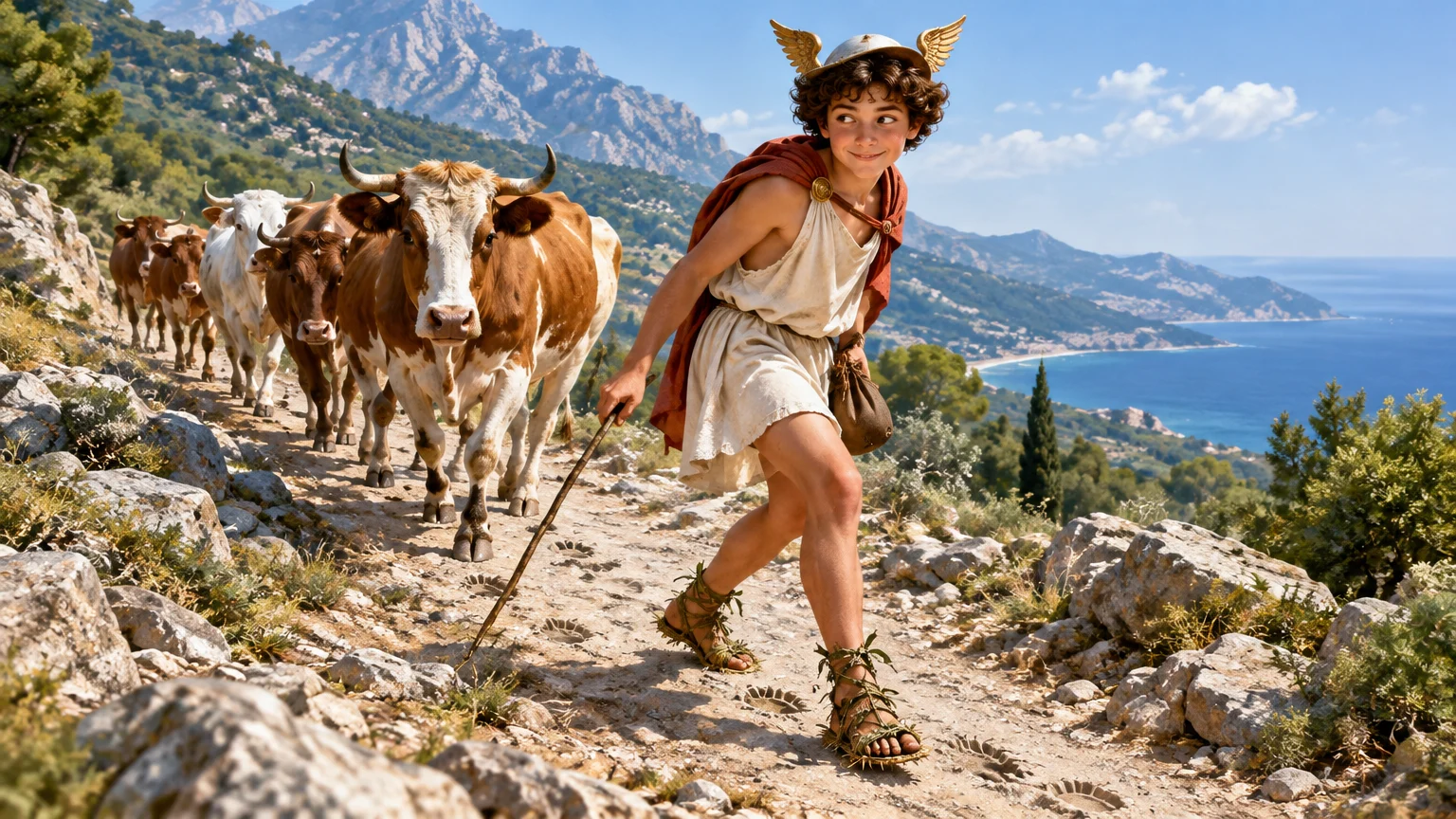
Finding a tortoise, Hermes converts its shell into a lyre, adding a soundboard, arms and strings. Musical invention precedes the theft, making creative craftsmanship, rather than dishonesty alone, central to his identity.
He then steals fifty cattle from Apollo’s herd in Pieria. Driving them backward confuses their tracks, while improvised sandals disguise his own footprints: deception becomes a practical manipulation of evidence.
At the river Alpheus, Hermes kindles fire and kills two cattle. He divides their flesh into twelve portions, but, despite craving meat, does not eat it.
The episode invites comparison with sacrifice, particularly through its ordered distribution of portions. Yet its unusual details resist treating the poem as a straightforward explanation of how Greek sacrificial ritual originated.
Apollo’s investigation combines testimony and divine perception. An old vineyard worker supplies information about the cattle’s passage, while a bird omen helps Apollo recognize Zeus’s newborn son as the thief.
Confronted in Maia’s cave, Hermes exploits his babyhood as an alibi. How could an infant manage cattle? His elaborate denials turn ordinary assumptions about age and innocence into defensive instruments.
Apollo carries the dispute before Zeus, where Hermes repeats his performance. Zeus laughs at the child’s ingenuity but orders him to reveal the cattle’s whereabouts, preserving paternal authority without extinguishing inventiveness.
The decisive settlement develops afterward, when Apollo hears the lyre. Anger gives way to fascination: Hermes possesses something his powerful brother genuinely wants, transforming an unequal confrontation into an exchange.
Hermes gives Apollo the instrument, and Apollo grants him charge of the cattle, placing a shining whip in his hand. Further negotiations establish privileges and limits, including Apollo’s refusal to surrender Zeus’s prophetic knowledge.
The hymn thus makes brotherhood a negotiated relationship, secured through gifts, promises and differentiated responsibilities. Hermes gains standing not because theft becomes harmless, but because his talents become valuable within Olympus.
This comic accommodation illuminates his broader responsibilities as messenger and patron of exchange. The god who manipulates tracks and arguments can also carry communications and broker transactions: boundary-crossing becomes an authorized divine service.
Prometheus and Enki: Stolen Fire and the Great Flood
Prometheus secures no easy accommodation within Olympus. In Hesiod’s account, his ingenuity benefits humanity while provoking punishments that explain why sacrifice, work and suffering belong to mortal life.
At Mecone in the Theogony, he divides an ox into deceptively presented portions: edible flesh concealed beneath its stomach, and white bones covered with attractive fat.
Zeus takes the fat-covered bones, establishing why people burn bones for the gods while retaining meat. Crucially, Hesiod insists Zeus recognizes the deception, preserving his sovereign knowledge.
Zeus nevertheless withholds fire from humanity. Prometheus steals it in a hollow fennel stalk, turning an ordinary plant into the means of circumventing divine control over an essential resource.
Retaliation reaches both benefactor and beneficiaries. An eagle consumes Prometheus’s regenerating liver; for humans, Zeus commissions the first woman, fashioned by Hephaestus and adorned by Athena.
The Theogony leaves this woman unnamed and develops a hostile account of women and marriage. Its gendered explanation of household dependence belongs to Hesiod’s perspective, not neutral social description.
Works and Days names her Pandora and shifts attention toward subsistence: Zeus hides humanity’s livelihood, while Epimetheus accepts her despite Prometheus’s warning against receiving Zeus’s gifts.
Pandora opens a jar, not the familiar later “box,” releasing afflictions while Hope remains inside. Where the Theogony emphasizes divine supremacy, this poem explains humanity’s burdensome working condition.
The Old Babylonian Atrahasis presents a different intervention. Ea, the Akkadian counterpart of Enki, circumvents the gods’ collective, oath-bound decision to destroy humanity through a flood.
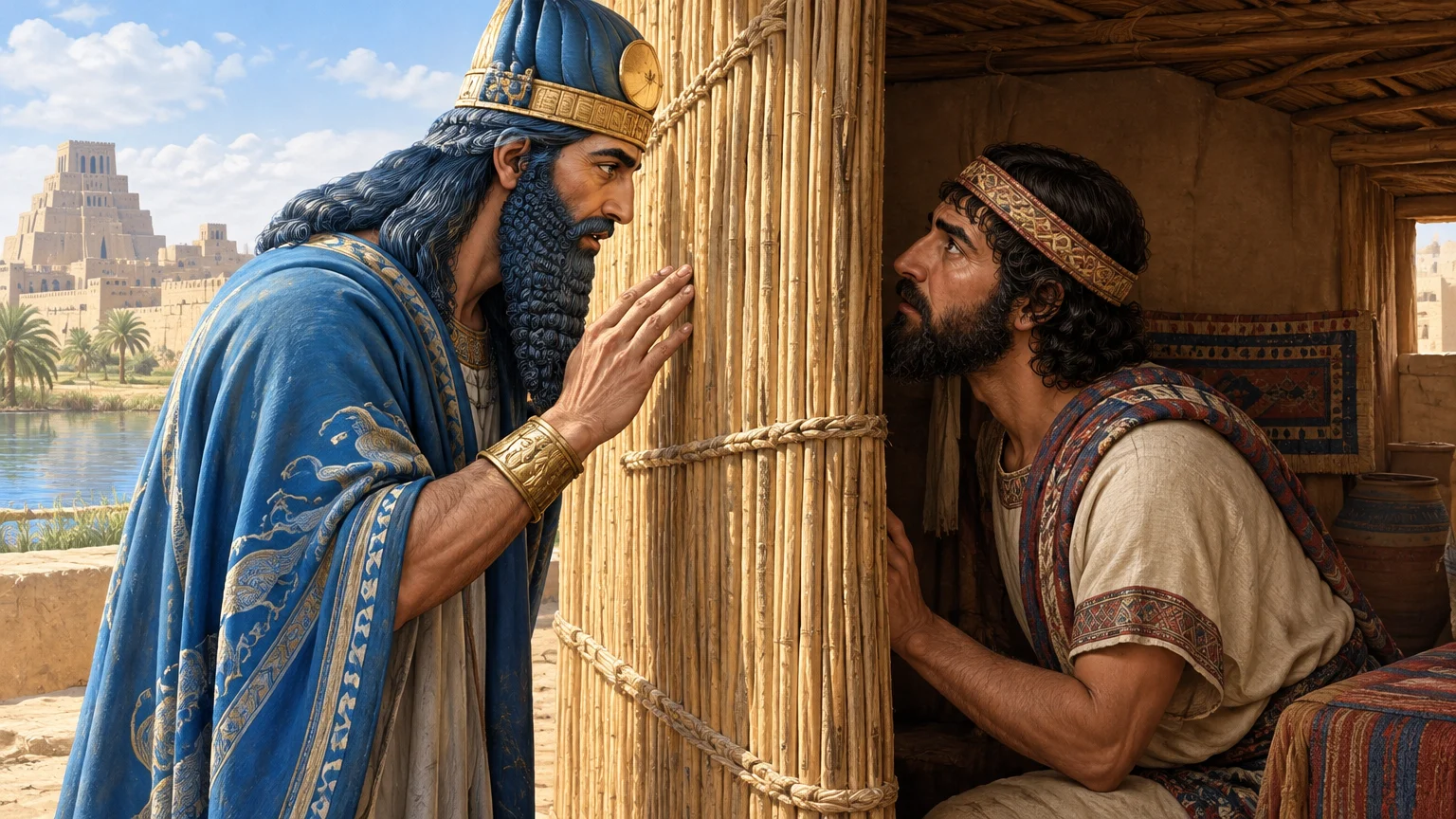
He addresses a reed wall within Atrahasis’s hearing, telling it to abandon the house, build a boat and save life. Indirect speech becomes a procedural escape from divine secrecy.
The instructions are practical: roof the vessel, strengthen its frame and toughen its bitumen. Survival depends on transmitted expertise and human construction, rather than a stolen substance alone.
Afterward, Enlil angrily demands how anyone survived. Anu identifies Enki’s disclosure; Enki acknowledges protecting life and argues for punishment directed at offenders instead of indiscriminate destruction.
The settlement preserves humanity but restricts reproduction through infertility, infant death and designated priestly categories excluded from childbearing. The damaged text also contains a reconstructed instruction assigning death to people.
These are not interchangeable rebellions. Prometheus’s confrontation leaves Zeus’s punitive sovereignty intact; Ea’s evasion produces negotiated limits on destruction. Neither grants human independence: survival remains conditioned by divine power.
Eshu and Legba: Divine Messengers in Yoruba and Fon Religion
Divine assistance depends not only on obtaining something forbidden, but on making a message arrive. In Yoruba religion, Eshu’s disruptive intelligence belongs to this essential work of mediation.
A widely circulated tale makes two friends quarrel after Eshu walks between them wearing a differently colored cap. Each sees one side and insists that his observation describes the whole.

A. B. Ellis included a version in The Yoruba-Speaking Peoples of the Slave Coast of West Africa (1894). That colonial-era collection records a particular telling, not a definitive Yoruba scripture.
The modern red-and-black retelling attributes the episode to Wande Abimbola’s Ifá translations without identifying a verse. Its precise attribution therefore needs distinguishing from the tale’s broader collection history.
The deception does not require either witness to invent evidence. Eshu arranges their encounter so that accurate but incomplete perceptions become incompatible claims, turning confidence into a threat to friendship.
Yet uncertainty is only part of his religious significance. In Ifá consultation, a babalawo interprets verses associated with the revealed odù; their counsel can prescribe offerings and changes in conduct.
Eshu is not interchangeable with Orunmila, the divinity associated with Ifá wisdom. His responsibilities include conveying offerings and overseeing the consequential relationship between divine instruction and human response.
Giving Eshu his due therefore acknowledges a religious obligation, rather than merely bribing a prankster. Interpretation must become action, and sacrifice must reach its intended recipients through an authorized intermediary.
Fon traditions of present-day Benin explain Legba’s authority through a different divine arrangement. In accounts recorded in Melville J. Herskovits’s Dahomey (1938), Mawu distributes responsibilities among her divine children.
The allocation also distinguishes their languages. Legba’s exceptional access to these languages allows him to interpret between divine domains and communicate with Mawu, making specialized powers dependent upon mediation.
His authority consequently rests on access rather than possession of every divine jurisdiction. Gods with their own responsibilities still need someone capable of carrying meaning across the boundaries separating them.
Eshu and Legba thus illuminate comparable problems without becoming aliases. Yoruba sacrifice and Ifá emphasize consequential exchange; the Fon allocation narrative explains why differentiated divine government requires an interpreter.
Huehuecóyotl and Tezcatlipoca: Trickery and Power in Nahua Mythology
Huehuecóyotl, “Old Coyote,” connects divine mischief with music and bodily pleasure in Nahua religion. His coyote identity does not, however, supply a biography interchangeable with other American coyote traditions.
In the Codex Borbonicus, musicians and dancers accompany the deity. He presides over the thirteen-day calendrical period beginning One Flower, placing performance within sacred time rather than outside religious order.
The UNAM commentary on the Codex Telleriano-Remensis distinguishes this imagery from colonial glosses associating him with discord and sexual transgression. Comparisons with Adam and Eve reveal Christian interpretive pressure, not transparent preconquest testimony.
Pleasure also sustained authority: Sahagún records nobles celebrating One Flower with dancing and banquets, while the ruler rewarded distinguished warriors and musicians. Festivity could affirm hierarchy rather than undermine it.
A different relationship between pleasure and power emerges in the Annals of Cuauhtitlan. Its account of Tollan’s downfall targets Topiltzin Quetzalcoatl, the priestly ruler, through attacks upon his self-understanding and discipline.
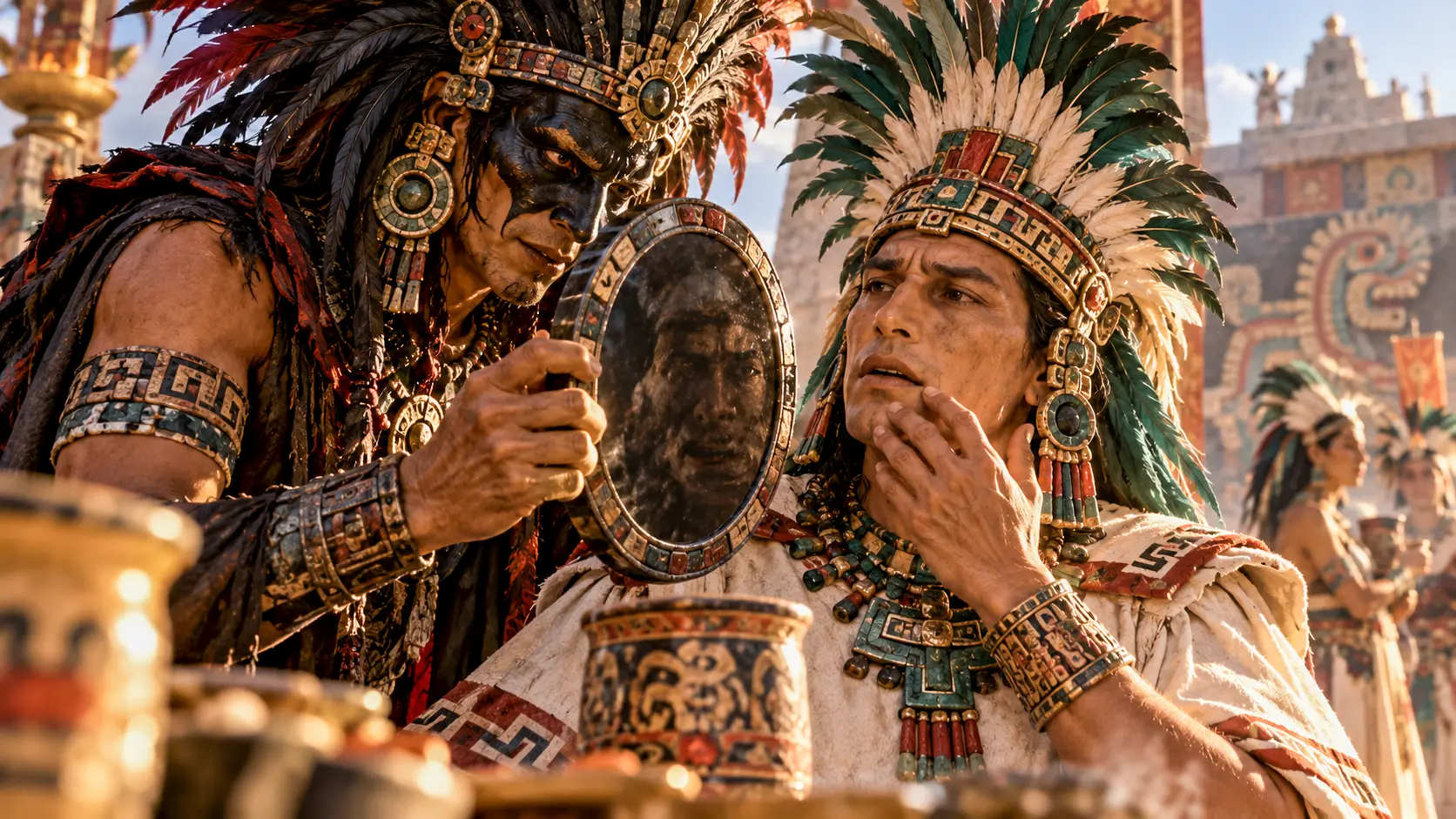
Tezcatlipoca presents Quetzalcoatl with a mirror. Confronted with his own disturbing appearance, the ruler becomes vulnerable to intervention; Ihuimecatl then adorns him. Seeing himself becomes an opening for manipulation.
The drinking episode involves further agents, including Toltecatl, rather than Tezcatlipoca acting alone. Quetzalcoatl becomes intoxicated and summons Quetzalpetlatl, a woman dedicated to religious service, into the drinking.
In Miguel Pastrana Flores’s discussion of the Annals, their encounter violates sexual abstinence as well as sobriety. They neglect ritual bathing and bloodletting with maguey spines; remorse follows at dawn.
Quetzalcoatl subsequently leaves Tollan. The narrative makes compromised priestly authority consequential for the community: duties sustaining relations with divine powers have failed, not merely the ruler’s private reputation.
The Florentine Codex gives the deception another configuration: Tezcatlipoca himself, disguised as an old man, offers pulque as medicine. These accounts should not be flattened into one identical sequence.
Huehuecóyotl participates in neither episode. His calendrical imagery and Quetzalcoatl’s downfall instead illuminate a shared ambiguity: pleasure could support sacred government, yet manipulated pleasure could help undo it.
Loki: The Trickster Who Saved and Destroyed the Gods
Loki’s outrages expose a different limit: restitution can enrich the gods, but some deceptions defeat reconciliation itself. Two narratives preserved by Snorri Sturluson dramatize that contrast without constituting a seamless biography.
In Skáldskaparmál, Loki cuts off Sif’s hair. Thor threatens to break his bones unless he obtains replacement hair from dwarven craftsmen, establishing compensation rather than punishment alone as the immediate solution.
The sons of Ívaldi produce golden hair that will grow like natural hair, Odin’s spear Gungnir and Freyr’s ship Skíðblaðnir. Loki then wagers his head that Brokkr’s brother cannot surpass their craftsmanship.

Disguised as a fly, Loki bites Brokkr while he works the bellows. During the hammer’s manufacture, blood obstructs Brokkr’s sight; his interruption leaves Mjöllnir with an unusually short handle.
Nevertheless, the gods judge Thor’s hammer the finest treasure. Loki escapes losing his head by arguing that the wager excludes his neck, but Brokkr sews his lips together: verbal ingenuity incurs bodily retaliation.
Snorri’s separate Baldr account in Gylfaginning offers no comparable settlement. Frigg obtains promises that things will not harm her son, but overlooks mistletoe because she considers it too young.
Loki discovers the exception, prepares mistletoe as a weapon and guides blind Höðr’s throw. Baldr dies during the gods’ supposedly harmless game of striking their protected companion.
Hel subsequently permits Baldr’s return if everything weeps for him. The giantess Þökk refuses, defeating that condition. Snorri reports that people believe Þökk was Loki, rather than presenting an independently witnessed transformation.
The poetic witnesses distribute responsibility differently. Völuspá names mistletoe and Höðr as Baldr’s slayer; Lokasenna has Loki claim responsibility for Baldr’s absence. Neither supplies Snorri’s complete Þökk episode.
Snorri wrote in Christian Iceland during the thirteenth century, preserving and organizing older traditions. That setting matters, but it does not make Loki simply a Norse version of the Christian devil.
No securely established cult demonstrates how widely Loki received worship. His narrative importance is clearer: compensation restores Sif, whereas the refusal to mourn blocks the collective action required to recover Baldr.
Trickster Gods: Divine Power, Deception and Their Consequences
The decisive difference is not how cleverly a god deceives, but what the deception does to an existing relationship: who gains recognition, who receives offerings, and who can still trust whom.
Hermes’ accommodation with Apollo makes ingenuity compatible with divine rank. Prometheus’ confrontation with Zeus instead explains an enduring division: in Hesiod’s Theogony, humans burn bones for the gods while retaining edible meat.
Eshu’s ritual priority gives potentially disruptive mediation an enduring religious office. Fon Legba and Haitian Vodou’s Papa Legba belong to distinct traditions, not interchangeable versions of a universal divine prankster.
Enki’s intervention offers another arrangement. After the flood in Atraḫasīs, Enlil invites him to deliberate with the birth goddess Nintu. The dissenter returns to collective government rather than abandoning it.
The resulting settlement includes infertility, infant death and restrictions on childbirth. Human survival therefore brings neither unrestricted flourishing nor freedom from divine control; rescue preserves a world still governed by painful limits.
Nahua practice likewise joins pleasure to authority. On One Flower, associated with Huehuecóyotl, rulers rewarded distinguished warriors and musicians. Festivity could affirm hierarchy, even where divine narratives exposed its vulnerability.
Tezcatlipoca’s attack on priestly discipline and Loki’s obstruction of collective mourning reveal different failures of solidarity. Neither outcome warrants treating destruction itself as liberation, or assuming every disrupted order deserved its fate.
These traditions make rules intelligible through their violation, but offer no single verdict on disobedience. Deception becomes religiously consequential through the obligations it renegotiates, preserves, or makes impossible to fulfil.
Further Reading
Homeric Hymn to Hermes – Anonymous Greek poet; translated by H. G. Evelyn-White (1914)
The principal ancient source for Hermes’ extraordinary infancy, Apollo’s stolen cattle, the invention of the lyre, and their eventual reconciliation.
The complete hymn provides direct evidence for the negotiation establishing Hermes’ place among the Olympian gods.
Relevant passage: Homeric Hymn 4, lines 1–580.
Source: https://www.theoi.com/Text/HomericHymns2.html
Politics and Theology in the Homeric Hymn to Hermes – Benediktas Vachninas (2022)
A modern academic examination of Hermes’ theft and deception within the political and theological order of Zeus.
Particularly useful for understanding how apparent misconduct becomes part of the young god’s recognition and integration into Olympus.
Publication: Literatūra, 64(3), pp. 8–19.
Source: https://journals.vu.lt/literatura/en/article/view/30080
Theogony – Hesiod; translated by H. G. Evelyn-White (1914)
Hesiod’s account of Prometheus dividing the sacrificial ox at Mecone, deceiving Zeus, stealing fire, and receiving punishment.
Essential for examining how divine conflict explains sacrifice, human dependence and the authority of Zeus.
Relevant passage: Lines 507–616.
Source: https://www.theoi.com/Text/HesiodTheogony.html
Works and Days – Hesiod; translated by H. G. Evelyn-White (1914)
Provides a related but distinct account of Prometheus and Pandora, emphasizing the withholding of livelihood, the theft of fire, Epimetheus’ acceptance of Pandora and the release of human afflictions.
Relevant passage: Lines 42–105.
Source: https://www.theoi.com/Text/HesiodWorksDays.html
Atraḫasīs, Old Babylonian Tablet III (Sippar) – Ancient Akkadian text; Sources of Early Akkadian Literature, Hebrew University
An academic transcription and translation of the Mesopotamian flood narrative.
Documents Enki’s indirect communication through the reed wall, his instructions to Atrahasis and the practical preparations for surviving the flood.
Relevant passage: Tablet III, column I, especially C₂ i 15′–24′ and C₁ i 29′–39′.
Source: https://seal.huji.ac.il/node/1517?tid=80
Akan-Ashanti Folk-Tales – R. S. Rattray (1930)
A collection of Akan stories recorded in the Gold Coast, with Twi texts and English translations.
Contains the account explaining how Ananse acquired Nyame’s stories through a series of cunning captures.
Relevant passage: Tale 17, “How it came about that the Sky-god’s stories came to be known as Spider-stories,” pp. 54–59.
Source: https://archive.org/details/akanashantifolkt0000ratt
The Yoruba-Speaking Peoples of the Slave Coast of West Africa – A. B. Ellis (1894)
An early ethnographic description of Yoruba religion, supernatural beliefs, priests and divine figures.
Useful as historical evidence of colonial-era interpretations, although its descriptions must be distinguished from contemporary Yoruba religious perspectives.
Relevant sections: Chapters II–V, concerning deities, priests and worship.
Source: https://wellcomecollection.org/works/y9jfdxdq
Divination Tray (Opon Ifa) – Herbert F. Johnson Museum of Art, Cornell University
A museum examination of Yoruba divination equipment and ritual practice.
Explains the diviner’s relationship with Orunmila and the significance of Eshu Elegba as a mediator between human and spiritual worlds.
Relevant material: Object description and interpretation of the carved face on the divination tray.
Source: https://emuseum.cornell.edu/objects/35026/divination-tray-opon-ifa
Ifa Divination System – UNESCO Intangible Cultural Heritage (2005; inscribed 2008)
An institutional account of the living Yoruba Ifá divination tradition, its extensive oral literary corpus, trained practitioners and ritual significance.
Provides essential contemporary context beyond nineteenth-century European collections.
Relevant material: Description of the odù corpus, babalawo practitioners and transmission of religious knowledge.
Source: https://ich.unesco.org/en/RL/ifa-divination-system-00146
Dahomey: An Ancient West African Kingdom – Melville J. Herskovits (1938)
A historical anthropological study of the religious organization, divine figures and ritual practices of Dahomey, now Benin.
Provides background for Fon understandings of Legba, Mawu-Lisa and differentiated divine responsibilities.
Relevant material: Discussions of Fon religious organization, vodun and divine relationships.
Source: https://books.google.com/books?id=l-FEAAAAMAAJ
Dahomean Narrative: A Cross-Cultural Analysis – Melville J. Herskovits and Frances S. Herskovits (1958; 1998 edition)
An extensive collection and analysis of Dahomean oral narratives.
Important for examining Legba’s mediation between divine powers, the allocation of responsibilities and the relationships among Fon deities.
Relevant material: Legba narratives, particularly the account of his linguistic mediation, pp. 125–126 in the cited edition.
Source: https://nupress.northwestern.edu/9780810116504/dahomean-narrative/
Codex Telleriano-Remensis, Folio 10v – UNAM, Tlachia Digital Codex Project
An academic digital examination of a Nahua manuscript depicting Huehuecóyotl within the thirteen-day calendrical period beginning One Flower.
Provides iconographic and historical commentary distinguishing indigenous imagery from colonial-era explanatory annotations.
Relevant passage: Folio 10v, Huehuecóyotl and the trecena beginning Ce Xochitl.
Source: https://tlachia.iib.unam.mx/telleriano/385_10v
The Glosses of the Codex Borbonicus, or How to Read a Nahua Book after the Conquest – Alessia Frassani (2026)
A modern scholarly analysis of colonial annotations added to a Nahua pictorial manuscript.
Helps distinguish indigenous calendrical and religious imagery from later European interpretation, especially when assessing claims about morality and divine behavior.
Publication: Estudios de Cultura Náhuatl, volume 71, pp. 104–151.
Source: https://doi.org/10.22201/iih.30618002e.2026.71.78775
Florentine Codex – Bernardino de Sahagún and Nahua collaborators (sixteenth century); Getty Research Institute digital edition
A major illustrated source documenting Nahua religion, historical traditions and cultural practices.
Book III preserves traditions concerning the gods and Tollan, including material relevant to Quetzalcoatl’s downfall and divine deception.
Relevant material: Book III, especially folios 10v, 12r and 22r, cited in scholarship on the Tollan narratives.
Source: https://florentinecodex.getty.edu/codex
Tezcatlipoca frente a Quetzalcóatl – Miguel Pastrana Flores (2011)
A scholarly interpretation of Tezcatlipoca’s actions against Quetzalcoatl in the traditions concerning Tollan.
Examines disguise, intoxication, ritual transgression and the consequences of undermining religious authority, comparing surviving narrative versions.
Publication: Arqueología Mexicana, no. 112, pp. 30–35.
An accessible excerpt is provided online.
Source: https://arqueologiamexicana.mx/mexico-antiguo/tezcatlipoca-frente-quetzalcoatl
Skáldskaparmál – Snorri Sturluson (thirteenth century); translated by Arthur Gilchrist Brodeur (1916)
The principal medieval narrative source for Loki cutting Sif’s hair, the dwarves’ manufacture of divine treasures and the creation of Thor’s hammer.
Demonstrates how a destructive trick produces restitution and unexpected advantages.
Relevant passage: Section XXXV, “Why Gold Is Called Sif’s Hair.”
Source: https://sacred-texts.com/neu/pre/pre05.htm
Gylfaginning – Snorri Sturluson (thirteenth century); translated by Arthur Gilchrist Brodeur (1916)
Contains the detailed medieval account of Baldr’s death, Loki’s manipulation of Höðr, the mistletoe weapon and the unsuccessful attempt to secure Baldr’s return.
Essential for understanding the contrast between reparable mischief and irreversible harm.
Relevant passage: Section XLIX, concerning Baldr’s death and the refusal of Þökk to weep.
Source: https://sacred-texts.com/neu/pre/pre04.htm
Völuspá – Poetic Edda; translated by Henry Adams Bellows (1923)
An important poetic witness to Baldr’s death, the mistletoe and Höðr’s involvement.
Useful for comparing older poetic material with Snorri’s fuller prose account without assuming that both preserve identical narrative details.
Relevant passage: Stanzas 31–35.
Source: https://sacred-texts.com/neu/poe/poe03.htm
Lokasenna – Poetic Edda; translated by Henry Adams Bellows (1923)
A confrontational poem in which Loki insults other deities and claims responsibility for Baldr’s absence.
Provides a distinct poetic perspective on divine conflict, accusations and Loki’s deteriorating relationship with the gods.
Relevant passage: Stanzas 27–29, especially Loki’s admission in stanza 28.
Source: https://sacred-texts.com/neu/poe/poe10.htm
Old Norse Mythology – John Lindow (2021)
A modern scholarly study of Scandinavian mythology and its medieval preservation.
Particularly valuable for understanding Loki’s complex position, differences between surviving sources and the difficulty of reconstructing pre-Christian beliefs from later Icelandic texts.
Publication: Oxford University Press.
Source: https://academic.oup.com/book/41179
Explore Related Beasts
 AnansiAnansi is the Akan spider trickster whose tales spread from West Africa to the Caribbean. Clever, greedy, and inventive,…
 HelHel, ruler of a Norse realm of the dead, described as half black & half flesh-coloured, keeps Baldr after…