What Does a Human Owe Its Maker?
Why did the gods create humans? Across ancient mythology, the answer is not always an act of generosity. Sometimes humanity begins with a problem that divine powers need to solve.
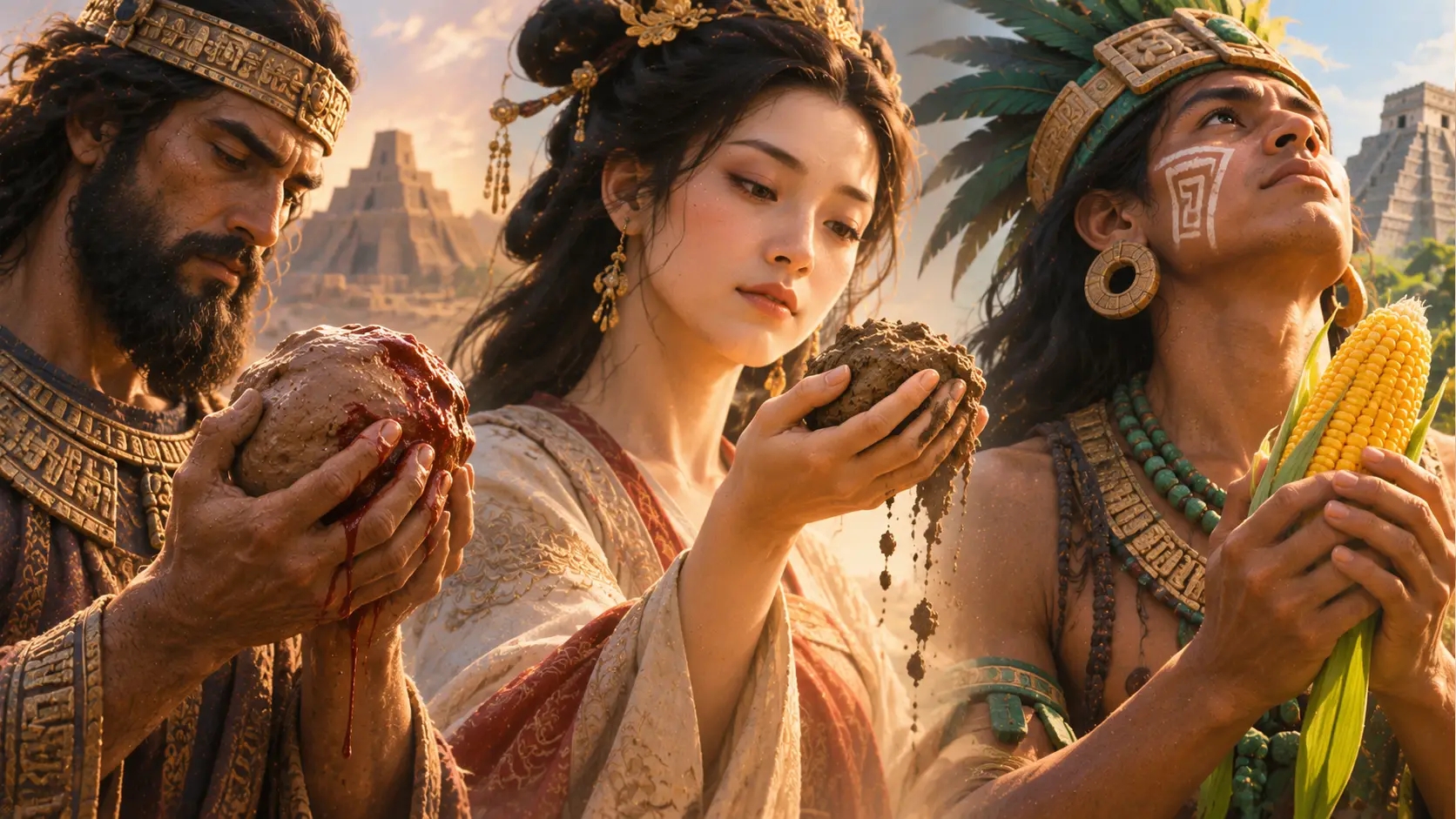
In the Babylonian Atrahasis, lesser gods rebel against their exhausting labor. The solution is extraordinary: humans are created from clay mixed with divine flesh and blood, inheriting the work the gods no longer wish to perform.
In a Chinese tradition, the goddess Nüwa shapes people from yellow earth. When making them individually becomes too demanding, she uses a cord drawn through mud.
The two methods become an explanation for differences in social standing.
The K’iche’ Maya Popol Vuh tells another story. After unsuccessful attempts involving animals, mud, and wood, the creators finally fashion humanity from maize.
These people can speak, remember, and acknowledge those who made them.
Each tradition offers a different understanding of human existence. Clay carries the burden of labor, molded earth explains social distinctions, and maize connects humanity to the food that sustains life.
Together, these remarkable creation stories reveal that becoming human involves more than receiving a body. It also means inheriting responsibilities, limitations, and relationships with the powers that brought humanity into existence.
Mesopotamia: The Gods Who Wanted to Stop Working
In the Akkadian Atrahasis, human creation answers a crisis of divine labor. Before people exist, gods themselves bear the exhausting work that will eventually define humanity’s place in the world.
The opening describes subordinate gods digging waterways and carrying burdens under senior divine authority. Their labor includes the Tigris and Euphrates, placing the maintenance of an ordered landscape within the story’s earliest history.
These workers, identified as the Igigi, eventually rebel. They burn their tools, gather together, and surround Enlil’s dwelling at night.
Their complaint concerns excessive toil, not a wish to create human companions.
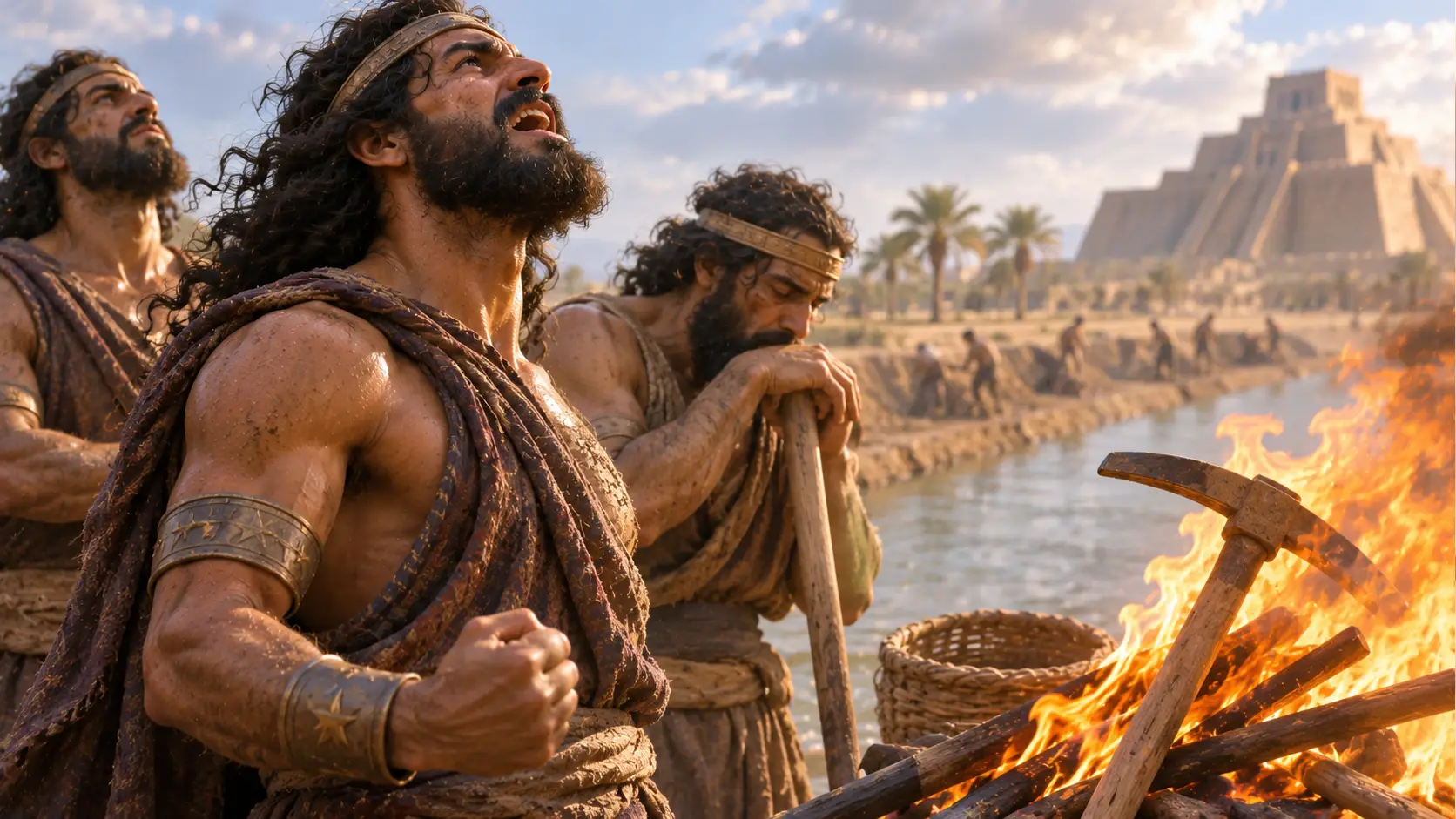
Enlil’s messenger Nusku reports the confrontation, and the senior gods deliberate. Enki, the god associated with wisdom and subterranean fresh water, supports a solution that acknowledges the workers’ grievance while preserving divine authority.
The proposed settlement transfers the burden to a new being. Humans will perform the gods’ work, allowing the exhausted divine laborers relief.
Creation therefore follows collective resistance and negotiation rather than an uncomplicated act of generosity.
The birth goddess is indispensable to this arrangement. Addressed as Mami and Nintu, among other titles, she supplies the reproductive power through which the gods’ decision can become living human bodies.
Yet clay alone is not the recipe. A god described as possessing intelligence is slaughtered in the divine assembly, and the birth goddess mixes his flesh and blood with clay.
This is a costly creation, involving divine death as well as earthly material. Humanity’s substance joins the worked ground to a god’s body, even though humanity’s assigned position remains explicitly subordinate.
Divine ingredients do not make people equal partners in government. The poem instead holds together two claims: humans possess a connection to divinity, and their reason for being is to shoulder labor others reject.
The account develops creation through the language and procedures of birth. Divided clay, womb goddesses, pregnancy, and delivery turn the proposed workforce into embodied people, dependent from their beginnings on maternal powers.
That emphasis matters because the new laborers are not merely implements replacing broken tools. They must be generated through a divine reproductive process, bringing vulnerability and bodily dependence into the solution to exhaustion.
The waterways make this arrangement especially intelligible in Mesopotamian context. Irrigation agriculture required channels to be dug, cleared, and maintained; agricultural production depended on coordinated work beyond any single household’s fields.
Institutions could organize substantial labor, but the epic is not a documentary transcript of canal administration. Its divine dispute transforms recognizable burdens into a question about cosmic authority and the distribution of necessary work.
For this comparison, the crucial point is that humans are neither accidental nor self-sufficient. Earth and divine flesh make their bodies, birth powers bring them forth, and an inherited obligation establishes their purpose.
China: Handmade People, Unequal Lives
Where Atrahasis assigns humanity a shared burden, one Chinese account explains differences within humanity itself. Nüwa makes everyone from earth, but her two methods become an explanation for unequal social standing.
The account is attributed to Ying Shao’s Fengsu tongyi, a work concerned with customs and beliefs compiled during the late Eastern Han dynasty. Its title is often translated as Comprehensive Meaning of Customs.
The passage survives through quotation in the Taiping yulan, a tenth-century imperial encyclopedia compiled under Li Fang. This transmission matters: a later collection preserves material from a work no longer surviving complete.
At the beginning of the episode, heaven and earth already exist, but people do not. Nüwa takes yellow earth and shapes human beings, making the population through direct, individual handiwork.
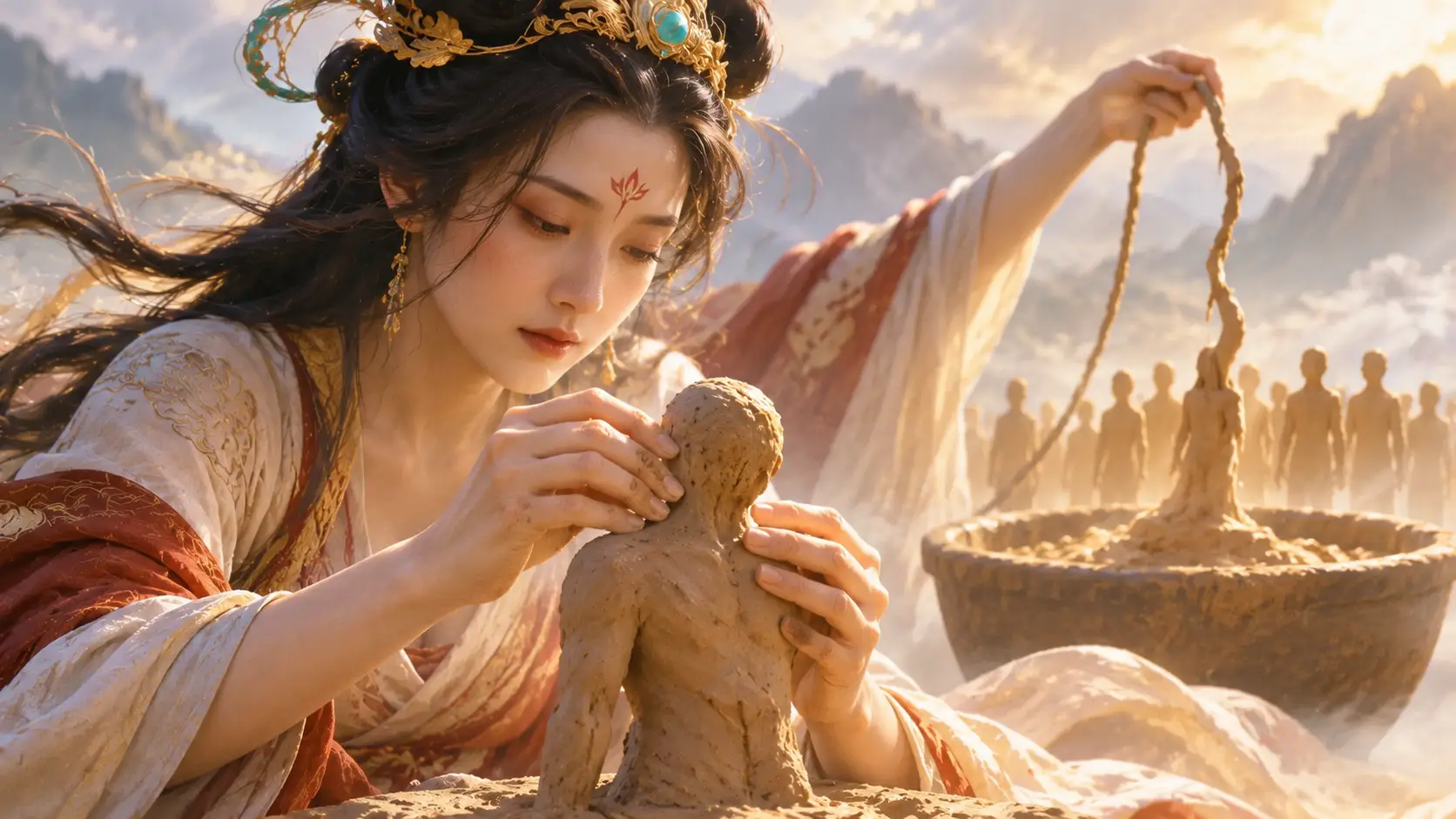
Her task proves too demanding to complete by that method alone. She therefore draws a cord through mud and lifts it out, producing more people through this less individually worked material.
The change is practical before it becomes social: one maker confronts the difficulty of producing an entire humanity. The cord multiplies her productive capacity beyond what patient modeling can accomplish.
The transmitted account then associates the yellow-earth people with the rich and noble, and the cord-made people with the poor and lowly. Different techniques explain different positions within human society.
That conclusion changes the significance of the material. Earth establishes a common bodily origin, yet the distinction between individual modeling and multiplied production supplies an imagined foundation for rank.
The passage does not describe different human species or assign different moral characters to their bodies. Its explicit distinction concerns wealth and status, not a visible anatomy identifying superior and inferior people.
Read socially, the account makes privilege appear rooted in creation rather than subsequent human arrangements. Those enjoying elevated standing receive an origin marked by their maker’s more individualized attention.
But this is a particular explanation preserved within Chinese tradition, not a timeless statement of what all Chinese communities believed. Ying Shao’s interest in customs locates it within a varied cultural record.
Nor should this episode be merged with Nüwa’s repair of the damaged heavens, famously recounted in the Huainanzi. Restoring cosmic order and producing socially differentiated people answer different narrative questions.
The comparison with Atrahasis is therefore precise rather than interchangeable. In the Babylonian epic, human creation transfers necessary work from gods to people; here, creation explains distinctions among people themselves.
Neither account treats making a body as merely technical. The process establishes a relationship: humanity collectively inherits divine labor in one, while contrasting methods give social inequality a primordial explanation in the other.
Maya: A Body Is Not Enough
In the K’iche’ Popol Vuh, making a human body does not guarantee a successful human being. The creators seek creatures capable of speech, remembrance, and acknowledgment, qualities that successive attempts fail to unite.
The narrative belongs to a particular Maya literary history. K’iche’ writers committed it to alphabetic writing during the sixteenth century, under Spanish colonial rule, preserving ancestral accounts in their own language.
Early in the eighteenth century, the Dominican friar Francisco Ximénez copied the K’iche’ text alongside a Spanish translation. His manuscript became the principal surviving witness through which later readers encountered the work.
The creation sequence begins with animals assigned their habitats: deer inhabit the woods, while birds occupy trees. But when commanded to invoke their makers, they produce their different cries rather than intelligible praise.
Their failure changes their place in creation. Animals will become food for others rather than the speakers the creators desire.
Living successfully in a habitat is not yet equivalent to fulfilling humanity’s intended relationship.
The next attempt uses earth and mud. This figure cannot hold together: it softens, crumbles, and lacks the coordinated capacities its makers require.
Its speech provides no adequate understanding, and the experiment is undone.
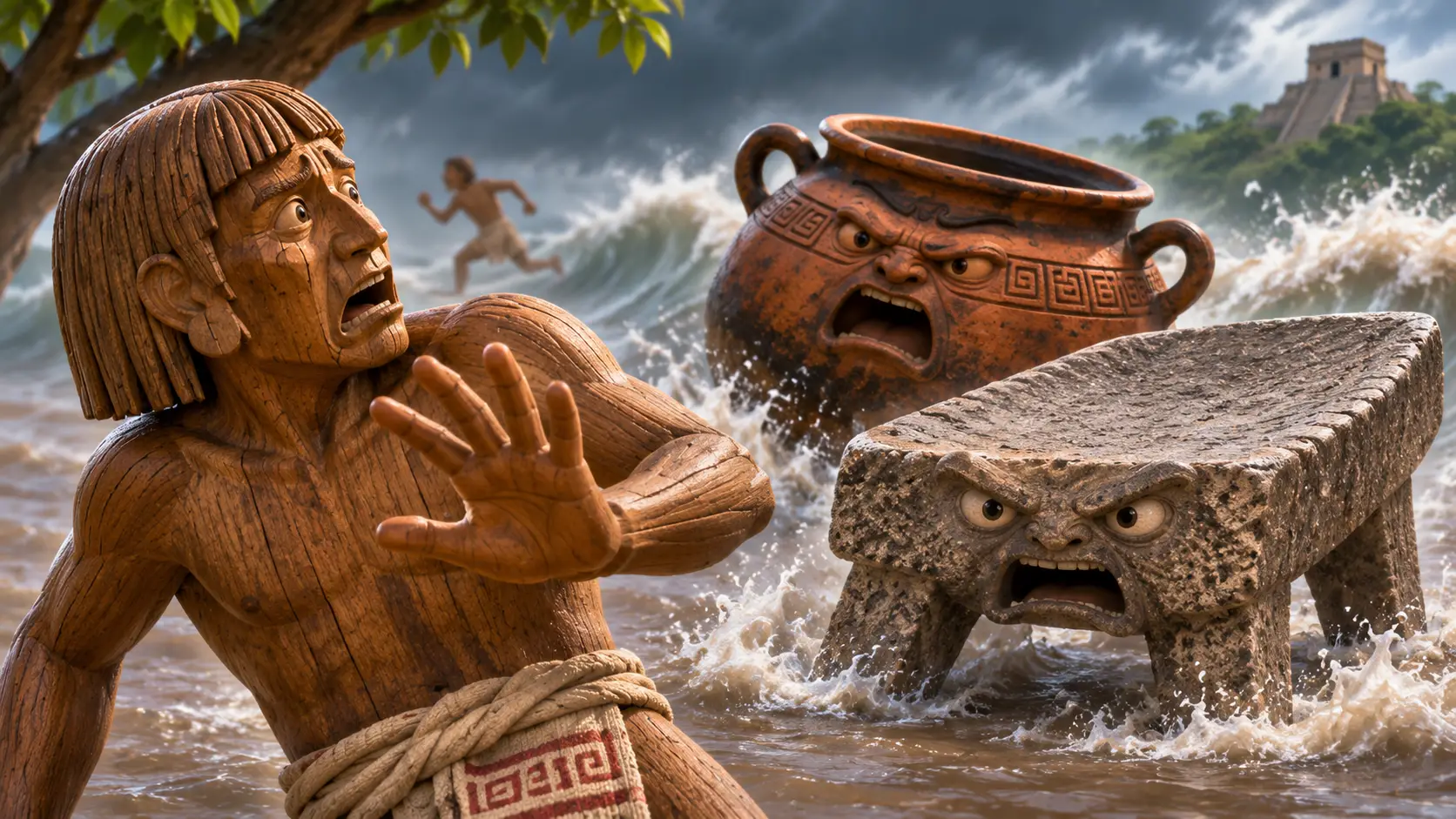
Wooden people appear more promising. They speak, reproduce, and populate the earth. Yet they possess neither the understanding nor the remembrance sought by their makers; outwardly human activity conceals a fundamental failure of relationship.
Their destruction consequently involves more than another defective material breaking apart. A devastating flood overtakes them, while beings and objects previously subjected to their use acquire voices and turn against them.
Dogs and turkeys accuse the wooden people of mistreatment. The dogs recall being driven away and denied food; their attack reverses a household hierarchy in which the powerful consumed without caring for dependent creatures.
Grinding stones likewise protest their exhausting daily work. Cooking pots and griddles join the assault, retaliating for burning and injury.
Implements associated with preparing food become accusers rather than silently obedient possessions.
Attempts to escape fail as houses, trees, and caves refuse shelter. The account connects surviving remnants of these wooden beings with monkeys, whose resemblance to humans preserves a visible reminder of the unsuccessful creation.
The episode therefore tests more than durability. Its failed humans can multiply and command resources, but cannot remember their makers or maintain sustaining relationships.
Their victims’ grievances expose what bodily competence alone leaves disastrously incomplete.
Maya: Successful Humans Still Need Limits
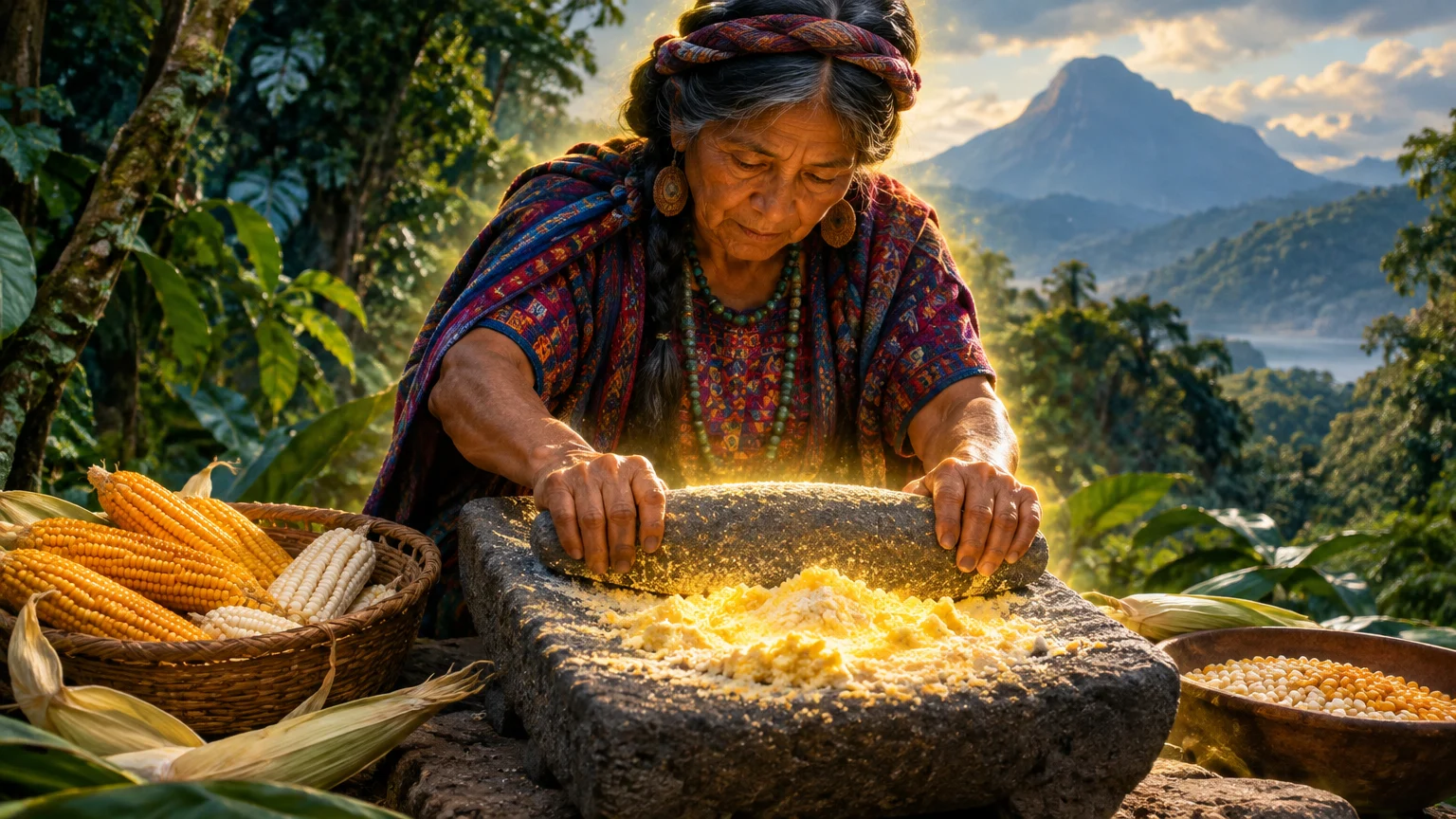
The next creation succeeds through food rather than wood. In the Popol Vuh, yellow and white maize from Paxil and Kayala supplies the substance of humanity, joining bodily existence to nourishment.
Xmucane grinds the maize nine times and prepares the nourishment from which human flesh and strength are formed. Grinding, an essential household labor, becomes part of creation itself rather than merely its aftermath.
The first four men, Balam Quitze, Balam Acab, Mahucutah, and Iqui Balam, can speak, understand, and thank their makers. Unlike their wooden predecessors, they recognize the powers responsible for their existence.
Yet their success introduces another problem. Their sight reaches across the world, encompassing distant places without requiring travel. Their understanding approaches a comprehensiveness the makers consider inappropriate for created beings.
The makers therefore cloud their eyes, using breath compared to mist upon a mirror. The men retain sight, but can no longer perceive everything with their original extraordinary reach.
This correction does not replace their maize bodies or erase their gratitude. It establishes a distinction between human knowledge and divine knowledge: successful humanity must remain less than all-seeing.
In Atrahasis, the problem is not excessive perception but increasing population. Human noise disturbs Enlil, prompting successive attempts to reduce humanity through plague and shortages of food before the flood.
Enki repeatedly helps people survive these measures. When the gods resolve upon the flood, he warns Atrahasis, enabling the preservation of life rather than accepting humanity’s complete disappearance.
The flood nevertheless exposes the gods’ dependence on those they destroy. Deprived of human offerings, they experience hunger; afterward, they gather around Atrahasis’s sacrifice, making annihilation an unstable solution.
The resulting settlement restricts births and survival instead. Enki instructs the birth goddess Nintu to establish conditions under which some women bear children while others do not.
The arrangements also include a child-snatching demon and categories of consecrated women barred from childbearing. Infant death, infertility, and religious restrictions become features of the reconstructed human order.
These are different explanations of human limits. The K’iche’ account restricts the reach of knowledge; the Babylonian settlement makes reproduction precarious while preserving the population upon whose labor and offerings divine society depends.
Maize supplies a further distinction. The first men’s material is also sustaining food, linking creation to repeated cultivation and preparation.
Restricted sight leaves that dependence intact: humans remain beings nourished by a living world they cannot comprehend completely.
Hebrews: Made in God’s Image, Formed from Dust
The Hebrew Bible opens with two distinct accounts of human creation. Genesis 1:1–2:3 places humanity within the ordering of the cosmos; the second account, beginning at Genesis 2:4, describes formation from the ground.
These accounts appear together in the Book of Genesis, or Bereshit, the first book of the Torah. Biblical scholars generally understand them as traditions with different literary histories, later combined within the biblical text.
In Genesis 1, God creates through commands that establish light, sky, land, vegetation, and living creatures. Humanity appears on the sixth day, after the world has already acquired the conditions needed to support life.
The creation of humans receives a distinctive announcement: God determines to make them in the divine image and likeness. Male and female are both included in this description, without separate accounts of their bodily construction.
Unlike the humans of Atrahasis, these beings are not created to relieve exhausted gods of agricultural labor. They receive a blessing and a mandate to multiply, fill the earth, and exercise dominion over other living creatures.
One influential scholarly interpretation connects the divine image with humanity’s representative authority within creation. In this reading, language associated with royal status applies to humanity collectively, rather than only to rulers.
Genesis 2 approaches human origins through a different sequence. Here, God forms the first human from dust taken from the ground and breathes life into its nostrils, transforming the shaped material into a living being.

The Hebrew wording creates a deliberate connection between adam, the human, and adamah, the ground. Human identity is tied linguistically to the earth from which the body originates and upon which survival depends.
That material connection recalls Mesopotamian creation traditions, but the ingredients differ. Genesis does not require the slaughter of a god or the mixing of divine flesh with clay.
The decisive act is God’s life-giving breath.
God places the human in a garden in Eden, where trees provide food. A river waters the garden before dividing into four branches, connecting this setting with a wider landscape.
The human receives responsibility for working and tending the garden before any act of disobedience occurs. God also gives the prohibition concerning the tree of knowledge of good and evil in Genesis 2:16–17.
This distinction matters when comparing Genesis with Atrahasis. Work belongs to human existence in both narratives, but the biblical garden is not presented as a workplace created to spare the deity from unwanted toil.
The account also addresses human companionship. After declaring that the human should not remain alone, God presents animals for naming, but none provides the corresponding partner the narrative seeks.
God consequently causes the human to fall into a deep sleep and forms a woman from what is traditionally translated as a rib, though the Hebrew term can also mean a side.
The resulting relationship establishes another dimension of human existence beyond the individual’s connection with the ground. The human recognizes the woman as sharing the same flesh and bone.
Genesis 3 recounts the serpent’s challenge and the woman’s and man’s eating of the forbidden fruit. They become aware of their nakedness and face consequences that transform their relationship with God and their environment.
The ground now produces thorns and thistles, and obtaining food requires painful agricultural labor. The human will eventually return to dust, the substance from which the body was originally formed.
The distinction between tending Eden and struggling with resistant soil is important. The narrative does not introduce all work as punishment; instead, it connects exhausting labor and hardship with the consequences of disobedience.
Knowledge also becomes a boundary between humanity and divinity. After the humans acquire knowledge of good and evil, God prevents access to the tree of life, ensuring that their altered condition does not lead to endless life.
This resembles the Popol Vuh only in a limited sense. Both traditions examine humanity’s relationship with its creators and the limits of human capacities, but they explain those limits through different narrative events.
In the K’iche’ account, the creators restrict the maize people’s extraordinary vision. In Genesis, the humans violate a prohibition, acquire forbidden knowledge, and lose access to the garden and its tree of life.
The two Genesis accounts consequently present distinct perspectives on humanity: one emphasizes divine likeness, reproduction, and authority within creation; the other explores earthly substance, life-giving breath, companionship, responsibility, and mortality.
Read together, they establish a relationship that neither makes humanity divine nor reduces people to replacement laborers. Humans receive life and authority from their creator, remain dependent upon the earth, and encounter boundaries they cannot freely cross.
Conclusion: Not a Recipe, but a Relationship
Creation materials seem to promise answers about human nature, but these traditions ask a deeper question: what kind of relationship begins when someone creates someone else?
Divine substance does not grant freedom in Atrahasis. Shared earth does not guarantee equal standing in Nüwa’s account.
Read together, the Genesis narratives place divine likeness alongside human mortality and responsibility.
The Popol Vuh introduces another tension: successful humans must remember their makers, yet cannot retain unrestricted knowledge. Being successfully created does not mean possessing unlimited freedom or understanding.
Together, these tensions reveal how creation stories can explain and legitimize social arrangements. Work, hierarchy, gratitude, and obedience become matters of cosmic origin rather than simply human custom.
Their shared materials do not establish a universal explanation of humanity. Instead, each tradition reveals how a particular society understood dependence, authority, and the responsibilities of being human.
Further Reading
The Epic of Atrahasis – Livius translation (adapted from B. R. Foster)
This account describes the lesser gods’ revolt and the creation of humans to relieve their workload, making it useful for comparing divine labor and human purpose.
Translation: https://www.livius.org/sources/content/anet/104-106-the-epic-of-atrahasis/
Atra-Hasis: The Babylonian Story of the Flood – W. G. Lambert, A. R. Millard (1969)
Lambert and Millard’s edition of the Akkadian epic provides a route to the divine labor revolt, human creation, the flood narrative and its reproductive restrictions.
Catalogue record: https://openlibrary.org/works/OL19106082W
Taiping yulan, volume 78: Nüwa human-making quotation from Fengsu tongyi
The surviving Chinese quotation presents Nüwa shaping humans from yellow earth and using a cord drawn through mud, followed by the explanation of social rank.
Chinese text: https://ctext.org/text.pl?if=en&node=367836
Myths from Mesopotamia: Creation, the Flood, Gilgamesh, and Others – Stephanie Dalley (translator) (2000)
Dalley’s translated Akkadian texts include Atrahasis, with notes and context for the divine labor revolt, human creation and flood traditions.
Before the Muses: An Anthology of Akkadian Literature – Benjamin R. Foster (2005)
This substantial scholarly anthology provides translations and commentary across Akkadian literature, placing the Atrahasis epic within the wider Mesopotamian literary tradition.
Publisher listing: https://www.eisenbrauns.org/books/titles/978-1-883053-76-5.html
Chinese Mythology: An Introduction – Anne Birrell (1993)
Birrell surveys classical Chinese myth from fragmentary transmitted texts, with attention to cultural context, textual variants and the interpretation of figures such as Nüwa.
Handbook of Chinese Mythology – Lihui Yang, Deming An, Jessica Anderson Turner (2005)
A reference to Chinese myths and their historical transmission, useful for situating Nüwa’s human-making account among other traditions without merging distinct narratives.
Publisher listing: https://www.bloomsbury.com/us/handbook-of-chinese-mythology-9781576078068/
Popol Vuh: The Mayan Book of the Dawn of Life (revised edition) – Dennis Tedlock (translator) (1996)
Tedlock’s annotated translation of the K’iche’ Popol Vuh offers an additional reading of the creation episodes and the text’s wider narrative and cultural setting.
Catalogue record: https://discover.library.unt.edu/catalog/b1963209
Genesis, Chapters 1–3 – Hebrew Bible, Book of Genesis.
The primary biblical accounts of human creation describe humanity made in God’s image, the human formed from dust, the divine breath of life, and Eden.
These chapters provide the narrative basis for examining human responsibility, knowledge, mortality, and the relationship between humanity and its creator.
Biblical text, beginning with Genesis 1: https://www.sefaria.org/Genesis.1
Genesis’ Two Creation Accounts Compiled and Interpreted as One – Konrad Schmid.
A scholarly examination of the distinct creation narratives in Genesis 1 and Genesis 2–3, their literary origins, differences, and eventual combination within the Hebrew Bible.
Particularly useful for understanding why the accounts present different sequences and conceptions of humanity’s creation.
https://www.thetorah.com/article/genesis-two-creation-accounts-compiled-and-interpreted-as-one
Five Ancient Near Eastern Myths Behind the Bible’s Three Creation Accounts – Shawna Dolansky.
A comparative essay on ancient Near Eastern parallels to biblical creation accounts, useful for extending the article’s discussion of human origins beyond the individual narratives examined here.
https://www.thetorah.com/article/five-ancient-near-eastern-myths-behind-the-bibles-three-creation-accounts