Overview of the Pre-Colonial Australia Period
Pre-colonial Australia describes the long history of Aboriginal and Torres Strait Islander societies before British colonization began in 1788, rather than one uniform civilization or bounded cultural era.
Archaeological evidence indicates human presence on the continent for tens of thousands of years, although dating and regional histories remain subjects of continuing scholarly investigation.
Hundreds of distinct nations and language groups developed across varied environments, so no single account can accurately represent every community’s cosmology, storytelling, or understanding of supernatural beings.
Mythological traditions were culturally important partly because they connected ancestral events with particular places, social relationships, and responsibilities within living communities.
Cultural and Religious Worldviews
Dominant Belief Systems
Aboriginal Australian traditions did not constitute one centralized religion; beliefs and practices differed among communities and were transmitted through locally grounded cultural knowledge.
The English term Dreaming is widely used for complex relationships among ancestral beings, creation, law, place, and continuing existence, but it cannot fully represent every Indigenous concept.
Many traditions describe ancestral beings whose actions shaped landscapes, species, and relationships, although identities, names, and significance vary substantially between distinct cultural traditions.
Torres Strait Islander communities possess their own histories and cosmologies, shaped by island environments and maritime connections; these should not be treated as interchangeable with mainland traditions.
Role of Myth in Daily Life
Stories could communicate obligations concerning kinship, conduct, land, and resources, embedding knowledge within memorable accounts rather than separating it into modern categories.
Some knowledge was restricted by age, gender, or community standing, while other stories circulated more broadly; evidence does not support assuming identical transmission rules everywhere.
Local narratives helped establish connections between communities and country, making particular landmarks meaningful through remembered ancestral events and inherited responsibilities.
Mythological Beasts and Supernatural Entities
Common Types of Mythical Creatures
Rather than a shared bestiary, traditions include ancestral beings, powerful spirits, and beings associated with specific animals, waters, landforms, or dangerous places.
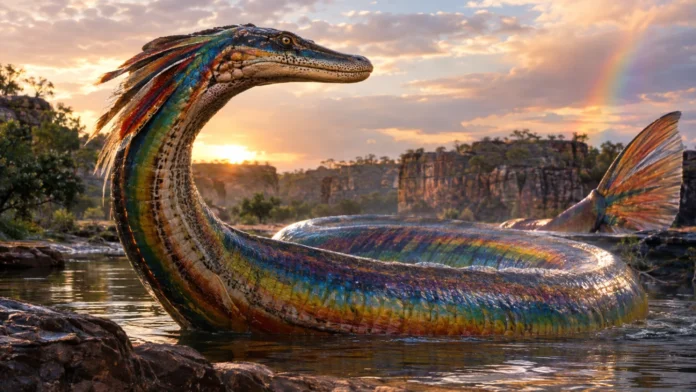
The Rainbow Serpent is a broad comparative label applied to distinct traditions, not one universally named creature with consistent attributes across Aboriginal Australia.
Some accounts associate serpent beings with water, landscape formation, or fertility, but those meanings belong to particular narratives and cannot be generalized to every community.
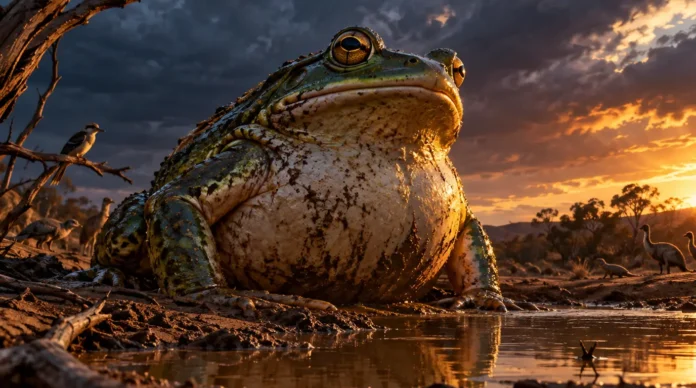
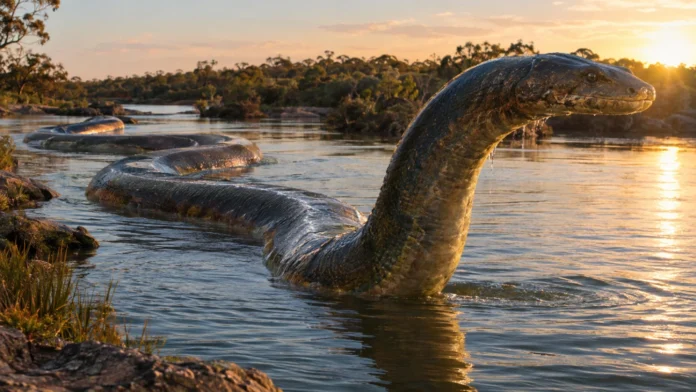
Colonial records later popularized the name bunyip for a feared water-associated being, but descriptions varied and cannot establish one standardized pre-colonial creature.
Symbolism and Meaning
Animal forms in ancestral narratives could express relationships between human communities, species, and country, rather than functioning merely as invented monsters for entertainment.
Water-associated beings may signify the significance and potential danger of particular waterways within specific traditions; interpretation requires local context rather than universal symbolism.
Such beings could connect moral responsibilities with place, but surviving evidence does not justify assigning one psychological meaning to all supernatural figures.
Folklore Traditions and Storytelling
Oral and Written Transmission
Oral transmission was central to preserving many traditions, with repeated telling supporting continuity while allowing knowledge to remain connected to community and place.
Rock art provides evidence of Indigenous visual traditions, but images alone rarely establish the precise narrative, name, or meaning associated with a depicted being.
Written records were largely produced after colonization by outsiders or Indigenous authors working in changed circumstances; they cannot be treated as transparent transcripts of earlier storytelling.
There is no single pre-colonial Australian canon of religious texts or inscriptions comparable to the written scriptural traditions found in some other world regions.
Regional Variations
Across the continent, distinct languages and environments shaped different narrative traditions, including accounts tied to desert, riverine, coastal, and tropical settings.
Torres Strait Islander traditions reflect island societies and maritime environments, whereas mainland accounts arise from diverse continental settings; neither category is culturally uniform.
Even widely recognized figures such as the Rainbow Serpent have locally specific forms and meanings, making comparison useful only when differences remain explicit.
Relationship Between Humans and the Mythical World
Fear, Protection, and Reverence
Supernatural beings could be approached with respect because narratives connected them to consequential places, ancestral authority, or community obligations.
Some beings were associated with hazards or prohibited conduct, but their perceived threat depended on particular traditions rather than a continent-wide classification.
Describing every entity as either guardian or monster distorts traditions in which ancestral presence, place, and human responsibility may be inseparable.
Influence on Art and Material Culture
Rock paintings and engravings document long-standing visual engagement with ancestral beings, although interpretations depend on cultural knowledge and are not always recoverable from archaeological evidence.
Decorated objects and ceremonial designs may carry restricted meanings; external descriptions therefore cannot reliably identify every image as a mythological creature.
Built forms varied among communities, and evidence does not support a continent-wide architectural style devoted to representing supernatural beasts.
Transition and Legacy of the Pre-Colonial Australia Period
Colonization disrupted communities through dispossession, violence, introduced disease, and restrictions on cultural practices, affecting the transmission of knowledge in diverse local ways.
Indigenous storytelling continued through adaptation, family transmission, and cultural renewal, although particular histories of continuity and interruption differ among communities.
Contemporary use of terms such as Dreaming reflects translation and historical scholarship; Indigenous concepts themselves should not be reduced to a single colonial-era label.
Historical Reliability and Interpretation
Archaeology, linguistics, community knowledge, and colonial-era documentation offer different kinds of evidence, none of which independently captures the full history of oral traditions.
Records made by outsiders may misidentify beings or omit cultural context, so their descriptions require careful comparison with Indigenous testimony and local histories.
Mythological narratives are evidence of cultural knowledge and belief, not straightforward reports verifying supernatural events as historical fact.
Where a being’s pre-colonial history cannot be established, the responsible account acknowledges uncertainty rather than supplying an invented origin or treating later descriptions as ancient testimony.