Introduction
Tiddalik is a water-drinking frog in Aboriginal Australian Creation Story traditions. The telling presented at Bunjilaka Aboriginal Cultural Centre belongs to the Gunnai Kurnai people of Gippsland, Victoria.
Related tellings circulate more widely, but they should not be treated as one uniform Australian story.
In the familiar contemporary narrative, the thirsty frog drinks the water from the waterways, leaving the other animals without it. They work together to make Tiddalik laugh, releasing the water.
The frog’s extraordinary appetite creates a crisis that the surrounding community must address.
That reassuring conclusion is not shared by every recorded version. Nineteenth-century Kurnai accounts discussed by specialist John Morton include a disastrous flood, drowning, and people stranded on islands.
Their consequences extend beyond the comic restoration familiar from many children’s retellings.
Tiddalik therefore matters both as a memorable story figure and as an example of variation within a living storytelling tradition. Water, collective responsibility, and the consequences of one being’s actions connect prominent versions, while regional context and differences in their endings remain essential.
History/Origin
The documented history of Tiddalik includes nineteenth-century records of Kurnai storytelling in Gippsland. Those records establish an early written presence, not the beginning of the oral tradition.
The available evidence does not supply a reliable date for the story’s first telling.
John Morton’s specialist discussion identifies accounts recorded by John Bulmer, Edward Curr, Alfred Howitt, and Robert Brough Smyth. These historical collectors provide an important background to the story’s later circulation.
Morton summarizes their material rather than reproducing the original accounts in full.
The older Kurnai narratives differ substantially from the widely circulated restorative version. Once the water is released, a flood kills some people and leaves others stranded on islands.
Borun the pelican rescues survivors, and the narrative continues into a further episode concerning Borun and pelicans.
This difference prevents a simple history in which an unchanged tale passes directly into modern children’s entertainment. The familiar ending foregrounds relief and cooperation; the older recorded sequence also confronts destructive consequences.
The evidence establishes the contrast without establishing exactly when or how every adaptation developed.
A dated example of screen adaptation is the Australian puppet film Tiddalik the frog, released in 1985 and catalogued by ACMI. Its account of animals making the frog laugh documents the familiar children’s narrative in a specific production, rather than proving that ending universal.
Community-specific storytelling also continues outside the Gippsland presentation. The Wonnarua Language & Culture Archive preserves a telling by Uncle James Wilson Miller recorded in 2021.
Its associated educational and language materials document a contemporary Wonnarua context, not an interchangeable copy of every Gunnai Kurnai version.
Name Meaning
Tiddalik and Tiddalick are documented spellings of the frog’s name. Tiddalik appears in the museum presentation and film catalogue, while Tiddalick occurs in the Wonnarua community archive.
The spelling difference does not establish two separate beings or different animal identities.
A reliable literal meaning or linguistic derivation is not established by the available evidence. The name should therefore not be translated as “water-holding frog,” “giant frog,” or another descriptive phrase merely because such wording would fit an episode in the story.
The expanded label “Tiddalik the Frog” identifies the character’s animal form rather than supplying an etymology. Likewise, the use of Tiddalick for an associated rock formation in Wonnarua educational material connects the name with place, but does not independently explain its linguistic origin.
The Wonnarua archive includes language resources alongside the story and advises consultation with the Wonnarua Nation Aboriginal Corporation about their use. That community context matters when interpreting vocabulary; a familiar English-language spelling alone is insufficient evidence for a definitive translation.
Appearance
Tiddalik’s best-supported physical identity is a frog. In the Gunnai Kurnai telling presented at Bunjilaka, the character is specifically small, mischievous, and thirsty.
Smallness is important here because the frog’s remarkable capacity to drink water does not depend on an enormous body.
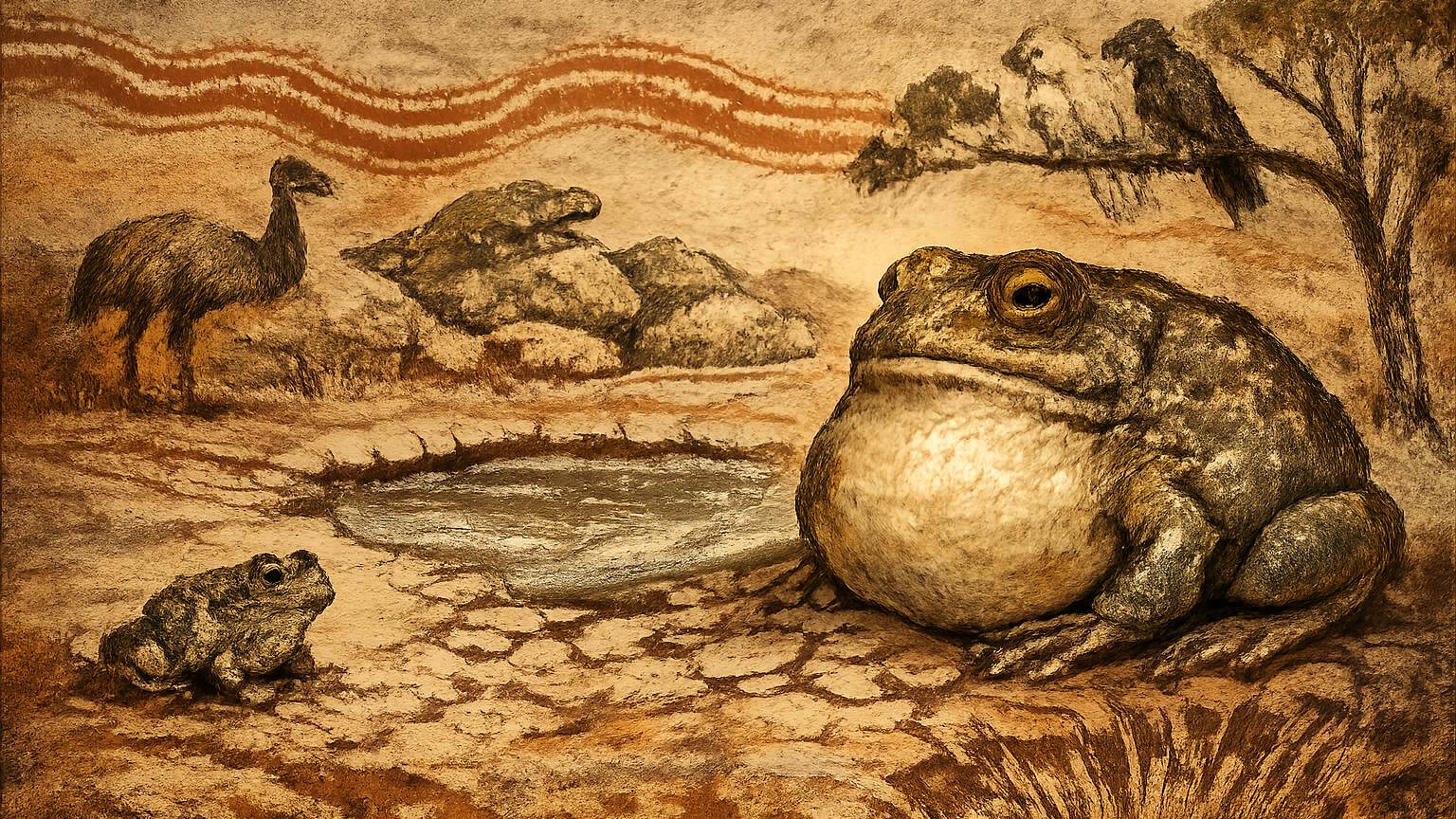
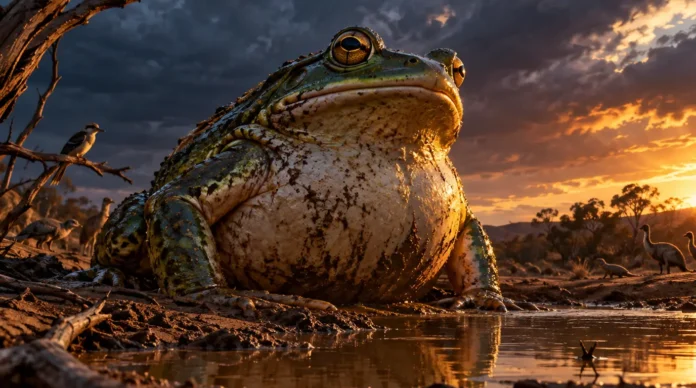
Some modern retellings instead describe Tiddalik as huge or giant. That difference should remain visible rather than being resolved into a single standard appearance.
A giant frog belongs to those particular tellings, while the small frog remains the baseline for the Bunjilaka version.
The supported body plan is recognizably amphibian, with a frog’s body and limbs rather than a human-frog hybrid. The sources do not establish a definitive biological species, skin colour, pattern, or set of measurements.
Such details cannot safely be treated as traditional identifying features.
A full or swollen-looking body can illustrate the episode after Tiddalik has consumed the water. However, this is a visual interpretation of the action, not a fixed feature established across the tradition.
The character’s defining attribute is what the frog does, rather than a prescribed silhouette.
The surrounding landscape helps identify the scene: waterways, a waterhole, or a billabong depleted by the frog’s drinking, with other animals responding nearby. These settings express the shared crisis more reliably than an invented physical ornament or a supposedly diagnostic species marking.
Images of the aftermath also depend on the version being represented. A scene of welcome returning water fits the familiar restorative telling; a destructive flood fits the older Kurnai accounts discussed by Morton.
Neither outcome should become a universal visual attribute of Tiddalik.
Background Story
Tiddalik’s background lies in Creation Story traditions connecting animal characters, water, and the conditions of shared life. The Gunnai Kurnai attribution anchors the Bunjilaka telling in a particular community and region.
It is not simply an anonymous fable detached from cultural context.
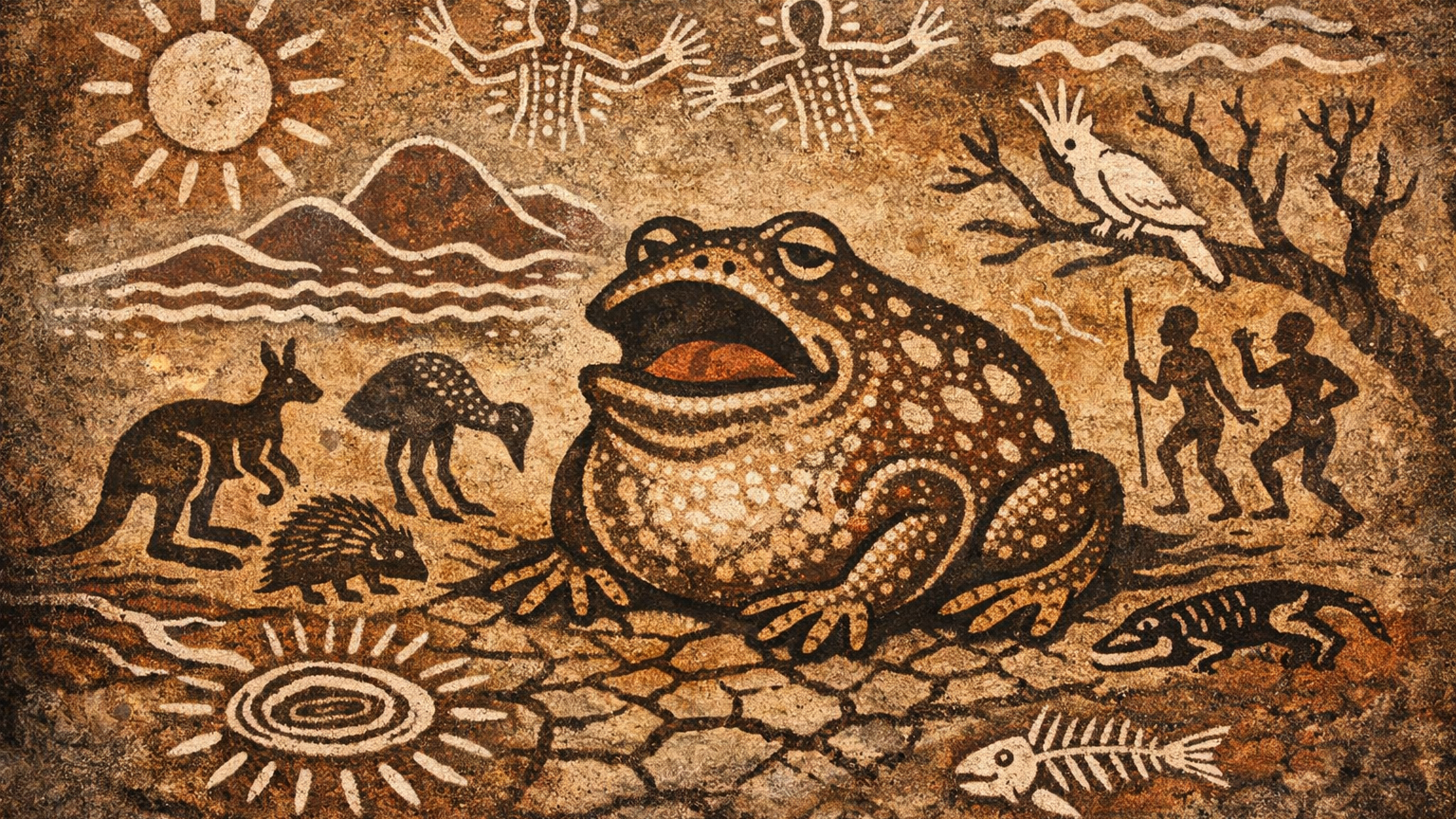
The central disruption is the concentration of water in one thirsty being while others are deprived of it.
In the familiar contemporary version, the animals must act collectively to recover access. The narrative makes dependence on a shared resource concrete through the frog’s extraordinary drinking.
The Bunjilaka presentation explicitly connects its version with caring for water, sharing, listening to elders, and teamwork. These themes explain the significance of the animals’ cooperation.
They are supported interpretations of that telling, rather than grounds for assigning identical lessons to every recorded account.
Humour supplies the familiar means of release: the animals try to make Tiddalik laugh. Their participants and performances vary between retellings, so there is no single cast that can be assumed throughout the tradition.
The shared narrative device matters more than an unsupported fixed sequence.
The older flood ending gives the release a different significance. Scarcity is followed by destructive excess, and the story continues through stranded people and Borun’s rescue.
This sequence places the frog episode within a broader narrative, rather than ending as soon as the water becomes available again.
Contemporary Wonnarua educational materials connect Tiddalick with storytelling, language learning, and an associated rock formation site. Together with the Gippsland evidence, this shows why local context must accompany the widely recognizable plot.
The character’s continuing life includes community transmission as well as published and screen adaptations.
Famous Folklore Stories
Tiddalik’s best-documented narratives share the water-drinking frog but differ substantially in their consequences. The headings below describe recurring episodes rather than authenticated traditional titles.
The Gunnai Kurnai telling presented at Bunjilaka and the older Kurnai accounts should therefore be read as distinct versions.
The Water-Drinking Frog and the Animals’ Laughter
In the familiar contemporary telling, Tiddalik’s thirst empties the waterways, leaving the other animals without water. Their response turns the frog’s private appetite into a collective problem: everyone depends on the missing resource, and the animals must find a way to recover it.
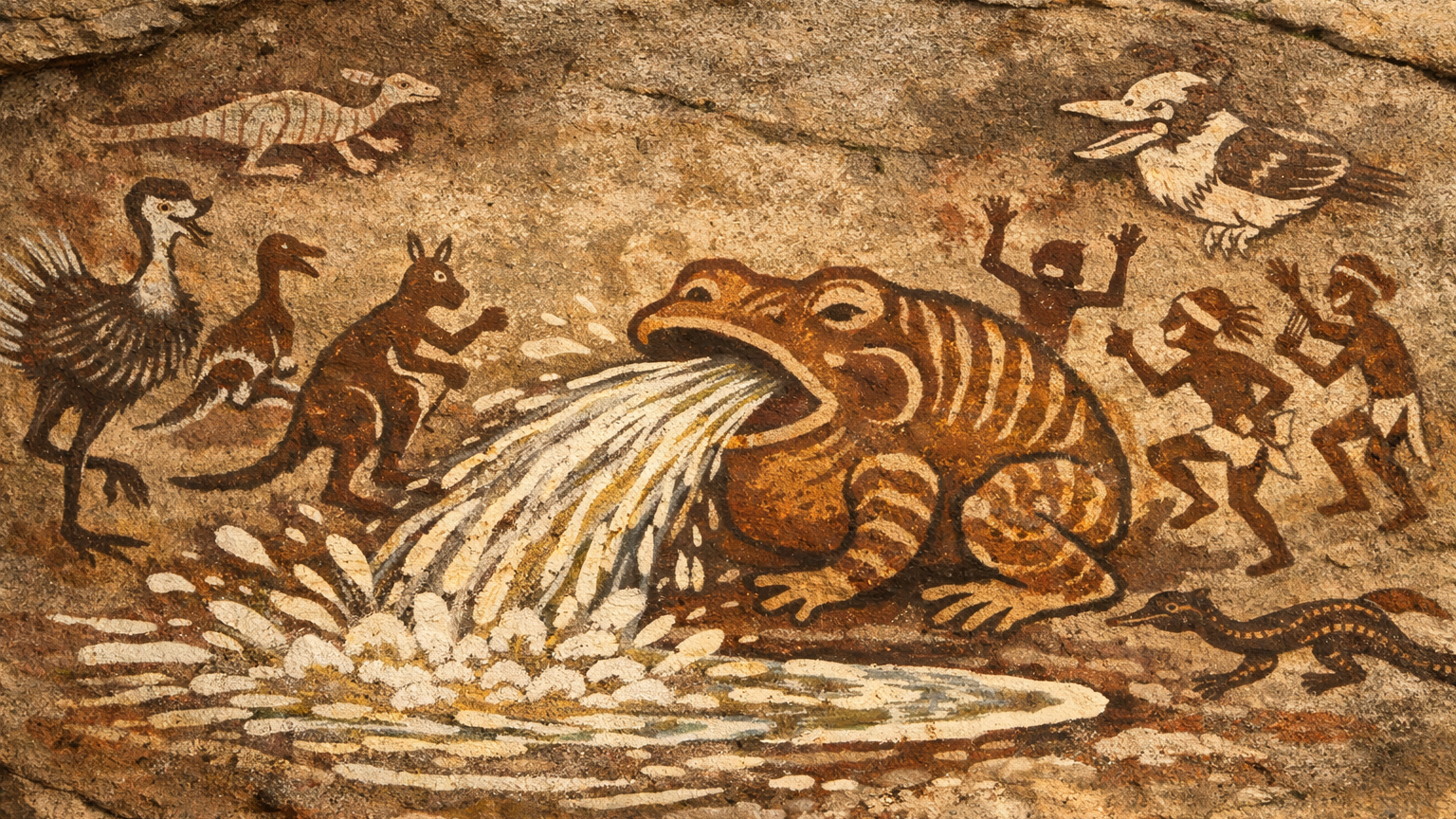
The animals attempt to make Tiddalik laugh, hoping that laughter will cause the swallowed water to escape.
Their efforts provide the story’s comic action. The participating animals and their performances vary between retellings, so no single cast or sequence should be treated as universal.
When Tiddalik finally laughs, the water pours out and becomes available again. This restorative conclusion makes cooperation central to the familiar children’s version.
It is also the narrative pattern represented in the 1985 puppet film Tiddalik the frog, rather than evidence for every traditional ending.
The Catastrophic Flood and Borun’s Rescue
The release of water has a markedly different outcome in nineteenth-century Kurnai accounts summarized by John Morton. Instead of simply relieving thirst, it produces a disastrous flood.
People drown, while others survive but become stranded on islands, turning apparent release into a further crisis.
Borun the pelican rescues stranded people, and the narrative continues into an episode concerning Borun and the pelicans. This continuation connects the frog’s action with other figures and consequences.
It should not be appended to the modern comic version as though both formed one standard story.
The contrast changes more than the ending’s mood. In one version, returning water restores communal life; in the other, its uncontrolled return endangers people.
Morton’s discussion summarizes historical records rather than reproducing them, so these broad differences are firmer ground than a reconstructed scene-by-scene account.
Cultural Impact
Tiddalik’s cultural significance extends beyond an entertaining animal plot. In the Gunnai Kurnai version presented at Bunjilaka, water connects individual conduct with the needs of others.
The story is taught through themes of sharing, caring for water, listening to elders, and working together.
The contrast between scarcity and flood also matters when considering the tradition’s historical meaning. The earlier recorded ending cannot be reduced to the cheerful lesson familiar from many children’s adaptations.
Preserving that difference keeps the older narrative’s danger and human consequences visible alongside contemporary educational uses.
Contemporary Wonnarua educational use connects Tiddalick with language and place. Community archive materials include a story, a word list, a recording, school activities, and an associated rock formation site.
These connections demonstrate a locally situated cultural context, not merely the circulation of an interchangeable classroom fable.
A telling by Uncle James Wilson Miller, recorded in 2021, gives this educational material identifiable community provenance. Naming the storyteller distinguishes a living, attributed telling from an anonymous summary.
It also prevents the Gunnai Kurnai attribution of the Bunjilaka version from being extended automatically to every presentation.
Screen adaptations have carried the familiar laughter-and-release plot to wider audiences. ACMI preserves records for both a puppet film and an animated retelling.
Such works document modern circulation, while Morton’s comparison with historical accounts highlights how easily a popular adaptation can become mistaken for the entire tradition.
Similar Beasts
Kappa

Kappa are Japanese river beings associated with mischief and dangerous encounters. Their recognizable features include webbed limbs, a turtle-like shell, and a water-filled bowl on the head.
Like Tiddalik, Kappa connect an animal-like figure with water and disruptive behavior. Unlike the frog, they are not defined by swallowing the waterways’ water.
Mishipeshu

Mishipeshu is a powerful water spirit in Anishinaabe traditions, often depicted with feline and serpentine features. Its associations include guarding water bodies and expressing both destruction and abundance.
The comparison concerns water’s capacity to sustain and endanger life, especially in Tiddalik’s flood variant. Mishipeshu remains a distinct spirit, not a corresponding frog figure.
Nyami Nyami

Nyami Nyami is a river deity in Tonga traditions, associated with the Zambezi. Descriptions give this protective and powerful being a snake’s body and a fish’s head.
Both figures connect supernatural animal imagery with essential, potentially destructive water. Nyami Nyami’s divine and protective role differs from Tiddalik’s role in the water-drinking narrative.
Rainbow Serpent
The Rainbow Serpent is a separate ancestral being in Aboriginal Australian traditions, associated in some tellings with water and landscape creation. Its meanings differ between communities and versions.
Its relevance lies in water and Creation Story contexts, not shared identity. Tiddalik is neither another name for the Rainbow Serpent nor a frog-shaped version.
Religion/Ritual
The Gunnai Kurnai telling presented at Bunjilaka is classified as a Creation Story. That designation places it within a cultural framework broader than recreational fiction.
It does not, by itself, establish that Tiddalik was worshipped or that the narrative accompanied a particular ceremony.
The consulted material documents storytelling and educational use, but no specific Tiddalik-centered ritual, offering, taboo, or seasonal observance. The Wonnarua archive also advises consultation over language materials and possible inaccuracies.
Those contemporary cultural protocols should not be misrepresented as ancient rites associated with the frog.
Scientific or Rational Explanations
Tiddalik is securely documented as a frog story figure, but the evidence does not establish a particular biological species. Identifying the character conclusively with a real frog would require direct cultural or specialist support.
A recognizable amphibian body plan is not sufficient evidence for species identification.
An environmental reading can focus on the narrative’s explicit movement between water scarcity and water release. These conditions make dependence on waterways immediately understandable.
This is an interpretation of the documented plot, however, not proof that the story originated as an explanation of a particular drought.
The older flood ending complicates any interpretation limited to water conservation. Water is necessary, yet its sudden return can be destructive.
Read together, the variants allow discussion of both deprivation and excess, without requiring an unsupported claim that they preserve a specific historical flood event.
A social reading is more directly supported for the contemporary Bunjilaka presentation. The frog’s drinking affects everyone, and the animals respond collectively.
Its stated lessons about sharing and teamwork make this a documented educational interpretation, rather than a speculative reconstruction of the story’s original purpose.
The clearest historical explanation concerns transmission and retelling. A museum presentation, a community recording, nineteenth-century collected accounts, and screen adaptations preserve different forms of the narrative.
Comparing them helps explain why a familiar modern ending cannot establish what every earlier or community-specific telling contained.
Modern Cultural References
Modern adaptations carry Tiddalik’s story into film, television, books, music, and digital art. These works document the frog’s continuing cultural presence, but their choices of tone, imagery, and ending should not be mistaken for a single version shared by every Aboriginal community.
Tiddalik the frog, puppet film (1985)
Produced by Ursula Kolbe and narrated by Bob Maza, this Australian puppet film retells the legend.
Tiddalik’s water-drinking and the animals’ response form its central narrative.
(acmi.net.au)
Classic Tales: “Tiddalik,” television episode (2008)
This instalment of Classic Tales is Season 1, Episode 27. It places Tiddalik at the centre of a dedicated television adaptation of the water-drinking frog story.
(tv.apple.com)
Once Upon a Time… there was a Thirsty Frog: A Tale About Sharing, illustrated fiction (2021)
This DK Children retelling features illustrations by Maja Andersen.
Its thirsty frog is explicitly named Tiddalik, presenting the water-drinking narrative through a children’s story about sharing.
(mitpressbookstore.mit.edu)
Qué hizo reír al Tiddalik? Una leyenda aborigen australiana, podcast episode (2020)
This Spanish-language episode of Mitos y más narrates an Australian Aboriginal legend.
Its subject is Tiddalik, bringing the frog’s story and its lesson to Spanish-speaking listeners.
(podcasts.apple.com)
Tiddalik: Musical Story, musical-story recording (1994)
This released recording is credited to Play School and appears on Oomba Baroomba.
It presents Tiddalik through musical storytelling rather than a printed or screen adaptation.
(music.apple.com)
Tiddalik, digital artwork by Jonathan Zawada and Flume (2021)
This digital-art collaboration takes its title and inspiration from Tiddalik’s story.
The work draws on the narrative rather than functioning as a direct depiction of the frog.
(paramounthousehotel.com)
Conclusion
Tiddalik is best understood as a water-drinking frog within documented Aboriginal Australian Creation Story traditions, including the Gunnai Kurnai telling from Gippsland presented at Bunjilaka. The familiar modern narrative makes the animals’ cooperation central to restoring water, giving the story a clear relationship to sharing and collective responsibility.
Yet nineteenth-century Kurnai accounts include a disastrous flood rather than a simply reassuring resolution. Keeping that distinction visible preserves the tradition’s complexity instead of reducing every telling to a cheerful children’s lesson.
The frog’s lasting significance lies in the relationship between individual action, shared water, and the wider community affected by its loss or release. Modern books, performances, recordings, and screen adaptations extend that narrative’s reach, while community-specific presentations retain connections to cultural knowledge and place.
Neither a fixed body size nor a definitive biological species is established across the evidence. A careful account therefore values Tiddalik’s recognizable story while respecting the differences between regional traditions, historical records, and later creative retellings.
Further Reading
Activities for school children (K-Year 2), Wonnarua Language & Culture Archive, Mukurtu
Documents Wonnarua community educational use of the story, linked language resources, a place associated with Tiddalick, and the archive’s cultural protocols.
(wonnaruanation.mukurtu-nsw.org.au)
Museums Victoria / Bunjilaka, “Creation Stories”, Museumsvictoria.com
In a widespread modern retelling, thirsty Tiddalik drinks the water from the waterways.
The other animals try to make the frog laugh so the water will return. Which.
(museumsvictoria.com.au)
John Morton, “Who is Tiddalik?” Victorian Frog Group, Frogs.org
In early Kurnai versions as summarized by John Morton, the water’s release becomes a disastrous flood.
Some people drown and others are stranded on islands; Borun the pelican.
(frogs.org.au)
Tiddalik the frog, acmi.net.au
puppet film 1985 ACMI’s collection record identifies this Australian film and describes its telling of the water-drinking frog legend.
(acmi.net.au)
Tiddalik: based on an aboriginal legend, acmi.net.au
animated film ACMI’s works explorer identifies a specific animated film about Tiddalik and its water-drinking story; the page does not provide a verified year in the opened record.
(acmi.net.au)
Tiddalik the Frog, BBC Traditional Tales, downloads.bbc.co.uk
television episode 2019 A two-part story episode centered on Tiddalik; BBC educational materials identify the episodes and provide the story text.
(downloads.bbc.co.uk)
Once Upon a Time… there was a Thirsty Frog: A Tale About Sharing, mitpressbookstore.mit.edu
published fiction 2021 An illustrated narrative retelling explicitly identifies the thirsty frog as Tiddalik and recounts his story.
(mitpressbookstore.mit.edu)
Qué hizo reír al Tiddalik? Una leyenda aborigen australiana, podcasts.apple.com
podcast episode 2020 A dedicated Spanish-language episode narrating the Tiddalik story and its lesson.
(podcasts.apple.com)