Introduction
The Rainbow Serpent is an English umbrella name for related but distinct ancestral beings in Aboriginal Australian traditions. Often serpent-like and associated with water, these beings shape or sustain Country.
They do not constitute one universally named deity with a single story shared across Australia.
Waterholes, rivers, underground passages, and rainbows recur in many accounts. Ancestral movement can explain how particular places came into being, while continuing presence connects those places with responsibilities and respect.
Creative power may also have a dangerous or destructive dimension.
Local identities are essential to understanding these traditions. In Kakadu, names include Almudj among Kundjeyhmi speakers and Bolung among Jawoyn speakers.
Western Arnhem Land traditions include Ngalyod, while Barkandji accounts of Ngatyi concern the land and Barka, the Darling River.
These are living relationships with Country, not simply stories about an extraordinary animal. Here, Country encompasses more than physical terrain: ancestral places, waters, living beings, and cultural responsibilities belong together.
Public accounts offer an introduction, while some knowledge remains restricted to appropriately initiated people.
History/Origin
The origins of Rainbow Serpent traditions cannot be reduced to a founding date or a single community. Their ancestral setting belongs to the Dreaming, which connects the formation of places with continuing cultural relationships.
The history of those traditions must be distinguished from the history of their English classification.
In Kakadu, the creation ancestor travelled through Country, forming waterholes and passages through rock and helping establish habitats. In western Arnhem Land, Ngalyod’s underground movements and emergence created sacred places.
These geographically situated accounts preserve different actions rather than episodes of one demonstrably universal narrative.
Institutional educational accounts associate some Rainbow Serpent rock imagery with an antiquity of at least 6,000 years. Such estimates concern particular images or artistic traditions.
They do not establish the age of every local account, nor demonstrate that today’s stories have remained unchanged throughout that period.
Baldwin Spencer’s Native Tribes of the Northern Territory of Australia, published in 1914, provides an early written record for historical comparison. Its accounts belong to colonial-era ethnography, shaped by an outsider’s collection and interpretation.
They are documentary evidence, not a substitute for the authority of the communities concerned.
A. R. Radcliffe-Brown’s 1926 article, The Rainbow-Serpent Myth of Australia, helped establish a comparative anthropological framework for grouping widespread traditions.
This scholarship made similarities visible to English-speaking readers, but its broad category should not be mistaken for an original Indigenous name or a single inherited account.
Contemporary community explanations retain distinctions that broad comparisons can obscure. Barkandji artist Badger Bates describes male and female Ngatyis and their relationship with Barka, whereas the public Kakadu account describes a female ancestor.
Historical continuity therefore includes locally maintained identities, not merely the persistence of a general serpent image.
Name Meaning
The English expression “Rainbow Serpent” combines two recurring associations: a serpent-like ancestral form and a connection with rainbows. “Rainbow Snake” is another English designation.
Neither expression is a universal Indigenous name, and neither supplies a complete translation of the meanings attached to every local being.
In northern Kakadu, Almudj is the name given in Kundjeyhmi; in the south, Bolung is used in Jawoyn. These names locate the ancestor within particular languages and communities.
Listing them as interchangeable aliases without that context would conceal distinctions in cultural ownership and understanding.
Ngalyod belongs to western Arnhem Land accounts, while Ngatyi is used in the Barkandji context described by Badger Bates. Their resemblance as written names does not itself establish a shared etymology.
The available evidence supports their regional identification, rather than a speculative word-by-word translation.
The rainbow connection is explicit in some local representations. Bates’s female Ngatyi sculpture blows a rainbow, giving that association a particular Barkandji expression.
This does not mean that every being grouped under the English name has rainbow-coloured skin or an identical relationship with the sky.
Appearance
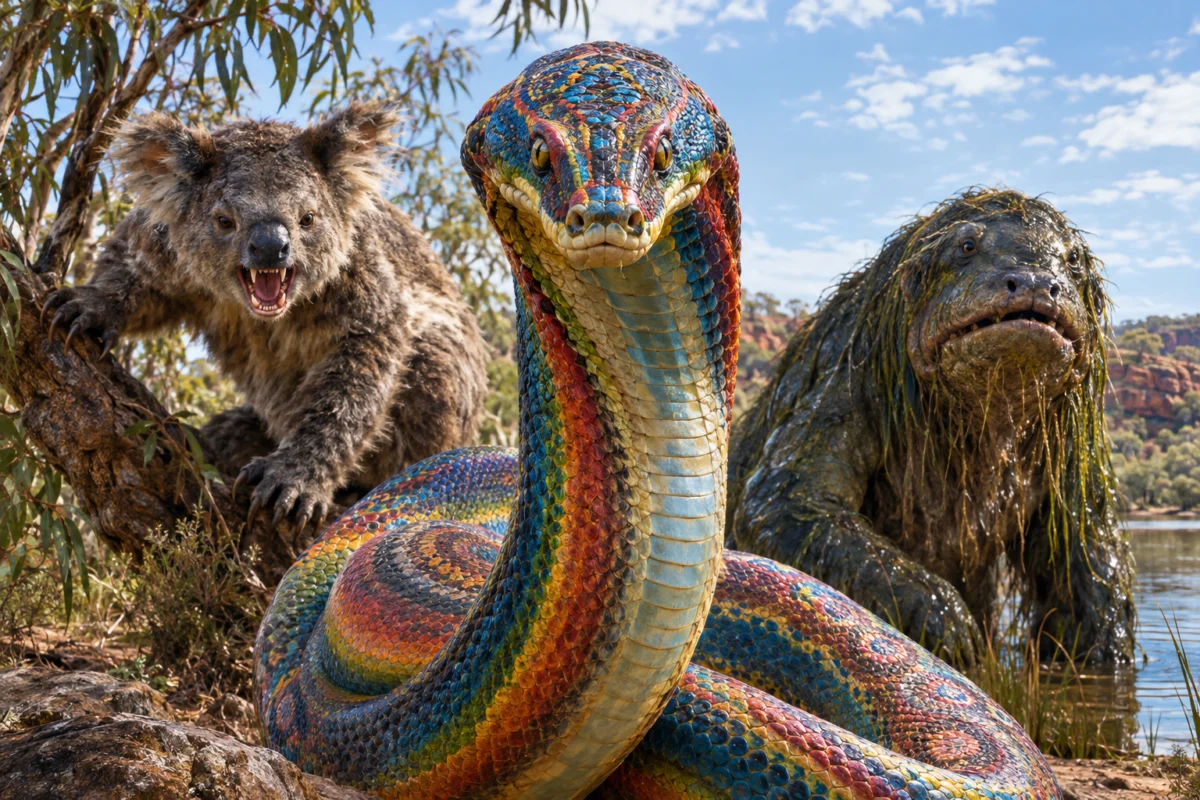
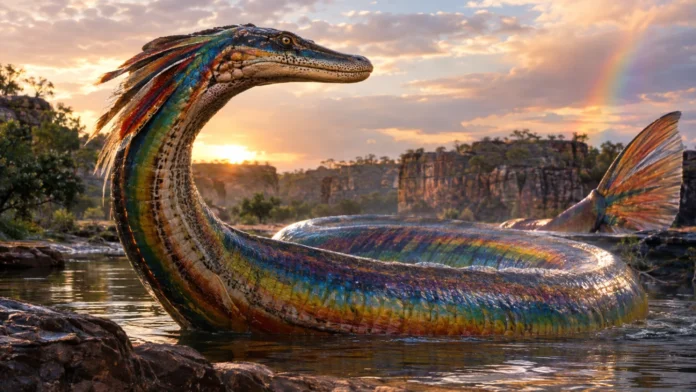
A large, elongated, snake-like body is a common representative form of the Rainbow Serpent. Its scale and association with waterways distinguish it from an ordinary snake.
Nevertheless, the broad English category encompasses different visual traditions rather than prescribing one anatomy, colour scheme, or bodily outline.
Western Arnhem Land depictions of Ngalyod can combine features of several animals. These may include a crocodile or kangaroo head, an emu’s crop, and a fish tail.
Such composite forms belong to that regional artistic tradition and should not be transferred indiscriminately to Kakadu or Barkandji representations.
The variety of Ngalyod’s forms is significant: the being need not resemble a magnified zoological snake. A serpentine body can coexist with features drawn from other animals.
This is a documented local visual expression, not evidence that all Rainbow Serpent traditions describe the same hybrid creature.
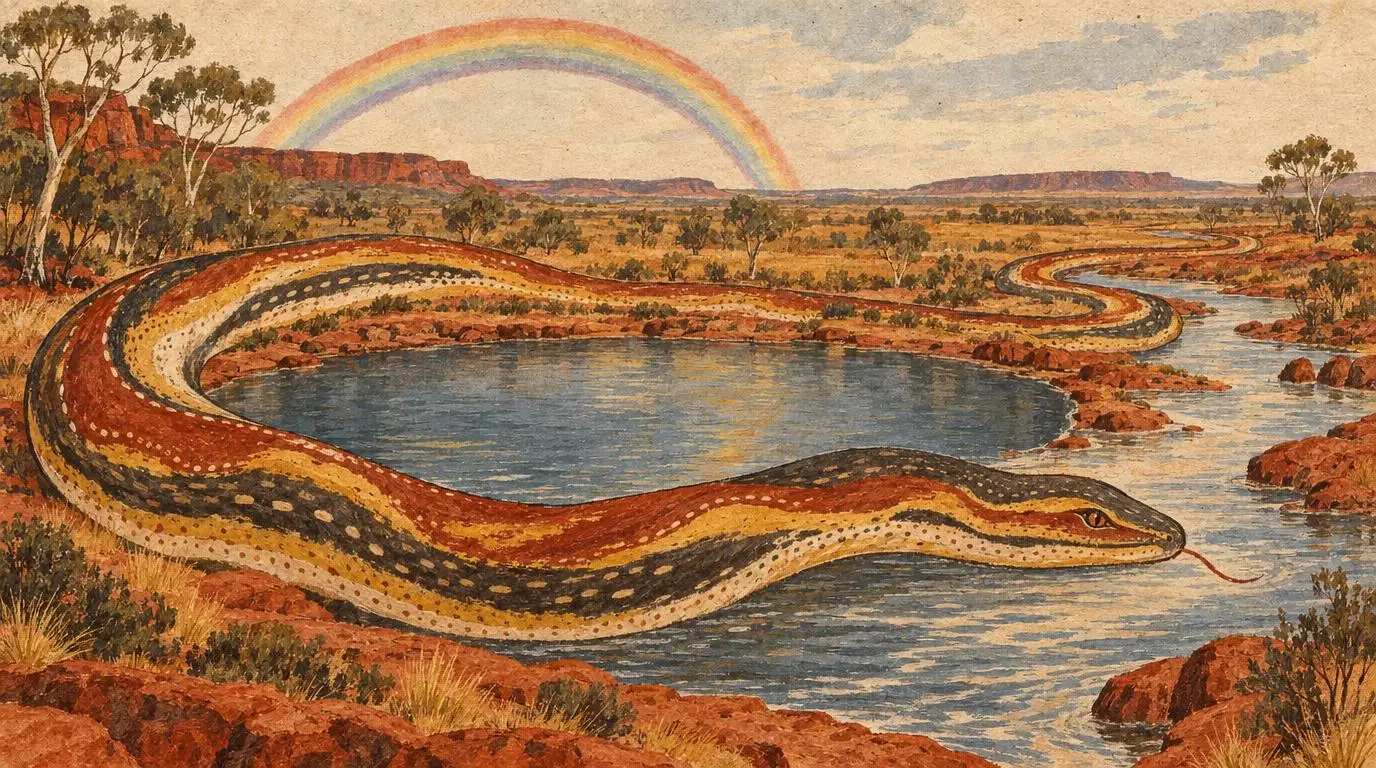
Gender also varies between accounts. The public Kakadu tradition presents a female ancestor, while Badger Bates describes both female and male Ngatyis.
His 2022 sculpture, Save our Ngatyi, represents a female blowing a rainbow and includes eggs that he identifies as a female feature of that work.
Setting is as important as bodily form. Waterholes, rivers, and underground movement place these beings within particular landscapes, not an interchangeable fantasy environment.
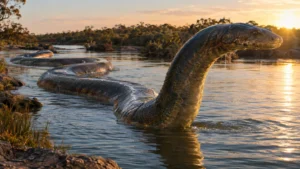
A representative image may show an immense serpent beside water, but a specific depiction requires the relevant community, place, and artistic context to be identified.
Background Story
The background of Rainbow Serpent traditions lies in relationships between ancestral activity, water, landscape, and cultural responsibility. There is no single biography behind the English label.
The relevant framework is the Dreaming: ancestral journeys connect the formation of Country with places and obligations that remain significant.
Dreaming tracks connect places associated with ancestral travel and the creation of landscape, plants, animals, and Law. Within this framework, a serpent’s route is more than a movement across a map.
It can connect the physical character of a place with its continuing cultural meaning.
In Kakadu, the ancestor’s creation of waterholes and rock passages helps explain the formation of habitats. Water is therefore not merely scenery surrounding the being.
It belongs to the ancestor’s shaping of Country and to the places where that ancestral presence continues to matter.
Western Arnhem Land accounts give Ngalyod a different sequence of actions. Burrowing beneath the earth and emerging at the surface creates sacred sites; spirit beings may be swallowed, taken underground, or regurgitated as landscape features.
These episodes connect bodily transformation with the formation of particular places.
In Badger Bates’s Barkandji account, Ngatyi created the land and Barka, brings water, and has a protective presence. People avoid swimming in places where Ngatyis live.
Creation and protection thus carry practical responsibilities toward river places, rather than ending with an event in the distant past.
Across these accounts, life-sustaining power and danger coexist. The same broad family of traditions encompasses the provision of water, protection of Country, and destructive ancestral action.
Those connections help explain the shared English category, while their local expression prevents it from becoming one uniform creation story.
Famous Folklore Stories
The public record preserves locally situated creation episodes rather than one canonical Rainbow Serpent tale. The headings below describe documented regional motifs, not authenticated traditional story titles.
Each account belongs to its own cultural setting and should not be combined into a single narrative.
Ngalyod’s Underground Journeys in Western Arnhem Land
In western Arnhem Land, Ngalyod travels beneath the earth and emerges at the surface, creating sacred sites. Underground movement is central to this narrative pattern: ancestral activity connects the visible landscape with powers and journeys extending below it.
Related episodes involve Ngalyod swallowing spirit beings. They may be carried underground or regurgitated as features of the landscape.
These transformations make the serpent’s actions part of the formation of Country, rather than simply encounters between a monster and its victims.
Creation here can involve engulfing and transformation as well as movement. The episodes belong specifically to the documented Ngalyod tradition; they do not establish that every being called a Rainbow Serpent swallows spirits or creates places through the same sequence of actions.
Ngatyi, Barka, and the Bringing of Water
In Barkandji Lore, Ngatyi is connected with the creation of land and Barka, the Darling River. Barkandji artist Badger Bates’s public account presents these beings as bringers of water and protective presences, linking ancestral creation with the river’s continuing importance.
This account concerns more than a river’s distant beginning. Ngatyis remain associated with particular places, and respect for their presence shapes how people approach those waters.
Bates describes places where people do not swim because Ngatyis live there, connecting narrative with present-day conduct.
Bates also describes male and female Ngatyis, preserving a distinction absent from simplified accounts of one universally gendered serpent. His explanation is a publicly shared account of Barkandji Lore, not a continent-wide creation story or a complete disclosure of the tradition.
The Making of Waterholes and Rock Passages in Kakadu
In Kakadu’s public creation account, a female Rainbow Serpent ancestor forms waterholes and passages through rock. Her activity helps shape habitats, connecting the making of physical places with the conditions that allow plants, animals, and people to live there.
The regional names include Almudj among Kundjeyhmi speakers and Bolung among Jawoyn speakers. These names locate the account within particular language communities.
They should not be treated as interchangeable labels that make Kakadu’s narrative identical to Ngalyod or Barkandji Ngatyi traditions.
The account also connects ancestral presence with water and places across Country. Its emphasis falls on habitat and continuing relationships, rather than a self-contained adventure ending when creation is finished.
Public interpretation presents those relationships without claiming to reveal every associated cultural teaching.
Cultural Impact
Rainbow Serpent traditions connect ancestral action with places that remain culturally significant. Dreaming tracks link sites associated with ancestral travel and the formation of landscapes, plants, animals, and Law.
Their importance therefore extends beyond storytelling into relationships with Country and cultural responsibility.
Creative and destructive power can coexist within these traditions. A water-associated ancestor need not fit a simple division between benevolent protector and hostile monster.
That complexity matters when interpreting serpent imagery, which can express ancestral authority rather than merely danger or decorative symbolism.
Local visual traditions preserve distinctions that broad summaries can obscure. Western Arnhem Land representations of Ngalyod include composite animal features, while contemporary Barkandji work expresses particular relationships with Ngatyi.
Neither provides a universal design that can stand for every Aboriginal community’s ancestral being.
Kakadu’s park logo depicts the Rainbow Serpent and represents local Aboriginal people and the wider community. This public emblem brings an ancestral figure into contemporary institutional identity, while its significance remains grounded in the park’s living cultural landscape rather than generic fantasy imagery.
Badger Bates’s 2022 steel sculpture, Save our Ngatyi, places Barkandji Lore within contemporary artistic expression and concern for rivers. Its title connects care for ancestral beings with care for water, showing cultural continuity through a modern medium rather than replacement of tradition.
Similar Beasts
Nyami Nyami

Nyami Nyami is a river deity in Tonga tradition, associated with the Zambezi. Described with a snake’s body and fish’s head, the being combines protection with destructive river power.
The comparison concerns serpentine form and powerful relationships with water. Nyami Nyami belongs to a separate tradition, not a version of an Aboriginal Australian ancestor.
Uktena

Uktena is a powerful serpent in Cherokee tradition, distinguished by horns, glowing scales, and a magical forehead crystal. Encounters with it involve danger and extraordinary supernatural power.
Its serpent form offers a useful comparison, but Uktena’s distinctive features and encounter motifs should not be transferred to locally specific Rainbow Serpent traditions.
Mishipeshu

Mishipeshu is a powerful water spirit in Anishinaabe folklore, often represented through feline and serpentine features. Its associations include guarding waters, destructive power, and abundance within that tradition.
Like some Rainbow Serpent traditions, it joins water, authority, and composite animal imagery. The resemblance is thematic, not evidence of shared identity or historical borrowing.
Bunyip
The Bunyip is a separate Australian water-being in broad reference usage. In Badger Bates’s Barkandji account, Ngatyis can sometimes take a form outsiders call a Water Dog or Bunyip.
This locally described transformation creates a specific point of contact. It does not establish that Bunyips and Rainbow Serpents are interchangeable throughout Aboriginal Australia.
Religion/Ritual
These traditions concern living ancestral relationships, not only stories about a remote past. In the Barkandji account shared by Badger Bates, respect for Ngatyi includes avoiding swimming in places where the beings reside.
This is a locally documented practice, not a universal prohibition.
Some aspects of Rainbow Serpent stories are restricted to initiated persons. Public narratives and artworks therefore represent selected, shareable knowledge rather than the whole tradition.
Access to a museum explanation does not imply permission to reproduce restricted designs, teachings, or ceremonial material.
The available public evidence does not establish a shared Rainbow Serpent ceremony, offering system, or ritual calendar. It supports place-specific respect and differentiated access to knowledge.
More detailed ceremonial claims would require appropriate community authority and evidence beyond these public summaries.
Scientific or Rational Explanations
The documented material concerns ancestral beings, cultural knowledge, and artistic representation. It does not establish the Rainbow Serpent as a zoological species.
Treating the figure as an unidentified giant snake would misclassify accounts whose central concerns include creation, Law, and relationships with Country.
An environmental interpretation can examine the prominence of waterholes, rivers, habitats, and underground movement. These associations are documented narrative features.
However, their presence alone does not prove that the traditions originated as explanations of floods, erosion, rainbows, or encounters with particular animals.
Historical anthropology also shaped the broad comparative category. A. R. Radcliffe-Brown’s 1926 study helped establish an English framework for comparing serpent traditions.
That framework is useful for identifying recurring themes, but it can conceal differences in local identity, gender, narrative action, and responsibility.
Baldwin Spencer’s 1914 Native Tribes of the Northern Territory of Australia provides an early ethnographic record for comparison. As an outsider’s colonial-era collection, it documents particular observations and accounts, rather than supplying final authority over living communities or proving a universal tradition.
Archaeological imagery and present-day narratives require separate evaluation. Institutional materials mention serpent rock art at least 6,000 years old, but an ancient motif does not demonstrate one unchanged story across that period.
Dating an image and establishing continuity of meaning are different research questions.
Modern Cultural References
Contemporary appearances range from Aboriginal artworks grounded in particular traditions to documentary treatments and fantasy fiction. These forms should not be treated as interchangeable: an artist’s account of ancestral relationships to Country has a different purpose and authority from an entertainment adaptation.
Save our Ngatyi (Rainbow Serpents), sculpture (2022)
Barkandji artist Badger Bates created this steel sculpture with Matt Mewburn and Eveleigh Works.
It expresses Ngatyi Lore and the beings’ relationships with rivers and Country.
(australian.museum)
First Australians: “The Rainbow Serpent”, documentary television clip (2008)
This clip comes from Blackfella Films’ documentary series for SBS Television.
It addresses the Rainbow Serpent, with an educational presentation preserved by Australia’s national audiovisual archive.
(dl.nfsa.gov.au)
Episode 37: Rainbow Serpent, podcast episode (2017)
Spirits Podcast released this dedicated episode on June 21, 2017, with audio and a transcript.
The Rainbow Serpent is its central subject rather than an incidental reference.
(spirits-podcast.squarespace.com)
The Rainbow Serpent (A Kulipari Novel #2), novel (2014)
Trevor Pryce and Joel Naftali’s novel features illustrations by Sanford Greene.
Its Rainbow Serpent holds the key to saving the Amphibilands, making this a fictional adaptation.
(abramsbooks.com)
Ngalyod, the Rainbow Serpent, artwork (2018)
Zebulun Nayilibidji’s painting appeared in a Darwin exhibition documented by ABC News.
Its unusual front-on depiction presents Ngalyod through a contemporary artwork rather than a generic serpent illustration.
(abc.net.au)
Bawáliba & Ngalyod, artwork (2024)
Lucy Yarawanga’s bark painting is documented as a Telstra Bark Painting Award winner.
Its accompanying account directly depicts Ngalyod encountering the Bawáliba, grounding the work in a particular narrative.
(michaelreid.com.au)
Conclusion
The Rainbow Serpent is best understood as an English umbrella name for related, locally distinct Aboriginal ancestral beings, not a single character with one authoritative biography. Water, creation, and the shaping or protection of Country recur across the public accounts, but names, forms, genders, and actions differ.
Ngalyod in western Arnhem Land, the Kakadu ancestors, and Barkandji Ngatyi belong to particular cultural landscapes. Their differences are essential to understanding the traditions, rather than inconsistencies that need to be removed.
The figure’s enduring importance lies in relationships between ancestral presence, living communities, waterways, and responsibilities to place. Contemporary Aboriginal art makes those relationships visible without reducing them to an ancient story or a fantasy animal.
Documentary and fictional adaptations extend public recognition, but cannot stand in for community knowledge. A careful reading therefore holds shared themes alongside local distinctions, respects the limits of publicly available accounts, and recognises that cultural significance continues beyond what an outsider’s summary can contain.
Further Reading
Native Tribes of the Northern Territory of Australia, Internet Sacred Text Archive
Makes an early ethnographic collection by Baldwin Spencer available for historical comparison; it should be read as a colonial-era record, not a substitute for community authority.
(sacred-texts.com)
National Museum of Australia, Nma.gov
The National Museum of Australia describes western Arnhem Land Ngalyod burrowing through the earth, emerging at the surface, and swallowing spirit beings that may be taken underground or.
(nma.gov.au)
Australian Museum, recording Badger Bates, Australian.museum
Barkandji artist Badger Bates describes Ngatyi as creator of the land and Barka (Darling River), a protector associated with water and places people respect by not swimming in.
(australian.museum)
Parks Australia, Kakadu National Park, Kakadu.gov
Parks Australia’s Kakadu account says the creation ancestor formed waterholes and rock passages, helping shape habitat, and remains associated with water and places across Country.
Documented folklore story:.
(kakadu.gov.au)
First Australians: “The Rainbow Serpent”, dl.nfsa.gov.au
documentary television clip 2008 A specific documentary-series clip about the subject, catalogued by the National Film and Sound Archive of Australia.
(dl.nfsa.gov.au)
Secret of the Rainbow Serpent, tvguide.com
television episode 2011 A 21-minute episode set in Kakadu and Arnhem Land that follows the host’s search for the Rainbow Serpent and discusses its depictions in local rock.
(tvguide.com)
The Rainbow Serpent (A Kulipari Novel #2), abramsbooks.com
novel 2014 The publisher confirms publication on October 14, 2014, and the story identifies the Rainbow Serpent as a character holding the key to saving the Amphibilands.
(abramsbooks.com)
Ngalyod, the Rainbow Serpent, abc.net.au
artwork 2018 ABC News documents a contemporary painting depicting Ngalyod and its display in a Darwin exhibition, describing the unusual front-on portrayal.
(abc.net.au)