
Scramble for Africa
Relevant Beasts
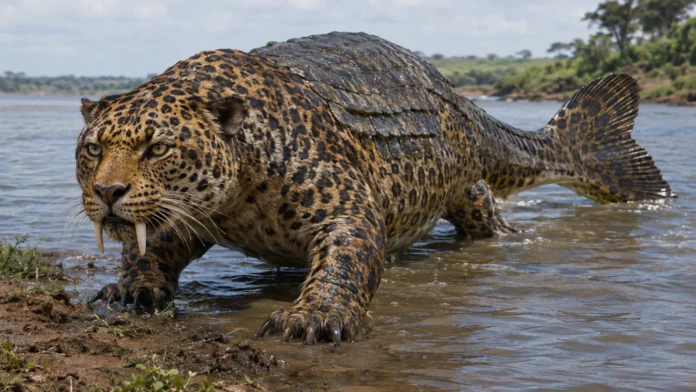
Dingonek is a reported East African water monster, described in early twentieth-century accounts as a large, spotted, crocodile-like creature...
Dingonek is a reported East African water monster, described in early twentieth-century accounts as a large, spotted, crocodile-like creature...
The Scramble for Africa refers chiefly to intensified European imperial expansion from the late 1870s through the early twentieth century, especially the partition formalized at Berlin in 1884–1885.
African societies during this period included centralized kingdoms, city-states, pastoral communities, and decentralized political systems; these varied histories cannot be reduced to one continental religious or mythological framework.
Colonial conquest altered political authority, movement, education, and communication unevenly. It did not create a single new class of African mythical beasts or a unified folklore tradition.
Mythic beings mattered within existing local frameworks because they could explain relationships among people, ancestors, land, animals, and unseen powers; particular meanings depended on specific communities.
Indigenous African religious systems differed substantially across regions and languages. Many documented traditions recognize spiritual agency beyond humans, but their accounts of divinity, ancestors, and spirits are not interchangeable.
Christianity and Islam had established African histories before the Scramble. Their teachings and institutions interacted with local religious practices in varied ways, rather than replacing them uniformly.
Ideas about animals, ancestors, spirits, and sacred places were locally specific. A creature associated with danger in one account cannot automatically represent the same force elsewhere.
Oral narratives could communicate expectations about conduct, kinship, authority, and communal obligations. Their significance arose within particular social settings, not from a universal African moral code.
Accounts involving supernatural beings could help explain misfortune or social conflict within a community’s own interpretive framework. Such explanations document belief, not independent proof of supernatural events.
Colonial schools, churches, and administrative systems sometimes challenged or recast local narratives. The extent and consequences differed by place, period, and the institutions involved.
Historical records describe diverse categories, including spirits associated with places, ancestors, powerful animals, and beings encountered in narratives. Labels applied by outsiders often blur distinctions maintained locally.
Some traditions attribute unusual agency to animals, but this does not establish a continent-wide category of hybrid monsters. Interpretations require attention to language and context.
No verified sources describe this for this context: a distinct class of mythical beasts created by the Scramble itself. The period chiefly changed conditions of recording and transmission.
Animal figures could express relationships between human communities and their environments. Their meanings depended on local narrative roles, ecological knowledge, and established symbolic associations.
Spirits attached to particular places could articulate obligations or limits concerning human conduct. This interpretation must be grounded in the relevant community’s own accounts.
European collectors sometimes translated unfamiliar beings through categories such as demon, monster, or superstition. Those terms reflect colonial interpretation and may distort local understandings.
Oral performance remained an important means of transmitting narratives, with memory, occasion, and audience shaping particular tellings. A recorded version cannot always represent every variation.
Missionaries, officials, and travelers wrote down some oral accounts, often through interpreters. Their records can preserve valuable details while also reflecting selective interests and translation choices.
Written transmission also included African-language publications and religious materials produced in changing colonial circumstances. Their existence does not mean all local traditions were committed to writing.
West African traditions cannot be treated as equivalent to those of the Congo basin or southern Africa. Each region contained distinct languages, political histories, and narrative conventions.
In parts of West Africa, recorded accounts connect spiritual beings with particular communities and landscapes; southern African materials reflect different linguistic and historical contexts, not merely regional versions of one system.
Colonial borders did not define the full extent of cultural communities. Cross-border exchange and migration shaped storytelling, although particular routes and effects require evidence for each case.
Supernatural beings could be approached as dangerous, protective, or worthy of respect within specific traditions. These roles varied, so no single emotional response describes African belief.
Narratives about spiritual consequences could reinforce social expectations. They should not be classified automatically as formal law, since moral authority and legal institutions differed among societies.
European accounts sometimes interpreted local reverence as fear or irrationality. Such descriptions reveal the observer’s assumptions as much as they clarify the beliefs recorded.
Representations of animals and spiritual figures appear in varied African artistic traditions, including sculpture and objects with social or religious significance. Their functions require contextual interpretation.
Colonial-era collections often removed objects from their original settings. This separation can make the precise relationship between an image, a narrative, and its use difficult to establish.
Architecture and clothing cannot be assigned mythical meanings solely from visual resemblance. Reliable interpretation depends on documented local explanations, provenance, and the historical circumstances of production.
Twentieth-century urbanization, schooling, religious change, and mass media altered the circulation of folklore unevenly. These developments transformed transmission without proving that older narratives simply disappeared.
Some narratives entered print or public performance in new forms, while others remained embedded in local contexts. Continuity and change must be assessed tradition by tradition.
Modern retellings may adapt older beings for contemporary audiences. Such versions belong to later cultural history and should not be mistaken for unchanged nineteenth-century belief.
Evidence for this period includes travel accounts, missionary writings, administrative records, oral testimony, and material objects. Each source type preserves different information and carries distinct limitations.
Colonial records often reflect unequal power and outsider categories. Researchers therefore compare accounts with African-language evidence and community knowledge where available, while recognizing archival gaps.
A recorded narrative establishes that an account was collected, not necessarily that every community member accepted it literally. Belief, performance, metaphor, and historical fact require distinction.
Scholarly interpretation remains uncertain when provenance, translation, or date is unclear. Responsible taxonomy identifies those limits instead of treating diverse traditions as evidence for one continental mythology.
From hidden lore to legendary beasts, immerse yourself in the world of myth
All content, images, and articles on Myth Beasts are protected by copyright. Content © 2024 Myth Beasts. Reproduction or redistribution without permission is strictly prohibited