Hallucination Inducement – an Overview
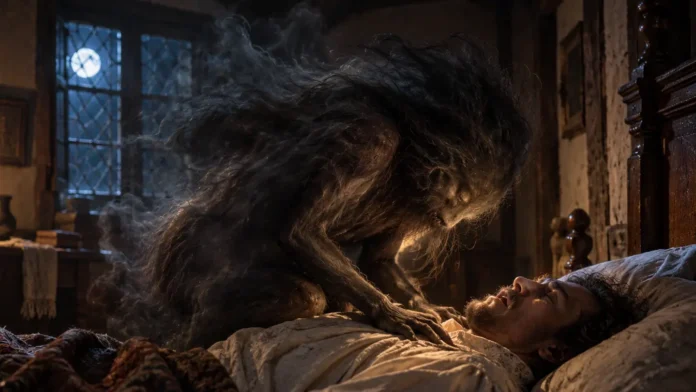
Hallucination Inducement is a modern comparative label for traditions in which a supernatural agent or setting causes perception of things absent from ordinary shared experience.
Historical communities did not generally organize this phenomenon under one equivalent category; their explanations instead depended on local cosmologies, religious vocabulary, and narrative purposes.
The category concerns attributed alteration of perception, not every supernatural appearance, dream, prophecy, mistaken judgment, or culturally accepted vision reported in historical sources.
Its analytical boundary depends on evidence that perception itself is disrupted; an apparition witnessed as objectively present within a tradition’s cosmology does not automatically qualify.
This distinction permits comparison without asserting that different societies shared one theory of perception or recognized a universal supernatural mechanism.
Manifestation and Constraints
How Hallucination Inducement Is Expressed
Sources make altered perception observable through reported visions, misrecognition, or apparent environmental changes, rather than through descriptions equivalent to contemporary clinical terminology.
In Greek literature, deceptive dreams can present misleading images to a sleeper; these episodes concern dream experience, not necessarily waking hallucination.
That distinction prevents dream figures from being treated as evidence for a general capacity to alter waking perception across Greek religious belief.
Medieval European accounts of deceptive spirits sometimes describe travellers seeing misleading lights or routes, but individual records require examination before classification.
Limits and Conditions
In many traditions, misleading perception is attached to a specific encounter, dream, landscape, or moral circumstance rather than presented as an unrestricted ability.
For example, a deceptive dream’s significance may depend on its narrative source and interpretation; this does not establish a universal rule governing visions.
Historical accounts rarely provide systematic conditions for such experiences, so modern taxonomies should not convert scattered story details into established operational limits.
No verified sources describe a single cross-cultural doctrine defining who may induce hallucinations, under what conditions, or with what consistent constraints.
Mythological Role and Meaning
Symbolic and Cultural Significance
Misleading perception can represent uncertainty about knowledge when a narrative distinguishes deceptive appearances from reliable revelation or ordinary perception.
In Greek epic, the deceptive dream sent to Agamemnon in the Iliad demonstrates how a false appearance can expose the vulnerability of human judgment.
Its role is specific to that narrative and divine context; it should not be generalized into a Greek doctrine of hallucination as moral punishment.
Other traditions may treat visionary experience as meaningful communication rather than deception, making the same modern label unsuitable without contextual distinctions.
Accordingly, classification must preserve whether a source presents an experience as false, divinely authorized, socially disputed, or simply unexplained.
Hallucination Inducement in Myth and Folklore
In the Iliad, Zeus sends a deceptive dream to Agamemnon, creating confidence in an outcome that the narrative later disproves.
The episode structures divine authority through misleading communication, but its sleeping recipient makes it evidence for dream deception rather than waking hallucination.
European folklore about will-o’-the-wisp lights associates uncertain visual appearances with perilous travel in some recorded traditions, although accounts vary by region.
Such lights may be explained as deceptive beings, natural phenomena, or folkloric motifs; the evidence does not establish induced hallucination as their essential identity.
Beasts with Hallucination Inducement
No verified sources describe three or more historically documented mythological beasts whose defining identity centrally consists of inducing hallucinations.
Assigning this function to creatures associated with dreams, enchantment, deceptive lights, or fear would exceed the surviving evidence and conflate distinct traditions.
This exclusion is taxonomically significant: a creature should qualify only where perception-altering effects define its documented role, not merely accompany an episode.
Cultural Interpretations and Regional Emphasis
Greek epic presents a deceptive dream as communication from a named deity, whereas European will-o’-the-wisp traditions foreground uncertain lights encountered in particular landscapes.
The former emphasizes divine manipulation within political and military narrative; the latter often concerns hazardous orientation, though local explanations differ substantially.
These are not equivalent cultural doctrines: one concerns a sleeping recipient in epic poetry, while the other belongs to varied regional folklore.
South Asian religious and literary traditions include visions with differing theological meanings, but grouping them as induced hallucinations without case-specific evidence would erase those distinctions.
Comparison therefore concerns how sources frame perception and credibility, not an assumption that cultures share a stable supernatural category.
Similar or Related Mythological Functions
Dream visitation is adjacent because it presents perceptible figures during sleep, yet sleeping dreams differ from waking perception in both reported context and classification.
Glamour or enchantment is also adjacent where stories describe deceptive appearances, but such terms may signify transformation or concealment rather than hallucination.
Prophetic vision differs because a tradition may treat its unusual perception as truthful revelation, even when observers cannot independently verify its content.
Apparition accounts likewise require separate evaluation: within a religious worldview, a perceived spirit may be considered genuinely present rather than perceptually fabricated.
These distinctions prevent a broad modern label from replacing culturally specific ideas about dreams, revelation, deception, and supernatural presence.
Historical Interpretation and Evidence Limits
Historical interpretation must separate a source’s own explanation from later psychological descriptions, which employ categories unavailable to many earlier communities.
Scholars may analyze a vision as literary device, religious experience, social memory, or reported perception, depending on genre and historical evidence.
None of those interpretations alone proves that a supernatural agent objectively caused the experience or that witnesses used a clinical concept.
Surviving narratives disproportionately preserve elite literary and religious perspectives, leaving ordinary explanations and local variations less consistently documented.
Translations can further blur distinctions among dream, vision, apparition, illusion, and deception when source-language terms lack exact modern equivalents.
Consequently, Hallucination Inducement is most reliable as a cautious comparative descriptor for particular documented claims, not as a historical universal category.